

Content marketing is probably the most dependable way to build a real, lasting connection with your audience. I like to think of it as owning a home versus renting an apartment. Paid ads? That’s renting. You pay every single month, and the moment you stop, your visibility disappears.
The Modern Engine for Business Growth

Unlike old-school advertising that just interrupts people, content marketing is all about giving your audience genuine value before you ever ask for a sale. It’s a smart, strategic approach where you create and share digital assets—things like blog posts, videos, and helpful guides—to pull in and hold onto a specific audience.
By consistently answering your customers' questions and solving their problems, you build up a huge amount of trust. Over time, this positions your brand as the go-to expert in your field.
This approach completely flips the script. Instead of shouting for attention with ads, you’re starting a conversation by offering the very solutions people are actively searching for. Every piece of content you publish becomes a digital asset that works for you 24/7. It's an investment that actually grows in value as it starts pulling in organic traffic from search engines.
It’s really the foundation of any solid inbound marketing strategy because it draws customers to you naturally. To see how they fit together, you can explore the connections between inbound and content marketing in our detailed guide.
Content marketing is the only marketing left.
– Seth Godin
This isn't a short-term play; it's a long-term investment that delivers compounding returns, making it a true cornerstone for any business that wants sustainable growth. To get the most out of it, you'll need to understand the most effective content marketing strategies available today.
Top 5 Reasons Content Marketing Is a Core Business Asset
To put it simply, content marketing has become non-negotiable for modern businesses. Here’s a quick summary of the core reasons why it’s such a powerful asset.
| Benefit | What It Means for Your Business |
|---|---|
| Builds Brand Authority | Establishes your company as a trusted expert, making you the first choice for customers. |
| Drives Organic SEO | Every article creates a new opportunity to rank on Google, attracting consistent, free traffic. |
| Generates Quality Leads | Helpful content naturally attracts ideal customers who are actively seeking solutions. |
| Nurtures Customer Relationships | Provides ongoing value that keeps your audience engaged and loyal long after the first purchase. |
| Delivers Compounding ROI | Content is an asset that grows in value, generating leads for years without ongoing ad spend. |
Each of these benefits directly contributes to a healthier bottom line, proving that investing in quality content is one of the smartest moves a business can make.
Building Your Brand Beyond a Logo

How does a business become the first name people think of in their industry? It’s not just about having a great logo or a catchy slogan. It happens when you consistently offer real value, and that’s where content marketing works its magic. It’s the process that turns your brand from just another company into a trusted, go-to resource.
Think about two businesses for a second. Company A just runs ads. They interrupt, they shout, they push their products at every opportunity. Then there's Company B. They invest their time creating genuinely helpful content—blog posts that answer real questions, videos that walk people through common challenges, and guides that make complicated subjects easy to understand.
Over time, something incredible starts to happen for Company B. They build a following, a community. People don't just see them as a seller; they see them as an expert who is there to help. This is precisely why content marketing is important: it forges a real connection that traditional advertising simply can't buy.
From Seller to Trusted Advisor
When you consistently help your audience solve problems without immediately asking for a sale, you earn something invaluable: their trust. This isn't just a feel-good tactic; it’s a strategic shift that completely redefines the customer relationship. You stop chasing leads and start attracting them, because you’ve already demonstrated your value upfront.
This approach has a real, measurable impact. For B2B companies, 83% of marketers report that content marketing is a key driver for building brand awareness. A massive 77% credit it with generating demand and leads. What's more, 79% of B2B specialists confirmed their content strategy was instrumental in hitting their core business goals.
By sharing what you know, you position your brand as a credible authority. This is a core pillar of building a strong brand identity, which you can learn more about in our guide on how to create a brand identity. So, when it's finally time for a customer to make a purchase, who are they going to choose? The company that interrupted them, or the trusted advisor who’s been guiding them all along?
The Lasting Impact of Authority
Establishing your authority with great content isn't a short-term win; it creates a powerful, lasting competitive advantage. It's about building a reputation that sticks.
Here’s how that authority pays off in real terms:
- Drives Customer Loyalty: When people trust your expertise, they’re far more likely to stay with you, even if a competitor dangles a slightly lower price.
- Attracts Higher-Quality Leads: The people who discover you through your content are already engaged and interested. They tend to be better-qualified and more ready to convert.
- Improves Brand Recall: Consistently delivering value makes your brand unforgettable. You become the first name that comes to mind, not a random option in a search result.
"A brand is no longer what we tell the consumer it is—it is what consumers tell each other it is."
This is why providing genuine value is so critical. It allows you to shape that conversation from the inside out.
Ultimately, content marketing is the most effective way to prove your expertise, earn trust, and become the recognized authority in your field. You’re not just selling a product or service; you’re building a legacy of value that turns curious visitors into loyal advocates for your brand.
Fueling Your SEO to Attract Organic Traffic
Think of your website as a powerful engine. Your SEO strategy is what keeps it finely tuned, but what’s the fuel? That’s content. High-quality content is the high-octane fuel that powers your entire SEO machine, driving you straight to the top of Google’s search results.
Every blog post, guide, or video you create isn’t just a piece of information; it’s a new digital doorway. Each one gives potential customers another chance to find you through a simple search. The more relevant, high-quality content you publish, the more entry points you build for organic traffic to pour into your site.
Without content, your SEO efforts are essentially running on empty. You can have the best site structure and a solid backlink profile, but Google’s core mission is to give people the best answers to their questions. Your content provides those answers, making it the single most critical factor for ranking well.
How Content Directly Boosts SEO Performance
The connection between content and SEO is no accident—it's a direct and powerful partnership. Search engines like Google are built to reward websites that consistently publish valuable, authoritative, and genuinely helpful content. This is a huge reason why content marketing is important for any business that's serious about being seen online.
Here’s a look at how that synergy plays out in the real world:
- Targets Keywords: Every article is an opportunity to rank for specific keywords your customers are typing into the search bar, from broad terms all the way down to niche, long-tail phrases.
- Earns Backlinks: Genuinely great content gets noticed. Other reputable websites will naturally link to it, and those backlinks act like votes of confidence that tell search engines your site is a credible resource.
- Increases Dwell Time: When your content solves a problem or keeps a reader engaged, they stick around longer. This "dwell time" is a crucial signal to Google that your page is high-quality, which can give your rankings a nice bump.
- Builds Topical Authority: Publishing in-depth content around a central subject over and over again establishes your website as an expert in that field. This makes it much easier to rank for all related keywords in the future.
This creates a positive feedback loop. Better content earns you better rankings, which brings in more traffic. That traffic sends even stronger quality signals to Google, which improves your rankings even more.
Structuring Content for Search Dominance
To get the absolute most out of your SEO, you can't just publish content at random and hope for the best. The most effective strategies organize content into a framework called "topic clusters." This model uses two types of content that work together to clearly signal your expertise to search engines.
A well-planned topic cluster model is the foundation of any modern SEO content strategy. It creates a logical site structure that helps both search crawlers and human visitors find exactly what they’re looking for.
1. Pillar Pages
A pillar page is a massive, comprehensive resource that covers a broad topic from top to bottom. Think of it as the definitive guide on a core subject, like "The Ultimate Guide to Digital Photography."
2. Cluster Content
Cluster content is made up of shorter, more specific articles that all link back to the main pillar page. Each of these articles dives deep into one of the subtopics mentioned in the pillar, such as "Choosing the Right Camera Lens" or "Mastering Manual Mode."
This structure shows Google that you aren’t just an expert on one keyword, but a deep authority on an entire topic. That kind of comprehensive coverage is what helps you dominate the search results for those really competitive terms.
By linking all your cluster posts back to your central pillar page, you build a powerful internal linking web that passes authority to your most important content. It’s a methodical approach that’s far more effective than a scattershot content plan, creating a sustainable way to earn organic traffic that pays off for years.
Turning Visitors into Leads and Customers
Getting traffic to your website is a huge win, but let's be honest—it’s only half the battle. The real magic of content marketing happens when you skillfully guide those visitors from being curious readers to becoming loyal customers. This is the point where your content stops being just information and starts becoming a reliable conversion engine.
Think of it as a journey. A potential customer doesn't just show up ready to buy. They go through distinct stages, often called a marketing funnel, and each stage requires a different kind of conversation. Your content's job is to build trust, offer genuine value, and gently nudge them toward a decision. Without this strategic path, traffic is just traffic.
This structured approach is precisely why content marketing is important—it provides a clear framework for building relationships at scale. You're not just hoping for sales; you're systematically creating them by offering the right help at the right moment.
The flow is pretty straightforward: you create something valuable, optimize it so people can find it, and then nurture the resulting traffic toward a business goal.
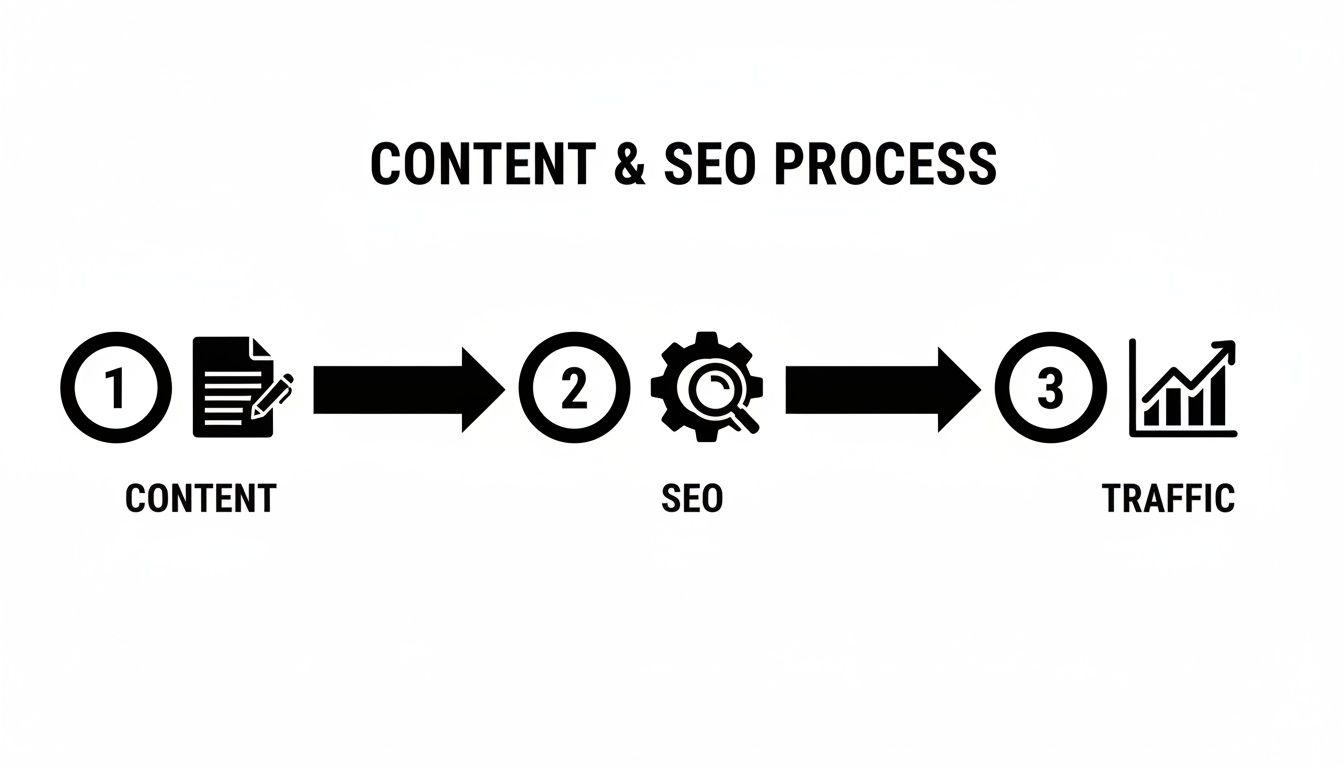
As you can see, quality content is the fuel. It kicks off a process that directly leads to more visitors—the raw material you need to generate leads and sales.
Stage 1: The Awareness Stage
Right at the top of the funnel (we call this ToFu), your audience has a problem, but they might not even know what the solution is called yet. They're typing broad questions into Google, looking for high-level, educational answers. Your job here isn’t to sell. It’s to help.
Content for this stage needs to be easy to find and digest, designed to attract a wide net of people. The entire goal is to establish your brand as a helpful, knowledgeable resource they can trust.
- Blog Posts: Think articles that answer common "what is," "how to," or "why" questions.
- Social Media Updates: Share quick tips, infographics, and short, engaging videos.
- Explainer Videos: Break down complex topics into simple, animated concepts.
By providing this value with no strings attached, you make an excellent first impression and start building that crucial brand awareness.
Stage 2: The Consideration Stage
Once someone moves into the middle of the funnel (MoFu), things get more serious. They now understand their problem and are actively researching and comparing different solutions, providers, and approaches. This is your chance to offer more in-depth content that shows off your expertise.
At this point, you shift from being a helpful stranger to a trusted guide. The content here is often "gated," meaning a user provides an email to access it.
This small exchange is a pivotal step. You've just turned an anonymous visitor into a tangible lead, and now you can start a direct conversation to keep building that relationship.
Examples of consideration-stage content include:
- In-Depth Guides or eBooks: A comprehensive resource that takes a deep dive into solving their specific problem.
- Webinars or Workshops: Live or recorded sessions that offer practical training and prove you know your stuff.
- Checklists or Templates: Actionable tools that help potential customers put what they've learned into practice.
This kind of content helps you identify the people who are truly serious about finding a solution—serious enough to trade their contact info for your expertise.
Stage 3: The Decision Stage
At the bottom of the funnel (BoFu), your leads are ready to pull the trigger. They’ve done their homework and are now weighing you directly against your competitors. The content you serve them now needs to give them that final nudge of confidence to choose you.
Here, you can be more direct about your product or service. The conversation shifts from general education to the specific, tangible benefits and social proof that make your solution the obvious best choice.
- Case Studies: Tell compelling stories of how you helped a customer just like them achieve amazing results.
- Customer Testimonials and Reviews: Let your happy customers do the selling for you with authentic feedback.
- Free Demos or Consultations: Offer a risk-free way to experience your solution firsthand, removing any lingering doubt.
This final layer of content is all about converting a well-informed lead into a happy, paying customer. By mapping your content to this funnel, you create a smooth, effective path that takes people all the way from their first curious search to a final purchase.
The Unbeatable ROI of Content Marketing
At the end of the day, every business decision boils down to the numbers. When the question is "Is it worth the cost?" the conversation turns to return on investment (ROI). This is where content marketing truly pulls away from the pack, consistently outperforming traditional advertising.
The secret? Its compounding value.
A paid ad campaign evaporates the second you turn off the spending. But a great blog post published today becomes a business asset you own forever. It can keep pulling in visitors, generating leads, and driving sales for years, actually appreciating in value as it climbs the search rankings. It’s a much more sustainable—and financially sound—long-term play.
Content is a Lasting Financial Asset
The real shift in thinking is seeing content as an asset, not an expense. Each article, video, and guide you create adds to a growing library of resources that builds your brand's authority and strengthens your SEO foundation. This creates a genuine competitive advantage that’s tough for anyone to copy overnight.
The data backs this up. While typical paid ads might bring back around $1.80 for every dollar spent, content marketing can generate about $3 in revenue for every $1 invested. It gets even better when you focus on SEO. Well-optimized content has shown average returns as high as $22.24 for every $1 spent, all thanks to the compounding magic of organic traffic. This incredible ROI is why 82% of businesses have made content a core part of their strategy.
The compounding nature of content means your initial investment doesn't just produce a one-time return. It builds a foundation for future growth, with each new piece of content adding another layer of value to your marketing engine.
This model also has a wonderful side effect: it lowers your customer acquisition cost over time. As your organic presence grows, you become less reliant on expensive paid channels, which means healthier profit margins and more predictable growth.
Calculating Your Return
Measuring the direct financial impact of your content isn't just a "nice-to-have"—it's essential for proving its value and fine-tuning your approach. For any business serious about results, learning how to measure content marketing ROI is a non-negotiable step.
While a deep dive requires some analytics tools, the basic formula is simple. You figure out what it cost to create and promote the content, then weigh that against the revenue you earned from the leads and sales it brought in.
To do this, you'll want to track a few key metrics:
- Cost of Production: What did you spend on writers, designers, and any software needed to create the content?
- Organic Traffic and Leads: How many new visitors and potential customers did a specific article or guide bring to your site?
- Conversion Rate: Of those leads, what percentage turned into paying customers?
- Customer Lifetime Value (CLV): Don't forget this one! Content often attracts higher-quality leads who tend to stick around and spend more over time.
By keeping an eye on these numbers, you can draw a straight line from your content efforts to your bottom line. It quickly becomes clear that investing in content isn't just another marketing expense—it’s one of the smartest investments you can make for the future of your business.
Got Questions? We’ve Got Answers.
Even after seeing all the benefits laid out, it's natural to have a few practical questions. When you're thinking about putting real budget behind content, you want to know what you're getting into. Let's tackle some of the most common ones we hear from businesses just like yours.
Getting these details ironed out helps clarify why we see content marketing as a long-term strategic pillar, not just another short-term marketing play.
How Long Until I Actually See Results?
Let's be upfront: content marketing is a long game. It's not a switch you flip for instant leads. While you might see some encouraging bumps in traffic in the first couple of months, you can expect to see significant, predictable results in about 6 to 12 months. That's the typical timeframe it takes for your content to gain traction with Google, build authority, and really start working for you.
Think of it like building a reputation in a new town. You don't become the go-to expert overnight. It takes time, consistency, and showing up with valuable advice before people start seeking you out. Once they do, though, that trust pays dividends for years.
What's the Difference Between Content Marketing and Social Media Marketing?
This is a common point of confusion, but the distinction is crucial. They aren’t interchangeable; they're two sides of the same coin and work best when they’re in sync.
- Content Marketing is about creating valuable assets that live on your turf—think blog posts, in-depth guides, case studies, and videos on your website. The goal here is to own the conversation, drive organic search traffic, and establish your authority.
- Social Media Marketing is about taking that great content and sharing it where your audience hangs out, like on LinkedIn, X, or Instagram. It's the distribution engine, the place where you engage in conversations and build a community around your brand.
Simply put, your content is the valuable "what" you have to say. Social media is one of the primary ways you get it in front of the right people.
Does This Stuff Actually Work for Niche or "Boring" Industries?
Yes! In fact, it often works even better. We believe there’s no such thing as a "boring" industry, just uninspired content. Every single business, no matter how technical or specialized, solves a problem for someone. That's your starting point.
The secret is to stop talking about your products and start talking about your customers' problems. A manufacturer of industrial ball bearings isn't just selling steel spheres; they're selling reduced downtime, improved machine efficiency, and lower maintenance costs. Their content should reflect that.
When you create content that genuinely helps your audience solve their very specific challenges, you become an indispensable resource, not just another vendor.
How Do I Know If My Content Is Actually Making Money?
Measuring the ROI of content marketing is less about vanity metrics like page views and more about connecting the dots straight to your bottom line. You need to track the metrics that show a real financial impact.
Here are the key performance indicators (KPIs) that matter:
- Organic Traffic Growth: Are more people discovering you through search engines month over month?
- Lead Generation: How many people are taking the next step? This could be downloading a whitepaper, signing up for your newsletter, or requesting a demo.
- Conversion Rate: Of the leads that came from your content, what percentage are turning into paying customers?
- Customer Lifetime Value (CLV): We often find that customers who come to you through content are a better fit, stick around longer, and spend more over time.
By keeping a close eye on these numbers, you can draw a straight line from a blog post to a closed deal and prove the value of your investment.
Ready to build a content engine that drives real, sustainable growth? The team at Sugar Pixels specializes in creating and executing data-driven content strategies that turn visitors into loyal customers. Explore our digital marketing services to get started.