

Getting an ecommerce company off the ground really boils down to four distinct phases: first, you have to find a profitable niche, then build your store, figure out your marketing, and finally, manage the launch and day-to-day operations. The good news? You can get from idea to your first sale on a surprisingly lean budget, as long as you focus on proving your concept before going all-in.
Finding Your Niche and Validating Your Idea
Every great ecommerce brand starts with a deep understanding of a specific customer group, not just a product. Before you even think about a logo or a website, your first job is to pinpoint a profitable corner of the market where you can actually make a dent. This initial step is all about turning a rough idea into a validated business concept, making sure people actually want what you're selling before you spend a dime.
The opportunity is massive. Global ecommerce sales are expected to land somewhere between $6.42 trillion and $7.5 trillion this year. That’s a huge jump from $5.7 trillion in 2023. This growth spurt means online retail now accounts for about 24% of all global retail sales, with over 2.77 billion people—almost a third of the world's population—shopping online. You can dig into more of these ecommerce statistics to see the full market potential.
This simple, three-stage process is how you'll validate your niche idea and make sure you're on the right track from the start.
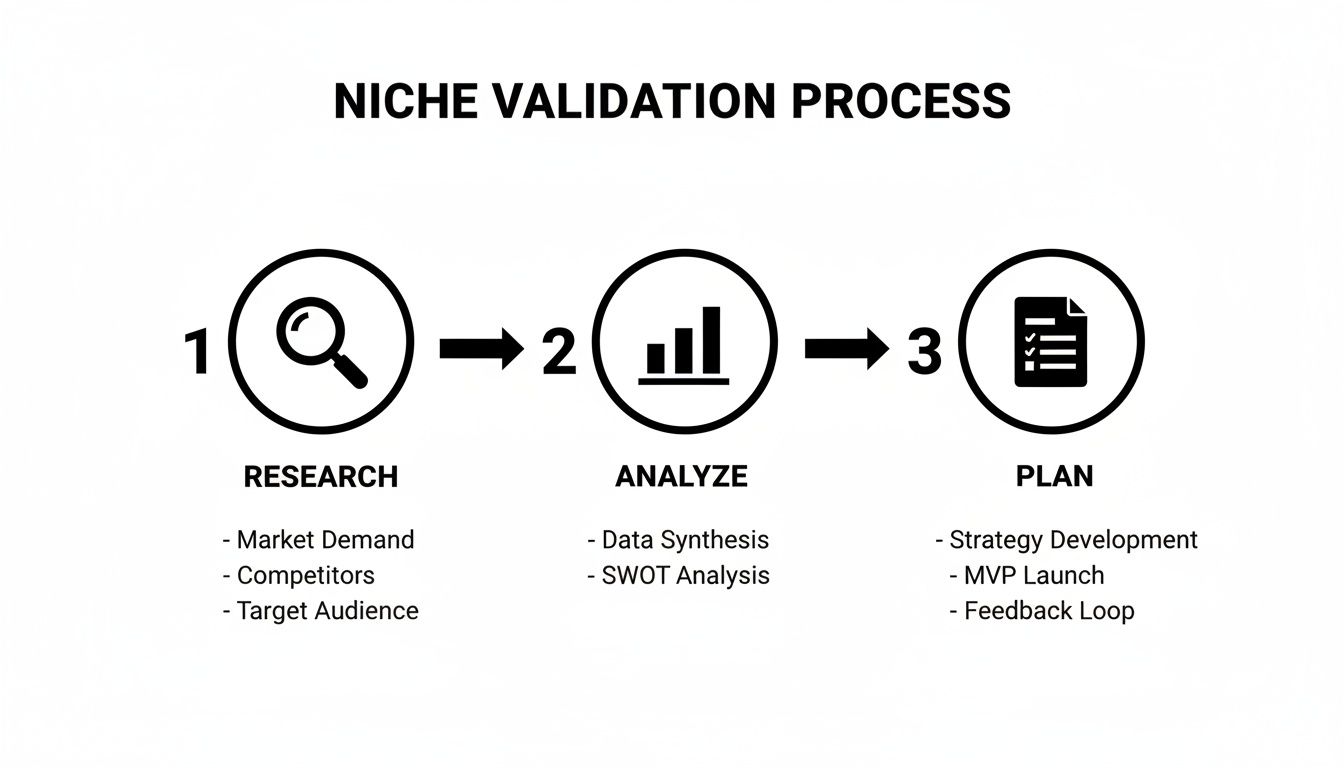
Following this flow from research to analysis and planning forces you to make decisions based on data, not just a gut feeling about what might sell.
Identifying Potential Niches
The best ideas usually come from your own life. What are you passionate about? What problems have you run into? What communities are you a part of? Often, the most powerful niches are born from solving a personal frustration or serving a group you already understand.
Instead of starting with a broad category like "selling coffee," you need to drill down. Think about specific sub-niches that cater to a more focused, and often overlooked, audience.
- Specialty Coffee: Organic, single-origin beans for true pour-over fanatics.
- Coffee Accessories: High-end, minimalist accessories for espresso machines.
- Subscription Boxes: A curated monthly tour of coffees from international roasters.
Getting specific like this actually reduces your competition. It lets you become the go-to expert for a dedicated group of customers who will feel like you truly "get" them. A niche isn't about limiting your potential; it's about concentrating your firepower where it will have the biggest impact.
A classic rookie mistake is chasing a hot trend. A lasting ecommerce business is built on solving a real problem for a specific group of people. That creates a loyal customer base that a trend-chasing brand can only dream of.
Gauging Demand with Data
Once you've got a few solid niche ideas, it's time to see if anyone is actually looking for them. This is where a free tool like Google Trends is your best friend. You can plug in your ideas and see how search interest has changed over time, helping you spot what’s gaining momentum versus what's fizzling out.
For instance, you can quickly see the difference in search volume and seasonality for terms like "pour over coffee" versus "french press coffee." This kind of insight is invaluable for planning your inventory and marketing calendar down the road.
But don't stop with search trends. Dive into online communities. Lurk on Reddit subs, join Facebook Groups, and scroll through forums related to your niche. Pay close attention to the language people use, the problems they complain about constantly, and the products they rave about. This is direct, unfiltered feedback from your future customers—it's absolute gold.
Creating Detailed Buyer Personas
With a validated niche in hand, your final step here is to bring your ideal customer to life by creating a buyer persona. This isn't just a list of demographics; it's about understanding their mindset.
Get specific and think about their psychographics:
- Goals: What are they trying to accomplish?
- Pain Points: What frustrates them about the products currently on the market?
- Values: What do they truly care about (e.g., sustainability, quality, convenience)?
For a specialty coffee brand, a persona might be "Alex, the 32-year-old remote worker who sees their morning coffee as a ritual, not just a caffeine hit, and cares deeply about ethical sourcing."
From this point on, every decision you make—from product design to the copy on your website—should be made with Alex in mind. This clarity ensures you're not just selling a product, but a solution that connects with your target audience on a much deeper level.
Building Your Brand and Legal Framework
Alright, you've pinpointed a promising niche. Now for the fun part: giving your idea a name and making it a real, legal business. This isn't just about tedious paperwork; it's about laying down the two foundational pillars of your company—a brand people remember and a legal structure that protects you.
A strong brand is so much more than a slick logo. It’s the entire vibe you put out there—your voice, your core values, and the story you tell. It's the reason a customer clicks "buy" on your site instead of one of the dozen others selling something similar. For a deeper look into this, our guide on how to create a brand identity is a great place to start.

Choosing Your Business Structure
The first major legal decision you'll make is how to structure your business. This choice has real consequences for your personal liability and how you'll handle taxes down the road. For most people just starting out, it usually boils down to a couple of key options.
-
Sole Proprietorship: This is the simplest path. You and your business are legally the same entity, which means you have unlimited personal liability. It’s incredibly easy to set up, but it offers zero protection for your personal assets if the business runs into debt or legal trouble.
-
Limited Liability Company (LLC): This is, hands down, the most popular route for new ecommerce stores. An LLC establishes a separate legal entity, which puts a protective wall between your business and your personal assets (like your house and car). It also gives you flexibility in how you're taxed, hitting that perfect balance of protection and simplicity.
I almost always recommend an LLC for new entrepreneurs. It offers that crucial liability shield without the headache and complex rules of a full-blown corporation. You get peace of mind so you can actually focus on growing the business.
Navigating the Legal Red Tape
Once you’ve picked a structure, it’s time to make it official. Getting these next few steps right ensures you’re compliant from day one and sets you up for smooth sailing later.
Register Your Business Name
If you plan to operate under a name that isn't your own legal name, you'll need to register it as a "doing business as" (DBA). If you're forming an LLC or corporation, securing your business name is already part of that registration process.
Get a Federal Tax ID Number (EIN)
Think of an Employer Identification Number (EIN) as a Social Security number for your business. It’s free to get from the IRS, and you'll need it for just about everything: opening a business bank account, hiring help, and filing your taxes. I suggest getting one even if you’re a sole proprietor—it’s the cleanest way to keep business and personal finances separate.
Secure Necessary Licenses and Permits
The specific permits you need will vary based on your city, state, and what you sell. Most businesses will need some combination of these:
- A general business operating license.
- A seller's permit, which allows you to collect sales tax.
- Industry-specific permits (for example, if you're selling food, alcohol, or other regulated goods).
As you get your legal ducks in a row, it’s helpful to see a full breakdown of the process. For our friends up north, this guide on How to Register a Company in Canada offers some great region-specific advice. Getting this legal framework solid from the start is a non-negotiable step in learning how to start a ecommerce company that's built to last.
Sourcing Products and Managing Inventory
If your products are the engine of your ecommerce store, then your supply chain is the fuel line. Mess this up, and the whole machine grinds to a halt. Deciding how you'll get your products is one of the most foundational choices you'll make—it dictates your business model, how much cash you need upfront, and what your daily grind will look like.
There's no single "best" way to do it. The right approach really depends on your niche, your budget, and how much hands-on control you want. Let's break down the main options so you can find the perfect fit for your vision.
Choosing Your Sourcing Model
Your first big move is picking a sourcing model. Each one comes with its own unique set of pros, cons, and headaches that will absolutely shape how you start and scale.
- Making Products Yourself: This is the path for the artisans, crafters, and creators with a unique skill. You get total control over quality and your brand story. The trade-off? It’s tough to scale and eats up a ton of your time.
- Working with a Manufacturer: Got a unique product idea? You can design it and have a third-party factory produce it for you. This gives you a proprietary product without building your own factory, but you'll often face high minimum order quantities (MOQs) and a crash course in logistics.
- Wholesale: This is a classic for a reason. You buy existing branded products in bulk at a discount and resell them. It's straightforward with proven demand, but your profit margins can be thin, and you’re in a crowded field selling the same stuff as everyone else.
- Dropshipping: You market and sell products you never actually touch. When a customer buys from you, you pass the order to a supplier who ships it directly to them. The startup cost is incredibly low, but you sacrifice almost all control over product quality and shipping times.
Don't forget that your market is global. A staggering 85% of global consumers now shop online. This might sound intimidating, but it means the barrier to entry for selling internationally has never been lower. And the market is far from saturated; if you take China out of the equation, global ecommerce penetration is only 12.8%. That leaves a massive runway for growth.
The Realities of Dropshipping
Dropshipping gets a lot of hype as the "easy button" for starting an ecommerce business, and there's some truth to that. You don't have to sink thousands of dollars into inventory, which takes a huge amount of financial risk off the table.
But it’s not a set-it-and-forget-it model. Your entire business lives and dies by the quality of your suppliers. Finding reliable partners isn't just a good idea—it's everything. Platforms like SaleHoo or Spocket can help by vetting suppliers, but the final responsibility to do your due diligence is on you.
One of the most common rookie mistakes in dropshipping is picking a supplier just because they have the lowest price. This almost always ends in disaster: shoddy products, infuriatingly long shipping times, and a flood of angry customer emails. Every single order is a reflection of your brand.
Sourcing from overseas, especially from major hubs like China, introduces a whole new layer of complexity. Mastering the logistics of international shipping is a critical skill. For a deep dive, check out a complete guide to shipping from China to the USA to understand what you're getting into.
Fundamentals of Inventory Management
If you decide to hold your own stock—whether you're making it yourself or buying wholesale—you’re now in the inventory management business. It sounds complicated, but it boils down to two simple things: knowing what you have and what you need.
Get this right, and you avoid stockouts (lost sales) and overstocking (trapped cash). When you’re just starting, a simple spreadsheet is all you need. Track your SKUs (Stock Keeping Units), the quantity you have on hand, supplier info, and your cost per unit.
As you grow, that spreadsheet will become your worst enemy. This is where your choice of ecommerce platform really matters. The right system can automate most of this for you. Our guide on the best ecommerce platforms for small business breaks down which ones have strong, built-in inventory tools.
Here’s a basic game plan for managing your stock:
- Set Reorder Points: Figure out the minimum stock level for each product. When your inventory hits that magic number, it’s the trigger to place another order with your supplier.
- Calculate Safety Stock: This is your "just in case" buffer. It’s a small amount of extra inventory to protect you from unexpected shipping delays or a sudden viral TikTok video causing a sales spike.
- Use a FIFO System: "First-In, First-Out" is a simple rule: sell your oldest stock first. It's non-negotiable for perishable goods but is a smart practice for everything to prevent items from becoming dusty, damaged, or outdated.
Whether your "warehouse" is a corner of your garage or you've hired a third-party logistics (3PL) company, these principles don't change. Building a solid supply chain from day one is what separates the businesses that scale smoothly from the ones that collapse under the weight of their own success.
Building Your High-Converting Online Store
Think of your website as more than just a digital storefront. It's your top salesperson, your cashier, and your brand's biggest advocate, working around the clock. Building a store that actually converts isn't about flashy gimmicks; it's about creating a smooth, intuitive path that turns a casual browser into a loyal customer. And that whole journey kicks off with one of the most critical decisions you'll make: choosing your ecommerce platform.
This isn't just a tech choice. It dictates your daily workflow, your budget, and your ability to scale down the road. The great news? It's never been easier to get started. Today, a solo entrepreneur can get a store up and running practically overnight, thanks to one of the 603 platforms powering a staggering 4.9 million stores. You can dig into more current digital commerce statistics to see just how massive this space has become.
Choosing Your Ecommerce Platform
Your first big fork in the road is deciding between a hosted or self-hosted platform. It’s a lot like renting an apartment versus buying a house.
-
Hosted Platforms (like Shopify): This is the “renting” model. You pay a monthly fee, and they take care of all the technical headaches—security, hosting, software updates, and payment integrations. It's the most straightforward path, letting you zero in on your products and marketing. The only real trade-off is that you have less control over deep, code-level customization.
-
Self-Hosted Platforms (like WooCommerce for WordPress): This is the “homeowner” model. The core software is often free, but you’re on the hook for everything else. You'll need to source your own hosting, manage security patches, and handle all the technical upkeep yourself. The upside is limitless flexibility, but it comes with a much steeper learning curve and a ton of responsibility.
For anyone just starting out, a hosted platform like Shopify is almost always the fastest and safest bet. It gets the technical roadblocks out of your way so you can launch quickly and start making sales.
Designing a User Experience That Sells
A beautiful website that’s a pain to navigate is a money pit. Your top design priority should always be a frictionless user experience (UX) that makes shopping feel easy and, dare I say, enjoyable.
Crafting Intuitive Navigation
Think of your site’s navigation as a map. If your customers get lost, they'll just leave. Keep your main menu dead simple with clear, logical categories. A clothing store, for instance, should use straightforward labels like "Men," "Women," "Kids," and "Sale." This is not the place to get clever with vague, artsy terms that no one understands.
Writing Product Descriptions That Convert
Your product descriptions have a job to do, and it's not just listing specs. They need to sell an outcome, an experience, a solution to a problem.
Instead of just saying, "Made from 100% cotton," try something like, "Experience the all-day comfort of our ultra-soft, breathable 100% cotton tee." Use bullet points to call out the key benefits so people can scan them easily. Tell a quick story that helps your customer picture themselves actually using—and loving—your product.
People don't buy what you do; they buy why you do it. A great product description connects the features of your product to the emotional needs of your customer. It’s the difference between selling a tent and selling a weekend adventure.
Setting Up Payments and Shipping
Okay, time for the nuts and bolts: getting paid and getting your products into customers' hands. These final steps are all about building trust, so you absolutely have to get them right.
Integrating Secure Payment Gateways
To take credit card payments online, you'll need a payment gateway. Services like Stripe and PayPal are the gold standard for a reason. They're secure, customers trust them, and they plug seamlessly into just about every ecommerce platform. Giving people multiple ways to pay, especially express options like Apple Pay or Shop Pay, can do wonders for reducing abandoned carts.
Configuring Shipping and Sales Tax
Your shipping strategy has a huge impact on whether people complete their purchase. Surprise shipping fees are the #1 killer of conversions. Be totally transparent with your costs right from the start.
Here are a couple of popular strategies:
- Flat-rate shipping: A simple, predictable fee for every order. No surprises.
- Free shipping: An incredibly powerful motivator. The most common approach is to tie it to a minimum spend (e.g., "Free shipping on all orders over $75!").
Sales tax is the other critical piece. Thankfully, you don't need to be an accountant. Modern platforms have built-in tools or third-party apps that automatically calculate the correct sales tax based on the customer's location, which takes all the compliance guesswork off your plate.
Your Go-To-Market Launch Strategy
So, you’ve built a stunning online store and sourced the perfect products. That's a huge accomplishment, but it means nothing without customers. This is where your go-to-market strategy comes into play—it's your roadmap for attracting those crucial first buyers and building real momentum.
A great launch doesn’t just happen on the day you go live. The real work begins weeks, sometimes even months, beforehand. Your goal is to build an audience that’s not just aware of your brand, but genuinely excited to buy from you the second you open your digital doors.
Building Pre-Launch Hype
That quiet period before you officially launch? That's your secret weapon. It’s the perfect time to create some buzz and, more importantly, start building an email list. Think of your email list as the only marketing asset you truly own, completely independent of the ever-changing whims of social media algorithms.
Here’s a simple game plan to get you started:
- Set up a "Coming Soon" page. This is a simple one-page site on your domain. Make sure it features your branding, a headline that clearly explains what you’re selling, and a can't-miss call-to-action to sign up for email updates.
- Offer a compelling incentive. Why should someone give you their email? A launch-day discount is a classic for a reason—it works. Something like, "Sign up to get 15% off your first order!" is highly effective.
- Get active on social media. Figure out where your target audience hangs out online and start posting. Share behind-the-scenes content, product sneak peeks, or your brand's origin story. You're trying to build a small, engaged community before you ever ask for a sale.
Your email list is your most valuable asset. For every $1 spent on email marketing, the average return is around $45 for retail and ecommerce brands. Start building it before you even have anything to sell.
Choosing Your Core Marketing Channels
Once you're live, the mission shifts to driving consistent traffic. When you’re just starting out, it’s much smarter to master one or two marketing channels than to spread your efforts too thin. For a brand-new ecommerce company, the initial focus should be on channels that give you the best bang for your buck.
Ecommerce Marketing Channel Overview
Picking the right channels can feel overwhelming. This table breaks down the most common options for new stores to help you decide where to focus your initial time and budget.
| Channel | Typical Cost | Effort Level | Time to ROI |
|---|---|---|---|
| SEO | Low (Sweat Equity) | High | 6-12 Months |
| Content Marketing | Low-Medium | High | 4-8 Months |
| Paid Social (Meta) | Medium-High | Medium | Immediate to 1 Month |
| Google Ads | Medium-High | Medium | Immediate |
| Email Marketing | Low | Low | Immediate |
| Influencer Marketing | Varies Widely | Medium | 1-3 Months |
While paid channels offer immediate results, don't sleep on the long-term value of organic channels like SEO and content marketing. The best strategies often blend both.
Foundational Search Engine Optimization (SEO)
SEO is the long game. It's the process of getting your site to show up in Google search results without paying for ads, which eventually becomes a source of "free" traffic.
- Keyword Research: First, you need to know what terms your customers are actually searching for. Focus on long-tail keywords (like "organic cotton baby onesies") because they're less competitive and usually signal someone is ready to buy.
- On-Page SEO: Make sure your product titles, descriptions, and category pages naturally include those target keywords. Don't just stuff them in; weave them into helpful, descriptive copy.
- Content Marketing: A blog is a fantastic tool for SEO. If you sell coffee, for example, articles like "How to Choose the Right Coffee Beans" or "A Beginner's Guide to Pour-Over Coffee" can attract highly qualified traffic.
Targeted Paid Advertising
While SEO takes time to ramp up, paid ads can deliver results almost immediately. Platforms like Google Ads and Meta (Facebook & Instagram) let you put your products right in front of very specific groups of people.
- Meta Ads: These are perfect for products with strong visual appeal. You can target users based on their interests, demographics, and even their online behaviors.
- Google Shopping Ads: For most ecommerce stores, these are a non-negotiable. They display your product image and price directly in the search results, grabbing the attention of shoppers with high purchase intent.
Getting the most out of your ad spend requires a smart approach. To dig deeper, you can explore these powerful marketing strategies for ecommerce that will help you find the right mix for your brand.
Tracking Your Success with Analytics
Here's a hard truth: you can't improve what you don't measure. Setting up analytics right from the start is non-negotiable if you're serious about building an ecommerce company that can scale. It's the only way to make decisions based on data instead of just guessing what works.
Install Google Analytics Immediately
Google Analytics is a free and incredibly powerful tool that gives you a deep understanding of your website's performance. It should be one of the very first things you set up after your store is built.
With it, you can track the metrics that really matter:
- Traffic Sources: Where are your visitors coming from? Is it Google, social media, or your email list?
- Conversion Rate: What percentage of visitors actually make a purchase? This is arguably the most important health metric for your store.
- Customer Acquisition Cost (CAC): How much do you have to spend on ads to get one new customer?
- Average Order Value (AOV): On average, how much does a customer spend each time they check out?
This data is your roadmap to growth. If you see that Instagram ads are driving tons of sales with a low CAC, you know exactly where to put more of your budget. If your blog is bringing in traffic but no one is buying, you know you need to work on your calls-to-action. This constant feedback loop is the key to spending your marketing budget wisely and building a truly profitable ecommerce machine.
Common Questions About Starting an Ecommerce Company
Jumping into ecommerce is exciting, but let's be real—it comes with a lot of questions. Getting straight answers from the get-go can save you a ton of headaches and rookie mistakes down the line. Let’s break down some of the big questions I hear all the time from people learning how to start an ecommerce company.

How Much Money Do I Really Need to Start?
This is the million-dollar question, isn't it? The honest answer is, it really depends on your business model.
If you’re going the dropshipping route, you can get a store up and running for just a few hundred bucks. That’ll typically cover your Shopify subscription, a domain name, and a small budget to test out some initial ads. It's a low-risk way to get your feet wet.
But if you plan on holding your own inventory, you'll need more skin in the game. For a business buying stock wholesale, a more realistic starting budget is somewhere between $1,000 to $5,000. That gives you enough runway to buy your first batch of products, pay your platform fees for a few months, and actually fund a proper marketing launch.
What Is the Most Common Mistake to Avoid?
I've seen this happen more times than I can count: skipping the validation phase. It's easily the most frequent and costly mistake new entrepreneurs make. They fall in love with a product idea, pour thousands into inventory and a slick website, and then… crickets. No one buys.
Never assume people will want your product. Prove it first. Spending a few weeks on proper niche research, competitor analysis, and talking to potential customers is the single best investment you can make to de-risk your entire venture.
This due diligence is what separates the stores that gain early traction from those that just burn through cash. It ensures you're actually solving a real problem for a real audience.
Do I Need to Register My Business Before I Start Selling?
Absolutely, yes. This is a non-negotiable step. While you could start as a Sole Proprietorship pretty easily, forming an LLC (Limited Liability Company) is the smarter play for most people.
Here’s why it’s so critical:
- Personal Asset Protection: An LLC builds a legal wall between your business and personal finances. If the business ever gets into hot water legally or financially, your personal assets—like your house and savings—are safe.
- Professionalism and Trust: A registered business name just looks more legitimate to customers, suppliers, and especially payment processors. It builds instant credibility.
- Financial Separation: It’s the only way to open a dedicated business bank account. Trust me, keeping your books clean from day one will save you a world of pain later on.
Setting up your legal structure isn't just a box to check; it’s a foundational move that protects you and prepares your business for real growth. Don't put it off.
Ready to build an online store that not only looks professional but is engineered to convert? At Sugar Pixels, we specialize in creating custom ecommerce websites and marketing strategies that drive real results. Let us handle the technical side so you can focus on growing your business. Explore our web design and marketing services today!