

Think of your website as a physical store. How do people find it? Do they see a big sign on the highway? Do they hear about it from a friend? Or do they already know the address and drive straight there?
Web traffic sources are just the digital versions of these paths. They are the channels people use to land on your website, and understanding them is the first step to figuring out what’s working in your marketing—and what isn’t.
Understanding Web Traffic Sources and Why They Matter
Let's stick with that store analogy. If your shop is tucked away on a side street with only one road leading to it, you're in trouble if that road ever closes. The same is true for your website. Relying on a single source of traffic, say, just from Facebook, is a huge risk. One algorithm change could wipe out your visitor flow overnight.
This is why building a diverse mix of traffic sources is non-negotiable for a resilient business. It’s about creating multiple pathways to your front door so that a roadblock in one area doesn't shut you down completely.
The Core Pathways to Your Website
Every person who visits your site comes from somewhere. Analytics tools like Google Analytics are fantastic at tracking these origins and grouping them into a few key categories. Each one tells a different story about how and why people are finding you.
Here are the main players you’ll see:
- Organic Search: This is traffic from people who found you by searching on Google, Bing, or another search engine and clicking on a non-paid result. They had a problem, you had the answer, and your SEO efforts paid off. Think of it as pure, earned reputation.
- Paid Traffic: These are visitors who clicked on an ad you’re paying for, like a Google Ad or a sponsored post on social media. It’s a fantastic way to get in front of a specific audience, fast.
- Direct Traffic: These are your loyal fans. They typed your website's URL directly into their browser or used a bookmark. They already know who you are and what you offer.
- Referral Traffic: Someone clicks a link on another website and lands on yours. This is digital word-of-mouth—a blog, a news site, or a partner sent them your way. It’s a powerful endorsement.
- Social Traffic: This traffic comes from social media platforms like Instagram, LinkedIn, or X. These visitors are part of your community, drawn in by content they found compelling enough to click.
A healthy mix of these web traffic sources not only protects your business from sudden changes but also allows you to connect with different audience segments. Some visitors are just browsing, while others are ready to buy, and each channel attracts a unique type of visitor.
By looking at where your visitors come from, you start to see the bigger picture. You can spot which channels bring in the most customers, which ones attract casual browsers, and where your marketing budget is best spent. It turns marketing from a guessing game into a smart, strategic plan for growth.
To give you a quick overview, here’s a simple breakdown of the most common traffic sources and what they're typically used for.
Quick Guide to Common Web Traffic Sources
| Traffic Source | How It Works | Best For |
|---|---|---|
| Organic Search | Users find you via unpaid search engine results (e.g., Google, Bing). | Building long-term brand authority, credibility, and sustainable traffic. |
| Paid Traffic | Users click on your paid advertisements (e.g., search ads, display ads). | Driving immediate, targeted traffic for specific campaigns or product launches. |
| Direct Traffic | Users type your URL directly into their browser or use a bookmark. | Measuring brand recognition, customer loyalty, and repeat visits. |
| Referral Traffic | Users click a link to your site from another website (not a search engine). | Building authority through backlinks, PR, and partner collaborations. |
| Social Traffic | Users arrive from social media platforms like Instagram, LinkedIn, or X. | Engaging communities, building brand personality, and driving top-of-funnel awareness. |
| Email Traffic | Users click a link within an email from you (e.g., a newsletter). | Nurturing leads, driving repeat purchases, and communicating with an owned audience. |
Having this foundational knowledge is key. It allows you to not only measure what's happening now but also to make smarter decisions about where to invest your time, money, and creative energy in the future.
Exploring the 9 Primary Web Traffic Sources
To really get a grip on your website's performance, you first need to understand the different roads people take to get there. Each path, or web traffic source, tells a different story about who your visitors are, what they want, and how well your marketing is working.
Think of it like a physical store. Some customers walk in because they saw your sign down the street, others were sent by a friend, and some are regulars who know exactly where you are. Each one is valuable, but they found you in very different ways.
This diagram gives you a bird's-eye view of how these channels funnel visitors to your site.
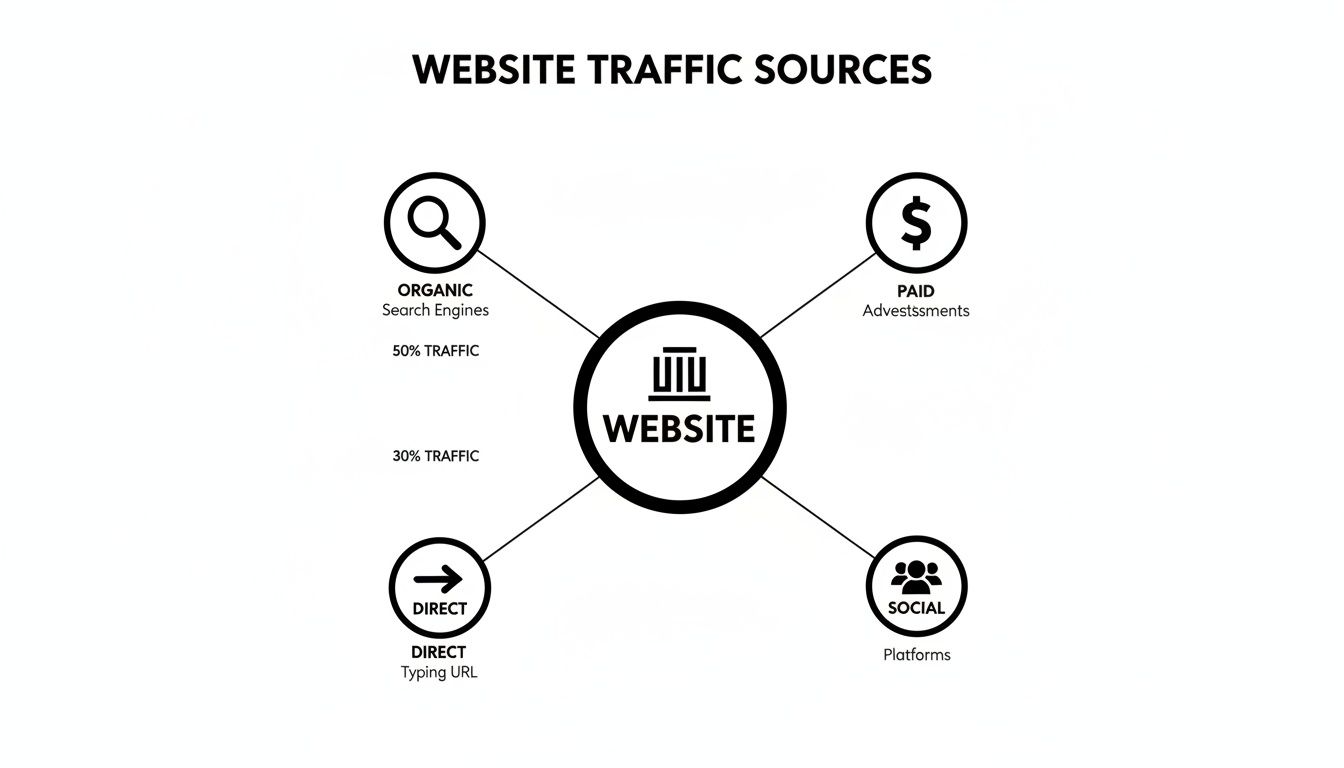
You can see how distinct sources like organic, paid, direct, and social media all pour into the same pool of visitors. This is why a multi-channel approach is so crucial. Let’s break down the nine main sources you need to know.
1. Organic Search
This is the holy grail of traffic. Organic search traffic comes from users who type a query into a search engine like Google or Bing, see your site in the results, and click—without you paying a dime for that click.
It’s earned, not bought. Getting consistent organic traffic means the search engines see your content as relevant, authoritative, and trustworthy. It's the digital equivalent of earning a prime spot in the busiest part of town because of your stellar reputation. It's a long game, built on solid SEO and great content, but the payoff is huge.
2. Paid Search
Paid search is the fast track. This traffic comes from users clicking on ads you've placed on search engine results pages (SERPs). Most of the time, these are pay-per-click (PPC) campaigns where you bid on specific keywords.
Think of it as leasing a giant, flashy billboard on a digital highway. Unlike organic search, which can take months to build momentum, a paid campaign can start sending targeted visitors your way almost instantly. It’s perfect for launching a new product or running a special promotion where you need immediate visibility.
3. Direct Traffic
Direct traffic is made up of visitors who already know you. They get to your site by typing your URL straight into their browser or by clicking on a bookmark they've saved. These are usually your most loyal customers and biggest brand fans.
Don't underestimate this channel. Believe it or not, a staggering 58% of all website traffic comes directly. That means a huge chunk of global internet users bypass search engines altogether. This highlights just how powerful brand recognition and customer loyalty really are. A healthy amount of direct traffic is a strong signal that your brand is memorable and people are seeking you out on purpose.
4. Referral Traffic
When another website links to yours and someone clicks that link, that's referral traffic. This could come from a blog that reviewed your product, a partner’s website, or an article that featured your company.
It’s the online version of a word-of-mouth recommendation. A link from a respected site acts as a powerful vote of confidence, sending you visitors who are already warmed up because they trust the source. This is where your PR and guest blogging efforts really shine.
5. Social Media
This one’s pretty straightforward. Social media traffic comes from platforms like Instagram, LinkedIn, X (formerly Twitter), or Facebook. It includes both organic traffic (from your non-paid posts) and paid traffic (from ads or boosted posts).
Social media is fantastic for building a community and showing off your brand's personality. While the traffic quality can sometimes be mixed, it's a non-negotiable channel for building top-of-funnel awareness and connecting with your audience on a human level.
6. Email Marketing
When someone clicks a link in one of your email newsletters, promotions, or automated messages, that’s email marketing traffic. This is an incredibly powerful channel because you're talking to people who have already given you permission to contact them.
Your email list is an asset you own. It isn't subject to the whims of a search engine algorithm or social media platform. That's why it consistently delivers one of the highest ROIs for nurturing leads and driving repeat business.
7. Affiliate Marketing
Affiliate traffic comes from partners who promote your products or services to their own audiences. These affiliates—who could be bloggers, influencers, or other businesses—earn a commission for every sale or lead they send your way.
It's a performance-based model, meaning you only pay for results. By tapping into the established trust and reach of your affiliates, you can get your brand in front of highly qualified audiences you might never have reached on your own.
8. Display Advertising
Ever see a banner ad or a video ad on a website or in an app? Clicks from those generate display advertising traffic. Unlike paid search, which targets users based on what they're actively searching for, display ads are more about building awareness.
You target people based on their demographics, interests, and online behavior. The goal is to put your brand in front of the right eyeballs, even when they aren’t looking for you, planting a seed for future consideration.
9. Other Traffic Sources
Finally, analytics tools often have a catch-all category for traffic that doesn't fit into any of the buckets above. This is usually a small slice of the pie, but it's worth keeping an eye on. It can sometimes point to tracking issues, like improperly tagged campaign URLs, that need fixing.
Understanding these different traffic sources is the first step toward creating a well-rounded marketing strategy. Each channel plays a part in a broader approach known as inbound marketing, which focuses on drawing customers in with genuinely helpful content. To see how it all fits together, check out our guide on inbound and content marketing.
How to Accurately Measure and Analyze Your Traffic
Knowing where your visitors come from is just the starting line. Real growth happens when you can look at the data and understand the story it's telling you. Without proper measurement, you’re essentially just throwing marketing dollars at the wall and hoping something sticks. By using analytics, you can stop guessing and start making smart, data-backed decisions that actually move the needle.

Think of your web analytics dashboard as the scoreboard for your website. It’s not just showing you the final score (like sales or leads). It’s breaking down the entire game: how many shots were taken (sessions), who passed the ball (referral sources), and which players (channels) were the most effective on the field. Learning how to read this scoreboard is absolutely critical.
Setting Up Your Analytics Foundation
For most businesses, the go-to tool for this job is Google Analytics. It’s the industry standard for a reason, offering deep insights into how people find and interact with your site. Getting it set up correctly from day one is the bedrock of any successful digital strategy.
We've put together a step-by-step guide to help you get this right. You can dive deeper into the setup process here: https://www.sugarpixels.com/how-to-track-website-traffic/
Once your tracking is in place, you can start digging into the numbers that really matter. These metrics give you the context needed to fairly judge how each traffic source is performing.
Decoding Key Performance Indicators
Not all metrics are created equal, and it's easy to get lost in a sea of data. To analyze your traffic sources effectively, you need to focus on the Key Performance Indicators (KPIs) that tell you the most about visitor quality and engagement.
Here are a few of the big ones you should always keep an eye on:
- Sessions: This is basically a single "visit" to your website. A session includes everything a user does—browsing pages, clicking links, filling out forms—before they leave.
- Bounce Rate: This tells you the percentage of visitors who land on a page and leave without interacting further. A high bounce rate can be a red flag, often signaling a disconnect between what the visitor expected and what your page delivered.
- Conversion Rate: This is the ultimate bottom-line metric. It’s the percentage of visitors who complete a goal, whether that’s making a purchase, signing up for your newsletter, or requesting a demo.
Remember, the goal isn't just to get more traffic; it's to get more of the right traffic. A channel that sends 100 visitors with a 10% conversion rate is far more valuable than a channel that sends 1,000 visitors with a 0.1% conversion rate.
To help you focus on what's most important for each channel, we've broken down the essential KPIs to watch.
Key Performance Indicators (KPIs) by Traffic Source
This table highlights the most important metrics for evaluating the health and ROI of your primary traffic channels.
| Traffic Source | Primary KPI | Secondary KPIs |
|---|---|---|
| Organic Search | Keyword Rankings | Organic Conversions, Bounce Rate, Pages per Session |
| Paid Search | Cost Per Acquisition (CPA) | Click-Through Rate (CTR), Conversion Rate, ROAS |
| Referral | Referral Conversions | Bounce Rate, Avg. Session Duration |
| Direct | Branded Search Volume | Direct Conversions, Returning Visitors |
| Social Media | Engagement Rate | Clicks, Shares, Social-Assisted Conversions |
| Email Marketing | Open Rate / Click Rate | Conversion Rate from Clicks, Unsubscribe Rate |
| Affiliates | Affiliate-Driven Sales | Conversion Rate, Average Order Value (AOV) |
| Display Ads | Impressions / Reach | View-Through Conversions, CTR |
Tracking these specific metrics will give you a much clearer picture of what’s working and what isn't, allowing you to allocate your budget and effort more effectively.
The Challenge of Attribution
Now, here’s where things get tricky. A customer’s path to purchase is rarely a straight line. They might see your ad on Instagram, search for your brand on Google a few days later, and then finally click a link in your newsletter to buy something.
So, who gets the credit? This is the central puzzle of attribution.
Imagine a soccer team scoring a goal. The striker who kicked the ball in gets all the glory, but what about the midfielder who made the perfect pass, or the defender who started the whole play from the back? Standard analytics tools often use "last-click attribution," which is like only giving credit to the striker.
This model tends to overvalue channels that are common final touchpoints (like Paid Search or Email) and undervalue the channels that introduce your brand to new people in the first place (like Social Media or Display Ads).
To get a true sense of how all your marketing efforts work together, you need to dig deeper. A great way to start is to master UTM variables in Google Analytics for accurate campaign tracking. These are simple tags you add to your links that tell Google Analytics exactly which ad, social post, or email brought a visitor to your site, giving you much cleaner data to work with.
Tailoring Traffic Strategies for Your Business Model
A one-size-fits-all approach to website traffic just doesn't cut it. The right mix of web traffic sources is completely dependent on your business model, your goals, and the resources you have at your disposal. What works for a brand-new startup would be a total waste of money for an established online store.
Think of it like choosing the right vehicle for a trip. You wouldn't take a Ferrari on a rugged mountain trail, and you wouldn't use a tractor for a cross-country race. Every business has its own unique terrain to navigate, and you need a purpose-built strategy to get where you're going.
The Lean Startup Playbook
If you're an early-stage startup, your world revolves around a few key things: validating your idea, getting some initial traction, and building brand awareness—all on a shoestring budget. The focus has to be on high-impact channels that don't burn through cash. It's all about sweat equity and creativity over a big marketing wallet.
The goal here is to build a solid foundation that you can scale up later on.
- Organic Search (SEO): This is your long-term growth engine. Start by zeroing in on niche, long-tail keywords that your ideal customers are actually typing into Google. Creating genuinely helpful, problem-solving content is how you build authority and attract qualified visitors without paying a dime per click.
- Social Media: Don't try to be everywhere at once. Pick one or two platforms where your customers actually hang out and focus on building a real community. Make it about engagement and providing value, not just blasting out marketing messages.
- Direct Outreach & Community Building: Get in the trenches. Participate in forums, relevant Reddit communities, and online groups where your audience lives. Offer help, answer questions, and build real relationships without just spamming your links. This grassroots approach brings in valuable early feedback and referral traffic.
The startup playbook is all about being resourceful. Your main investment is time—time spent understanding your customers, creating great content, and building a community one person at a time. This initial grind is what establishes the brand trust that will fuel your growth down the road.
The E-commerce Growth Engine
E-commerce businesses are in a tough spot. You're in a highly competitive space where driving sales right now is just as critical as building long-term customer loyalty. Your strategy needs a balanced blend of channels that can capture customers at every single stage of their buying journey, from "just looking" to "buy again."
This multi-pronged approach is what keeps a steady flow of both new and returning customers coming through your digital doors.
- Paid Search & Social Ads: For e-commerce, paid advertising is a beast for driving immediate revenue. Platforms like Google Shopping and Instagram Ads let you target users with high purchase intent—the people who are ready to buy. Best of all, you can measure these campaigns directly against sales, giving you a crystal-clear ROI.
- Email Marketing: Your email list is one of the most valuable assets you own, period. Use it to nurture relationships, announce new products, run exclusive promotions, and win back customers who abandoned their carts. Traffic from email often has the highest conversion rates because you're talking to a warm, engaged audience that already knows you.
- Affiliate & Influencer Marketing: Why not tap into an audience that's already built? Partnering with affiliates and influencers lets you do just that. It's a performance-based channel where you only pay a commission when they generate a sale, making it a low-risk way to expand your reach and build social proof.
For online stores, getting paid channels right is often what separates the winners from the losers. You can dive deeper with our expert insights on PPC for e-commerce to learn how to build campaigns that turn browsers into loyal buyers.
The Affiliate Marketer's Blueprint
Affiliate marketers are in the business of trust and authority. Their entire model depends on creating expert-level content that genuinely helps an audience, which in turn leads people to act on their recommendations. The main focus is on cultivating and monetizing a loyal following through very specific, high-value traffic sources.
Here, the name of the game is building a credible brand that people turn to for advice.
- Expert-Level SEO: Affiliates live and die by organic search. Success means dominating the search results for informational keywords ("how to choose X") and commercial keywords ("best X for Y"). This requires creating in-depth reviews, comparisons, and how-to guides that are far more comprehensive and helpful than anything else out there.
- Dedicated Email Lists: An email list gives an affiliate direct, unfiltered access to their audience, free from the whims of search engine algorithms. They can use it to promote new content, share exclusive deals, and build a stronger bond with their followers, driving high-converting traffic whenever they need it.
- Optimized Referral Traffic: Building a strong network of backlinks from other authoritative sites is a must. This doesn't just boost SEO; it also drives highly qualified referral traffic from readers who already trust the site that's linking to you. It's a powerful endorsement.
Building a Diversified and Resilient Traffic Strategy
Putting all your eggs in one traffic basket is a risky game. It's like building your entire storefront on a single road. What happens if that road closes for construction? Suddenly, no one can get to you. A Google algorithm update, a shift in social media policy, or rising ad costs can block your only path to customers overnight.
Real, sustainable growth comes from creating multiple highways leading to your website. This ensures that no single event can cut off your business, allowing you to weather any digital storm.

The goal is to build a smart portfolio of traffic sources where each channel plays a specific role. A solid SEO strategy can deliver a steady, compounding stream of visitors over the long haul. At the same time, a targeted paid search campaign can bring in immediate traffic for a big product launch. When they work together, you've got a marketing engine that's far more powerful and resilient.
How to Prioritize Your Traffic Channels
Diversifying doesn't mean you need to be everywhere all at once—that’s a recipe for burnout. The trick is to be strategic. Prioritize your channels based on your business goals, how much you've grown, and what resources you actually have.
A great way to think about this is to map channels on two axes: speed to results versus long-term sustainability.
Paid search, for instance, gets you visitors almost instantly, but the traffic stops the moment you turn off your budget. On the flip side, organic search is a slow burn; it takes months to gain traction, but it builds a valuable asset that can bring in traffic for years to come.
Your ideal channel mix is a living thing, not a static plan. It should change as your business matures. The channels that land your first 100 customers probably won't be the same ones that take you to 10,000. Always be auditing your traffic, looking for new opportunities, and shifting your focus based on what the data is telling you.
Sample Channel Mixes for Different Stages
Let's make this real with a couple of common scenarios. Each of these channel mixes is built to hit a specific target, blending different web traffic sources for maximum impact.
The "Growth Engine" Mix for Startups
If you're just starting out, your main goals are getting your name out there and winning over your first customers, usually without a huge budget. The focus here is on channels that reward hustle and build a strong foundation for the future.
- Primary Focus: Organic Search (SEO). Think of this as building a long-term asset. Every piece of content you create is a seed that can grow and bring in traffic for years.
- Secondary Focus: Social Media. This is where you build a community, show your brand’s personality, and generate that crucial top-of-funnel buzz.
- Tertiary Focus: Direct Traffic. As more people type your URL directly into their browser, it's a clear sign your brand recognition is growing.
This mix is all about planting seeds. By focusing on creating real value and connecting with people, startups can build momentum that pays off long after the initial push.
The "Scale and Convert" Mix for Established Businesses
Once your business has found its footing and has a product people love, the game changes. Now, the goals are all about scaling up customer acquisition, getting more value from each customer, and seeing a clear return on every dollar you spend.
The strategy gets more aggressive and much more data-driven:
- Paid Search: This becomes a core engine for growth. It lets you capture people with high intent—those who are actively searching for what you sell. It’s a direct lever you can pull to generate revenue.
- Email Marketing: You've already got a customer base, so this is your golden ticket. Use email to nurture leads, drive repeat business, and dramatically increase customer lifetime value. It's one of the highest ROI channels out there.
- Affiliate Marketing: This is how you expand your reach without massively increasing your workload. You tap into the audiences of trusted partners and only pay them when they deliver a result, like a sale.
By layering these channels together, you move from simply getting visitors to building a predictable, scalable system for growth. This is what a mature and resilient digital strategy looks like—one that isn't dangerously dependent on a single point of failure.
And that’s a wrap. We’ve covered a lot of ground, but the core idea is simple: building a powerful online presence is a long game, not a quick win.
Real, sustainable growth isn't about just getting more eyeballs on your site. It's about knowing exactly where those eyeballs are coming from and what it takes to get more of them. It's about strategically engineering that growth, not just hoping for it.
We've walked through everything from the slow-burn authority you build with organic search to the instant-on traffic from paid ads. The biggest takeaway? You absolutely must trust your analytics, and putting all your eggs in one traffic basket is a recipe for disaster. A smart, diversified mix of channels is your best defense when algorithms change or ad costs spike.
The real goal here is to build a predictable engine for growth. When you master your analytics and learn how to blend different traffic sources, your website stops being a static online brochure and becomes a machine that actively drives your business forward.
You now have the roadmap. The next step is to look at your own traffic, see where the opportunities are, and start applying what you've learned. As you build out your plan, these essential strategies to increase website traffic are a fantastic place to start. It's time to take the wheel and build a site that doesn't just exist—it delivers.
Answering Your Top Web Traffic Questions
Alright, we've covered the different types of web traffic. But that usually just opens up a new can of worms, doesn't it? Suddenly you're wondering, "How much traffic do I actually need?" or "How long is this SEO thing going to take?"
Let's cut right to the chase and tackle some of the most common, practical questions business owners and marketers ask.
What Is Considered Good Traffic for a Small Business?
This is one of those questions where the real answer is, "it depends." I know, not what you wanted to hear, but it's the truth. There's no magic number.
Good traffic is all about quality and conversions, not just volume. Think about it: a website pulling in 10,000 visitors a month with zero sales is failing. A different site with only 500 visitors that lands 25 fantastic leads is crushing it.
Instead of obsessing over a specific visitor count, shift your focus to engagement. Are people sticking around on your site? Are they downloading your guide, signing up for your newsletter, or actually buying something? High-quality traffic from the right audience will always outperform a high volume of random visitors.
How Long Does It Take to See Results from SEO?
If you're looking for a quick win, SEO isn't it. Search Engine Optimization is a marathon, not a sprint. It's a long-term investment that pays incredible dividends down the road. Realistically, you're looking at 6 to 12 months before you start seeing significant, meaningful results from a dedicated SEO strategy.
Of course, that timeline can shift based on a few key things:
- Competition: Are you in a super crowded market or a niche with some elbow room?
- Website Authority: Are you starting from scratch or working with a domain that already has some history and trust?
- Content Quality: Is your content genuinely helpful and better than what's already out there?
I like to compare SEO to planting a tree. It takes a lot of work upfront, and you don't get much shade for a while. But if you stick with it, you end up with a powerful, sustainable asset that brings in a steady stream of organic traffic for years to come.
Which Traffic Source Has the Best ROI?
This really comes down to your industry, business model, and what you're trying to achieve. That said, after years in this game, I've seen two channels consistently deliver the best long-term bang for your buck.
For pure, sustainable growth, Organic Search (SEO) is almost impossible to beat. Yes, there's an upfront investment of time and money in content and technical work. But once you're ranking, that effort can produce years of "free," highly qualified traffic. It builds a level of brand authority and trust that paid ads simply can't buy.
Right on its heels is Email Marketing. When you build an email list, you're creating a direct line of communication to your audience—it's a channel you actually own. These people have already raised their hands and said they want to hear from you, which makes them far more likely to convert. For nurturing leads and driving repeat sales, email is an absolute powerhouse.