
Trying to figure out how much a new website will cost can feel like you're trying to hit a moving target. Web design pricing packages bring much-needed clarity to this process by bundling common services—like design, development, and hosting—into a single, fixed price. These can start as low as $500 for a simple site and climb north of $10,000 for a highly complex build. The whole idea is to give you a clear, upfront cost so you can budget without any nasty surprises.
Why Web Design Packages Matter

If you’ve ever felt lost trying to estimate the cost of a new website, you’re in good company. Pricing can seem all over the map, with quotes ranging from a few hundred dollars to tens of thousands. This is exactly why web design pricing packages have become the go-to approach for most agencies.
Think of it like buying a car. You have your base model, a mid-range option with more features, and a fully-loaded luxury version. Each one has a clear set of features for a predictable price, which takes all the guesswork out of the equation.
The Benefits of a Packaged Approach
Packages make the entire web design process simpler for everyone involved—both for you as the client and for the design agency. They group together the most requested services a business needs to get online and succeed. This approach comes with some pretty significant wins:
- Cost Certainty: You know exactly what you’re paying from the get-go. No more surprise invoices or vague hourly rates that can easily get out of hand.
- Clear Deliverables: A good package spells out precisely what's included, like the number of pages, specific functions, and the level of support you'll receive.
- Efficient Workflow: Agencies can work more efficiently when they have a defined scope, which often means you get your site faster and the project stays on track.
This structured model shifts the focus from just trading time for money to building a real partnership based on value. Everyone agrees on the goals and outcomes from the start, rather than just clocking billable hours.
A Foundation for Success
Ultimately, picking a package sets the stage for a great working relationship. It gets you and your design team on the same page, focused on getting results instead of getting bogged down in administrative details. If you want a wider view of what's out there, this comprehensive guide to web design services in Australia is a great resource for seeing how all the different pieces fit together.
By getting a handle on how these packages are put together, you can confidently sort through your options and find a solution that lines up with both your budget and your business goals. This guide will walk you through the common tiers to help you make a smart investment.
What’s Usually Inside a Web Design Package?
Trying to compare web design pricing packages can feel a lot like comparing apples and oranges. Every agency bundles their services a little differently, which makes it tough to figure out what you’re actually getting for your money. Think of it like a restaurant's set menu—the price is fixed, but the courses included can change dramatically from one place to the next.
Let's pull back the curtain and break down the common ingredients you'll find in most packages. This will help you look beyond the price tag and see the real value each option offers your business.
Core Website Foundations
Every website, no matter how simple or complex, needs a few non-negotiable building blocks. These are the absolute must-haves that should be part of even the most basic package. Without them, your site just won't cut it in today's world.
- Number of Pages: Packages are often built around the number of unique pages included (like Home, About, Services, and Contact). A starter package might get you 3-5 pages, while a more comprehensive business package could offer 10-15 pages.
- Mobile-Responsive Design: This isn't a luxury anymore; it's a necessity. With over 60% of all web traffic coming from mobile devices, your site has to look and work flawlessly on a phone. If an agency lists this as an optional add-on, that's a huge red flag.
- Content Management System (CMS): A CMS, most commonly WordPress, is the engine of your website. It’s what lets you log in and update text, add a blog post, or swap out an image without having to call a developer for every little thing. It puts you in the driver's seat.
Think of these core elements as the digital equivalent of a building's foundation, walls, and roof. Everything else gets built on top of this structure.
Functionality and Growth Engines
Once the foundation is solid, the next step is adding features that help your website do something for your business. These are the components that turn a simple online brochure into a machine for attracting visitors and turning them into customers.
This is where you move beyond just having a presence and start building a real asset. A solid business-level package will add robust functionality designed to drive growth and give users a great experience.
Key Growth-Oriented Inclusions
- Basic SEO Setup: This isn't a full-blown SEO campaign, but it’s the essential technical groundwork. It involves creating an XML sitemap for Google, setting up proper meta titles and descriptions, and making sure your site is easy for search engines to crawl. It’s the launchpad for getting found online.
- E-commerce Functionality: If you sell products, this is a game-changer. Inclusions can range from a simple setup for a handful of products to a complete online store with a shopping cart, secure payment integration, and inventory management in the higher-end packages.
- Contact Forms and Lead Capture: A website’s job is often to generate leads. This means more than just a simple contact page. It includes professionally designed forms, newsletter sign-up boxes, and clear call-to-action (CTA) buttons that guide visitors to take the next step.
Support and Ongoing Operations
A website is not a "set it and forget it" project. It’s a living part of your business that needs regular attention to stay secure, functional, and effective. The better web design pricing packages almost always bundle in services to make sure your site runs smoothly long after it goes live.
These services give you peace of mind and protect your investment from hackers, technical glitches, and just plain becoming outdated.
- Website Hosting: Some agencies include hosting as part of their package, offering a true one-stop shop. They manage the server where your website lives, making sure it stays online and loads quickly for your visitors.
- Ongoing Maintenance and Support: This is one of the most critical long-term services you can get. It covers the important stuff, like software updates, security scans, and regular backups to prevent a catastrophe. To get the full picture, you can learn more about exactly what is website maintenance and why it's a must-have for any serious business.
- Training and Handover: A great agency won’t just build your site and walk away. They should take the time to train you or your team on how to use the CMS. This empowers you to manage day-to-day content updates on your own, confidently.
By understanding these common components, you’ll be much better equipped to analyze and compare different proposals, ensuring you pick a package that truly fits what your business needs to accomplish.
What Do Web Design Packages Actually Include? Let's Break It Down.
Trying to figure out web design pricing can feel like navigating a maze. You see prices all over the map—from a few hundred dollars to tens of thousands—for what looks like the same thing: a website. The key is to realize that web design pricing packages are tiered, a bit like car models. You have the standard base model, the upgraded trim with more features, and the fully-loaded luxury version.
Each tier is built for a different stage of business. By understanding what’s under the hood of each one, you can match your budget to your actual business goals and avoid paying for horsepower you don't need yet.
This diagram shows how the core parts of a website—like its pages, management system, and search engine visibility—are the building blocks for these packages.
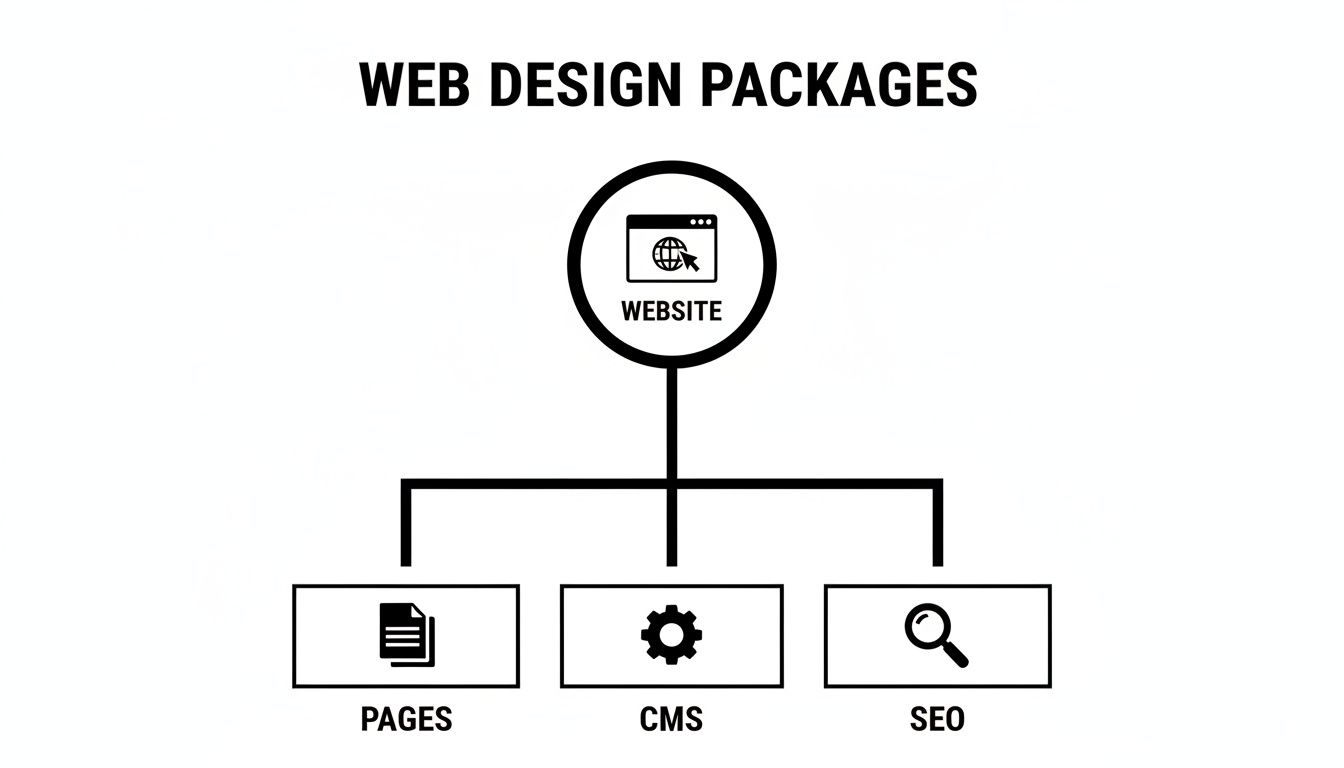
As you can see, the website is the main event, but these supporting pieces are what determine how powerful and effective it can be. Let's look at the common packages you'll run into.
The Starter Package: Your Digital Launchpad
Think of the starter package as your business's first, professional online home. It’s perfect for new businesses, freelancers, or small local shops that need to look credible and be found online without a huge initial cost. The mission is simple: get online, look professional, and give people a way to contact you.
This package almost always includes:
- A handful of core pages (3-5): Just the essentials—a Homepage, About Us, Services, and a Contact page.
- Template-based design: To keep it affordable, the site is built on a high-quality, pre-made template that’s then customized with your logo, colors, and content.
- A basic contact form: A simple way for potential customers to send you a message right from the website.
- Mobile responsiveness: This is non-negotiable. It ensures your site works perfectly on any device, from a desktop to a smartphone.
This is your entry point. It plants your flag on the web and gives you a solid foundation to build on later.
Price Range: $500 – $2,500
The Business Package: Your Engine for Growth
Once your business has its footing and you're ready to really grow, a simple online brochure isn't enough. The business package is designed to be a lead-generating machine. It’s for companies that are actively marketing and need a website that works for them, not just sits there.
This tier builds on the starter package with more firepower:
- More pages (10-15): Enough room for detailed service pages, team bios, case studies, and other in-depth content.
- Semi-custom design: This is a nice middle ground. It often blends a template's efficiency with custom-designed elements to make your brand truly stand out.
- Blog integration: A blog is a must-have for content marketing. It helps you attract visitors through search engines and establish yourself as an expert.
- Basic SEO setup: This gets the ball rolling with on-page SEO fundamentals, like optimizing your main pages with keywords so you can start showing up in search results.
- Lead capture tools: Think integrations with email marketing services or CRMs to help you capture and nurture leads automatically.
This is the point where your website transforms from a static asset into an active, revenue-driving part of your marketing strategy.
Price Range: $2,500 – $7,500
The Enterprise Package: Your Custom-Built Solution
For large companies, established e-commerce stores, or businesses with very specific, complex needs, a standard package just won’t cut it. The enterprise package is less of a "package" and more of a completely bespoke project—a digital platform built from the ground up to meet precise business objectives.
Enterprise-level work can involve:
- Unlimited pages & custom features: The ability to handle massive amounts of content and unique functionalities.
- Fully custom design & development: A one-of-a-kind website designed and coded from scratch to support advanced features.
- Advanced e-commerce: Things like custom product builders, subscription models, or complex inventory and shipping integrations.
- Third-party API integrations: Connecting your site seamlessly with other critical business software, like inventory systems, CRMs, or proprietary databases.
- Heightened security & compliance: Meeting strict security protocols and industry-specific regulations (like HIPAA or GDPR).
This is a serious investment for businesses where the website is a core part of their operations and a primary driver of revenue.
Price Range: $10,000 – $30,000+
Putting It All Together: A Quick Comparison
To make it even clearer, here’s a table that lays out what you can generally expect from each tier.
Comparison of Standard Web Design Package Tiers
| Feature | Starter Package | Business Package | Enterprise Package |
|---|---|---|---|
| Typical Pages | 3-5 | 10-15 | Unlimited |
| Design | Template-based | Semi-custom | Fully custom |
| SEO | None to minimal setup | Basic on-page SEO | Advanced & ongoing SEO |
| E-commerce | Not included | Basic storefront | Advanced, custom solutions |
| Integrations | Basic contact form | Email/CRM integration | Custom API integrations |
| Price Range | $500 – $2,500 | $2,500 – $7,500 | $10,000 – $30,000+ |
| Best For | New businesses, solopreneurs | Growing businesses | Large organizations, complex needs |
This breakdown should give you a solid framework for understanding where your project might fit.
Understanding the Financial Landscape
As you can see, web design pricing packages are built to serve a wide range of businesses. The numbers aren't arbitrary; they reflect the time, skill, and features required to meet different goals. General industry research confirms these tiers, with custom builds easily running from $5,000–$20,000 and enterprise solutions pushing $30,000–$100,000 or more.
To get a feel for what’s happening in a specific market, it's always helpful to look at local data. For example, this excellent guide on understanding website design costs in Australia provides a great regional perspective. By arming yourself with this knowledge, you can confidently choose a package that fits where you are today while clearing a path for where you want to go tomorrow.
Why Package Pricing Is a Win-Win for Clients and Designers
The web design world has been ditching hourly billing for a while now, and for good reason. This move toward web design pricing packages isn't just a passing trend—it's a smart shift that helps everyone by setting clear expectations right from the start. It turns a potentially confusing, open-ended process into a predictable, value-driven partnership.
For any business owner, the biggest plus is cost certainty. Think about hiring someone to build a deck with only a vague hourly rate. You'd be sweating over that final bill. Packages get rid of that anxiety by offering a fixed price for a specific list of deliverables. You know exactly what you're investing before a single line of code is written.
This transparency is also a powerful defense against "scope creep"—that all-too-common problem where small, extra requests slowly blow up the project's budget and timeline. With a package, the features are locked in upfront, creating a clear roadmap that keeps both sides focused and on the same page.
Creating a Value-Based Partnership
Beyond just locking in a budget, package pricing completely changes the client-designer relationship for the better. The focus shifts from tracking hours to achieving real business goals. The conversation stops being, "How long did this take?" and becomes, "Did this new feature actually help us get more leads?"
This approach fosters a true partnership where everyone is invested in the same outcome: building a website that delivers results. It's no longer just a transaction of time for money. It's a strategic collaboration aimed at hitting specific targets, whether that's driving sales, generating inquiries, or building up your brand's authority online.
The industry has fully embraced this model. By 2025, package pricing was the go-to choice for a massive 82% of professionals. That number blows hourly rates and retainers out of the water, as they barely make up 20% of the market combined. This shift is all about creating predictable revenue for agencies and straightforward proposals for clients, with over half of all projects—56.75%, to be exact—landing in the $2,500 to $9,999 range. You can dive deeper into the numbers in the latest web designer pricing report.
Why Designers Prefer Packages
For designers and their agencies, the benefits are just as compelling. Packages simplify everything from quoting new projects to managing the work itself. That efficiency means a more organized, predictable process, which ultimately helps the client with faster delivery and a more focused project.
By defining the project's boundaries from the start, designers can allocate resources effectively, prevent burnout from ever-expanding projects, and focus their creative energy on delivering the highest quality work within the agreed-upon framework.
At the end of the day, web design pricing packages create a win-win. Clients get financial predictability and a clear picture of what they’re paying for. Designers get a structured workflow that lets them do their best work without chaos. This shared understanding builds trust and leads to better websites and stronger, long-term business relationships.
Ever get two quotes for the same website and wonder why they're thousands of dollars apart? You're not the only one. The price of web design packages can swing wildly, and it usually comes down to two big, often overlooked, factors: where your designer is based and just how complex your project really is.
Think of it like hiring a carpenter. A master craftsman in a big city will naturally charge more for a custom-built cabinet than a skilled carpenter in a small town. The wood and nails might be the same, but the economics are completely different. Web design works the same way.
The Geographic Pricing Divide
A designer's location is one of the biggest single influences on their rates. The local cost of living, market competition, and what businesses typically pay all get baked into the final price. An agency with an office in New York or Sydney has way higher overhead than a freelancer working from Warsaw or Manila, and you'll see that difference in their quotes.
This global disparity explains the massive price range you often see. For example, geographic location profoundly impacts web design pricing packages in 2025. Hourly rates in top-tier markets like the United States, Canada, and Australia often sit between $100–$149. Meanwhile, talented developers in cost-effective hubs like India, Ukraine, and Mexico might charge anywhere from under $25 to $49.
What does that mean for a package deal? A US agency might bundle a small business website for $2,000–$5,000, while a firm overseas could offer something similar for under $3,000. If you're curious about these global trends, platforms like Clutch.co are a great place to see real-world data.
When Project Complexity Becomes the Great Equalizer
While location sets the baseline, the specific needs of your project can quickly take over as the main cost driver. A simple five-page "brochure" website is a pretty straightforward job. But adding layers of custom functionality? That’s like asking the carpenter to build an intricate, self-locking puzzle box instead of that simple cabinet.
The price climbs with every new layer of complexity.
- Custom Features: Need a unique booking system, a private member portal, or a dynamic pricing calculator? These things require specialized code and a lot more development time.
- E-commerce Intricacies: A basic online shop is one thing. But adding features like recurring subscriptions, a multi-vendor marketplace, or complicated shipping rules will push the cost up significantly.
- Third-Party Integrations: Getting your website to talk to your other software—like a CRM, an inventory system, or marketing automation tools—adds another layer of technical work.
- Multi-language Support: Building a site that works perfectly in multiple languages isn't just about translation; it requires careful planning for content management and user experience.
These kinds of features can easily double or even triple the cost of a standard package. To see how all these pieces fit together, take a look at our detailed guide on website design costing for a complete breakdown.
Once you understand how both location and complexity affect the price, you're in a much better position to make a smart hiring decision, whether you go with a local pro or find a partner across the globe.
Choosing the Right Web Design Package for Your Business
Picking the right web design package is so much more than just finding the cheapest deal. It’s an investment. Think of it like building a physical storefront: you’re not just paying for walls and a door. You're creating a space designed to welcome customers, showcase your value, and ultimately, make sales.
Your website is your digital storefront, and finding the right package means matching its features to what you actually need to accomplish.
Before you even glance at a price sheet, you need to get brutally honest about your goals. What is this website's number one job? Is it to generate a steady stream of leads through a contact form? Is it to sell products 24/7? Or is it to establish you as a go-to expert in your field? Nailing this down is your first, and most critical, step.
Aligning Features with Your Core Goals
Once you know your primary mission, it’s time to sort your feature list into two buckets: the must-haves and the nice-to-haves. This simple exercise is the key to comparing web design pricing packages without getting distracted by shiny objects. It keeps your budget focused on what actually delivers a return.
For example, if lead generation is your top priority, your must-haves might look like this:
- A killer contact form that’s impossible to miss.
- Direct integration with your CRM to keep leads organized.
- A blog ready for content that pulls in your ideal clients.
That fancy, complex animation you saw on another site? It’s probably a "nice-to-have." This kind of clarity stops you from paying for bells and whistles that don't help you win.
How to Properly Vet Potential Agencies
With your goals defined and your features prioritized, you’re ready to start talking to agencies. But vetting a potential partner is about more than just flipping through their portfolio. You have to dig a little deeper to find the right fit.
A great agency won’t just build what you ask for; they will ask why you need it. A strong focus on strategy and business outcomes during the initial discovery call is a sign of a true partner, not just a service provider.
Having a plan helps. Our guide on how to choose a web designer walks you through the right questions to ask. Keep an eye out for red flags, like a cookie-cutter proposal that doesn't mention your specific goals. The best proposals feel like they were written just for you, showing the agency was listening and is already thinking about how to make you successful.
Common Questions About Web Design Pricing
Even with a detailed plan in hand, a few questions almost always pop up when you're digging into web design pricing packages. Let's clear up some of the most common ones so you can move forward with confidence.
What Are the Most Common Hidden Costs?
Most of the time, "hidden" costs aren't really hidden—they're just services that fall outside a standard package. It pays to know what to look for.
A few usual suspects include:
- Domain Name and Hosting: While some agencies roll these into their plans, many expect you to handle them separately. Budget around $100 to $300 per year for these essentials.
- Premium Plugins or Themes: Need a specific, powerful feature? It might require a paid plugin, which could be a one-time purchase or an annual subscription.
- Stock Photography: High-quality, licensed images almost never come standard. If your site needs a lot of professional photos, this cost can add up fast.
The best way to avoid surprises? Just ask the agency what's not included in their proposal. That one simple question can save you a ton of headaches and unexpected bills later.
What Should Ongoing Maintenance Cost?
Once your beautiful new site is live, the work isn't over. It needs regular care to stay secure, fast, and functional. Think of a maintenance plan as an insurance policy for your website.
A typical maintenance package will run you somewhere between $50 and $250 per month. This usually covers the critical stuff: software updates, security scans, regular backups, and maybe an hour or two for small content changes.
Skipping maintenance is a bit like never changing the oil in your car. It might run fine for a while, but eventually, you're looking at a much bigger, more expensive problem.
My Needs Fall Between Two Packages. What Should I Do?
This happens all the time. You're a bit beyond the starter package but don't quite need everything in the next tier up. Don't feel forced to choose.
This is your cue to start a conversation with the agency. Any good web designer will be flexible. They can almost always put together a custom proposal that fits you perfectly, letting you add specific features from a higher-tier package to a lower one. This way, you only pay for what you actually need.
Ready to find a web design package that fits your goals without the guesswork? Sugar Pixels offers clear, tiered plans designed for businesses at every stage of growth. Explore our packages and build your ideal online presence today.