

When we talk about SEO services for startups, we're not just talking about keywords and rankings. We're talking about building a powerful, long-term engine for sustainable growth right from day one. Unlike paid ads that vanish the moment you stop paying, a smart SEO strategy creates a digital asset. It's an asset that generates compounding returns, pulls in qualified customers, and cements your brand's authority when it matters most.
Why SEO Is Your Startup’s Ultimate Growth Lever
As a founder, you're constantly balancing a tight budget with the need for immediate results. From that perspective, SEO can feel like a slow, uphill climb. But let's reframe that.
Think of paid ads like renting a prime retail spot—stop paying rent, and you're gone. SEO, on the other hand, is like buying the land and building your own skyscraper.

It’s a long-term investment that actually appreciates over time, delivering compounding returns and predictable growth. This guide breaks down SEO services for startups, showing you why it's not just another expense, but a strategic partnership built for lasting market dominance.
Building an Engine for Customer Acquisition
A well-executed SEO strategy quickly becomes your most reliable engine for acquiring new customers. It builds credibility and brand authority from the ground up, attracting users who are actively looking for the exact solution you offer. It’s the difference between making a thousand cold calls and having genuinely interested prospects walk right through your door.
When treated as a long-term play, investing in SEO can deliver a staggering 700% ROI for startups—an efficiency that other channels can't match. To put it in perspective, outbound leads have a close rate of just 1.7%, while leads from search engines convert at an impressive 14.6%. For a deeper look at getting started, check out this comprehensive guide to SEO for startups.
Creating a Sustainable Competitive Advantage
While your competitors burn through cash on ads for a temporary boost, you can be building a fortress of authority that’s tough to knock down. Every piece of optimized content, every high-quality backlink you earn, adds another brick to your digital foundation. Over time, this creates a protective moat around your business that only gets wider and more difficult for others to cross.
SEO is not just about being found; it’s about being found by the right people at the right time. For startups, this means connecting with customers at the precise moment they are looking for your solution, creating a powerful and cost-effective acquisition channel that scales with your business.
This long-game mindset is crucial. The first few months demand patience, but the reward is a steady stream of organic traffic that doesn’t live or die by your daily ad spend. This sustainable model frees up cash and focus, allowing you to pour resources back into your product, your team, and other core parts of the business. It's a common question we get—how long does it take and what's the real value? We cover that in our article exploring if SEO is worth it.
What Startups Actually Get from SEO Services
Let's cut through the noise. “SEO services” gets thrown around a lot, but for a startup founder, it often feels like a black box. What are you actually paying for?
Think of it like building a house. You don’t just hand over cash for “a house”—you’re paying for the blueprint, the foundation, the framing, the plumbing, and the electrical. SEO is no different. It’s a collection of specialized jobs that all have to work together to build something that lasts.
A real SEO strategy isn’t just one thing. It’s a coordinated effort across four core pillars. Get these right, and your website stops being a simple online brochure and starts becoming an engine that brings customers to you.
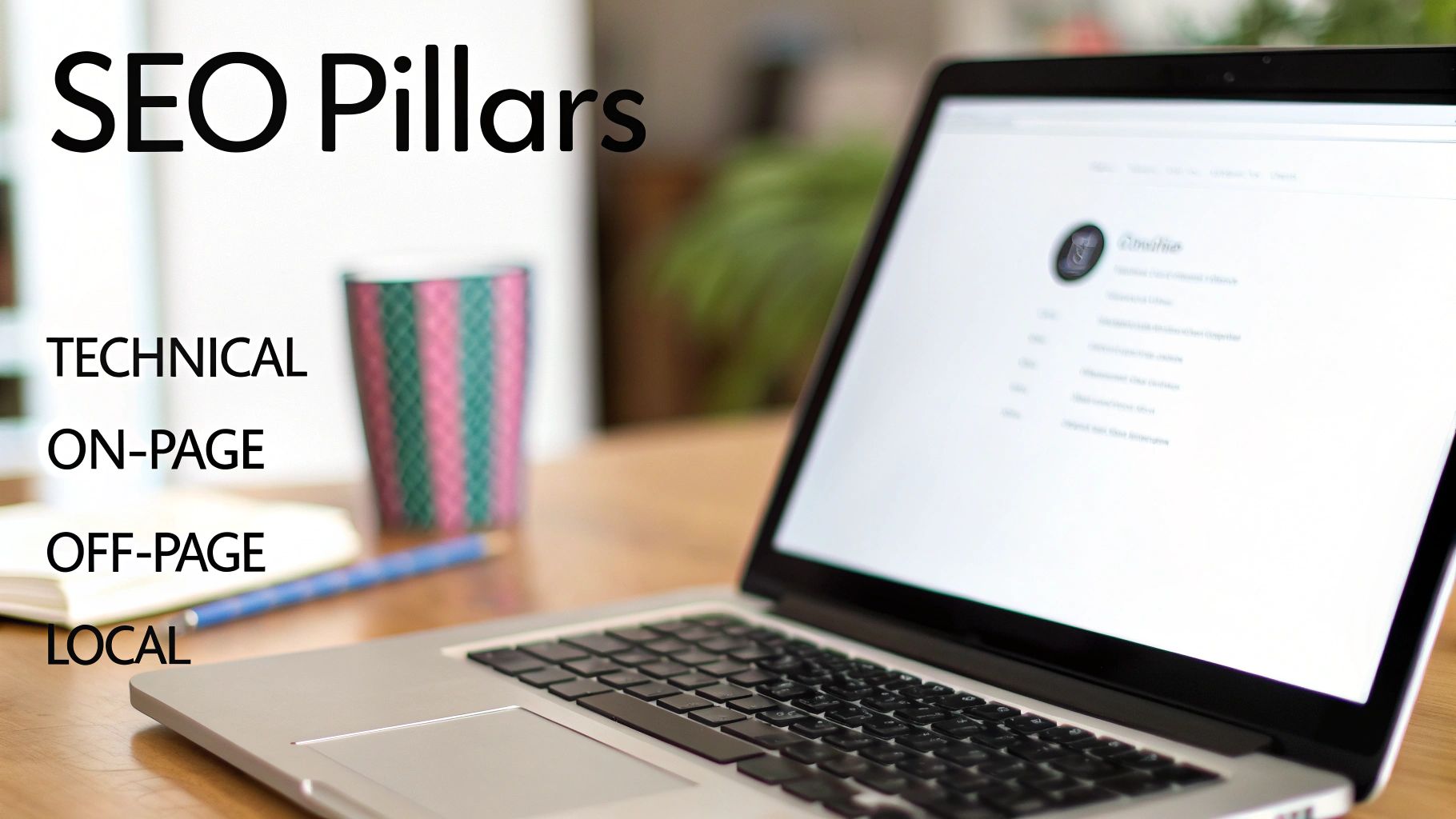
To make this tangible, let's break down exactly what goes into a solid SEO plan. The table below outlines the core services you should expect and, more importantly, why they matter for your startup's growth.
Core Components of Startup SEO Services
| SEO Service Component | What It Is | Why Your Startup Needs It |
|---|---|---|
| Technical SEO | The "under-the-hood" work: site speed, mobile-friendliness, security, and making sure Google can easily crawl and understand your site. | Creates a fast, frustration-free experience for users and makes you a favorite of search engines. It’s the non-negotiable foundation. |
| On-Page SEO | All about your content. It’s deep keyword research to find what customers search for, then creating and optimizing pages that answer their questions. | Aligns your product or service with the exact language your customers are using. This is how you prove your relevance. |
| Off-Page SEO | Building your site’s reputation across the web, primarily by earning backlinks from other credible websites. | Backlinks are votes of confidence. The more you have from reputable sources, the more Google sees you as an authority worth ranking. |
| Content Strategy | The plan for creating blog posts, guides, and other resources that attract and help your target audience. | Establishes your startup as a go-to expert, builds trust, and captures traffic from people who aren't ready to buy yet. |
| Local SEO | Optimizing your Google Business Profile, managing reviews, and getting listed in local directories. | Absolutely essential if you serve a specific geographic area. This puts you on the map for "near me" searches. |
This breakdown shows how each piece contributes to the bigger picture. A good SEO provider doesn't just focus on one area; they integrate them into a cohesive strategy designed for growth.
The Four Pillars of Startup SEO
Let's dig a little deeper into these four foundational areas. Understanding how they work helps you see what a good SEO agency is actually doing behind the scenes.
-
Technical SEO (The Foundation): This is the bedrock. If your website has a cracked foundation, everything else you build on top is at risk of crumbling. Technical SEO is all about making sure your site is fast, secure, and easy for search engine crawlers to navigate. It covers site speed, mobile experience, fixing broken links, and having a logical site structure. When Google’s bots can easily understand your site, they’re more likely to show it to people.
-
On-Page SEO (The Content and Structure): This is everything you can see on your website's pages. It starts with figuring out the exact words and phrases your ideal customers are typing into Google. Then, it's about creating genuinely helpful content that answers their questions and optimizing things like page titles, headings, and images to make it crystal clear to search engines what each page is about. This is where you connect what you offer with what your audience is actively looking for.
-
Off-Page SEO (The Authority and Trust): This involves all the things you do off your website to build its reputation. The biggest piece of this puzzle is link building—getting other respected websites to link back to yours. Think of every backlink as a vote of confidence. When a trusted site links to you, they're essentially vouching for your credibility, which gives your search rankings a serious boost.
-
Local SEO (The Neighborhood Reach): If your startup has a physical storefront or serves a specific city or region, this is non-negotiable. Local SEO is all about optimizing your Google Business Profile, getting listed in local online directories, and encouraging customer reviews. The goal is simple: when someone nearby searches for what you do, you need to be the one who shows up on the map.
Turning Clicks into Customers
These pillars can’t exist in a vacuum. A technically perfect site is useless if the content is bad. And amazing content will never get seen if it doesn't have the authority from backlinks to rank. They all have to work in concert.
When they do, you create a system that doesn't just drive traffic—it drives the right traffic.
A well-oiled SEO machine connects your startup with people who are already looking for the exact solution you provide. This massively improves the quality of your leads and can drastically lower your customer acquisition costs.
This strategic, multi-pillar approach is what separates real, sustainable SEO from just ticking off boxes on a checklist. By building a strong presence across all four areas, you create a powerful asset that can weather algorithm updates and consistently bring in new business.
Want to see how this translates directly into new leads? You can learn more by reading our detailed guide on SEO lead generation.
Finding the Right SEO Partner for Your Startup
Picking an SEO agency is one of the biggest marketing calls a startup founder will make. This isn't just about hiring a contractor; it’s about bringing on a growth partner who gets the unique pressures and tight resources of the startup world. You don't just need a technician—you need a strategist who knows the game.
Think of it like hiring a co-pilot for your company's maiden flight. Any pilot can fly, but a startup needs one who’s navigated storms in a brand-new plane with limited fuel and a ridiculously ambitious destination. The right partner understands the difference between just staying in the air and achieving a steep, sustainable climb.
Vetting Agencies That Get Startups
Let's be clear: not all SEO providers are built for the startup hustle. Many are used to working with big, established brands that already have years of domain authority and name recognition. A startup, on the other hand, is usually starting from a dead stop—a new website with zero online footprint.
Your vetting process has to filter for agencies that live and breathe this exact scenario. Look for partners who speak your language, whether you're a B2B SaaS company gunning for demo requests or a D2C e-commerce brand fighting for those first crucial sales. The data shows it works: startups that team up with specialized SEO agencies see an average 68% increase in organic traffic in just six months. Firms like RevenueZen, which focuses on B2B SaaS, can command rates over $8,000 a month, which tells you just how valuable that niche expertise is.
Before you even start reaching out, it’s a good idea to have a solid grasp of what an SEO agency does and its benefits. It will make your conversations infinitely more productive.
Critical Questions for Discovery Calls
Your discovery calls are where you separate the real experts from the smooth talkers. Go in armed with a list of questions designed to poke holes in their pitch and reveal how they actually think about growth for a company like yours.
Here are a few must-ask questions:
- "How do you build authority for a brand-new website with zero backlinks?" This cuts right to the chase, testing their grasp of foundational link-building and content strategy when you're a nobody.
- "Can you show us a case study of a startup you grew from our current stage?" Get specific. Ask about their starting traffic and where they are now. This separates the theorists from those with a proven track record.
- "What's your process for keyword research when a product category is brand new?" This reveals how they uncover opportunities when there's no existing search data to rely on.
- "How do you balance quick wins with our long-term strategic goals?" Startups need both. Their answer will tell you if they have a practical, phased approach that builds early momentum without sacrificing the long game.
The goal here is to understand their process, not just their promises. A great partner will walk you through the 'why' behind their strategy, showing they truly understand how SEO plugs into your actual business goals.
Red Flags to Watch Out For
Knowing what to look for is only half the battle; you also need to know what to run away from. The wrong SEO partner can torch your budget, get your site penalized by Google, and set your growth back by months, if not years.
Be on high alert for any of these red flags:
- Guarantees of #1 Rankings: Nobody can guarantee a specific spot on Google. Period. This is the oldest trick in the book, and it's a dead giveaway of inexperience or a shady sales pitch.
- Vague or "Secret" Strategies: If they can't explain their process in plain English, it's because they either don't have a real strategy or they're using risky techniques they don't want you to know about.
- A "One-Size-Fits-All" Approach: Does their proposal feel generic? If it doesn't mention your specific competitors, audience, or business goals, they haven't done their homework.
- Lack of Transparent Reporting: You should know exactly what they're tracking and get regular, clear reports. If their reporting is fuzzy or confusing, it’s a huge problem.
- Focus on Vanity Metrics: An obsession with traffic numbers without connecting them to leads, sign-ups, or sales is a classic rookie mistake. The only thing that matters is business impact.
Any good agency will insist on a thorough analysis of where you stand today. You can get a huge head start—and have a much smarter conversation—by understanding the basics of how to do an SEO audit yourself.
How Much Should a Startup Realistically Budget for SEO?
Let's talk about the elephant in the room: money. Budget conversations can be tense, but when it comes to SEO, getting this right from the start is crucial. Think of it less as a cost and more as an investment in a long-term growth engine.
Setting a realistic budget aligns your expectations with how organic growth actually works. It's not about just "doing some SEO"; it's about funding a sustained effort that builds momentum over time.
Trying to do SEO on a shoestring budget is a recipe for disaster. It often leads to corner-cutting tactics that not only fail to get results but can actually get your brand new website penalized by Google. It’s a hole you don’t want to have to dig yourself out of.
So, How Are SEO Services Usually Priced?
When you start looking for an SEO partner, you'll run into a few common pricing structures. Each one is built for a different need, and knowing the difference will help you figure out what makes sense for your startup's current stage.
The pricing model you choose can have a big impact on your relationship with an agency and the results you see. Here’s a quick breakdown of what you'll typically encounter:
Typical SEO Service Pricing Models for Startups
| Pricing Model | Typical Monthly Cost | Best For | Pros & Cons |
|---|---|---|---|
| Monthly Retainer | $2,000 – $10,000+ | Startups committed to consistent, long-term growth. | Pro: Builds compounding results over time. Con: Requires a consistent monthly budget commitment. |
| Project-Based | $1,500 – $7,500 (one-time) | Startups needing a specific deliverable, like a site audit or keyword strategy. | Pro: Fixed scope and cost. Con: Doesn't provide ongoing momentum. |
| Hourly Consulting | $150 – $400+ / hour | Startups with an in-house team that needs expert guidance or troubleshooting. | Pro: Highly flexible and targeted. Con: Can become expensive without clear goals. |
Ultimately, most startups that are serious about growth land on a monthly retainer. It’s the model best suited for building the kind of authority and traffic that creates a sustainable business.
What Does Quality SEO Actually Cost?
Okay, let's get down to real numbers. While prices can be all over the map, you generally get what you pay for. A serious SEO campaign for a national or SaaS startup requires real expertise—skilled strategists, talented writers, outreach specialists, and the tools to make it all happen.
The hard truth? Any agency pitching full-service SEO for under $1,500 a month is waving a massive red flag. They're almost certainly cutting corners, likely using automated, low-quality tactics that will hurt your brand in the long run.
To get meaningful results, you need to invest at a level that supports a professional, customized strategy. Here's a realistic look at what you should expect to budget:
- $2,000 – $5,000 per month (Foundational SEO): This is a solid starting point for a new startup. It should cover a deep dive into keyword research, comprehensive on-page optimizations, fixing technical issues, and getting an initial content plan off the ground.
- $5,000 – $10,000 per month (Growth-Focused SEO): Ready to scale? This budget level allows for a steady stream of high-quality content, a strategic and consistent link-building program, and more assertive efforts to build your site's authority.
- $10,000+ per month (Competitive Market SEO): If you're jumping into a crowded space like FinTech or B2B SaaS, this is the level of investment required to compete. It funds a dominant content strategy and the acquisition of high-authority links needed to get ahead.
Fueling Your Investment: The SEO ROI Timeline
Unlike paid ads that deliver traffic the moment you turn them on (and stop the moment you turn them off), SEO is an investment in a permanent asset. The first 6 to 12 months are all about building the foundation.
You’ll likely see some early wins on less competitive keywords, which is great for momentum. But the truly game-changing traffic—the kind that drives sustainable revenue—arrives later as your website's authority compounds on itself. Your budget isn't just buying a list of tasks; it's buying the consistent, focused effort over time that is the only true path to long-term organic growth.
Your Phased SEO Roadmap for Startup Growth
Trying to do everything in SEO at once is a classic startup mistake. It's a recipe for burnout and wasted cash. A much smarter approach is to treat it like a marathon, not a sprint, broken down into manageable phases.
This isn't just about organizing tasks; it’s about aligning your SEO efforts with your startup’s growth curve. You need to show progress, manage your budget wisely, and build momentum. A phased roadmap turns the overwhelming goal of "ranking on Google" into a clear, step-by-step plan that takes you from being invisible to becoming a known player in your space.
You wouldn't build a skyscraper without a solid foundation, right? The same goes for SEO. This approach ensures you nail the fundamentals before you start chasing the big, competitive keywords.
Phase 1: The Foundation (Months 1-3)
The first 90 days are all about getting your house in order. You simply can't build a powerful online presence on a technically flawed website. The goal here is to fix what's broken and deeply understand the competitive landscape you're walking into.
Think of this phase as diagnostics and setup. It ensures that when you do start pouring resources into content and outreach, none of that effort goes to waste.
Here’s what should be on the docket:
- A Deep-Dive Technical SEO Audit: This isn't a quick scan. It's a full-on health check for your site, digging into everything from page speed and mobile-friendliness to how easily Google can crawl and index your pages.
- Serious Keyword Research: This is where you find your "money" keywords—the terms your ideal customers are actually typing into Google. But just as important, you'll uncover lower-competition, long-tail keywords that can bring in some quick, early traffic and build confidence.
- On-Page SEO Implementation: Once you know your keywords, you need to bake them into your core pages. This means optimizing your homepage, service pages, and product pages with sharp page titles, compelling meta descriptions, and well-structured content.
This visual timeline breaks down how a smart SEO roadmap unfolds, moving logically from getting the foundation right to building authority and, finally, scaling up for real market impact.
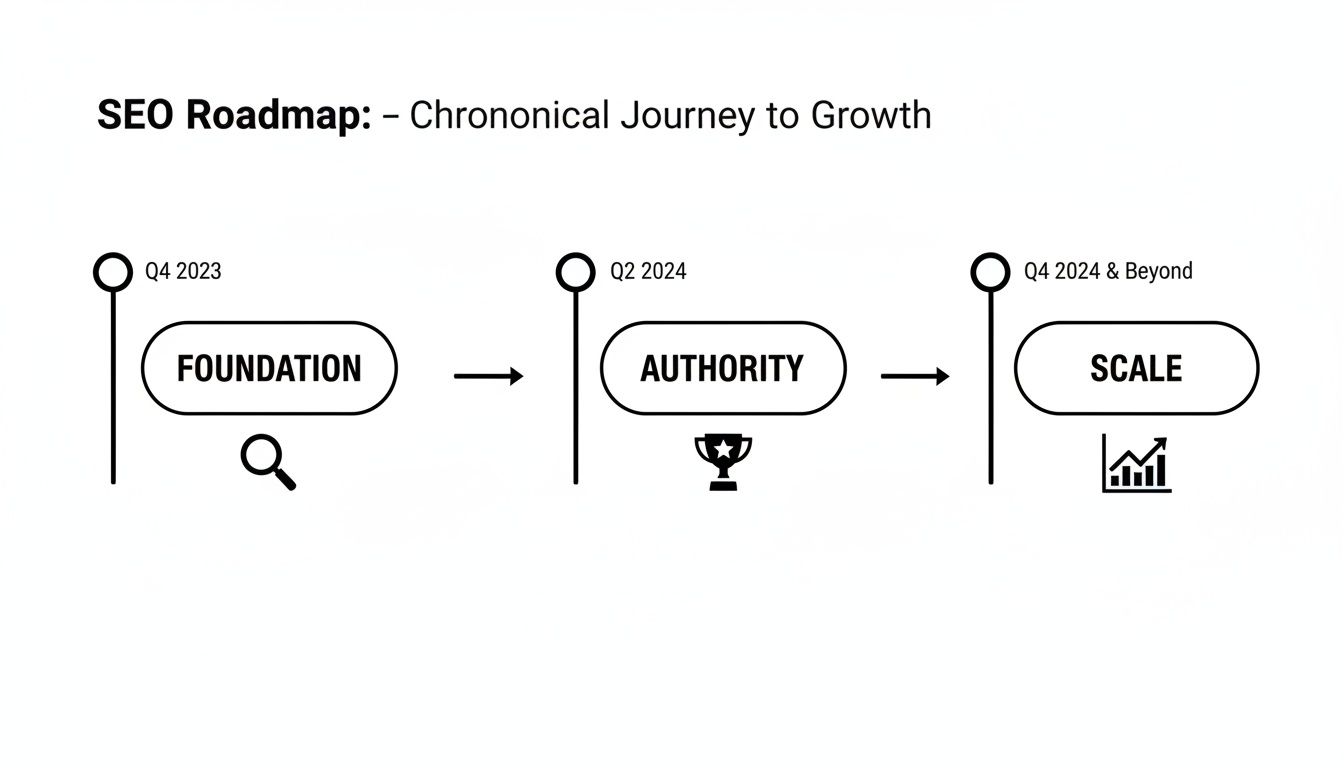
The key takeaway here is that SEO is a journey where each phase stacks on top of the last, creating compounding growth over time.
Phase 2: Content and Authority (Months 4-9)
With a solid technical base beneath you, it’s time to shift gears. This phase is all about creating genuinely valuable content and earning your website's authority. This is where you start to become a voice people listen to in your industry.
The goal here isn't just to churn out blog posts. It’s to create assets—pieces of content so insightful and helpful that other credible sites will want to link to them. That's how you build real authority in Google's eyes.
During these critical months, the focus sharpens on two main activities:
- Executing a Content Strategy: This means consistently publishing high-quality blog posts, in-depth guides, and other resources that solve your audience's biggest problems. A steady publishing cadence signals to search engines that your site is a living, breathing source of fresh information.
- Strategic Link Building: This is the active process of earning backlinks from reputable websites. High-quality links are like votes of confidence from around the web, and they remain one of the most powerful ranking signals.
Phase 3: Scaling and Optimization (Months 10+)
By now, you should be seeing a real, measurable flow of organic traffic. Phase three is about taking what's working and pouring gas on the fire. You'll lean on performance data to double down on your winners, go after more competitive keywords, and expand your footprint.
This is the rinse-and-repeat cycle of growth. You’ll analyze which articles are driving the most sign-ups, identify new clusters of keywords to target, and continuously fine-tune your technical SEO to stay ahead of the curve. This relentless process of analysis and improvement is what separates a good SEO campaign from a great one.
Tracking SEO Metrics That Actually Drive Business
In the startup world, what gets measured gets managed. But if you’re measuring the wrong things, you’re just spinning your wheels. Forget the dopamine hit from a spike in website visitors; for a startup, every single metric has to tie back to actual business growth.
This is where you need to get ruthless. Stop asking, "How much traffic did we get?" and start asking, "How much of that traffic turned into a real business opportunity?" That single change in perspective is what separates a startup that just does SEO from one that grows with it. It's the foundation for having meaningful conversations with your SEO services provider and proving the ROI of your investment.
Shifting from Vanity Metrics to Growth KPIs
It's tempting to get swept up in big, flashy numbers. A million visitors sounds incredible, right? But if none of them are your target customer, they're worth less than a hundred visitors who are ready to pull out their credit cards. The real goal is to track the data that tells a story about your business, not just your website's popularity.
So, what should be on your startup’s SEO dashboard?
-
Organic Keyword Rankings (for high-intent keywords): Don’t waste energy tracking every keyword under the sun. Zero in on the terms people search for when they are ready to solve a problem—your problem. Ranking for "what is our industry" is an ego boost, but ranking for "best [your product type] for small business" is what pays the bills.
-
Organic Conversion Rate: This is the ultimate truth-teller. It’s the percentage of visitors from Google who actually do what you want them to do—sign up for a trial, book a demo, or buy your product. A rising conversion rate is the clearest sign that your SEO is attracting the right people.
-
Customer Acquisition Cost (CAC) from Organic Search: How much does it really cost you to land a new customer through SEO? This can be a bit tricky to calculate at first, but it's the metric that demonstrates the long-term value and incredible efficiency of organic search compared to constantly feeding the paid ads machine.
A startup's SEO success isn't defined by traffic volume. It’s defined by the quality of that traffic and its ability to convert into revenue. Every report should answer one core question: "Did our organic presence bring us closer to a new customer?"
The Tools That Power Your Insights
Of course, tracking these KPIs requires the right gear. The global SEO software market—which is essential for any startup serious about SEO—was valued at USD 84.94 billion in 2025 and is projected to skyrocket to USD 265.91 billion by 2034. That explosive growth isn't random; it's fueled by businesses realizing they need hard data to win. You can discover more about this market surge.
For your startup, you don't need a dozen tools. Just lean on these three powerhouses:
-
Google Analytics 4 (GA4): You absolutely must set up conversion tracking from day one. This is non-negotiable. It’s how you’ll measure how many of your organic visitors become actual leads or paying customers.
-
Google Search Console: Think of this as your direct line to Google. It tells you exactly which keywords are driving clicks and impressions, helping you uncover hidden opportunities and track your real-world performance.
-
Ahrefs or Semrush: These paid platforms are the heavy lifters. They're invaluable for tracking specific keyword rankings, seeing what your competitors are up to, and keeping an eye on your backlink profile. They give you the deep-dive data needed to make smart, strategic moves.
By focusing on these business-centric metrics, you transform SEO from a murky marketing expense into a predictable, scalable engine for growth.
Answering Your Top SEO Questions
Even with a solid roadmap, you're going to have questions. Let's cut through the noise and give you direct, no-nonsense answers to the things startup founders ask us most. Think of this as your quick-reference guide for making smarter calls on organic growth.
How Long Does SEO Take for a New Startup?
For a brand-new website, you're realistically looking at six to twelve months before you see the first signs of meaningful results. I know, that can feel like an eternity in startup land, but it's important to understand what's actually happening during that time.
The first three to six months are all about laying the groundwork. This is when your SEO partner is busy with technical fixes, rolling out initial content, and starting to build trust with Google. You might see some small wins—a little traffic from super-specific, long-tail keywords—and that's a great sign things are moving in the right direction.
But the real, tangible impact on traffic and leads for your most important keywords usually starts to build in the second half of that first year. This is where your site's authority begins to compound. The key takeaway here is that patience and consistency aren't just nice-to-haves; they're absolute requirements for success.
SEO isn’t a magic button or a get-rich-quick scheme. If you're in a competitive space, truly owning your market can be a multi-year journey. The investment you're making now is building the momentum you’ll depend on for years to come.
Can We Do SEO In-House Instead of Hiring an Agency?
You can, but it's a massive undertaking for a lean startup. Doing SEO right requires a dedicated expert who is constantly up-to-date on technical optimization, content strategy, and link building. Frankly, that's a rare and expensive combination of skills to find in one person.
Hiring SEO services for startups gives you immediate access to a full team of specialists. You also get the benefit of their professional-grade tools—which can easily cost thousands a month on their own—and their proven systems for getting results. This frees up your internal team to focus on what they do best: building your product and talking to your customers.
For many, a hybrid approach works best:
- Let an agency handle the heavy lifting: complex technical strategy, deep keyword research, and authority-building campaigns.
- Have your in-house team focus on creating that authentic, expert-level content that only you can—the stuff that truly shows off your unique value.
Is SEO Better Than Paid Ads for a Startup?
This isn't an "either/or" situation. They're different tools for different jobs, and they're most powerful when they work together.
Paid ads (like Google Ads) get you traffic right now. They're fantastic for testing messaging, validating an offer, or making a splash with a product launch. The catch? The moment you turn off the spend, the traffic disappears. It's like renting an audience.
SEO, on the other hand, is about building a long-term, compounding asset. Every piece of content you publish and every backlink you earn adds to a foundation that generates "free" traffic over time. This organic traffic is also generally more trusted by users, which often leads to higher conversion rates. The winning play is to use paid ads for that initial traction while you're also investing in an SEO foundation that will eventually become your most cost-effective and reliable growth engine.
Ready to build a powerful, long-term growth engine for your startup? At Sugar Pixels, we specialize in creating comprehensive SEO strategies that deliver real business results. Let's talk about scaling your online presence.