

Promoting your brand on Twitter isn't just about scheduling a few tweets and hoping for the best. It's a game of building a real community, crafting content that actually adds value, and jumping into conversations to hit your business goals. The real magic happens when you find that sweet spot between authentic interaction and smart, targeted promotion.
Your Framework for Real Twitter Growth
Let's cut through the generic advice. This guide is your hands-on playbook for getting tangible results on Twitter. We're going to move beyond basic posting and get into the nitty-gritty of building a profile that actually converts, creating content that people want to share, and engaging in a way that builds a genuinely loyal following. This framework gives you a clear roadmap, starting with the foundational work of making a killer first impression before diving into the art of content and community.
Before we jump in, it helps to understand the field you're playing on. Here are some quick, essential numbers to keep in mind.
Key Twitter Promotion Metrics at a Glance
This table breaks down the core statistics you need to know before you even think about building your Twitter promotion strategy. It covers the user base, engagement benchmarks, and what you can expect from advertising.
| Metric | Statistic | Why It Matters for Your Strategy |
|---|---|---|
| Monthly Active Users | 415.3 million (as of 2025) | Your potential audience is massive, but you need a sharp strategy to cut through the noise and reach the right people. |
| Potential Ad Reach | Over 586 million | Paid campaigns can significantly amplify your message, reaching far beyond your organic followers. |
| Median Engagement Rate | 0.015% | This is the baseline. If you're hitting this, you're average. The goal is to consistently beat it. |
| Top 25% Engagement Rate | 0.08% | This is your target. Getting here means your content is resonating, representing a 433% improvement over the median. |
Seeing these numbers, it's clear that simply being on the platform isn't enough. The difference between the median and top performers is huge, and it all comes down to strategy. For a deeper dive, you can explore more Twitter statistics and performance benchmarks.
Setting the Stage for Success
Before you can even think about promoting your brand or product effectively, you need to lay a solid foundation. This is about knowing why you're posting, not just what you're posting. A clear strategy is what connects your daily Twitter activity back to your bigger business objectives, making sure every tweet, reply, and campaign serves a purpose.
Your first steps should be all about clarity:
- Define Your Goals. What are you actually trying to achieve? Is it brand awareness? Lead generation? Driving traffic to your latest blog post? Your goals will shape every content and engagement decision you make.
- Know Your Audience. Who are you talking to? What do they care about? What keeps them up at night? Use these insights to craft a brand voice and content pillars that truly connect.
- Nail Your Profile. Your profile is your digital handshake. A sharp, optimized bio, a compelling header image, and a strategic pinned tweet can be the difference between a visitor who bounces and one who clicks "Follow."
Treat Twitter like a dynamic conversation hub, not a one-way broadcast channel. This mindset shift is what turns you from someone pushing messages to a brand that pulls in an engaged, loyal audience.
This approach is a cornerstone of any solid digital marketing plan. If you're looking to build a strong base, learning how to gain Twitter following with sustainable tactics is a great next step. We also cover how Twitter fits into the broader marketing ecosystem in our guide on creating a sample digital marketing strategy.
Optimizing Your Profile for Maximum Impact
Before you even think about crafting that first promotional tweet, let's talk about your home base: your Twitter profile. Too many people treat it as an afterthought, but it's your digital storefront. If it’s messy, vague, or looks unprofessional, potential followers will scroll right on by.
Think of it this way: a sharp, optimized profile is your best salesperson, working around the clock to build credibility and guide visitors exactly where you want them to go. The numbers back this up—a solid 47% of people who land on a Twitter profile click the website link in the bio. That's not just branding; that's a direct line to traffic and sales.
Craft a Bio That Sells
You get 160 characters. That's it. This tiny space has to pull a lot of weight, explaining who you are, what you do, and why anyone should bother following you. Forget the corporate jargon or fluffy mission statements. Your bio needs to be a short, punchy pitch that grabs attention immediately.
A killer bio answers three simple questions:
- Who do you help? (e.g., "SaaS founders," "indie authors," "busy parents")
- How do you help them? (e.g., "with no-fluff marketing advice," "by sharing productivity hacks")
- What should they do next? (e.g., "Get my free template 👇," "Subscribe to my newsletter")
For instance, "Digital marketing services" is forgettable. But "We help e-commerce brands double their revenue with targeted SEO & PPC. Let's talk growth." is specific, benefit-driven, and speaks directly to the right person. Sprinkle in a relevant keyword, like "content marketing" or "startup growth," so you show up in searches.
Choose Visuals That Build Trust
We process images in a fraction of a second, which means your profile picture and header are your first handshake. This is no place for generic stock photos or a blurry logo.
- Profile Picture: If it's a personal brand, use a high-quality, professional headshot where you look approachable. For a company, it’s your logo, crisp and clear. The real pro-move is to use the same picture across all your social media to create instant brand recognition.
- Header Image: This is valuable real estate, not just decoration. Use it to show off your brand's personality, promote your latest product, feature social proof (like an "As Seen On" banner), or even include a call to action with an arrow pointing to your bio link.
Your profile visuals are a silent testament to your credibility. A pixelated logo or a poorly-lit headshot can make someone question your professionalism before they've even read a single tweet.
Master the Pinned Tweet
The pinned tweet is your secret weapon. It’s the very first post anyone sees on your profile, and most people are completely wasting it by pinning something random. This isn't just for your latest blog post; it's a strategic billboard.
Use your pinned tweet to spotlight your most valuable content—the stuff that directly supports your business goals.
Ideas for a High-Impact Pinned Tweet:
- A glowing customer testimonial: Nothing sells like social proof. Pin a screenshot of a happy client’s review.
- Your best lead magnet: Offer a free checklist, ebook, or webinar to capture emails right from your profile.
- Your most popular thread: Show off your expertise and give new visitors a ton of value right away.
- A quick intro video: A short, personal video can build a connection much faster than text alone.
When you treat your profile as a strategic landing page, every visitor has a clear, compelling reason to stick around. Nailing this foundation makes every other promotional effort you undertake on Twitter ten times more effective.
Creating Content That Connects and Converts
Your Twitter profile is your digital handshake, but it’s your content that really starts the conversation. If you want your promotion efforts to land, you have to create posts people actually want to read, share, and act on. It’s all about moving past random updates and building a content engine that people look forward to.
The platform is incredibly noisy. With X (formerly Twitter) handling over 500 million tweets a day, just showing up is not a strategy. You need to cut through that noise. The goal is to hit an engagement rate of 0.5–1%, which is a solid benchmark well above the average. You can find more data on how brands are succeeding on X at Sproutsocial.com. A smart, deliberate content strategy is what gets you there.

Developing Your Unique Brand Voice
Your brand voice is your personality—it's what makes your tweets instantly yours. Think about it: are you witty and informal like Wendy's, or are you more educational and authoritative like HubSpot? A consistent voice builds familiarity and trust, making your followers feel like they know who's behind the account.
Not sure where to start? Ask yourself these questions:
- Who am I talking to? You wouldn't talk to a tech founder the same way you'd talk to a craft blogger. Speak their language.
- What's my brand's personality? If your brand was a person, would they be a helpful mentor, a funny friend, or a serious expert?
- What's my mission? Let your purpose shine through. It’s the secret ingredient to authentic-sounding content.
Once you have a good handle on your voice, stick with it. Consistency is what cements your brand identity in people's minds.
Balancing Value and Promotion
One of the quickest ways to get unfollowed is to treat your feed like a non-stop commercial. People log onto Twitter for information, entertainment, and connection—not to be pitched in every single post.
A great rule of thumb here is the 80/20 principle.
Basically, 80% of your content should be genuinely valuable to your audience. This could be anything from helpful tips, industry news, insightful threads, and curated articles to entertaining memes. The other 20% can be promotional, where you directly plug your product, service, or latest offer.
This approach builds a ton of goodwill and positions you as an expert. Then, when you do post something promotional, your audience is way more likely to listen because you've already earned their trust.
"Think of your Twitter feed as a bank account. You have to make consistent deposits of value before you can make a withdrawal with a promotional ask. Without those deposits, you'll overdraw your audience's trust."
Choosing the Right Content Formats
Twitter isn't just about 280-character text blurbs anymore. Mixing up your content formats is key to keeping your feed fresh and appealing to different people. Some users love video, others live for in-depth threads. Catering to these preferences is a huge part of promoting effectively on Twitter.
Let's look at how different content types stack up.
Twitter Content Type Performance Comparison
Choosing the right format can make or break a post. This table breaks down what to use, when to use it, and how to get the most out of it.
| Content Type | Best For | Key Engagement Tactic | Example Use Case |
|---|---|---|---|
| Threads | Deep dives, storytelling, and tutorials | Start with a strong hook and number each tweet. End with a summary and a clear call to action. | Breaking down a complex topic from your latest blog post into a 7-tweet educational thread. |
| Single Tweets | Quick tips, questions, and timely comments | Use strong visuals (images or GIFs) and ask engaging questions to spark replies. | Posting a quick marketing tip with a relevant GIF to catch your followers' attention mid-day. |
| Polls | Audience research and generating quick interaction | Ask simple, compelling questions with clear options. Share and analyze the results in a follow-up tweet. | Polling your audience on which new feature they'd like to see next in your software. |
| Video | Demonstrations, behind-the-scenes content, and personal messages | Keep it short (under 60 seconds works best). Add captions, as many users watch with the sound off. | A 30-second screen recording showing a cool shortcut in your app. |
By rotating these formats, you give your audience more ways to engage with your brand and keep your feed from feeling stale. Of course, managing all of this can get chaotic without a plan. That's why it's so helpful to understand how to create a content calendar. It helps you organize your posts, ensure a balanced content mix, and make your promotional efforts feel much more natural and effective.
Building a Community People Actually Want to Join
Let's be honest: effective Twitter promotion is a conversation, not a broadcast. You've dialed in your profile and have a solid content plan, but now comes the real work—turning your account from a simple megaphone into a place where people actually want to hang out. This is how you stop chasing followers and start building a loyal community that does the heavy lifting for you.
True community isn't about sitting back and waiting for mentions to roll in. It's about proactively jumping into the conversations already happening in your niche. This is where you prove you're not just another brand with something to sell, but a genuine contributor to the space.
Don't Just Reply, Start Conversations
Responding to your mentions is table stakes. That’s the bare minimum. The real magic happens when you become an active participant in the wider conversation. The best way to do this is to get comfortable with Twitter's search function and find discussions where you can genuinely add value.
Get started by tracking keywords and phrases relevant to your field. For instance, if you run project management software, you might set up alerts for terms like "drowning in tasks" or "best team collaboration tools." When you see a tweet like that, you don't jump in with a sales pitch. You offer a helpful tip or a piece of advice. This small act immediately frames you as a helpful expert, not a pushy salesperson.
Think of it like this: a reply to a mention is like saying "thanks for coming in" when someone visits your shop. Proactive engagement is like walking into the town square, finding someone struggling, and offering a hand. One gets you a customer; the other builds a reputation.
This "active listening" approach does more than just boost your visibility; it gives you a real-time, unfiltered look at the exact problems and language your audience uses every single day.
Tame the Chaos with Twitter Lists
Your main Twitter feed is a firehose of information. It's almost impossible to keep up with the important conversations, and it's easy to get distracted. This is where Twitter Lists come in—they are, without a doubt, one of the most powerful and underused features on the platform.
Instead of trying to follow everything at once, you can create private lists that segment your feed into manageable streams.
- Industry Peers & Leaders: A list to keep tabs on what the top voices in your space are talking about. This is a goldmine for spotting trends and finding high-value conversations to join.
- Potential Customers: Add accounts that match your ideal customer profile. A little bit of thoughtful engagement with their content goes a long way in building familiarity.
- Your Champions: This is a VIP list for your biggest fans—the people who are always liking, sharing, and commenting. Nurturing these relationships is absolutely crucial for your long-term organic reach.
By checking these curated feeds daily, you can focus your time and energy on the interactions that matter most, making your efforts far more strategic and effective.
Spark Engagement with Polls and Q&As
If you want to get people talking, you have to give them something to talk about. Interactive content like polls and Q&A sessions are fantastic for this. They don't just boost your numbers; they make your followers feel like they're part of the conversation.
A smart poll can give you direct insight into what your audience is thinking. Instead of just posting content and hoping it lands, you can ask them what they want to see next. You can use polls for quick market research, content brainstorming, or even just to start a fun, lighthearted debate. We know that tweets with visuals get 150% more engagement, and while a poll isn't a picture, it serves a similar purpose by breaking up the feed and demanding a simple click.
Hosting a dedicated Q&A session is another great way to invite direct interaction and position yourself as an accessible expert. These formats are less about the metrics and more about showing you actually care what your community thinks. That, right there, is the foundation of real loyalty.
Amplifying Your Reach with Twitter Ads
Organic growth is the backbone of any solid Twitter strategy, but let's be real—sometimes you need to give it a serious push. When you have a time-sensitive offer, need to drive traffic right now, or want to guarantee your message hits a specific group of people, paid ads are your best friend. This isn't about ditching your organic efforts; it's about pouring gasoline on the fire you've already started.
Think of Twitter Ads as a direct line to your ideal customer. Instead of crossing your fingers and hoping the algorithm shows your tweet to the right people, you get to place your best content right in their feed. It’s a controlled, scalable way to turn your Twitter presence from a simple community hub into a powerful lead-generation machine.
To get the most bang for your buck, you need to know how to promote a tweet in a way that blends the best of both worlds. Paid promotion lets you slice through the noise and target users with incredible precision.
Aligning Ad Objectives with Business Goals
Before you spend a single dollar, you have to define what success actually looks like for you. Twitter's ad platform forces you to choose an objective upfront for a good reason—it completely changes how your campaign is delivered and optimized. Picking the right one is absolutely critical to getting a good return.
Don't just guess. Tie your ad objective directly to a real business goal:
- Awareness: The goal here is pure exposure. If you're a new brand or launching a new product, this option prioritizes getting your ad in front of the maximum number of eyeballs.
- Website Clicks: This is your workhorse for driving traffic. Choose this when you want to send people to a blog post, a new product page, or a specific landing page. Twitter's algorithm will find the "clicky" people in your audience.
- Engagement: Got a tweet that's already doing well organically? Use this objective to pour fuel on it. It’s fantastic for racking up retweets, likes, and replies, which builds powerful social proof.
- Followers: If your main KPI is growing your audience, this one is a no-brainer. It promotes your account to relevant users to help you gain followers faster.
- Lead Generation: This one is a gem. It allows you to collect email addresses with Twitter’s built-in Lead Generation Cards, making it incredibly easy for users to subscribe without ever leaving the platform.
Paid ads can dramatically speed up the entire community-building process at every single stage.
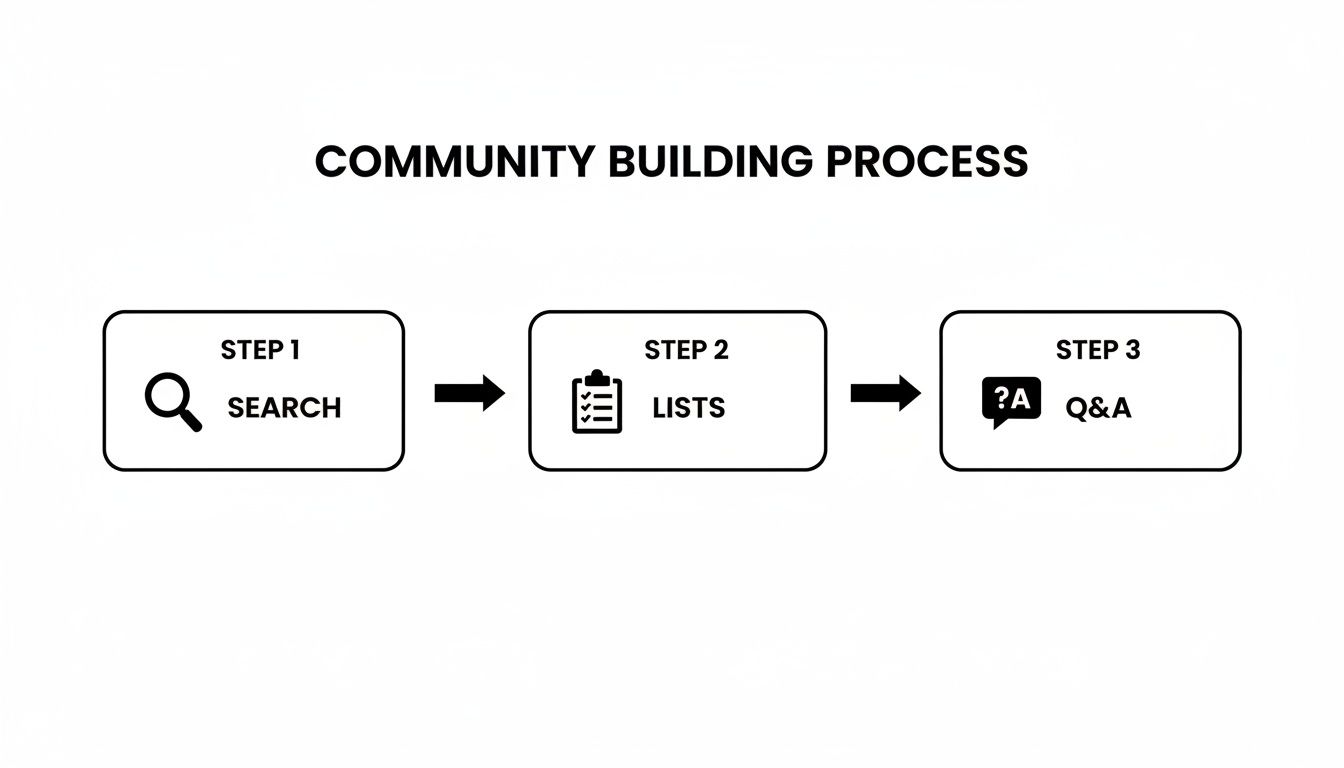
You can use ads to find people through keyword searches, engage them with valuable content, and quickly pull them into your orbit.
Laser-Targeting Your Ideal Audience
The real magic of Twitter Ads is in the targeting. You can go way beyond basic demographics and get hyper-specific, reaching people based on their actual behaviors and stated interests.
Here are a few of my favorite targeting options:
- Keyword Targeting: This lets you find people who have recently tweeted or searched for specific terms. For a coffee company, this could mean targeting anyone who mentions "pour-over" or "espresso machine." It’s incredibly direct.
- Follower Look-alikes: This is a total game-changer. You can tell Twitter to target users who are similar to the followers of another account—including your direct competitors.
- Conversation Targeting: This is perfect for tapping into real-time trends. You can show your ads to people engaging with tweets about a specific topic, like a big industry conference or a viral news story.
The platform's ad potential is huge, with projections showing 16.5% global growth in 2025. And you don't need a massive budget to get started. For small businesses, a typical monthly ad spend is a very manageable $101–$500, with the average cost per action sitting between $0.26 and $1.50.
Measuring and Optimizing for ROI
Launching your campaign is just the beginning. The real work—and the real success—comes from watching your results like a hawk and constantly tweaking your approach. Please, don't just "set it and forget it."
Treat your first ad campaign as a data-gathering mission, not a final exam. Your goal is to learn what resonates with your audience—which ad creative, headline, and targeting option works best—so you can double down on what’s effective and cut what isn't.
Keep a close eye on these core metrics in your Twitter Ads dashboard:
| Metric | What It Measures | Why It's Important |
|---|---|---|
| Cost Per Result (CPR) | How much you're paying for each desired action (e.g., a click, a follow, a lead). | This is your bottom-line efficiency metric. Your goal is always to get this number as low as possible. |
| Click-Through Rate (CTR) | The percentage of people who saw your ad and actually clicked on it. | A high CTR is a strong signal that your ad creative and copy are hitting the mark with your audience. |
| Conversion Rate | The percentage of users who took action on your website after clicking the ad. | This is the money metric. It connects your ad spend directly to tangible business results like sales or sign-ups. |
By checking these numbers regularly, you can A/B test different ad components to methodically improve your results over time. For a deeper dive into paid strategies, check out this guide on how to advertise your business on social media. This disciplined approach is what turns advertising from a gamble into a predictable growth engine.
Answering Your Top Twitter Promotion Questions
As you dive deeper into promoting your brand on Twitter, you'll inevitably run into some common questions. I've heard them all over the years. Getting straight answers is the fastest way to build momentum, so let's clear up some of the most frequent sticking points.
How Many Times a Day Should I Be Posting?
This is easily one of the most-asked questions, and the honest answer is: there's no single magic number. The right posting frequency really comes down to your industry, your audience, and what your team can realistically manage.
That said, most brands find their sweet spot somewhere between 1 to 5 times per day. The real goal isn't hitting an arbitrary number; it's about making sure every single tweet you send out is valuable. Spamming your followers' feeds with fluff is a quick way to get muted.
My advice? Start with 1-2 high-quality posts daily. See how your audience responds. Are you getting good engagement? Do you have more great content in the pipeline? If so, you can slowly ramp it up. Use your Twitter Analytics to find out when your followers are online and schedule your posts to hit those peak hours for maximum impact.
Remember, one deeply insightful thread or a well-produced video can be exponentially more effective than ten generic promotional tweets. Focus on impact, not just output.
What Are the Most Common Mistakes I Should Avoid?
Knowing what not to do is just as important as knowing what to do. I’ve seen countless brands stumble by making a few classic mistakes. Steering clear of these pitfalls will put you way ahead of the curve.
Here are the biggest errors I see people make:
- All promotion, no conversation. If your feed is just a running advertisement for your product, people will tune you out. A good rule of thumb is the 80/20 principle: 80% of your content should give value (tips, insights, entertainment), and only 20% should be a direct sales pitch.
- Ignoring your mentions and DMs. Twitter is a social network, not a megaphone. When people talk to you, talk back! Ignoring your community makes your brand seem aloof and uncaring.
- Going overboard with hashtags. Stuffing your tweet with a dozen hashtags looks spammy and amateurish. Stick to 2-3 highly relevant hashtags to help with discovery without cluttering the message.
- Running a sloppy profile. Your bio, header image, and pinned tweet are your storefront. An incomplete or unprofessional-looking profile tells visitors you don't take the platform seriously.
- Buying followers. This is the ultimate vanity metric and a huge red flag. Fake followers provide zero engagement, crush your credibility, and can even get your account penalized. Just don't do it.
How Do I Actually Measure the ROI of My Twitter Efforts?
Measuring the return on your investment from Twitter means looking beyond likes and retweets. You have to connect your activity on the platform back to real business results.
First, you need to be crystal clear about your goals.
- Want brand awareness? Track your impressions, reach, and follower growth. This tells you how many eyeballs you're reaching.
- Focused on engagement? Keep an eye on your likes, retweets, replies, and overall engagement rate. This shows if your content is actually hitting the mark.
- Need leads or sales? This is where you track conversions. It’s the metric that really matters to the bottom line.
To get this right, you absolutely have to use UTM parameters in the links you share. This little bit of code added to your URLs lets you see in Google Analytics exactly how much traffic, how many leads, and how much revenue came directly from Twitter. For your paid campaigns, the Twitter Ads dashboard makes this even easier, showing you your Cost Per Result (CPR), Conversion Rate, and Return On Ad Spend (ROAS).
Should I Focus on Organic Growth or Run Paid Ads?
The organic vs. paid debate is a false choice. The most powerful Twitter strategies don't pick one over the other—they use both, and they make them work together.
Think of organic growth as your foundation. It's how you build an authentic community, earn trust, and create a real presence that lasts. When you consistently share great content and genuinely engage with people, you build a loyal following that will spread your message for free. This is your long-term asset.
Paid ads are the accelerator. They're the tool you use to hit the gas. With ads, you can:
- Instantly reach a perfectly targeted audience.
- Amplify your best-performing organic content to a much wider group of people.
- Drive a surge of traffic and conversions for a specific launch or promotion.
Here’s the game plan: Start by building a solid organic presence. Figure out what your audience loves. Once you have a proven piece of content, use paid ads to pour fuel on the fire and get it in front of thousands more potential customers.
Ready to turn these insights into a powerful online presence? Sugar Pixels specializes in creating custom websites and executing digital marketing strategies that drive real growth. Whether you're a startup, a growing e-commerce brand, or a personal brand looking to scale, we have a solution for you. Learn more and start building your digital future at https://www.sugarpixels.com.