

In the competitive online arena, simply running ads is a fast track to a depleted budget. True success requires a sophisticated, multi-channel approach grounded in data. With countless platforms and tactics available, knowing where to focus your efforts is the primary challenge. From capturing high-intent searchers on Google to building brand loyalty on social media and optimizing every click for maximum return on ad spend (ROAS), the right PPC advertising strategies are what separate stagnant campaigns from exponential growth engines. This guide is designed to be your definitive playbook, a comprehensive resource that moves far beyond surface-level advice.
We will deconstruct ten proven, actionable strategies that startups, small and growing businesses, and e-commerce entrepreneurs can implement immediately to drive targeted traffic, generate qualified leads, and scale revenue profitably. Forget generic tips; this is a deep dive into the specific tactics that deliver results. We'll cover everything from advanced keyword bidding and social media ad sequencing to shopping feed optimization and account-based marketing for B2B.
Each section provides detailed implementation steps, expert insights, and practical examples to help you build and refine a powerful advertising machine tailored to your unique goals. Whether you're looking to master Google Ads, leverage video on YouTube, or build a high-converting landing page, the strategies outlined here will provide a clear roadmap. Let’s explore the playbooks that will define your digital advertising success and unlock sustainable growth for your business.
1. Search Engine Marketing (SEM) with Google Ads
Search Engine Marketing (SEM) is the cornerstone of many successful PPC advertising strategies. It involves placing paid advertisements on search engine results pages (SERPs) through platforms like Google Ads. Businesses bid on specific keywords relevant to their products or services, and their ads appear when users search for those terms. This strategy is exceptionally powerful for capturing high-intent traffic, as it targets individuals actively looking for a solution you provide.
The primary benefit of SEM is its immediacy. Unlike organic SEO, which can take months to yield results, a well-structured Google Ads campaign can start driving qualified traffic to your website or landing page within hours of launch. This makes it an indispensable tool for businesses aiming for rapid growth, product launches, or lead generation.

Why It's a Foundational Strategy
SEM is fundamental because it directly connects your business with prospects at the exact moment of their need. A SaaS company can bid on "project management software for small teams" to reach decision-makers, while a local plumber can target "emergency pipe repair near me" to capture urgent local leads. This direct-response nature delivers a measurable and often immediate return on investment.
Actionable Tips for Implementation
To maximize your SEM efforts, focus on precision and optimization from the outset.
- Start with Long-Tail Keywords: Instead of bidding on a broad, expensive term like "running shoes," target a more specific, lower-competition phrase like "men's trail running shoes for wide feet." This attracts more qualified buyers and often comes with a lower cost-per-click (CPC).
- Implement Negative Keywords: Actively build a list of negative keywords to prevent your ads from showing for irrelevant searches. For example, a premium software brand might add "free" and "cheap" to its negative list to filter out users not willing to pay.
- Leverage Ad Extensions: Enhance your ads with extensions like Sitelinks, Callouts, and Structured Snippets. These provide additional information, increase your ad's visibility on the SERP, and can significantly improve your click-through rate (CTR).
- Prioritize Conversion Tracking: Before spending a single dollar, ensure conversion tracking is correctly installed. This is the only way to accurately measure campaign performance and make data-driven decisions to optimize your ad spend.
2. Display Advertising and Retargeting
Display advertising expands your reach beyond search results, placing visual ads like banners, images, and videos across millions of websites in networks like the Google Display Network. While search ads capture intent, display ads generate it. This approach is excellent for building brand awareness and reaching potential customers early in their buying journey.
The most potent form of display advertising is retargeting (or remarketing). This tactic specifically targets users who have previously visited your website but did not convert. By showing them relevant ads as they browse other sites, you keep your brand top-of-mind, encouraging them to return and complete their purchase or inquiry. It's one of the most efficient PPC advertising strategies for recovering "lost" traffic.
Why It's a Foundational Strategy
Display and retargeting are fundamental for creating a full-funnel marketing approach. While SEM captures active demand, display advertising builds that demand and re-engages interested prospects. For an e-commerce store, this means showing the exact pair of shoes a user viewed but didn't buy. For a SaaS company, it means staying in front of a decision-maker who downloaded a whitepaper but hasn't yet signed up for a demo.
Actionable Tips for Implementation
Success with display and retargeting hinges on audience segmentation and creative testing.
- Segment Your Audiences by Behavior: Don't treat all website visitors the same. Create separate retargeting lists for different actions, such as "homepage visitors," "product page viewers," and "cart abandoners." Tailor your ad creative and bids to each segment's level of intent.
- Use Dynamic Retargeting for E-commerce: Connect your product feed to your display campaigns to show users ads featuring the specific products they viewed. This highly personalized approach dramatically increases relevance and conversion rates for abandoned carts.
- Implement Frequency Capping: To avoid annoying potential customers and wasting your budget, set a frequency cap. This limits the number of times a single user will see your ad within a specific period (e.g., no more than 5 impressions per day).
- Refresh Your Ad Creatives Regularly: Ad fatigue is real. Users will start ignoring your ads if they see the same visuals repeatedly. Create 3-5 different ad variations and rotate them to keep your campaigns fresh and engaging.
3. Social Media Advertising (Facebook, Instagram, LinkedIn, TikTok)
While search ads capture existing demand, social media advertising excels at creating it. This PPC strategy involves placing paid ads on platforms like Facebook, Instagram, LinkedIn, and TikTok, leveraging their sophisticated targeting to reach users based on demographics, interests, behaviors, and connections. These platforms are inherently visual, making them ideal for engaging audiences with compelling images, carousels, and video-first formats.
The core advantage of social media PPC is its ability to connect with potential customers earlier in their journey, building brand awareness and nurturing interest before they even begin searching. It allows businesses to find and engage their ideal audience proactively, rather than waiting for the audience to find them. This makes it a crucial component of a comprehensive set of ppc advertising strategies.
Why It's a Foundational Strategy
Social media advertising is fundamental for demand generation and full-funnel marketing. A fashion brand can use Instagram Shopping ads to drive direct sales from visually-driven content, while a B2B SaaS company can target specific job titles on LinkedIn to generate high-quality leads. For those specifically focusing on platforms like Facebook, Instagram, LinkedIn, and TikTok, understanding ten powerful social media advertising strategies can provide a significant competitive edge. This strategy builds an audience that can be retargeted later, creating a sustainable marketing ecosystem.
Actionable Tips for Implementation
To get the most from your social media ad spend, focus on audience alignment and creative testing.
- Create Platform-Specific Creative: Tailor your ads to each platform’s native experience. Use vertical videos for TikTok and Instagram Reels, high-quality images for the Instagram feed, and professional carousels or documents for LinkedIn.
- Use Lookalike Audiences: Once you have a list of your best customers or website converters, upload it to create a lookalike audience. This tells the platform to find new users who share similar characteristics, dramatically improving targeting efficiency.
- Implement Conversion Pixels: Before launching, install the Meta Pixel, LinkedIn Insight Tag, or TikTok Pixel. This tracking code is essential for measuring conversions, optimizing campaigns for specific actions, and building retargeting audiences. For more tips, learn how to boost your social media engagement.
- Test with Small Daily Budgets: Start with a modest daily budget to test different audiences, creatives, and offers. Once you identify winning combinations with a positive return on ad spend (ROAS), you can confidently scale your budget.
4. Shopping Feed Optimization and Google Shopping Ads
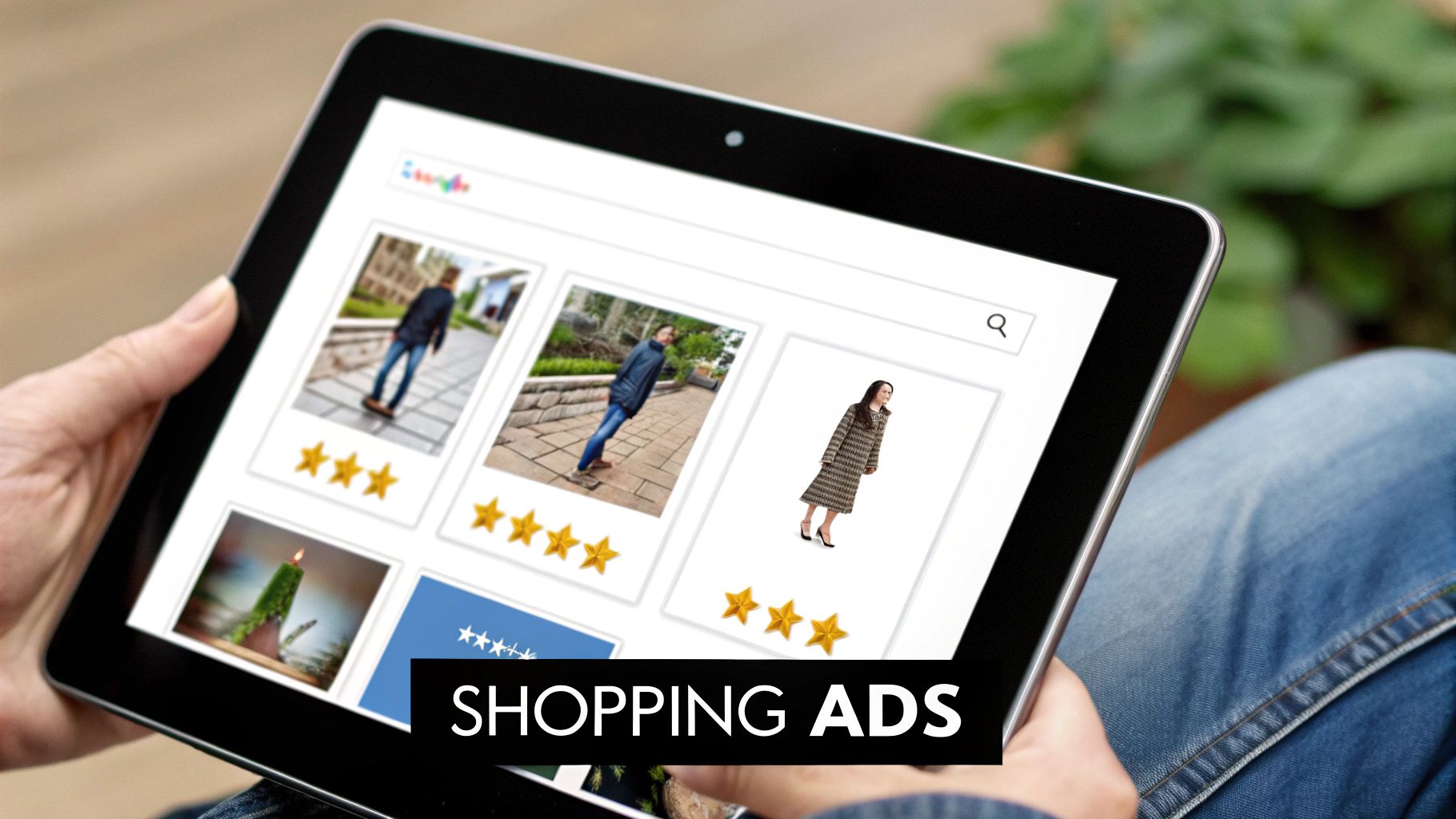
For e-commerce businesses, Google Shopping ads are a non-negotiable component of a robust PPC advertising strategy. These visually engaging ads display your product images, prices, and store name directly on the search results page. They pull data from a product feed you submit to Google Merchant Center, allowing you to capture high-intent buyers searching for specific items.
This strategy is exceptionally powerful because it pre-qualifies traffic. Shoppers see the product and its price before they even click, leading to higher conversion rates and a better return on ad spend (ROAS) compared to standard text ads. It's a direct path from product discovery to purchase.
Why It's a Foundational Strategy
Shopping ads are foundational for retail because they dominate the most valuable real estate on the SERP for commercial queries. Whether a Shopify store wants to showcase its new apparel line or an established retailer is promoting seasonal inventory, these ads provide a direct, visual connection with consumers ready to buy. The quality of your product feed directly dictates your campaign's success.
Actionable Tips for Implementation
Optimizing your shopping feed is the single most important lever for improving Google Shopping performance.
- Enrich Product Titles: Your product title is your most critical feed attribute. Instead of "Men's Shirt," use a descriptive title like "Brand Name Men's Slim-Fit Oxford Shirt – Size M – Light Blue." This helps Google match your product to more specific, high-intent searches. You can learn more about writing effective product descriptions to further enhance your listings.
- Use High-Quality Images: Your main product image is the first thing a user sees. Use a high-resolution image with a clean, white background that clearly showcases the product. Test different lifestyle and product-only images to see what drives the highest click-through rate.
- Implement Custom Labels: Use custom labels in your feed to segment products for bidding. You can create labels based on profit margin, seasonality, sale items, or best-sellers (e.g., "high-margin," "summer-promo"). This allows you to set more aggressive bids on your most valuable products.
- Monitor Feed Health Daily: Log in to your Google Merchant Center account regularly to check for feed errors and warnings under the "Diagnostics" tab. Disapproved products won't serve in ads, so fixing these issues immediately is crucial for maintaining visibility and sales volume.
5. Keyword Research and Bid Strategy Optimization
Strategic keyword research and intelligent bidding are the foundational pillars of profitable PPC advertising strategies. This process involves identifying high-value keywords with strong conversion potential, understanding user search intent, and implementing automated or manual bid strategies to maximize return on investment (ROI). It’s about being present for the right searches and paying the right price for each click.
Effective execution here ensures your ad spend is directed toward terms that drive business outcomes, not just website traffic. By aligning your keywords with what your ideal customers are actively searching for, you create a direct path from their problem to your solution, making every dollar work harder.
Why It's a Foundational Strategy
This strategy is fundamental because it directly controls both the relevance and profitability of your campaigns. Choosing the wrong keywords means showing your ads to an uninterested audience, wasting your budget. An e-commerce site targeting high-margin product keywords or a SaaS company bidding on specific solution-based terms can dramatically improve profitability by focusing on the most valuable segments of their market.
Actionable Tips for Implementation
To maximize your keyword and bidding efforts, approach them with a structured and data-informed mindset.
- Separate Keywords by Search Intent: Group keywords into themes like informational ("how to fix a leaky faucet"), commercial ("best plumbers reviews"), and transactional ("emergency plumber near me"). This allows you to tailor your ad copy and landing pages to match the user's stage in the buying journey.
- Analyze Competitor Keywords: Use tools like SEMrush or Ahrefs to discover which keywords your competitors are successfully bidding on. This can reveal valuable opportunities you may have missed and provide insights into their campaign strategies.
- Leverage Smart Bidding Strategies: Once you have sufficient conversion data, use Google's automated bidding strategies like Target CPA (Cost Per Acquisition) or Target ROAS (Return on Ad Spend). These algorithms use machine learning to optimize bids for conversions in real-time.
- Create Tightly Themed Ad Groups: Don't put hundreds of keywords into one ad group. Instead, create small, tightly themed groups of closely related keywords (e.g., one group for "men's trail running shoes" and another for "women's road running shoes"). This improves your Quality Score and ad relevance.
6. Landing Page Optimization and Conversion Rate Optimization (CRO)
Driving traffic through PPC ads is only half the battle; converting that traffic into customers is where you see the real return. Landing page optimization and Conversion Rate Optimization (CRO) is a critical PPC advertising strategy focused on refining the post-click experience. It involves systematically testing and improving elements on your destination page, such as headlines, calls-to-action (CTAs), and page layout, to maximize the percentage of visitors who complete your desired action.
This process transforms your ad spend from an expense into a high-yield investment. A small increase in your conversion rate, from 1% to 2%, effectively doubles your ROI without spending a penny more on ads. To truly maximize your investment in platforms like Meta or Google Ads, focusing on building High-Converting Ecommerce Landing Pages that drive profit is absolutely essential.
Why It's a Foundational Strategy
CRO is foundational because it directly impacts your campaign’s profitability and scalability. By improving the efficiency of your landing pages, you lower your cost-per-acquisition (CPA), allowing you to acquire more customers for the same budget or bid more competitively for top ad placements. A SaaS company can A/B test its signup form fields to increase free trial signups, while an e-commerce store can test product image arrangements to boost "add to cart" clicks, making every ad dollar work harder. Learn more about what a landing page is and how to build one.
Actionable Tips for Implementation
To implement CRO effectively, adopt a methodical, data-driven approach to testing.
- Align Ad Copy with Landing Page: Ensure your landing page headline and content directly reflect the promise made in your ad copy. This message match reassures visitors they've come to the right place, reducing bounce rates.
- Test One Element at a Time: To accurately measure impact, isolate your A/B tests to a single variable. Test your CTA button color first, then move on to the headline, then the primary image, and so on.
- Include Compelling Social Proof: Build trust and credibility by prominently displaying testimonials, customer reviews, case studies, or trust badges. This helps overcome visitor skepticism and encourages action.
- Optimize for Mobile and Speed: With a majority of traffic coming from mobile devices, a responsive, fast-loading page is non-negotiable. Ensure your page loads in under three seconds and provides a seamless user experience on all screen sizes.
7. Email List Building and Lead Nurturing Through PPC
While many PPC advertising strategies focus on immediate sales, a more sustainable approach is using paid ads to build a valuable, long-term asset: an email list. This strategy involves driving traffic to a landing page with a high-value offer, known as a lead magnet (like a free guide, webinar, or template), in exchange for a user's email address. Once captured, these leads can be nurtured through automated email sequences, building trust and guiding them toward a purchase over time.
This method transforms a one-time click into an ongoing relationship. Instead of constantly paying to reach the same audience, you build a direct communication channel that you own. This reduces your reliance on ad platforms and lowers your long-term customer acquisition cost, creating a powerful growth engine for your business.
Why It's a Foundational Strategy
This approach is fundamental because it prioritizes asset building over transactional interactions. A SaaS company can offer a free "Project Management Template" to capture leads, while an e-commerce store can offer a "15% Off Your First Order" coupon for an email signup. This strategy effectively bridges the gap between a user's initial interest and their final purchase decision, making it invaluable for businesses with longer sales cycles or those focused on repeat business.
Actionable Tips for Implementation
To successfully build your email list with PPC, focus on creating an irresistible offer and a seamless user experience.
- Create a High-Value Lead Magnet: Your free offer must solve a specific problem for your target audience. A B2B agency might offer a free audit report, while a personal brand could host a free webinar to build an audience for a future course launch.
- Keep Signup Forms Simple: Minimize friction by asking only for essential information, typically a name and email address. A form with more than three fields can significantly decrease your conversion rate.
- Implement an Automated Nurture Sequence: Have a welcome email series ready to go the moment someone signs up. This immediate follow-up is crucial for engaging new subscribers and starting the relationship on the right foot.
- Track Cost Per Qualified Lead (CPQL): Don't just measure the cost per email signup. Monitor how many of those signups eventually become paying customers. This metric provides a true understanding of your campaign's profitability and lead quality.
8. Affiliate Marketing and Partner PPC Networks
Affiliate marketing introduces a unique dimension to PPC advertising strategies by leveraging partnerships to drive sales and leads. This model involves paying a commission to external partners, or affiliates, for the traffic or sales they generate from their own marketing efforts, which often include running their own PPC campaigns. For businesses, it's a way to scale advertising reach without directly managing every campaign, while for affiliates, it's an opportunity to monetize their audience by promoting products and services.
This performance-based approach minimizes upfront risk, as you only pay for actual conversions, making it a highly efficient method for expansion. An e-commerce brand can recruit bloggers in its niche to run targeted ads for its products, or an affiliate marketer can use Google Ads to promote a high-commission SaaS tool, earning revenue without ever handling inventory or customer service. It's a symbiotic relationship that fuels growth for both parties.
Why It's a Powerful Scaling Strategy
Affiliate PPC is a powerful lever for growth because it outsources customer acquisition to a motivated, performance-driven network. Instead of relying solely on your internal team, you can tap into the expertise and audiences of countless partners, from influencers to niche content creators. This distributed model allows you to enter new markets and reach diverse customer segments with minimal internal resource strain, making it an ideal strategy for rapid, cost-controlled scaling.
Actionable Tips for Implementation
To build a successful and secure affiliate PPC program, focus on quality, transparency, and support.
- Recruit High-Quality Affiliates: Prioritize partners who have an engaged and relevant audience. A micro-influencer with a dedicated following in your niche will likely drive more qualified traffic than a generic coupon site with millions of unengaged visitors.
- Provide Excellent Creative and Landing Pages: Equip your affiliates for success by providing them with high-converting landing pages, compelling ad copy, and professional banners. This ensures brand consistency and maximizes their chances of earning commissions.
- Use Unique Tracking Links: Implement robust tracking using unique affiliate links or promo codes for each partner. This is crucial for accurately attributing sales and commissions, which builds trust and motivates your affiliates.
- Implement Fraud Detection: Protect your ad spend by using tools to detect and prevent invalid clicks or fraudulent conversions. This is essential for maintaining the integrity and profitability of your affiliate program.
9. Account-Based Marketing (ABM) and B2B PPC Strategies
Account-Based Marketing (ABM) flips the traditional demand generation funnel on its head. Instead of casting a wide net to capture as many leads as possible, ABM focuses marketing and sales resources on a predefined set of high-value target accounts. This PPC advertising strategy is exceptionally effective for B2B companies with long sales cycles and high-ticket products or services, as it allows for hyper-personalized and efficient ad spend.
The core principle of ABM is precision. Rather than targeting broad keywords or interests, you target specific companies, job titles, and even individuals within those organizations. Platforms like LinkedIn Ads are purpose-built for this, enabling you to deliver bespoke messaging directly to the C-level executives or department heads who make purchasing decisions, ensuring your budget is spent only on prospects who can truly move the needle.
Why It's a Foundational Strategy
ABM is foundational for B2B marketers because it aligns sales and marketing efforts with surgical precision, eliminating wasted ad spend on irrelevant audiences. An enterprise SaaS company can use it to target key decision-makers at Fortune 500 companies on their wishlist, while a management consulting firm can ensure their ads for "digital transformation services" are seen exclusively by VPs of Operations in the manufacturing sector. This focus maximizes impact and delivers a higher return on investment.
Actionable Tips for Implementation
To launch a successful ABM PPC campaign, your approach must be strategic and deeply personalized.
- Identify High-Value Target Accounts: Work with your sales team to create a focused list of 20-50 "dream" client accounts. Base this list on firmographics, revenue potential, and strategic value.
- Use LinkedIn for Hyper-Targeting: Leverage LinkedIn Ads to target users by their specific company, job title, industry, and seniority. Upload your target account list to create a matched audience for maximum precision.
- Create Personalized Landing Pages: Don't send high-value prospects to a generic homepage. Develop landing pages with messaging, case studies, and testimonials tailored to their specific industry or even their company, acknowledging their unique pain points.
- Coordinate with Sales Outreach: Time your PPC campaigns to coincide with your sales team's outreach efforts. A decision-maker seeing your targeted ads right before receiving a personalized email from a sales rep creates a powerful, multi-touchpoint experience.
10. Video Advertising and YouTube PPC Strategy
Video advertising, particularly through platforms like YouTube, has become an essential component of modern PPC advertising strategies. This approach leverages the power of sight, sound, and motion to tell compelling brand stories, showcase products in action, and explain complex services in a digestible format. YouTube Ads allow you to target viewers based on their search history, interests, demographics, and on-platform behavior, making it a highly effective channel for building brand awareness and driving consideration.
The primary advantage of video advertising is its ability to forge a deeper, more emotional connection with your audience. Unlike static text or image ads, video content can capture attention, convey personality, and build brand recall more effectively. For businesses of all sizes, from e-commerce stores to SaaS companies, video ads offer a dynamic way to engage potential customers at various stages of the marketing funnel.
Why It's a High-Impact Strategy
Video advertising is powerful because it meets consumers where they are increasingly spending their time. A SaaS company can run a short tutorial as a pre-roll ad to demonstrate a key feature, while an e-commerce brand can use a 15-second skippable ad to show its product being used in a real-world setting. This visual and auditory engagement makes your message more memorable and can significantly boost brand lift and purchase intent.
Actionable Tips for Implementation
To get the most out of your YouTube PPC campaigns, focus on creating engaging content and using precise targeting.
- Hook Viewers Immediately: The first 3-5 seconds are critical. Start with a compelling question, a visually arresting shot, or a clear statement of the problem your product solves to prevent viewers from skipping your ad.
- Optimize for Sound-Off Viewing: Many users watch videos without sound. Include clear on-screen text overlays and captions to ensure your message is communicated effectively, regardless of the viewing environment.
- Use Specific Audience Targeting: Go beyond broad interests. Use Custom Audiences to target people who have searched for specific keywords on Google or In-Market Audiences to reach users actively researching products like yours.
- Test Skippable vs. Non-Skippable Formats: Skippable in-stream ads are great for longer storytelling, as you only pay if a user watches a significant portion. Non-skippable ads are better for short, high-impact messages where brand recall is the primary goal.
10-Point PPC Strategy Comparison
| Strategy | Implementation Complexity (🔄) | Resource Requirements (⚡) | Expected Outcomes (📊) | Ideal Use Cases (💡) | Key Advantages (⭐) |
|---|---|---|---|---|---|
| Search Engine Marketing (SEM) with Google Ads | 🔄 Medium–High — setup + continuous optimization | ⚡ Significant budget for competitive keywords; analytics & bid tools | 📊 Immediate, high-intent traffic and measurable conversions; ⭐⭐⭐ | 💡 Startups needing fast visibility; e‑commerce launches; local services | ⭐ Captures purchase intent; scalable budget control |
| Display Advertising and Retargeting | 🔄 Medium — pixel setup, audience segmentation | ⚡ Creative assets, display budget, retargeting pixel | 📊 Broad reach and brand recall; recovers warm visitors; moderate direct conversions; ⭐⭐ | 💡 E‑commerce with site traffic; brands building awareness | ⭐ Cost-effective awareness and strong retargeting |
| Social Media Advertising (Facebook, Instagram, LinkedIn, TikTok) | 🔄 Medium — platform-specific creative & testing | ⚡ High-quality creative, audience data, ongoing testing budget | 📊 High engagement and leads; lower search intent; ⭐⭐ | 💡 Consumer brands, personal brands, e‑commerce, B2B lead gen (LinkedIn) | ⭐ Precise demographic/interest targeting; native formats |
| Shopping Feed Optimization & Google Shopping Ads | 🔄 Medium — technical feed management & sync | ⚡ Product feed integration, inventory sync, feed tools | 📊 High purchase-intent traffic with product-level attribution; ⭐⭐⭐ | 💡 Retailers, inventory-heavy e‑commerce, Shopify stores | ⭐ Visual product listings that drive purchase CTR |
| Keyword Research & Bid Strategy Optimization | 🔄 Medium — research + bid automation tuning | ⚡ Keyword tools (SEMrush/Ahrefs), historical data, smart bidding | 📊 Reduces wasted spend; improves ROI and scalability; ⭐⭐⭐ | 💡 All PPC campaigns; startups optimizing limited budgets | ⭐ Maximizes budget efficiency and conversion growth |
| Landing Page Optimization & CRO | 🔄 Medium–High — testing frameworks & dev work | ⚡ A/B testing tools, designers/devs, analytics | 📊 Higher conversion rates and lower CPA without more ad spend; ⭐⭐⭐ | 💡 Any advertiser focused on ROI—e‑commerce, SaaS, services | ⭐ Boosts ROI via data-driven page improvements |
| Email List Building and Lead Nurturing Through PPC | 🔄 Medium — funnel & automation setup | ⚡ Lead magnets, email platform, content creation resources | 📊 Builds owned audience and long-term LTV; slower direct sales; ⭐⭐ | 💡 SaaS, personal brands, affiliates, businesses seeking recurring revenue | ⭐ Creates owned channel and lowers long‑term acquisition cost |
| Affiliate Marketing and Partner PPC Networks | 🔄 Medium — partner recruitment and tracking | ⚡ Tracking infrastructure, commission budget, creative assets | 📊 Performance-based scale; pay-per-result growth; ⭐⭐ | 💡 Affiliate marketers, e‑commerce scaling distribution | ⭐ Low upfront risk; scalable via partners |
| Account-Based Marketing (ABM) and B2B PPC Strategies | 🔄 High — account research, personalization & coordination | ⚡ Intent data, CRM integration, LinkedIn budget, bespoke creative | 📊 Higher conversion rates for targeted accounts; longer cycles; ⭐⭐ | 💡 Enterprise B2B, high‑ticket services, targeted industry accounts | ⭐ Highly personalized targeting with stronger sales alignment |
| Video Advertising and YouTube PPC Strategy | 🔄 Medium–High — video production + campaign setup | ⚡ Video production, editing, targeting and analytics tools | 📊 Strong brand recall and engagement; good for consideration; ⭐⭐ | 💡 Brands telling stories, product demos, personal brands, agencies | ⭐ High engagement and memorability via visual storytelling |
From Strategy to Scale: Integrating Your PPC Efforts for Maximum Impact
You've just navigated a comprehensive roadmap of modern PPC advertising strategies, from the foundational power of Google Search Ads to the dynamic engagement of TikTok video campaigns. We've explored the nuances of keyword bidding, the art of landing page optimization, the precision of B2B account-based marketing, and the profit-driving potential of Google Shopping. Each of these strategies represents a powerful tool in your digital marketing arsenal, capable of delivering significant results on its own.
However, the true mastery of PPC doesn't come from executing these tactics in isolation. The most successful advertisers understand that the real growth engine is built through integration. The journey from a curious prospect to a loyal customer is rarely linear; it's a multi-touch, multi-channel experience. Your PPC efforts should reflect this reality, creating a seamless and intelligent ecosystem where each channel amplifies the others.
Weaving a Cohesive Customer Journey
Think of your PPC channels as a relay team. A broad-reaching YouTube ad might pass the baton to a highly-targeted Facebook retargeting campaign. A click on a Google Search ad could lead to a landing page that captures an email, initiating a lead nurturing sequence. That same user might later see a dynamic Shopping ad showcasing the exact product they viewed. This interconnected approach ensures you remain top-of-mind, building trust and familiarity at every stage of the funnel.
This holistic view transforms your advertising from a series of disjointed expenses into a single, high-performance system. It allows you to attribute success more accurately, understand your customer journey more deeply, and allocate your budget with surgical precision. By breaking down the silos between your search, social, display, and video campaigns, you create a powerful flywheel effect that drives sustainable and predictable growth.
Your Actionable Blueprint for PPC Success
The path forward is clear: move from random acts of advertising to a deliberate, integrated strategy. To help you transition from theory to practice, here are your essential next steps:
- Audit and Prioritize: Review the strategies outlined in this article. Which one addresses your most immediate business challenge? Is it acquiring new leads with SEM, or re-engaging past visitors with retargeting? Start with one or two high-impact areas before expanding.
- Establish Unified Tracking: Ensure your analytics and tracking are set up correctly across all platforms. Use tools like Google Analytics 4 and conversion tracking pixels to create a single source of truth for your data. You cannot optimize what you cannot measure.
- Develop a Testing Roadmap: The core of all successful PPC advertising strategies is a commitment to continuous improvement. Create a simple testing plan. What will you test first? Ad copy, landing page headlines, audience segments, or bid strategies? Document your hypotheses, run your tests, and implement the winners.
- Embrace the Full Funnel: Map your current PPC activities to the marketing funnel (awareness, consideration, conversion). Identify the gaps. Are you investing heavily in bottom-funnel search ads but neglecting top-funnel awareness through video or display? A balanced approach is key to building a resilient customer acquisition pipeline.
Mastering these concepts is more than just an academic exercise; it's the key to unlocking scalable, profitable growth. It allows you to turn your advertising budget from a fluctuating cost center into your most reliable investment, delivering a consistent return that fuels your business's future. The journey from a startup to a market leader is paved with data-driven decisions and a relentless focus on optimization. By implementing these integrated PPC advertising strategies, you are not just buying clicks; you are building a competitive advantage.
Ready to build a comprehensive, multi-channel PPC engine that drives real business results? The team at Sugar Pixels specializes in designing and executing the integrated PPC advertising strategies discussed in this guide. Contact Sugar Pixels today to see how our expert-led approach can accelerate your growth and maximize your return on ad spend.