

So, you're ready to jump into affiliate marketing. The first, and arguably most important, move you'll make is figuring out where you fit in this massive online world. It’s about connecting what you genuinely love with a market that's actually profitable.
This isn’t just about picking a topic; it’s about finding your corner of the internet, building a brand, and becoming the go-to person for a specific audience.
Finding Your Place in the Affiliate World
Before you even dream of writing a blog post or recording a video, you need to lock down your niche. Get this wrong, and you'll be fighting an uphill battle. Success isn't about chasing the highest-paying products; it's about building a genuine brand around something you actually care about that also has real earning potential.
If your content feels forced or inauthentic, your audience will sniff it out a mile away. Think of it as a three-way intersection: your interests, your audience's problems, and market profitability. Your passion keeps you going when things get tough, and market demand ensures there are people ready to listen—and buy.
Aligning Passion with Profit
The most successful affiliate businesses I’ve seen are built on a solid foundation of genuine interest. When you're passionate about your topic, creating content doesn't feel like a chore. That natural enthusiasm is contagious, and it's what helps you build a real connection with your audience.
Imagine a home baker who’s obsessed with sourdough. Their content wouldn't just be "buy this mixer." It would be detailed guides on starter care, troubleshooting dense loaves, and honest reviews of the specific banneton baskets and Dutch ovens they use every day. That's not a sales pitch; it's trusted advice from an expert.
Validating Your Niche Idea
Passion is the fuel, but you need to make sure the car has an engine. You have to confirm people are actually spending money in your chosen area. A crucial early step is researching profitable affiliate marketing niches that also get you excited. Start by brainstorming broad topics you love, then get specific.
Here’s how to quickly check if your idea has legs:
- Check Search Trends: Use tools like Google Trends to see if people are consistently searching for your topic. A stable or growing trend is a great sign.
- Scope Out the Competition: Are other affiliate marketers already in your potential niche? Don't be discouraged—competition often means there's money being made.
- Look for Affiliate Programs: A quick search will tell you if there are well-established affiliate programs for the products you'd want to promote. No programs is a huge red flag. Our guide to the best affiliate marketing platforms at https://www.sugarpixels.com/best-affiliate-marketing-platforms/ is a great starting point for this.
This simple flowchart breaks down the process: start with what you love, check the market, and then carve out your specific niche from there.
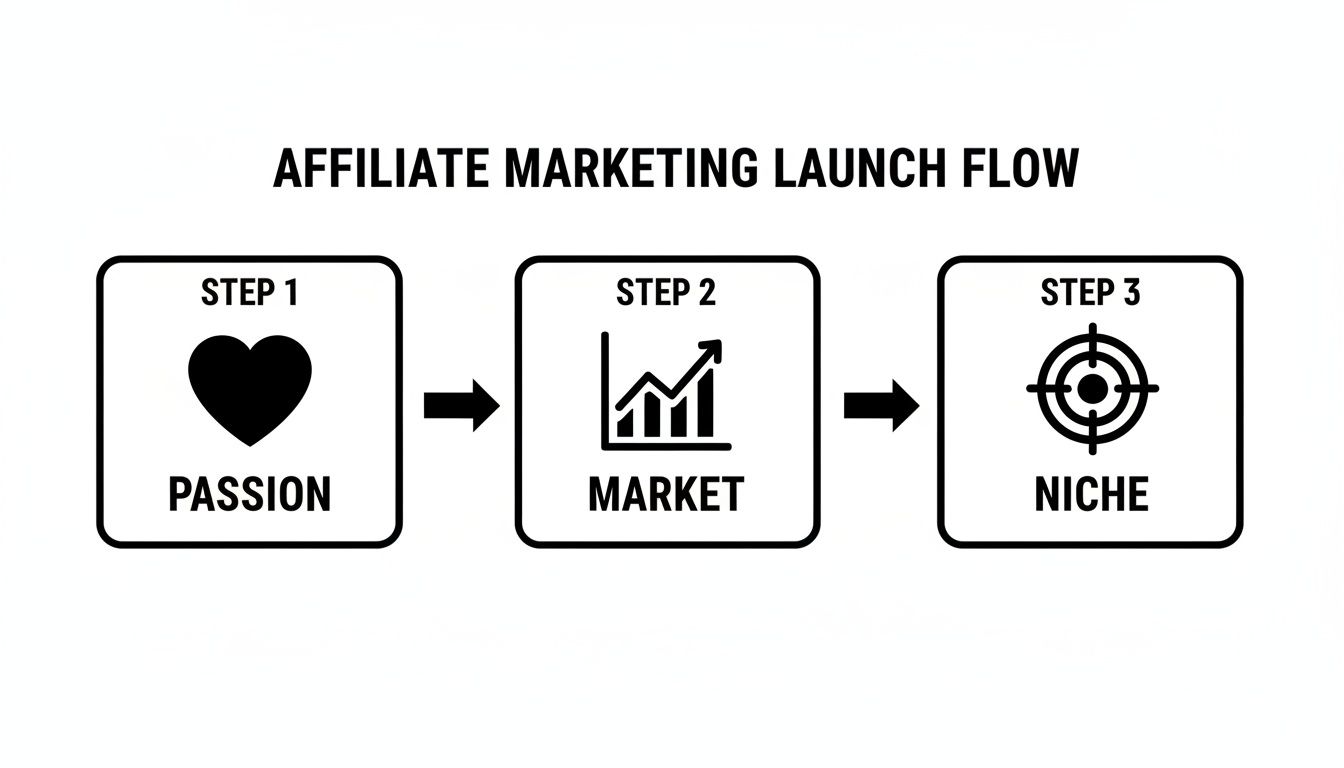
As you can see, a solid launch starts with authentic interest, not just a spreadsheet of market data.
And the opportunity is only getting bigger. The global affiliate marketing industry was valued at $27.8 billion in 2024 and is expected to hit $48 billion by 2027. With over 80% of brands running affiliate programs, it's clear this is a core part of modern marketing.
A niche isn’t just a topic; it’s an audience with a specific problem. Your job as an affiliate marketer is to become the most trusted source for the solution to that problem.
Putting in the work now to choose a niche that combines your interests with proven demand is the smartest thing you can do. It saves you from pouring months of effort into a topic with no audience or earning potential, setting a strong foundation for everything that comes next.
Establishing Your Online Headquarters

Okay, you've locked in your niche. Now comes the big question: Where are you going to build your brand and connect with your audience? This is your digital "home base," the foundation of your entire affiliate business, so choosing the right platform from the get-go is a critical move.
The three main players in this game are a blog, a YouTube channel, and social media. Each has its own unique personality and set of advantages.
A blog is a long-term asset that you own completely. Think of it as your central hub for detailed, search-friendly content like in-depth product reviews, tutorials, and side-by-side comparisons. If you enjoy writing and want to build a sustainable machine that pulls in organic traffic from Google for years to come, this is your path.
On the flip side, a YouTube channel is phenomenal for building a personal connection and actually showing products in action. Video is incredibly engaging; you get to demonstrate, not just describe. I've also found that for certain niches, the SEO competition on YouTube can be less intense than on Google, offering a faster route to getting noticed.
Picking Your Main Platform
The choice between a blog or YouTube often boils down to your niche and your personal strengths. Do people in your space prefer to read detailed breakdowns or watch a video walkthrough? This little breakdown should help clear things up.
| Platform | Key Strengths | Best For Niches Like… |
|---|---|---|
| Blog (Self-Hosted) | Total ownership, long-term SEO asset, great for deep-dives and detailed reviews. | Tech, personal finance, software, and anything requiring detailed product comparisons. |
| YouTube Channel | High engagement, builds personal trust, perfect for visual demos and tutorials. | Beauty, gaming, home improvement, cooking—anywhere seeing the product is key. |
| Social Media | Fast community growth, great for trending topics, direct audience interaction. | Visually-driven niches like fashion, travel, and food, especially for quick-hit promotions. |
While it's smart to start with one, most successful affiliates eventually build a multi-platform presence. For instance, you could have a primary blog and use a YouTube channel to create companion videos that you embed right into your articles.
Getting Your Affiliate Website Live
If you’ve decided a blog is the right move, the first order of business is getting the technical foundation sorted. Don't worry, this isn't nearly as complicated as it sounds, but making the right choices here will save you a ton of headaches later.
Here are the absolute must-dos to get started:
- Nail Down a Domain Name: This is your address on the internet. Go for something memorable, easy to spell, and connected to your niche. Try to avoid hyphens and numbers—they just make it harder for people to remember.
- Invest in Quality Hosting: Your web host is the engine that powers your site. Please, don't cheap out on this. A slow, unreliable host will kill your visitor experience and sink your search engine rankings. Look for providers known for solid speed, uptime, and customer support.
- Install WordPress: While other options exist, self-hosted WordPress.org is the undisputed king for affiliate marketing blogs. Its flexibility, massive ecosystem of plugins, and SEO-friendliness make it the best tool for building a scalable site that you actually own.
For a complete walkthrough on this, our guide on how to create a website for affiliate marketing breaks down every single step.
My Two Cents: When you're just starting, keep it simple. Pick a lightweight and fast WordPress theme like GeneratePress or Kadence. They give you a clean, professional look without all the bloat that can drag your site speed down.
Managing Affiliate Links Like a Pro
With your site up and running, the last technical piece is managing your affiliate links. Just pasting raw, ugly affiliate links directly into your articles looks amateurish and messy. It’s also a nightmare to manage if a program ever changes its link structure.
This is where a link management plugin saves the day. Tools like ThirstyAffiliates or Pretty Links let you cloak your links. This turns a long, clunky affiliate URL into a clean, branded link that's easy to share and looks trustworthy.
For instance, an ugly raw link might look like this: https://brand.com/products/widget-pro?affiliate_id=user123&tracking_code=xyz
But a cloaked link would look clean and simple, like this: https://yourwebsite.com/recommends/widget-pro
This one small step gives you several huge wins:
- Trust and Professionalism: Clean links look far more trustworthy to your audience.
- Centralized Management: Need to update a link? Change it once in the plugin's dashboard, and it's updated everywhere across your entire site. Instantly.
- Click Tracking: These tools show you exactly which links people are clicking on, giving you priceless data on what's working.
Getting your platform and tools set up correctly from day one separates the hobbyists from the serious business builders. It establishes a professional foundation that positions you to provide real value and earn real income.
Creating Content That Actually Converts

Alright, with your platform ready, it's time for the real work. Your content is the engine of this whole operation. Think of it as the bridge connecting your audience’s problems to the solutions you’re recommending.
Forget about just churning out articles stuffed with affiliate links. That game is over. Your goal now is to become the most helpful, trustworthy resource in your niche. You're not a salesperson; you're a problem-solver. This mindset shift is what separates the affiliates who make a few bucks from those who build a real, sustainable business.
Proven Content Formats That Actually Sell
Why reinvent the wheel? Certain types of content just work for affiliate marketing because they catch people at the exact moment they're ready to buy. Start with these formats—they're practically designed to turn visitors into customers.
- In-Depth Product Reviews: This is more than a list of features. A killer review dives deep into your personal experience. Talk about the pros, the cons, and exactly who the product is perfect for (and who it's not for). If you're a photographer reviewing a new lens, you better believe your audience wants to see sample photos, hear how it performs in bad lighting, and see how it stacks up against its main rival.
- "Best Of" Listicles: These comparison posts are gold. An article titled “The 5 Best Yoga Mats for Hot Yoga” is a magnet for people who are already pulling out their wallets. Make their decision ridiculously easy by including a simple comparison table that highlights key features like grip, thickness, and price.
- Tutorials and How-To Guides: Show, don't just tell. A guide on "How to Make the Perfect Sourdough" is the ideal place to link to the Dutch oven, digital scale, and proofing baskets you actually use. You’re not just recommending a product; you’re demonstrating its value in a real-world scenario.
The best affiliate content never feels like a sales pitch. It feels like a genuine, helpful recommendation from a trusted friend who’s already done all the research for you.
Focusing on these content types means you're creating assets that attract an audience actively searching for answers, which is the bedrock of building a successful affiliate marketing business from the ground up.
Your Most Valuable Asset: Trust
In a world drowning in sponsored posts and ads, trust is the only currency that matters. And you build it by being brutally honest.
Does a product you love have a tiny, annoying flaw? Point it out. People will appreciate your honesty, and it makes your praise for its other features that much more believable. For example, when reviewing a budget laptop, you could say, "The battery life won't win any awards, but for this price, you won't find better performance for everyday tasks."
This kind of transparency builds long-term credibility. People won't just visit for a single purchase; they'll come back because they see you as a reliable voice in the noise.
The Disclosure Rule: Don't Skip This
This isn't just a friendly tip—it's the law. The Federal Trade Commission (FTC) requires you to clearly and obviously tell your audience that you might earn a commission if they buy through your links.
Don't bury this in the footer. Place a clear disclosure right at the top of any post containing affiliate links. It can be simple and friendly:
"Heads up: This post contains affiliate links. If you buy something through one of these links, I may earn a small commission at no extra cost to you. Thanks for supporting my work!"
Proper disclosure isn't just about avoiding legal trouble; it reinforces the trust you're working so hard to build. Being upfront shows you respect your audience, which is the cornerstone of any brand that plans on sticking around.
Alright, let's talk about traffic. You can create the most brilliant, helpful review on the planet, but if no one sees it, you're just shouting into the void. Getting the right eyeballs on your content isn't just a part of the job; it is the job.
We're not talking about just any traffic, either. We need targeted visitors—people who are actively looking for the solutions you're talking about. Forget the old "if you build it, they will come" fantasy. We have to be strategic and proactive. This means focusing on two powerhouse methods that will work for you 24/7: Search Engine Optimization (SEO) and building an email list you actually own.
Mastering Search Engine Optimization
SEO is, without a doubt, your single most powerful tool for getting free, consistent, and high-quality traffic. It's how you get your content to show up on the first page of Google when someone is searching for something you know about.
Think about it. When someone types "best running shoes for flat feet" into Google, they aren't just window shopping. They have a problem and are actively looking for a product to solve it. That's a buyer, and you want to be the one to help them.
This all starts with good old-fashioned keyword research. You need to figure out the exact phrases your ideal customer is typing into that search bar. A beginner might search for "how to start a blog," but someone a bit more advanced might be looking for a "GeneratePress theme review." These phrases represent different points in their journey, and your content needs to meet them where they are.
Once you know your target keywords, you need to weave them into your content naturally. Don't just stuff them in; make them part of the conversation.
- The Post Title: It has to grab attention but should also feature your main keyword.
- Headings and Subheadings: Use keywords to create a logical structure for your article.
- The Content Body: Make sure your primary keyword appears early on, ideally in the first 100 words.
- Image Alt Text: This is a simple one. Describe your images for search engines, and if a keyword fits, use it.
At its heart, good SEO is about one thing: creating the single best, most helpful resource on the internet for a specific query. When you genuinely solve the searcher's problem better than anyone else, Google takes notice and rewards you.
This mindset shift is crucial. You're writing for people first, which is exactly what search engines want. To really get a handle on this, you've got to understand the fundamentals of SEO for affiliate marketing at https://www.sugarpixels.com/seo-for-affiliate-marketing/; consider it required reading.
Building Your Most Valuable Asset: Your Email List
SEO is incredible, but putting all your eggs in the Google basket is risky. Algorithm updates can—and do—change everything overnight. An email list, on the other hand, is an asset you completely control. It's a direct line to your biggest fans.
To get people on your list, you need to give them a good reason to sign up. This is where a lead magnet comes in. It's simply a free, valuable piece of content you offer in exchange for their email address. It doesn't have to be a 200-page book; it just needs to solve one specific problem for your audience.
Here are a few simple lead magnet ideas that work like a charm:
- A Checklist: "The 10-Point Pre-Publish SEO Checklist for Bloggers"
- A Short Recipe Guide: "5 Beginner-Friendly Vegan Recipes for Busy Weeknights"
- An Exclusive Video: "How to Set Up Your First WordPress Plugin"
- A Tools List: "My Top 10 Favorite Free Tools for Graphic Design"
Nurturing Your New Subscribers
Getting the email is just the beginning. Now you need to build a relationship. This is where a simple automated welcome series comes into play. It’s your chance to make a fantastic first impression.
This short sequence of emails, sent automatically over a few days, introduces you, delivers the goods, and provides instant value. A solid three-part welcome series might look something like this:
- Email 1 (Sent Immediately): Deliver the lead magnet you promised. Welcome them warmly and set expectations.
- Email 2 (2 Days Later): Share one of your best blog posts or a killer tip related to why they signed up. Give, don't ask.
- Email 3 (4 Days Later): Share a bit of your story. Why are you so passionate about this niche? This builds connection and trust.
This simple sequence turns a random visitor into a warm subscriber who feels like they know you. Down the road, when you recommend a product you believe in, they'll be far more likely to listen. By combining the wide net of SEO with the deep connection of email, you build a truly resilient and profitable affiliate business.
Turning Data Into Dollars and Scaling Up

You've done the hard work. Your platform is live, you're creating solid content, and people are starting to show up. This is the moment you transition from being just a content creator to a real business owner. To really make this thing fly, you have to stop guessing and start measuring. Data is your roadmap to profit.
This is where we find out what's actually working so you can do more of it. We're going to dive into your affiliate dashboards and pull back the curtain on the handful of numbers that truly matter. Getting a grip on these metrics is the key to turning your side hustle into a scalable business.
Decoding Your Affiliate Dashboard
Logging into an affiliate dashboard for the first time can feel like you’re trying to read a foreign language. There’s a wall of acronyms, charts, and numbers staring back at you. Don't sweat it. You only need to focus on a few key metrics to get a crystal-clear picture of your performance.
- Clicks: This one’s easy. It’s the total number of times people have clicked on your unique affiliate links. Think of it as your first signal that people are actually engaging with what you’re recommending.
- Conversion Rate (CR): Here’s where the magic happens. This is the percentage of clicks that turn into a sale or another desired action, like a free trial sign-up. If 100 people click your link and 3 of them buy, you've got a 3% conversion rate. This number tells you exactly how persuasive your content is.
- Earnings Per Click (EPC): This is the ultimate health check for your affiliate efforts. It’s your average earnings for every single click you send, calculated by dividing your total commissions by your total clicks. A high EPC tells you that you’ve found a fantastic offer and are sending the perfect, motivated audience to it.
These three metrics tell a powerful story when you look at them together. Low clicks probably means you have a traffic problem. A low conversion rate, on the other hand, could point to unconvincing content or a mismatch between your audience and the offer. Keeping an eye on these is non-negotiable if you’re serious about growth.
Finding and Fueling Your Winners
You’ll quickly discover that not all of your content performs equally. In fact, the Pareto Principle is almost always in play here: 80% of your affiliate income will likely come from just 20% of your content. Your mission is to find that winning 20% and pour gasoline on the fire.
Go into your analytics and pinpoint the specific blog posts, videos, or social updates that are bringing in the most cash. Is it that super in-depth review of a particular software? Or the "best of" list you published three months ago? The numbers won't lie.
Once you’ve identified a top-performing piece of content, it's time to double down.
- Boost its SEO: Can you beef it up with more detail? Answer more user questions or target some new long-tail keywords to help it climb even higher in the search results?
- Promote it relentlessly: Make it a staple in your email welcome sequence. Share it again on social media. Link to it from other relevant posts.
- Clone its success: If a specific format or angle is clearly hitting the mark, create more content around similar topics or in that same successful style.
Your audience tells you exactly what they want with their clicks and purchases. Listen to them. Your data is the clearest, most honest feedback you will ever get.
By focusing your time and energy on what's already proven to work, you stop spinning your wheels on content that doesn't convert. This is how you accelerate your earnings in the smartest, most efficient way possible.
Smart Strategies for Scaling Your Income
Once you have a steady stream of income and you know what your top performers are, you can start to scale more deliberately. This is about more than just pumping out more content; it's about building a more resilient and diversified affiliate business.
One of the first moves you should make is to diversify your affiliate programs. Putting all your eggs in one merchant's basket is a huge risk. If they slash their commission rates or shut down their program, your income could disappear overnight. Start looking for complementary products that your audience would also find valuable.
Another powerful tactic is to negotiate a commission bump. Once you're consistently sending a brand high-quality sales and have established yourself as a top-performing affiliate, you have leverage. Don't be shy about reaching out to your affiliate manager, showing them your numbers, and asking for a better rate. Most companies are happy to reward their best partners.
Finally, you can start building more advanced sales funnels. This might look like creating a dedicated landing page for a high-ticket offer, maybe even driving some paid traffic to it, and using a targeted email sequence to nurture leads before you even show them the affiliate link. It’s a more strategic approach that can dramatically lift your conversion rates on premium products. Scaling is about working smarter, not just harder, and using your early success as a springboard for much bigger things.
Common Questions About Starting Affiliate Marketing
Diving into any new venture always comes with a flood of questions. When you're just figuring out the ropes of affiliate marketing, it's easy to get tangled up in the same uncertainties that trip up most beginners. Let's clear the air and tackle some of the biggest questions you probably have right now.
So, How Much Can You Actually Make?
This is always the first question, and for good reason. The honest answer? It's all over the map. Some people make a few extra bucks a month, while top-tier affiliates are pulling in well over $10,000+ per month. It's a massive range.
What you really need to know is that it starts slow. Really slow. Don't expect to see a meaningful commission check in your first month. It often takes a solid three to six months of consistent work—publishing content, getting it in front of people—before the first real money starts to trickle in. Patience isn't just a virtue here; it's a requirement.
What's the Real Cost to Get Started?
The next big question is always about the startup cost. One of the best things about affiliate marketing is that the barrier to entry is incredibly low. But "free" isn't quite the right word if you're serious about building a real business.
Here's a realistic look at your initial expenses:
- Domain Name: This is your spot on the internet. Expect to pay about $10-20 per year.
- Web Hosting: To run a proper blog, you need good hosting. Quality shared hosting plans usually start around $5-15 a month. This is one thing you shouldn't skip.
- Optional Tools: Down the road, you might want to invest in an email service or a premium theme, but you absolutely don't need them on day one.
You could start for free using just social media or YouTube. But owning your own website gives you total control, and it's the smartest long-term play.
Your biggest investment in the beginning won't be money—it's your time. The real engine of early success is your commitment to creating genuinely helpful content that people actually want to read or watch.
Can I Do This With Zero Audience?
Yes, you can. In fact, everyone starts with an audience of zero. Your first mission isn't to sell anything; it's to start building that audience from scratch.
How? By creating content that solves a specific problem or answers a burning question in your niche. Forget about sales for a while and just focus on being incredibly helpful. Use basic SEO to make sure people who are searching for your topic can find you. An audience is simply what you get when you consistently provide value.
If you're looking for more answers to get you off the ground, check out this practical guide for beginners on how to start affiliate marketing. It's a great resource that can help fill in some of the blanks as you get started.
Ready to build the professional website that will become the foundation of your affiliate marketing business? Sugar Pixels specializes in creating high-performance, SEO-ready websites that are designed to convert. Let us handle the technical setup so you can focus on creating amazing content. Start building your online asset today at https://www.sugarpixels.com.