

Tired of paying for expensive SEO software just to find a few backlink opportunities? What if I told you the best tool for the job is one you already use every single day, and it's completely free?
You can turn Google Search into a powerful prospecting machine by using a few clever search commands, known as advanced search operators. This approach lets you pinpoint websites that are already linking to your competitors or talking about topics in your niche, giving you a ready-made list of high-quality targets. It’s all about analyzing what Google already values to find authoritative sites for your own outreach campaigns.
Why Google Is Your Best Free Backlink Tool

Before you pull out your credit card for a pricey SEO platform, let’s talk about the untapped potential sitting right in your browser. For startups, small businesses, or anyone on a tight budget, Google itself is a backlink goldmine. It offers a direct, unfiltered view of what the search engine already trusts in your industry.
Think about it: the search results page (or SERP) is essentially a pre-vetted list of winners. The sites that consistently rank for your most important keywords are there for a reason. They’ve earned authority, demonstrated relevance, and built a strong backlink profile. By digging into these top players, you can effectively reverse-engineer their success and uncover the exact links that helped them climb the ranks.
To put it simply, using Google for backlink research offers several key advantages that paid tools can't always replicate.
Key Advantages of Using Google for Backlink Prospecting
| Advantage | Why It Matters for Your Business |
|---|---|
| Completely Free | You can start finding high-value opportunities immediately without any financial investment or subscription fees. |
| Real-Time Data | The results reflect what Google currently sees and values, giving you the most up-to-date view of the competitive landscape. |
| Direct Insight | You’re looking directly at the SERPs, which helps you understand the context and relevance of a link, not just its metrics. |
| Discover Untapped Niches | You can uncover hyper-relevant blogs, forums, and community sites that larger, automated tools might overlook. |
These benefits make Google an indispensable starting point for any savvy link builder.
A Modern Approach to Link Discovery
Back in the day, SEOs had a simple trick up their sleeve: the link: operator. You could type link:yourcompetitor.com and get a sample of who was linking to them. It was quick, but it wasn't great. Google quietly phased this out around 2017 because the data was often inaccurate and only showed a tiny fraction of a site's actual backlink profile.
Today's approach is much smarter and far more effective.
Instead of hunting for a direct list of every single backlink, the modern strategy is about discovering the types of content and websites that naturally attract links in your space. This method helps you find:
- Guest post opportunities on respected blogs that Google already considers authoritative.
- Curated resource pages that list the "best-of-the-best" links on a specific topic.
- Link roundup posts that feature top-notch content on a weekly or monthly basis.
- Niche forums and communities where your brand and content can be mentioned organically.
The Undeniable Power of Backlinks
This direct-from-the-source prospecting is so critical because the link between backlinks and rankings is as strong as ever. A well-known study found that pages ranking #1 in Google have, on average, 3.8 times more backlinks than the pages ranking in positions #2 through #10. That’s a massive difference. This stat alone shows how vital it is to find and earn high-quality links if you want to secure those top spots. You can read more about the importance of backlinks for SEO on Search Engine Land.
By learning how to find backlinks in Google Search, you are not just finding links; you are understanding the web of trust in your industry. You get to see exactly which sites are considered credible sources, giving you a clear roadmap for your own outreach efforts.
Mastering Search Operators for Link Prospecting
Just typing your keywords into Google will only get you so far. The real power is in telling Google exactly what to look for, and that's where search operators come in. Think of them as special commands that filter billions of web pages down to a curated list of prime backlink targets.
Using these operators is the difference between casting a wide, hopeful net and spearfishing with precision. Instead of just finding any blog in your niche, you can find blogs actively seeking guest writers or resource pages that have a perfect spot waiting for your guide.
Combining Operators for Powerful Queries
The real breakthroughs happen when you start chaining these commands together. Each operator adds a new layer to your filter, letting you build highly specific searches that uncover fantastic opportunities you'd otherwise miss.
Let’s look at a few ways to put this into practice:
- Find Guest Post Opportunities:
intitle:"write for us" "your keyword"
This simple query instantly brings up pages with "write for us" in their title that also talk about your topic. It’s a direct line to sites looking for contributors. - Discover Resource Pages:
inurl:resources "your keyword"
This one hunts for URLs containing the word "resources" that are relevant to your keyword. These pages are goldmines—curated lists of helpful links where your content could be a valuable addition. - Locate Link Roundups:
intitle:"weekly roundup" "your keyword"
Plenty of blogs run weekly or monthly roundups showcasing the best new content. This search finds them, giving you a list of editors to pitch your latest article to.
The goal isn't just to memorize what each operator does. It's about thinking creatively to answer a specific question, like, "Where can I find websites that list helpful tools for my audience?"
Essential Google Search Operators for Backlink Hunting
To get you started, here's a quick-reference guide to the operators I find myself using constantly. While there are many others, these are the heavy hitters for finding link opportunities.
| Search Operator | Example Query | What It Finds |
|---|---|---|
| "quotes" | "best fly fishing tips" |
Finds pages containing that exact phrase. Essential for controlling your search and finding specific mentions. |
| intitle: | intitle:"digital marketing guide" |
Narrows results to pages with the specified phrase in their title tag, perfect for finding topic-specific content. |
| inurl: | inurl:blog "content strategy" |
Restricts the search to pages with a specific word in their URL, like /blog/, helping you focus on certain sections of a site. |
| site: | site:forbes.com "your name" |
Limits the search to a single website. It's great for checking if a specific site has ever mentioned you or a competitor. |
These commands are your foundational tools, but keep in mind that a purely manual search can become time-consuming as you scale up. Eventually, you’ll probably want to look into some of the best SEO tools for beginners to help automate the discovery and analysis.
Real-World Scenarios and Queries
Let's see how this works in a couple of common situations.
Scenario 1: You're a SaaS company with a new project management tool.
Your mission is to find blogs that review software or publish "best of" lists. A killer query for this would be: intitle:"best project management tools" -site:yourcompetitor.com
This search uncovers listicles about your topic but specifically excludes a competitor's site, helping you spot opportunities they may have overlooked.
Scenario 2: You run an e-commerce store selling eco-friendly products.
You want to connect with influencers and bloggers who write about sustainable living to pitch your products for review. A great search to start with is: "sustainable living" intitle:"gift guide"
This query immediately surfaces gift guides created by bloggers in your niche, which is a perfect entry point for outreach. Of course, finding the opportunity is only half the battle; you still need to find the right person to contact. Learning about leveraging Google search operators to find business emails is a natural next step that perfectly complements these prospecting techniques.
Alright, now that you've got a solid grasp on search operators, it's time to put them to work. We're moving beyond simple commands and into building repeatable, strategic workflows. Think of these as your personal playbooks for uncovering all sorts of backlink opportunities hiding right inside Google's search results.
The real power here is in the flexibility. Whether you’re on the hunt for guest post slots, high-value resource pages, or even just mentions of your brand that forgot to link back, the right search query will bring them straight to you.
It boils down to a simple, three-part process: target the kind of link you want, combine your operators to zero in on it, and then go find those opportunities.
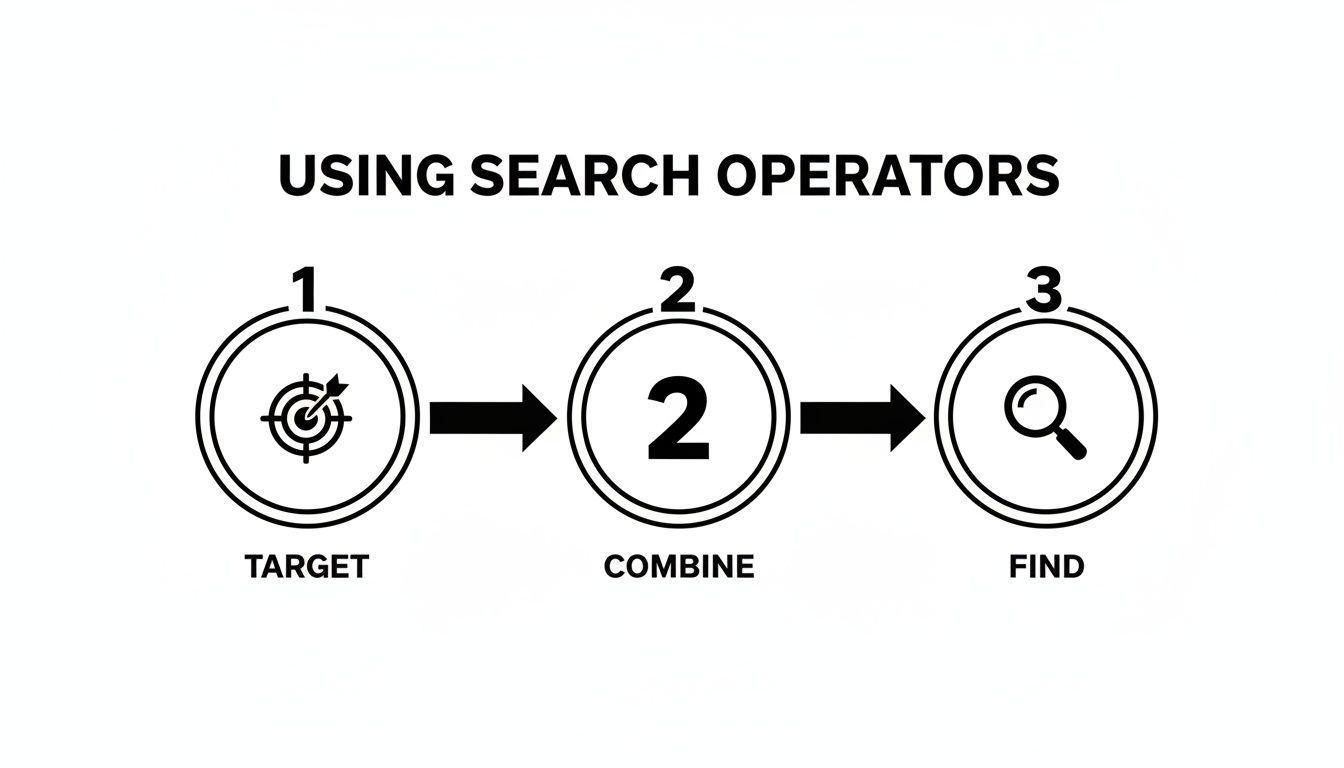
Following this simple flow turns a vague goal like "get more links" into a concrete, actionable search, keeping your prospecting focused and effective.
Digging Up Guest Post Opportunities
Guest posting is still one of the best ways to build authority and earn genuinely relevant links. Instead of just cold-emailing every blog you can find, you can use Google to pinpoint sites that are actively looking for people like you.
Here's the classic query I always start with:"your industry" intitle:"write for us"
For example, if I were running a digital marketing agency, I’d be searching for things like:
"SEO tips" intitle:"write for us""content marketing" intitle:"contribute""b2b marketing" "guest post guidelines"
These searches cut right through the noise and show you pages that explicitly invite contributors. That means your pitch is landing on a receptive audience, which massively boosts your chances of a "yes."
Finding Prime Real Estate on Resource Pages
Resource pages are goldmines. They are essentially curated lists of the best content on a specific topic, and getting your link on one is a huge vote of confidence. It’s an editorially-vetted backlink from a page designed to be helpful.
This is my go-to query for finding them:intitle:"resources" "your keyword"
You could also try variations like:inurl:"links" "your keyword"
Let’s say you just published an incredible guide on sustainable gardening. You could pop intitle:"resources" "sustainable gardening" into Google and get a ready-made list of pages that already link out to similar content. They’re practically waiting for you to reach out.
The most effective link builders don't just look for any opportunity; they find the right opportunity. They use search operators to pinpoint pages where their content doesn't just fit—it adds immediate value.
Reclaiming Your Unlinked Brand Mentions
This is probably the lowest-hanging fruit in link building. Unlinked brand mentions happen when a site talks about your company, your product, or your content but just… forgets to add the link. The hard part—getting mentioned—is already done.
You can hunt these down with a simple query:"Your Brand Name" -site:yourdomain.com
This search scours the web for any mention of your brand while filtering out results from your own website. Once you find one, a quick, polite email to the author is usually all it takes to get them to add the hyperlink. It's a quick win.
And don't underestimate the power of Google for this. With Google dominating roughly 91.5% of the global search market, its index gives you a nearly complete picture of the web. Considering that around 51% of users discover new businesses through organic search, finding and securing these mentions is a no-brainer for brand visibility.
If you're looking to do this at a larger scale, you might explore more advanced methods. For serious backlink prospecting and keeping an eye on competitors, you could even go a step further by building a custom SERP results checker to automate how you collect and analyze this kind of ranking data.
How to Qualify Your Link Opportunities

Alright, you've run your search queries and have a list of potential websites. It's easy to get excited here, but this is where the real work begins. Not every site that links to a competitor is a good fit for you.
Chasing every single opportunity is a surefire path to burnout. The trick is learning to spot the gems and toss the duds—fast. With a bit of practice, you can vet a site's potential in minutes, focusing your outreach energy only on the links that will actually move the needle.
Assessing Website Quality and Relevance
Your first move should be a quick gut check. Open the website. Does it look professional? Or does it scream 2005? Things like a clunky, outdated design, a ton of flashing ads, or poorly written content are immediate red flags.
If the site passes the eye test, the next question is simple: Is it relevant? A backlink from a site that has nothing to do with your industry is practically worthless in Google's eyes. You need links from sites that talk about the same things you do and serve the same kind of audience.
Look for a few key signs of a quality, relevant site:
- Topical Alignment: The site is clearly in your niche or a very closely related one.
- A Pulse: It's not a ghost town. Look for recent blog posts, active social media profiles, or even reader comments.
- Clean and Professional: The layout is user-friendly and isn't a minefield of pop-ups and aggressive ads.
This initial once-over helps you immediately filter out the obvious junk before you waste another second on it.
Evaluating Authority and Context
Once a site passes that first smell test, it's time to dig a little deeper. We need to think about authority and the context of its links. And no, I'm not just talking about a Domain Authority score from some tool. I mean real, genuine authority—is this a respected voice in the space?
Take a look at who they link out to. Are their articles referencing other high-quality, reputable sources? Or are they spraying links to spammy, low-value sites? A website is known by the company it keeps, and you can tell a lot about its credibility by its outbound link patterns.
A backlink is an endorsement. You want your brand endorsed by credible, authoritative sites, not lumped in with a list of random, irrelevant links on a page that offers no real value to readers.
To make this process consistent, create a quick checklist for every prospect. This keeps you honest and ensures your link-building efforts are tied to your bigger picture. This all fits into a broader SEO content strategy, where every link you build is a deliberate step toward strengthening your online presence.
Turning Prospects Into Powerful Backlinks
Alright, so you've got a solid list of potential websites. That's a great start, but it's only half the job. Now for the real work: turning those prospects into live, authority-boosting backlinks. This is where your outreach game has to be on point, bridging that gap between just finding a site and actually earning a link from it.
Forget about those generic, copy-paste email templates you've seen online. They scream "spam" and get deleted instantly. Real, effective outreach is all about personalization and showing genuine value. Before you even think about hitting "send," you have to answer the site owner's silent, all-important question: "What's in it for me?"
If you can't clearly explain how your link makes their content better, more thorough, or more useful for their readers, your email is probably headed straight for the trash.
Crafting an Outreach Email That Gets a Reply
Your email needs to be short, personal, and focused on value. A simple structure works best. Kick things off with a genuine compliment about a specific article or resource on their site. Mention something you actually found interesting—it shows you’ve done your homework and aren't just blasting out random requests.
Next, smoothly introduce your own content. Explain precisely where you think it would fit and, more importantly, why it would be a great addition for their audience. Be super specific. Don't just say, "You should link to my guide." Instead, try something like, "I saw you mentioned X in your fantastic post on Y. My guide actually provides a step-by-step walkthrough of that exact process, which your readers might find really helpful."
Finally, make your ask simple and direct, but keep it low-pressure. End with a polite call to action that doesn't sound pushy or demanding.
The best outreach feels less like a cold request and more like a helpful tip from a peer. It’s about relationship building, not just link grabbing. You want to position yourself as a helpful member of their community.
The Art of the Follow-Up
Let's be real: people are swamped, and inboxes are chaotic. Your email can easily get buried. A single, polite follow-up is almost always a good idea. I usually wait about a week before sending a gentle nudge. Keep it brief and friendly—you're just trying to bump the original message back to the top of their inbox.
But this is key: don't overdo it. One follow-up is professional persistence. Any more than that, and you start looking annoying, which can burn bridges and hurt your reputation.
To stay on top of all this, a simple spreadsheet is your best friend. Make sure you track the essentials:
- Target Website: The domain you’re reaching out to.
- Contact Person/Email: The specific person you emailed.
- Date of First Contact: When the first email went out.
- Date of Follow-Up: When you sent the reminder.
- Status: A quick note on the outcome—replied, link added, declined, no response.
This basic tracking system keeps you from accidentally emailing the same site twice and helps you see what's working so you can refine your pitch. Honestly, managing this outreach process takes a lot of time and effort. It's why many businesses ultimately decide to partner with professional off-page SEO services to handle and scale their link-building campaigns.
A Few Lingering Questions About Finding Backlinks
Even with the best search operators in your toolkit, a few questions always pop up when you're digging for backlinks in Google. Let's clear the air on some of the most common ones I hear.
Is Google Search Actually Better Than Paid SEO Tools?
This is a classic "right tool for the job" situation. It's not about one being better than the other; they serve completely different purposes.
Paid tools like Ahrefs or Moz are incredible for a bird's-eye view. They give you a massive, historical database of a competitor's entire backlink profile in just a few clicks. You simply can't get that kind of large-scale data dump manually.
Google Search, on the other hand, is your scalpel for real-time, surgical prospecting. It’s perfect for finding brand-new opportunities—like a resource page that went live yesterday or a fresh call for guest post submissions—that the big tools haven’t even crawled yet.
My advice? Use both. I rely on paid tools for the big-picture competitive analysis and then switch to Google's advanced search for highly targeted, up-to-the-minute link prospecting.
Think of it like this: Ahrefs gives you the complete map of the territory. Google lets you walk the trails yourself, discovering hidden gems the map hasn't marked yet.
How Can I Tell if a Potential Backlink Is Actually a Good One?
This is a crucial question. A "good" link comes from a site that's credible, relevant to your niche, and has a real, engaged audience. When you land on a potential site, run it through this quick mental checklist:
- Is it topically relevant? Does this site live and breathe the same topics you do? A link from a respected industry blog is worth its weight in gold compared to a dozen links from random, unrelated websites.
- Does the site pass the "sniff test"? Take a look around. Does it have a professional design? Is the content updated regularly? Are people commenting or sharing? Steer clear of sites that are just plastered with ads or look like they were built solely to sell links.
- What’s the context of the link? Think about where your link would live. Would it be placed naturally within a helpful piece of content? Or would it be dumped on a "partners" page with 100 other random links? Context is everything.
Answering these questions will help you quickly separate the high-value opportunities from the spammy time-wasters.
My Competitor Has Thousands of Backlinks. How Can I Possibly Compete?
First, take a deep breath. It's easy to get overwhelmed by the numbers, but this is one area where quality beats quantity every single time.
You don't need to match them link-for-link. Your goal is to be smarter, not bigger.
A single, powerful backlink from a highly respected, authoritative website in your space can move the needle more than a hundred low-quality links from spammy directories ever will. Use your newfound Google Search skills to find those unique, high-impact opportunities your competitor might have overlooked.
Start small, stay consistent, and focus on building genuine relationships. A quality-driven approach is not only more effective but also builds a much more sustainable foundation for your SEO success in the long run.
At Sugar Pixels, we specialize in building a powerful online presence from the ground up, combining expert web design with strategic SEO to help you grow. Learn more about how our digital marketing services can elevate your brand.