

Building a website for affiliate marketing really boils down to three big phases. First, you need to find a profitable niche that you actually care about. Then, you'll pick a memorable domain name and solid hosting. Finally, you'll build out your site, usually on a flexible platform like WordPress. Get this foundation right, and you'll have a launchpad for creating great content that pulls in an audience and drives affiliate sales.
Your Blueprint for a Profitable Affiliate Website
Before you start getting into the weeds of website builders and plugins, it's crucial to have a clear roadmap. Think of this less like a single task and more like a strategic project with distinct, manageable stages.
Success in affiliate marketing isn’t about just slapping up a website and stuffing it with links. It’s about building a genuine, trusted resource that helps people solve a problem or make a better buying decision. The whole business model is based on understanding how to make money selling other people's products, and that starts with providing real value.
The Strategic Foundation
Your first job is to lay a solid strategic groundwork. This means moving past the "idea" phase and making the concrete decisions that will define your site's entire future. Honestly, these first few steps are the most important because they set the direction for everything else you'll do.
The process has a simple, logical flow: figure out your market, lock down your brand identity, and then build the digital "home" where your content will live.
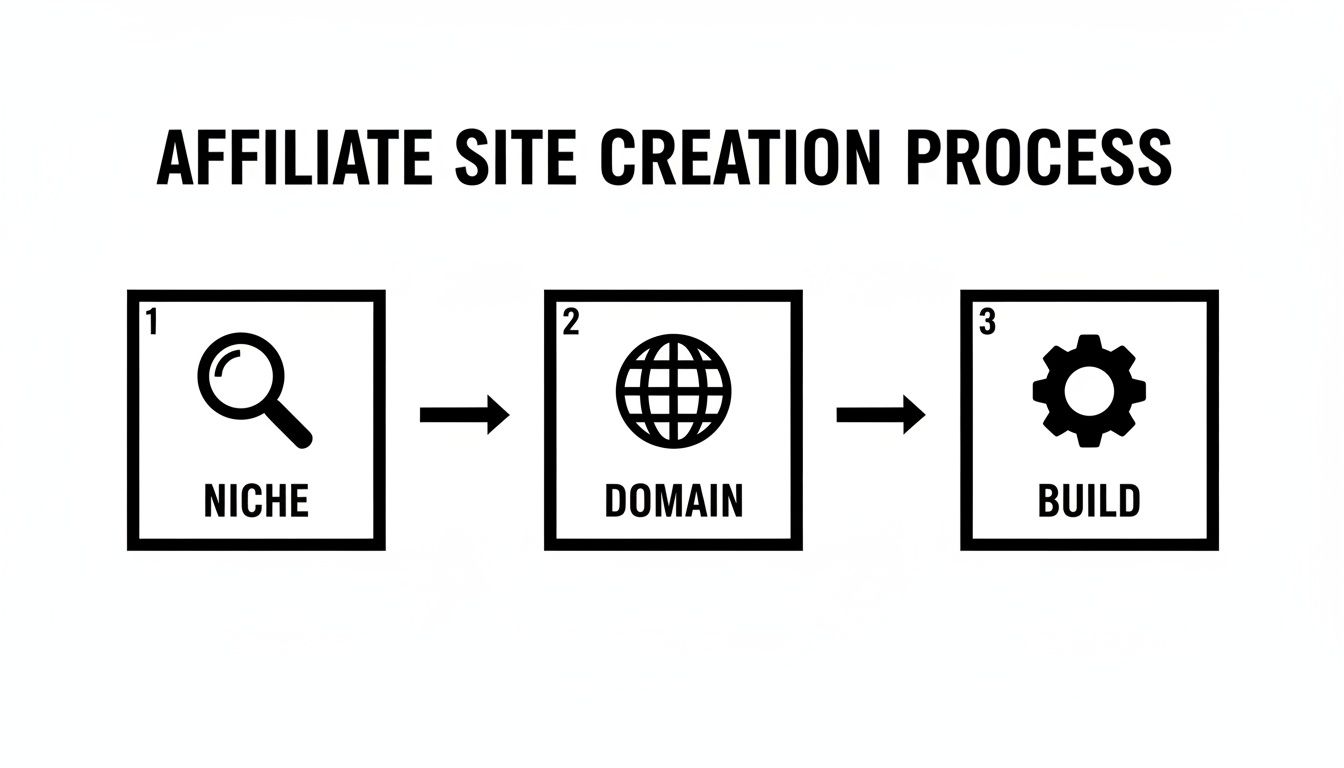
As you can see, a successful affiliate site starts long before you write a single word. It all begins with smart research and getting the foundational pieces in place.
Understanding the Market Opportunity
Jumping into affiliate marketing isn't just a small-time hustle; you're entering a massive and growing market. The global affiliate industry was valued at a staggering $27.8 billion in 2024 and is expected to climb to nearly $48 billion by 2027.
With over 80% of brands running affiliate programs, there's huge demand for quality publishers like you. It’s also worth noting that around 62% of all affiliate traffic comes from mobile devices, which makes having a responsive, fast-loading website an absolute must-have if you want to capture the majority of potential commissions.
To get your site off the ground, you'll need to pull together a few key components. Think of these as the non-negotiable building blocks for your affiliate business.
Core Components of Your Affiliate Website
| Component | Why It Matters | Key Decision |
|---|---|---|
| Niche | Defines your audience, content, and monetization strategy. A focused niche builds authority faster. | Which specific audience can I serve better than anyone else? |
| Domain Name | Your brand identity and first impression. It should be memorable, relevant, and easy to type. | What name is brandable and available as a .com? |
| Web Hosting | The engine of your site. Good hosting means better speed, security, and uptime. | Which hosting provider offers the right balance of performance and price? |
| CMS Platform | The software you'll use to build and manage your site. WordPress is the industry standard. | Will I use WordPress.org for maximum flexibility and control? |
These decisions are the bedrock of your entire project. Making smart choices here will save you countless headaches down the road and set you up for long-term growth.
A successful affiliate website is a business asset, not just a blog. Treat it that way by making informed, strategic decisions about your niche, brand, and tech stack from day one. Your goal is to build authority and trust.
Laying out this initial blueprint ensures you don't waste time on busywork that doesn’t move the needle. When you have a clear vision for your niche, brand, and technical setup, you create a powerful launchpad for everything that comes next.
Finding a Profitable Niche You Actually Like
Let's get one thing straight: your niche is everything. It's the bedrock of your entire affiliate marketing business. Get this right, and you’re building on solid ground. Get it wrong, and you'll be fighting an uphill battle from day one.
The goal isn't just to find any topic, but to pinpoint that sweet spot where your genuine interest, real audience demand, and actual earning potential all overlap. So many new affiliate marketers crash and burn right here. They either go way too broad (think "health" or "fitness") and get crushed by massive authority sites, or they chase a trend they couldn't care less about and burn out within a few months.
The secret? Don't be a generalist. Become a specialist. Authenticity is your superpower in this game, and it’s a whole lot easier to be authentic when you genuinely love what you’re talking about.

Think of it like this. Instead of a generic "travel" blog, you could create a site dedicated to "eco-friendly travel gear for solo female backpackers." Instead of just "cooking," you could zero in on "high-protein vegan meal prep for busy professionals." That kind of focus is magnetic. It helps you attract a tribe of loyal followers and makes it infinitely easier to rank for valuable keywords people are actually searching for.
Brainstorming Potential Niches
Your best ideas won't come from a keyword tool; they'll come from you. Start by looking at your own life. What are you into? What problems have you solved? Your personal experience is a goldmine because you already understand the audience's language and their biggest frustrations.
Grab a notebook and just start listing things that genuinely spark your interest. No filter, no judgment.
- What are your hobbies? Maybe it's hiking, homebrewing coffee, or flying drones. All of these have thriving communities and endless products to recommend.
- What's your day job? If you're an expert in project management software, graphic design tools, or personal finance, you can build a site helping others level up their skills.
- What are your passions? What do you find yourself reading about late at night? It could be anything from sustainable fashion and classic car restoration to smart home automation.
Once you’ve got a solid list, it's time to see if your passion project has legs. For a much deeper dive, this guide on how to find your niche market is an excellent resource to walk you through the process.
Validating Your Niche Idea
Passion is the fuel, but profit is the destination. You have to make sure there's an actual audience searching for information and products in your niche. A little upfront research here will save you a world of pain later.
First, check for affiliate potential. Are there actual products or services you can promote? Pop over to major affiliate networks like ShareASale or CJ Affiliate and do a few searches. If your idea is "home coffee brewing," you'll quickly find affiliate programs for everything from high-end espresso machines and coffee bean subscriptions to online barista courses.
Key Takeaway: A profitable niche must have a clear path to monetization. If you can't find products or affiliate programs that solve your audience's problems, you've got a great hobby, not a great business idea.
Next, you need to size up the competition. Use a keyword research tool to see what people are searching for. The magic is in the long-tail keywords—those longer, super-specific phrases. Ranking for "best backpack" is nearly impossible, but ranking for "best travel backpack for European trains" is totally achievable.
See who’s showing up on the first page of Google for these terms. Is it all faceless corporations, or do you see smaller, independent blogs run by people just like you? Seeing other affiliates succeed is the best validation you can get. It means there's room at the table for you, too.
Securing Your Domain and Hosting
Once you’ve locked in a validated niche, it’s time to claim your corner of the internet. Your domain name is your brand—it needs to be catchy, easy to spell, and a .com if at all possible. Try to include a relevant keyword if it feels natural, but don't force it. A memorable brand name is always better than a clunky, keyword-stuffed one.
Think of your web host as the engine that powers your site. For an affiliate site, speed and reliability are non-negotiable. A slow site doesn't just annoy visitors; it actively harms your Google rankings. While cheap, budget hosting looks tempting, investing in a quality provider from the get-go is one of the smartest moves you can make. Find a host known for stellar performance and support—it's the foundation that will carry your business as it grows.
Getting Your Affiliate Hub Online with WordPress
Alright, you've nailed down your niche and snagged the perfect domain name. Now it's time for the fun part: actually building the website where your affiliate empire will live.
This is where your ideas start becoming a reality. For most of us in the affiliate marketing game, there’s really only one choice for a platform: WordPress. There's a good reason it powers over 43% of all websites on the internet. Its flexibility is just unbeatable.
Choosing WordPress isn't just about following the trend; it's a strategic move. You're giving yourself a foundation that can grow with you. Unlike some of the boxed-in website builders out there, the self-hosted version (WordPress.org) gives you total freedom over your site's look, feel, and, most importantly, how you make money with it.
This level of control is absolutely critical for an affiliate site. You'll be plugging in specialized tools for managing your links, beefing up your SEO, and tracking what works. Getting this technical stuff right from day one will save you from massive headaches later on.
A Fast Theme is a High-Converting Theme
Your WordPress theme is the visual skeleton of your website. It’s so easy to get distracted by themes that promise a million flashy features, but trust me, that's a classic rookie mistake. These bloated themes are often stuffed with messy code that slows your site down to a crawl, which tanks both the user experience and your Google rankings.
In affiliate marketing, site speed is everything. Did you know a one-second delay in page load time can slash your conversions by 7%? That’s money straight out of your pocket.
The name of the game is choosing a lightweight, performance-first theme. Look for a clean design, make sure it’s mobile-responsive, and check that it has a reputation for being fast. You can always add extra bells and whistles with plugins later.
Here are a few themes that are widely trusted in the affiliate community for being blazing fast:
- GeneratePress: This one is a legend. It’s incredibly light and customizable, making it a favorite for SEOs who need clean code and top-tier performance.
- Astra: Another speed-focused option that plays nicely with page builders and comes with a huge library of pre-built site templates to get you started quickly.
- Kadence: This theme strikes a great balance, offering powerful design features without making you sacrifice speed.
Picking one of these gives you a rock-solid, lean foundation. It lets your content and your affiliate offers do the talking, not some clunky theme.
Arming Your Site with Essential Plugins
Plugins are where WordPress truly shines. They're like apps for your website, extending its core power to do exactly what you need. But just like with themes, more is not better. Piling on dozens of plugins, especially poorly coded ones, is a recipe for security holes and a sluggish website.
You really only need a handful of killer plugins to get started. The goal is to pick tools that solve specific problems for affiliate marketers—things like SEO, link management, and making your site faster. Getting your technical foundation solid is key, and our guide on how to choose web hosting can give you some extra background on what a smooth-running site needs.
Your Must-Have Plugin Toolkit
1. An SEO Plugin (Rank Math or Yoast SEO): This is completely non-negotiable. An SEO plugin is your guide to optimizing every single page and post. It helps you nail your meta titles, write good descriptions, and handle all the technical stuff like sitemaps. It’s the key to getting seen by Google.
2. An Affiliate Link Manager (ThirstyAffiliates or Pretty Links): Trying to manage hundreds of raw affiliate links manually is a waking nightmare. A link management plugin is a lifesaver. It lets you:
- Cloak your links: It turns those long, ugly affiliate URLs into clean, trustworthy links like
yoursite.com/go/product-name. - Update links globally: If a program changes its links, you can update it in one place, and it will automatically change across your entire site. No more digging through old posts.
- Track your clicks: You can see exactly which links people are clicking on, which is vital for knowing what's working.
3. A Caching Plugin (WP Rocket or FlyingPress): A good caching plugin is the easiest way to make your site faster. It creates static copies of your pages so they don't have to be reloaded from the database for every single visitor. The result? A much faster experience for your readers and a nice little boost in your SEO.
4. An Analytics Plugin (MonsterInsights or Site Kit by Google): You can't grow what you don't measure. A simple plugin to install your Google Analytics code lets you see where your traffic is coming from, how people behave on your site, and which content is actually driving commissions.
By starting with a fast theme and a few strategic plugins, you're not just building a website. You're engineering a high-performance machine designed from the ground up to convert visitors and earn you commissions.
Turning Your Words into a Paycheck: Content That Actually Sells
Okay, so you've got your site set up with a sleek theme and the right plugins. Now for the fun part: creating the content. This is where the magic happens. Your website is essentially a blank canvas, but we're not just painting pretty pictures. We're building the engine that will power your entire affiliate business.
Think of your articles as the bridge connecting someone's problem to a product's solution. Your goal is to make that bridge feel sturdy, trustworthy, and incredibly easy to cross.
The most successful affiliate sites never feel like they're selling. They feel like a helpful guide, a trusted advisor, or a recommendation from that one friend who's an expert on the topic. To do this, you have to move past generic blog posts and zero in on content that catches people right when they're about to buy.

This is precisely why a solid understanding of SEO for affiliate marketing is non-negotiable. You’re not just chasing traffic; you're hunting for the right kind of traffic—people with their credit cards practically in hand. Let's break down how to do just that.
Hunting for "Buy Now" Keywords
Before you type a single word, you need to get inside your audience's head. What are they Googling moments before they decide to make a purchase? This is the art of targeting keywords with commercial intent. These aren't just casual questions; they're phrases that scream, "I'm ready to buy!"
Consider the massive difference between these two searches:
- Informational Keyword: "what is a drone"
- Commercial Keyword: "best drone for travel photography under $500"
See it? The first person is just curious. The second person is on a mission. By focusing your content on keywords like the second one, you position your site to earn commissions.
Keep an eye out for these common commercial keyword patterns:
- Best [Product Type] for [Use Case]: "best running shoes for flat feet"
- [Product A] vs [Product B]: "GoPro Hero 11 vs DJI Action 3"
- [Product Name] Review: "Sony WH-1000XM5 review"
- [Product Type] Under [Price]: "best 4k tv under $1000"
Fire up your favorite keyword research tool and start digging for these long-tail, high-intent gems. They're the foundation of content that actually makes money.
Choosing the Right Content Format to Drive Sales
Once you have your keywords, you need to pair them with the right type of article. A generic blog post simply won't do the trick. You need to use formats specifically built to help people make a buying decision.
A well-structured review or comparison doesn't just list features; it builds confidence. You're helping the reader justify their purchase by giving them an expert's validation and clear, actionable advice.
The numbers don't lie. SEO is the primary traffic source for roughly 69% of affiliate marketers, and about 65% depend on blog content to convert that traffic. What's more, customers who come through affiliate channels often have a 21% higher average order value. This makes investing your time in high-quality reviews and comparisons a statistically brilliant move.
To get the best results, you'll want to master a few key content types.
High-Converting Affiliate Content Formats
Not all content is created equal when it comes to driving sales. Certain formats are simply better at guiding a reader from "curious" to "customer." Here's a look at the heavy hitters.
| Content Type | Main Goal | Best For… | Conversion Potential |
|---|---|---|---|
| In-Depth Product Review | Build trust through a deep-dive on a single product. | Keywords like "[Product Name] review." | High |
| "Best Of" Roundup | Curate the top options and declare a winner. | Keywords like "best [Product Category] for [Use Case]." | Very High |
| Comparison Post | Act as the tie-breaker for a buyer stuck between two choices. | Keywords like "[Product A] vs [Product B]." | Highest |
| How-To Guide/Tutorial | Solve a problem using an affiliate product as the solution. | Keywords like "how to fix/build/do [Task]." | Medium-High |
As you can see, matching your keyword intent to the right content format is a critical step in building a profitable affiliate site.
Here’s a closer look at the top three formats that will likely become the backbone of your affiliate strategy.
1. The In-Depth Product Review
This is your chance to become the ultimate authority on one specific product. A truly great review is brutally honest and answers every question a potential buyer could have.
- Get hands-on. Go way beyond the spec sheet. Talk about the unboxing experience, the setup, and what it’s really like to use the product.
- Show, don't just tell. Your own photos and videos are gold. They prove you’ve actually used the product and build instant credibility.
- Be balanced. Don't be afraid to point out flaws. Acknowledging a product's downsides makes your praise for its strengths a hundred times more believable.
2. The "Best Of" Roundup Post
This is where you target those juicy "best " keywords. You’re essentially acting as a trusted curator, creating a definitive list of the top choices in a category.
- Set the ground rules. Explain your evaluation criteria right up front. Are you judging based on price, features, or ease of use?
- Use comparison tables. They are amazing for scannability and a perfect spot to place your affiliate links. Readers love them.
- Pick a winner. Don't sit on the fence. Tell people your top pick and why. Naming a "Best Overall," "Best Budget Option," or "Best for Beginners" is incredibly helpful.
3. The Comparison Article ([Product A] vs. [Product B])
This format targets buyers who are at the very end of their journey. They've narrowed it down to two options, and they just need a final push. Your job is to be the tie-breaker.
- Go head-to-head. Break down the comparison point by point on the features that matter most.
- Make it visual. A side-by-side photo or video comparing the two products can be incredibly persuasive.
- Give a clear verdict. End by telling the reader who should buy Product A and who would be better off with Product B. This kind of specific, helpful advice is what seals the deal and gets the click.
Choosing Affiliate Programs and Ensuring Legal Compliance
Okay, your site is live and you've started publishing some fantastic content. Now for the exciting part—turning that hard work into revenue. This is where you strategically pick affiliate programs that actually make sense for your niche and, more importantly, for your audience. It's not just about chasing the biggest commission; it's about finding partners you can genuinely stand behind.
You essentially have two main ways to find these programs: you can join a massive affiliate network or go straight to the source and apply to a company's in-house program. Neither is "better"—they just serve different purposes, and you'll likely use a mix of both.
Networks are the big marketplaces, giving you access to thousands of brands from one central dashboard. They're incredibly efficient for finding new products and managing all your payments in one place. On the other hand, going direct often means better commissions and a closer relationship with the brand's affiliate manager, which can be invaluable.
Where to Find the Right Affiliate Programs
So, where do you actually start looking? The goal is to find products that your audience will thank you for recommending. When your promotions genuinely solve a problem for them, your recommendations feel less like an ad and more like a trusted tip from a friend.
The easiest place to begin your search is on a major affiliate network. Think of these as the middlemen connecting you (the publisher) with companies (the merchants).
-
Affiliate Networks: Powerhouses like ShareASale, CJ Affiliate, and Impact are the industry standard for a reason. They give you a streamlined way to apply to hundreds of programs, see all your performance stats in one place, and get paid in a single, consolidated payment. It’s a true one-stop-shop.
-
In-House Programs: Don't overlook the brands that run their own show. Everyone from huge retailers like Amazon Associates to niche software companies manages their own affiliate programs. You’ll have to apply to each one individually, but the direct line of communication and often better terms can be well worth it. Just Google "[Brand Name] affiliate program" to see if they have one.
If you want a deeper dive into the pros and cons of each, our guide to the best affiliate marketing platforms breaks it all down to help you find the perfect fit.
Choosing a partner isn't just about the product—it's about the partnership itself. Look for companies with a stellar reputation, good reviews from other affiliates, and a product you'd actually be excited to use. Your credibility is everything.
Once you’ve got a list of potential programs, it's time to look past the flashy commission rates. The real value is often hidden in the details.
What to Look for Beyond Commission Rates
A high commission rate looks great on paper, but it’s just one part of the equation. A 20% commission is worthless if the product doesn't convert or the program's terms make it nearly impossible to get paid. You need to be a bit of a detective and look at the whole picture.
-
Cookie Duration: This is critical. It’s the window of time after someone clicks your link that you're eligible for a commission. A longer cookie life—think 30, 60, or even 90 days—is always in your favor. It gives your readers plenty of time to think about their purchase without you losing the credit.
-
Payout Terms: Get clear on the payment threshold (the minimum you need to earn before they pay you) and the schedule. Some programs pay out every month like clockwork, while others operate on net-60 or net-90 terms, meaning you could be waiting a few months for your money.
-
Affiliate Support: Is there a dedicated affiliate manager you can talk to? Good support is a game-changer. A helpful manager can give you marketing assets, answer your questions, and offer tips to boost your conversions. That kind of partnership can make a huge difference in your success.
Staying on the Right Side of the Law
As you start weaving affiliate links into your content, you can't ignore the legal side of things. Being transparent isn't just good for building trust; it's a legal requirement from bodies like the Federal Trade Commission (FTC) in the US.
The rule is simple: you must clearly and conspicuously disclose your financial relationship with the companies you promote. Tucking a tiny disclaimer in your website’s footer or burying it on a legal page doesn't cut it. Your disclosure needs to be right there, near the affiliate links, where no one can possibly miss it.
An easy way to handle this is to place a simple statement at the very top of your blog posts. Something like this works perfectly: "This post may contain affiliate links. If you make a purchase through these links, I may earn a commission at no extra cost to you." It’s honest, it protects you legally, and your audience will respect you for it.
Answering Your Biggest Questions About Affiliate Websites
As you get ready to build your own affiliate website, a few big questions are probably rattling around in your head. That's completely normal. Everyone wonders about the same things when they're starting out: how much will it really cost, how long will it take to see a return, and where will the traffic come from?
Let's clear the air and tackle these common hurdles. Getting straight answers now will help you set realistic expectations and save you a ton of guesswork down the road.
How Much Does It Really Cost to Start an Affiliate Website?
Let's bust a common myth right away: starting an affiliate site isn't free. But the good news is, it's incredibly affordable compared to almost any other type of business. You don't need a massive budget, but you do need to cover a few basics.
At a minimum, you'll need a domain name and web hosting. A domain will set you back about $10-$20 a year, while solid shared hosting can be found for $5 to $15 a month. All in, you can get your website live and running for well under $100 for the first year.
Now, if you want to get serious and speed up your progress, most successful marketers make a few strategic upgrades:
- A Premium Theme: Free themes are fine to start, but a premium option like GeneratePress or Kadence (usually around $59/year) gives you a huge leg up with better performance, more customization options, and actual customer support.
- Keyword Research Tool: Professional tools like Ahrefs or Semrush are the gold standard, but they're not cheap. Many people start with their free features or more budget-friendly alternatives to find those golden keyword opportunities.
- Affiliate Link Manager: A plugin like ThirstyAffiliates is a lifesaver. The pro version can automatically link keywords in your content to your affiliate offers, which saves an incredible amount of time as your site grows.
Your First-Year Budget: A realistic starting budget is somewhere between $150 and $300. This will cover your domain, hosting, a quality theme, and maybe one or two essential plugins. It’s a small investment that builds a proper foundation for a real business.
How Long Until I Start Making Money?
This is the million-dollar question, and the only honest answer is: it depends. Affiliate marketing is a marathon, not a sprint. You're building a real asset—a website with valuable content that needs to earn trust from both your readers and Google.
For most brand-new affiliate sites, it takes at least 6 to 12 months to see any meaningful income.
Several things can speed up or slow down that timeline:
- Your Niche: If you jump into a super competitive space, you'll be fighting an uphill battle. A smaller, more focused niche often allows you to rank and start earning much faster.
- Content Production: The more high-quality, genuinely helpful content you publish, the faster Google takes notice. Consistency is everything.
- Promotion Strategy: SEO is a long-term play. If you're also actively promoting your content elsewhere, you can get the ball rolling much sooner.
Think about it this way: a site trying to rank for "best credit cards" might not see a single commission for over a year. But a niche site about "eco-friendly dog toys" could start earning in six months by targeting very specific, low-competition keywords. The takeaway here is patience and persistence. Focus on creating the best resource you can, and the money will eventually follow.
What Are the Best Traffic Sources Besides SEO?
Search engine optimization is the holy grail for affiliate marketers because it delivers passive, targeted traffic for years. But waiting for Google to rank your new site can feel like watching paint dry. That's why smart affiliates diversify their traffic sources from day one.
Instead of just waiting on Google, get proactive with these powerful alternatives:
- Pinterest: It's not social media; it's a visual search engine. This makes it a goldmine for visual niches like home decor, recipes, fashion, or anything DIY. A single, well-designed Pin can continue driving traffic for months, long after a tweet has been forgotten.
- YouTube: Video is a powerhouse. You can create tutorials, reviews, or informational videos that complement your blog posts. Embed the videos into your articles and drop a link back to your site in the video description. This creates a fantastic, self-reinforcing traffic loop.
- Facebook Groups: The key here is to add value, not spam. Become a helpful, recognized member of groups related to your niche. When the moment is right and it genuinely helps the conversation, you can share a link to one of your articles. This drives super-targeted traffic.
- Email Marketing: This is non-negotiable. Start building an email list from the very beginning. Offer a simple freebie—like a checklist or a short guide—in exchange for an email. This gives you a direct communication channel with your most loyal readers, allowing you to promote new content and affiliate offers right to their inbox.
At Sugar Pixels, we build the kind of high-performance, conversion-focused websites that serious affiliate marketers rely on. We handle the technical side—from lightning-fast themes to SEO-ready architecture—so you can focus on creating great content. Ready to build an affiliate site that’s truly engineered for growth? Take a look at our web design and development services today.