

Before you even think about searching for a marketing agency, you need to look inward. The absolute first step is to get crystal clear on what success actually looks like for your business. It's about setting real, measurable goals and taking a hard look at what you're already doing. This homework is what separates a successful agency partnership from a frustrating waste of money.
Defining Your Goals Before Starting the Search

Jumping into agency calls without a clear brief is like asking an architect to design a house with no other instruction than "make it nice." You'll end up with something, but it probably won't be what you need.
Goals like "increase brand awareness" or "get more traffic" are too fuzzy to be useful. They’re a recipe for disappointment because no one can agree on what "done" looks like. You have to translate your high-level business objectives into specific marketing outcomes.
Let's say your big-picture goal is to "grow revenue by 30% this year." A good marketing partner needs more than that. They need targets they can build a strategy around, like:
- Increase marketing qualified leads (MQLs) by 40% in the next six months.
- Boost e-commerce conversion rates from 2% to 3.5% by the end of Q3.
- Reduce customer acquisition cost (CAC) by 15% while scaling ad spend.
See the difference? Those are goals an agency can sink its teeth into. If you need a little more inspiration, here’s a great list of powerful marketing goals examples that can really move the needle.
Audit Your Current Marketing Efforts
With your goals in hand, it's time for an honest audit of what's happening right now. This isn't just about listing your activities; it's about figuring out what’s actually working—and what’s not.
Dive into your analytics and be ruthless. Which channels are bringing in your best customers? Where are the glaring performance gaps? Are there any budget-draining activities that deliver almost no return? This self-assessment will quickly show you whether you need a full-service agency to run the whole show or a specialist to fix a single, specific problem, like terrible SEO performance.
A critical part of choosing an agency is moving from a cost mindset to an investment mindset. You are not just spending money; you are investing in a growth engine for your business. The right partner will focus on delivering a measurable return on that investment.
Aligning Your Budget with Your Ambitions
Let's be blunt: your budget needs to match your ambition. If you're aiming for the moon, a shoestring budget won't build the rocket. Do some research to get a feel for typical agency costs, but remember that your budget should be directly tied to the results you expect.
This financial clarity is also a fantastic filtering tool. Some agencies are brilliant at helping startups with smaller budgets make a huge splash, while others are built to manage seven-figure ad spends for massive companies. A growth-focused agency will be upfront about the investment needed to hit your numbers. It’s no surprise that the best agencies deliver. A 2025 benchmark showed 74% of agencies grew last year, and many saw over 25% increases by zeroing in on high-impact services.
By defining your goals, auditing your current state, and setting a realistic budget, you've created a solid brief. This document is your north star, making every conversation with a potential agency more focused, productive, and pointed toward achieving your ultimate business goals.
Finding and Vetting Potential Agency Partners
Alright, you've got your strategic brief locked and loaded. Now comes the fun part—turning that plan into action. The mission isn't just to find an agency; it's to build a tight shortlist of partners who can actually move the needle for your business. This means going a little deeper than a quick Google search.
Your best starting point is almost always your own network. Think about the marketers you know and respect. Whose company blog do you always read? Who just launched a campaign that made you a little jealous? Reach out. A warm referral is worth its weight in gold because it comes pre-vetted. Your contact can give you the real scoop on an agency's strengths, how they communicate, and whether they genuinely delivered.
Next, hit the trusted industry directories. Platforms like Clutch and UpCity are fantastic because they feature verified reviews and detailed agency profiles. You can filter by industry focus, budget, or service, which saves a ton of time. It's a great way to discover specialized agencies you might have otherwise missed, whether you need a team for e-commerce SEO or B2B lead generation.
First, Judge Them by Their Cover
Once you have a few names on your list, the real vetting begins. And your first test is simple: look at how they market themselves. If an agency preaches SEO but is buried on page five of Google, that’s a problem. If their website is a clunky, slow-loading mess from 2010, how can you expect them to build a great digital experience for you?
A good agency eats its own dog food. Their marketing is their resume in action.
- Their Website: Is it clean, modern, and quick to load? Can you immediately understand what they do and who they do it for?
- Their Content: Dig into their blog posts, whitepapers, and guides. Is it genuinely helpful and insightful, or just keyword-stuffed fluff?
- Their SEO: Try searching for terms they should rank for, like "B2B SaaS marketing agency." This is a live demonstration of their skills.
This isn't about being picky; it's a critical first filter. An agency that clearly invests in its own brand shows it believes in the power of its work. That's the kind of confidence you want in a partner.
The best agencies aren’t just vendors; they’re partners who get invested in your growth. Their own marketing should be a shining example of the quality and strategic thinking they promise to bring to your business.
Dig Into Their Track Record
Now it's time to pop the hood and look at their past work. Don't just skim the logos on their homepage. You need to dissect their case studies and look for cold, hard proof of success. Fluffy claims like "we boosted brand awareness" are a massive red flag.
A powerful case study doesn't hide behind vague language. Instead of "we grew online sales," it'll say something like: "We increased their organic revenue by 120% in just 9 months, which delivered a 4.5x return on ad spend (ROAS)." See the difference? That level of detail proves they track what matters and connect their work directly to business goals.
As you review their portfolio, keep these questions in mind:
- Are the results specific and meaningful? Look for real business metrics—leads, cost per acquisition (CPA), conversion rates, and, of course, ROI.
- Is their experience relevant? They don't need to have worked with your direct competitor, but experience in your industry is a huge plus. It means they'll get up to speed much faster.
- Can you verify the testimonials? Authentic praise usually includes a client's full name, title, and company. A link to their LinkedIn profile is even better—it shows they’re willing to stand behind their words.
This deep dive is what separates the talkers from the doers. By moving past the sales pitch and focusing on proven performance, you'll build a shortlist of agencies that have already shown they know how to deliver.
You’ve got your shortlist. Now the real work begins.
Moving from a list of promising agencies to the one requires a sharp eye and a structured approach. It's about more than just slick case studies or a flashy website; you're looking for a genuine partner who gets your business, speaks your language, and is laser-focused on your goals.
One of the biggest mistakes I see is businesses hiring a stable of specialist agencies—one for SEO, one for PPC, another for content. It sounds good in theory, but it almost always ends in chaos. You get siloed strategies, mixed messages, and a project management nightmare. Each agency hits their specific KPIs, but nobody is accountable for the one that actually matters: your overall business growth.
This is why integrated, digital-first agencies are no longer a trend; they're the standard. The data backs this up, showing that integrated services are on track to command a 42.02% share of the U.S. marketing agency market in 2025. This demand is pushing the entire market to grow from $182.49 billion in 2025 to an estimated $251.07 billion by 2031. If you're curious about the numbers, you can dig into the full U.S. marketing agency industry trends report.
To help you visualize the vetting process, here's a decision tree that outlines the key stages of evaluation.
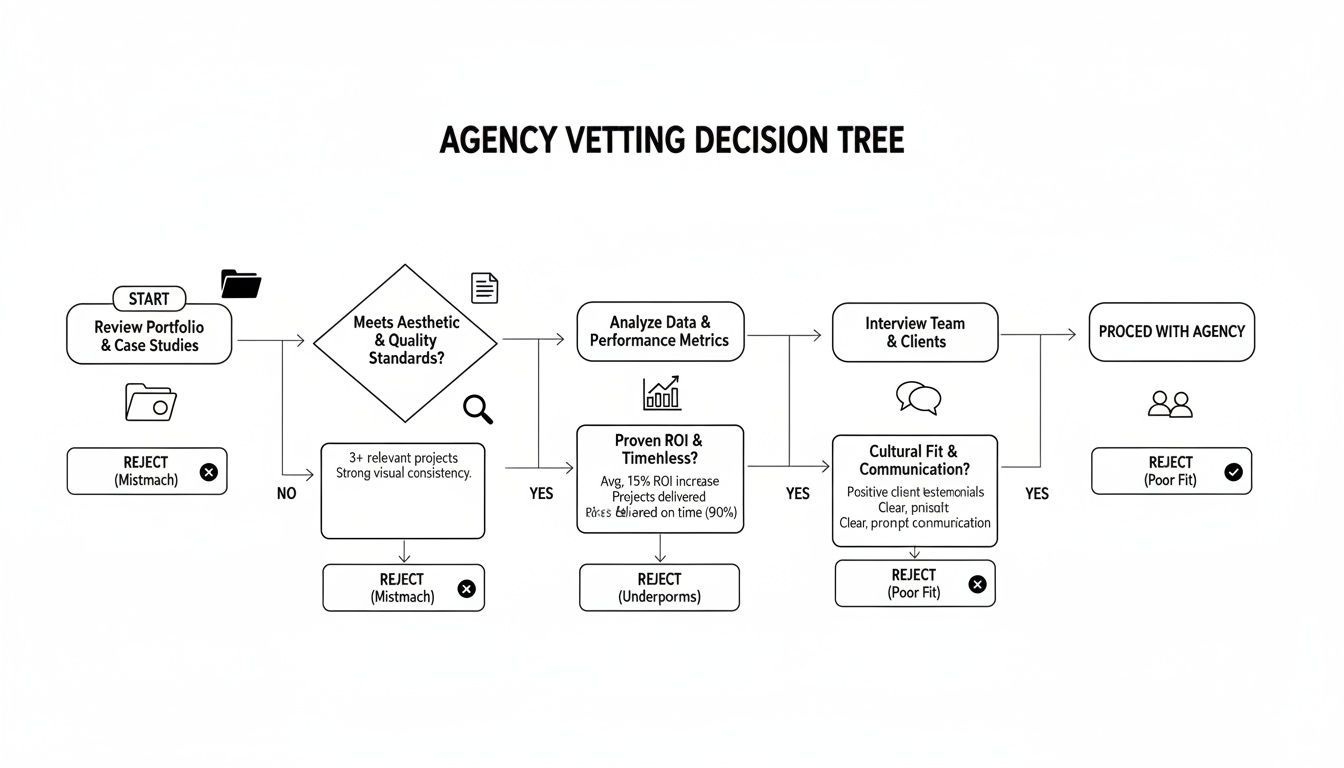
This kind of systematic approach is your best defense against making a costly wrong turn. It ensures you’re comparing apples to apples and making a choice based on evidence, not just a gut feeling.
Nail Down Their Strategic Approach and ROI Focus
You're not just hiring a pair of hands to execute tasks; you're hiring a brain. The best agencies are strategists first. They need to show you how they think, not just what they do.
Ask them to walk you through their process for a new client. How do they get from your high-level business goals to a concrete marketing plan? If their answer is just a list of tactics, that's a problem. A strong strategic framework should always include:
- Deep Discovery: They should be asking tons of questions about your customers, competitors, and market.
- Clear Strategy: A documented plan that connects channels, messaging, and measurable KPIs.
- Smart Execution: A process for not just launching campaigns, but for constantly monitoring and tweaking them.
- Transparent Reporting: A commitment to showing you the good, the bad, and the ugly, and explaining what it all means.
An agency that talks more about their creative process than your ROI is a major red flag. The best partners are business-minded. They know that a beautiful ad that doesn't make the phone ring is a failure.
Tying their work back to revenue is non-negotiable. If they get squirmy when you ask how they measure success, it's time to move on. To arm yourself for this conversation, you can check out our guide on how to calculate marketing ROI to get comfortable with the metrics that truly matter.
Scrutinize Their Tech Stack and Approach to AI
The tools an agency uses are a direct reflection of their efficiency and sophistication. Don't hesitate to ask for a look under the hood. Are they running on modern, best-in-class platforms for analytics, automation, and reporting?
Clinging to outdated software means they're wasting time—your time and your money. A modern agency should have a powerful tech stack to manage everything from deep-dive SEO audits with tools like Ahrefs to complex project management in Asana.
Beyond that, ask them how they’re using Artificial Intelligence. AI isn’t just a buzzword anymore; it’s a fundamental tool for supercharging research, personalizing campaigns, and making sense of huge datasets. Get specific with your questions:
- How are you using AI to find new keyword opportunities or optimize ad bids?
- What tools are you using for predictive analytics or AI-assisted content creation?
- What's your governance policy for using AI? How do you ensure accuracy and brand safety?
An agency that can give you clear, practical answers is one that's built for the future. If you just get vague hand-waving about "using AI for everything," they likely don't have a real strategy.
Find the Right Pricing and Agency Model
Not all agencies are structured the same way, and their pricing models can vary dramatically. Understanding these differences is key to finding a partner that aligns with your budget and how you like to work. Some are full-service shops, while others are boutique specialists. Each has its pros and cons.
Here’s a breakdown of the most common models to help you see what might be the best fit.
Comparing Agency Models and Pricing Structures
This table compares common marketing agency models and their typical pricing structures to help you identify the best fit for your budget and needs.
| Agency Model | Best For | Common Pricing Structures | Pros | Cons |
|---|---|---|---|---|
| Full-Service Agency | Enterprises or companies needing a single, integrated marketing partner. | Retainer, Project-Based, Custom Packages | One-stop shop for all needs; cohesive strategy; single point of contact. | Can be expensive; may lack deep specialization in niche areas; less flexible. |
| Boutique/Specialist | Businesses with a specific, well-defined need (e.g., just SEO or just PPC). | Retainer, Hourly, Performance-Based | Deep expertise in one area; often more agile and innovative. | Can lead to siloed strategies if you hire multiple; narrow focus. |
| Freelancer/Consultant | Startups, small businesses, or projects with limited scope and budget. | Hourly, Project-Based | Cost-effective; highly flexible; direct communication. | Limited bandwidth; lacks the resources of a full team; potential reliability issues. |
| In-House Team | Large companies with the resources to build and manage their own talent. | Salaries & Benefits | Deep brand knowledge; full control and alignment; quick turnaround. | Very high overhead; difficult to attract and retain top talent; risk of skill gaps. |
Choosing the right model is a strategic decision. A full-service retainer might offer stability and scale, while a performance-based deal with a specialist can be great for a specific, measurable goal like lead generation. Weigh your needs against these structures before you get too far down the road.
Don’t Underestimate Cultural Fit and Communication
This might sound like a soft skill, but it's critically important. You're about to enter a close partnership. You need to work with people you trust and, frankly, people you like. You'll be in the trenches with them, navigating challenges and (hopefully) celebrating big wins.
Pay attention to the vibe during your meetings. Do they listen more than they talk? Are they asking smart, insightful questions about your business, or are they just waiting for their turn to pitch? A great partner feels like a natural extension of your team—they're collaborative, transparent, and genuinely invested in seeing you succeed.
Before you sign anything, get clear on what communication will look like.
- Rhythm: Are we talking weekly calls and a monthly report, or do you need a shared Slack channel for daily updates?
- Contact: Who is my day-to-day point person? Are they a senior strategist or a junior account coordinator?
- Reporting: Can I see a sample performance report? Is it customizable to show the metrics I care about most?
Setting these expectations upfront saves a world of frustration later. The right agency won’t just have the technical chops; they'll have a communication style that meshes with yours, creating a partnership built to last.
Asking the Right Questions During the Interview
So, the proposal looks solid, their case studies are compelling, and the agency’s reps are sharp. This is the make-or-break moment. The interview is where you cut through the polished sales pitch and see what’s really going on behind the curtain. It's your best chance to understand not just what they do, but how they actually think.
If you ask generic questions, you’ll get the same rehearsed answers they give everyone else. To really see if they have the expertise you need, you have to ask strategic, open-ended questions that push them off their script. This is how you find out if you're getting a true partner or just another task-oriented vendor.
Uncovering Their Strategic Process
First things first, test their problem-solving chops right then and there. Give them a quick snapshot of your biggest business challenge and ask them to think out loud. How they respond will tell you more about their strategic approach than any case study ever could.
Instead of a vague question like, "What would you do for us?", get specific:
- "Walk me through how you'd tackle our goal of increasing qualified leads by 25% in the next six months. What would your first 90 days look like?"
Pay close attention to their process. Do they immediately jump to tactics like "we'll run more ads," or do they start by asking smart, clarifying questions? A great agency partner will want to know about your target audience, current conversion rates, and the competitive landscape. They think like a strategist first, focusing on discovery before they start prescribing solutions.
Watch out for the one-size-fits-all pitch. If their proposed strategy sounds like it could be for any company in any industry, they haven’t really been listening. A true partner customizes their thinking to your specific situation.
Getting to Know the Real Team
The people who wine and dine you during the sales process are often not the ones who will be in the trenches with you, managing your account day-to-day. It is absolutely crucial to find out who you’ll actually be working with.
Don't be shy about asking direct questions about team structure.
- Who will be my daily point of contact, and what's their background? You need to make sure your account won't be handed off to a junior coordinator who is still learning the ropes.
- Can we meet the key team members who will actually be working on our account? Getting a few minutes with the strategist, content lead, or ad specialist who will be hands-on gives you a much better feel for their real expertise.
- What is your team’s current capacity? This is a polite way of asking if they're stretched too thin or if they have the bandwidth to give your account the focus it needs to succeed.
Scrutinizing Their Approach to Technology and AI
Let's be real—an agency’s effectiveness today is directly tied to how well they use technology, especially AI. A forward-thinking agency uses AI not as a buzzword, but as a core tool for getting an edge. It's a huge factor when you're deciding how to choose a marketing agency that can deliver results now and in the future. In fact, a whopping 89% of agencies are already using AI to get more done. You can see more insights in the 2025 digital agency industry landscape report.
Ask them point-blank how they integrate AI into their workflow. Are they using it for market research, campaign execution, or digging through analytics? An agency that can clearly explain its AI strategy for things like predictive analytics for SEO or smarter bid optimization in paid media is an agency built for the modern world.
Clarifying Communication and Reporting
Nothing sours an agency partnership faster than a mismatch in communication expectations. Before you even think about signing a contract, you need a crystal-clear picture of what the day-to-day working relationship will feel like.
- What's your typical communication rhythm? Are we talking weekly calls? Monthly reports? A shared Slack channel for quick questions?
- Can you show us a sample performance report? When you see it, check if it connects marketing efforts directly to business goals like revenue and customer acquisition cost. You don't want a report full of vanity metrics like clicks and impressions.
- How do you handle it when a campaign isn't hitting its goals? Their answer here is telling. It reveals their commitment to transparency and accountability. A good partner will have a clear process for figuring out what went wrong, telling you about it openly, and pivoting the strategy.
Finalizing the Contract and Setting Up for Success

You’ve made it through the proposals, the interviews, and the tough decisions. You've picked your agency. The finish line is just ahead, but this last stretch is where a good partnership is either made or broken.
Signing the contract and kicking off the onboarding process sets the entire tone for your future together. Don't rush it.
A solid contract is so much more than a legal formality; it's the actual blueprint for your working relationship. It's what you'll both refer back to when questions come up, preventing misunderstandings and making sure everyone is on the same page. It’s your job to read every single line.
Scrutinizing the Service Level Agreement (SLA)
The Service Level Agreement, or SLA, is the beating heart of your contract. This is where you get past the high-level promises and nail down the specifics of what the agency will actually deliver.
Your SLA needs to be airtight. If any of the following points feel vague or are missing entirely, you need to push for more detail before putting pen to paper.
- Scope of Work: Get granular here. "SEO Services" isn't enough. A good SLA will say something like, "Monthly keyword research, on-page optimization for 10 pages, and securing 4 high-authority backlinks."
- Key Deliverables: What are you actually getting? This needs to be spelled out. Think tangible outputs like a monthly performance report, two new blog posts per week, or a fully managed PPC campaign.
- Performance Metrics (KPIs): This is non-negotiable. How will you both define success? The KPIs have to tie directly back to your business goals. For example: "achieve a 15% increase in Marketing Qualified Leads (MQLs) by Q3" or "maintain a Customer Acquisition Cost (CAC) below $50."
- Reporting Cadence: How often will you get updates, and what will they look like? The SLA should specify whether reports are weekly, bi-weekly, or monthly and what metrics they will include.
As you finalize the contract, it’s also a smart move to talk about performance-based compensation. Tying a portion of their fee to hitting specific goals is a powerful way to make sure their incentives are perfectly aligned with yours.
Key Clauses You Cannot Ignore
Beyond the SLA, a few other clauses are critical for protecting your business. Any reputable agency will have these in their standard agreement, but you need to double-check that they work for you.
First up is the termination clause. What’s the exit plan if things go south? Most agreements have a 30- or 60-day notice period, which is standard. Just make sure the terms are reasonable and you aren't locked into a long-term deal with no way out if the agency underperforms.
Next, look for ownership of work. You must retain full ownership of every creative asset, piece of content, and ad account created for your brand. This is crucial—it prevents an agency from holding your assets hostage if you decide to part ways.
Finally, a confidentiality clause is a must-have to protect your sensitive business data.
The contract isn’t an obstacle to get through; it's a tool for building a strong foundation. A transparent, detailed agreement is a sign that you're working with a professional agency that values clarity and accountability.
The Onboarding Checklist for a Fast Start
With the ink dry on the contract, it's go-time. A messy, disorganized onboarding can kill momentum before you even get started. The real goal here is to arm your new agency with everything they need to start delivering value right away.
Don't make them chase you for information. Get an "onboarding kit" ready with all the essential assets and access credentials they'll need.
Here’s a quick checklist of what to hand over:
- Brand & Style Guides: Logos, color codes, fonts, and especially your brand voice guide. This lets them hit the ground running with on-brand content.
- Audience Personas: Who are your ideal customers? Share those detailed profiles—their pain points, their goals, and where they spend their time online.
- Access to Key Accounts: Grant them the right permission levels for Google Analytics, Google Ads, your social media profiles, and your website CMS.
- Past Performance Data: Give them access to any previous marketing reports. This historical context is pure gold for their strategy development.
- Product & Service Info: The better they understand what you sell, the better they can market it. For service businesses, showing how you structure your offerings is key; you can see examples of how detailed web design pricing packages can be.
By providing all this information upfront, you empower your agency to skip weeks of discovery and jump straight into execution. It's the fastest way to start seeing a return on your investment.
Lingering Questions Before You Sign
Even after you’ve done all your homework, a few last-minute questions always seem to surface. These are the practical, “what if” scenarios that can make or break the first few months of your new partnership. Getting them answered now saves you a world of headaches later.
Let's walk through some of the most common things people ask right before they pull the trigger on a new agency.
What’s This Going to Cost Me?
This is the million-dollar question, isn't it? The honest, if unsatisfying, answer is: it really depends. Agency fees are all over the map, driven by the scope of work, their reputation, and the specific services you need.
A small local business might find a solid partner for a few thousand dollars a month. For a growing mid-sized company, it's not unusual to see retainers in the $5,000–$25,000+ per month range for a comprehensive strategy.
And for large enterprises with a ton of moving parts? Monthly retainers can easily top $50,000. The trick is to stop looking at the price tag and start looking at the value. You want an agency with clear, transparent pricing—like a fixed monthly retainer or straightforward project fees—so you can connect your investment directly to the results you expect.
Should I Go with a Full-Service or a Specialized Agency?
Knowing the difference here is critical to finding the right team for the job.
A full-service agency aims to be your all-in-one marketing department. They cover the whole spectrum—web design, SEO, content, paid ads, you name it. This is a great setup if you want one point of contact and a truly integrated strategy where your left hand knows what your right hand is doing.
A specialized agency, often called a boutique agency, goes incredibly deep on just one or two things. Think of a firm that only does high-stakes PPC management or technical SEO for e-commerce sites. They bring an elite level of expertise, making them the perfect choice when you have a specific, critical problem to solve and need the absolute best.
How Long of a Contract Should I Sign?
Most agencies will start with a six or twelve-month contract. That's pretty standard and, honestly, quite fair. It gives them enough time to get their strategies up and running, collect meaningful data, and actually start showing you some real progress. Good marketing, especially anything involving SEO, just doesn't happen overnight.
You might find some agencies willing to do a three-month trial, which can be a fantastic way to see how you work together before committing long-term.
My advice? Be wary of agencies pushing for extremely long contracts (like 24 months) right out of the gate, especially if there aren't clear performance milestones or an easy out-clause. A good contract gives the agency stability to produce results while giving you the flexibility to make sure the partnership is still working.
Ready to stop searching and start growing? Sugar Pixels is a full-service digital marketing agency that builds and scales your online presence with custom strategies that deliver real results. Let's build something amazing together. Learn more at Sugar Pixels.