

If you're asking, "how many keywords should I use for SEO?", you're asking one of the most common questions in the business. The answer, however, isn't a magic number. It's a strategic framework.
For any single page on your website, you should aim to target one primary keyword and then support it with a group of 3-5 secondary, related keywords. This structured approach keeps you from falling into outdated traps and helps you create content that modern search engines actually want to rank.
Thinking Beyond the Keyword Count
The way we talk about keyword strategy has evolved—a lot. Years ago, it was common to see people "stuff" their pages with dozens of keywords, thinking a wider net would catch more fish. Today, that approach is a recipe for disaster. It doesn't just fail; it can actively damage your site's reputation with search engines.
Google doesn't reward quantity. It rewards razor-sharp relevance and a fantastic user experience. The key is to shift your thinking from "how many" to "which ones and why." This gets back to the very basics of what is search engine optimization and how much it has matured.
A winning strategy starts with a clear hierarchy. Your primary keyword is the North Star for that specific page. It dictates your title, your main headings, and the core message you're trying to communicate. Think of it as the title of a chapter in a book—it sets the entire theme.
The Role of Secondary and LSI Keywords
Your secondary keywords are the supporting cast. They add the necessary depth and context, fleshing out the main topic. These are often synonyms, long-tail variations, or closely related concepts (sometimes called LSI keywords) that paint a complete picture for both users and search engines.
Let's say your primary keyword is "best running shoes for beginners." Your secondary keywords might look something like this:
- "comfortable running sneakers"
- "affordable athletic shoes for new runners"
- "what to look for in first running shoes"
- "cushioned running shoes for jogging"
See how they all orbit the main topic? This cluster signals to Google that your page is a comprehensive resource. It's not just a thin article about one term; it's a deep dive into the subject, which also helps you capture traffic from all sorts of related searches.
The guiding principle is this: One page should be the absolute best answer for one specific user need. Your keyword choices are simply the tools you use to build that answer. You're creating a topic-focused resource, not just a list of terms.
To get this right, you first need to understand what keyword optimization is at its core. It’s about precision, not volume.
The data backs this up completely. Research shows that roughly 50% of all searches are four words or longer. People are getting incredibly specific with their queries. When you try to cram too many unrelated keywords onto one page, you dilute its focus and destroy its ability to rank well for the most important term.
Keyword Targeting Quick Reference Guide
To make this easier to visualize, here’s a quick-reference table that breaks down how to approach keyword targeting for different types of pages on your website.
| Page Type | Primary Keywords | Secondary/LSI Keywords | Key Focus |
|---|---|---|---|
| Homepage | 1-2 (Broad/Brand) | 3-5 (Core services) | Brand identity & high-level value proposition |
| Service/Product Page | 1 (Transactional) | 3-5 (Features, benefits, variations) | Converting visitors by solving a specific problem |
| Blog Post/Article | 1 (Informational) | 5-8+ (Subtopics, questions) | Answering a user's question comprehensively |
| Landing Page | 1 (Campaign-specific) | 2-4 (Pain points, offer details) | Driving a single, focused action (e.g., sign-up) |
This table isn't about rigid rules but about providing a strategic starting point. Your main takeaway should be that every page needs a clear purpose, and its keyword strategy should directly support that purpose.
It's Not About How Many Keywords, It's About the Right Keywords
Let's be honest, trying to rank for huge, generic keywords feels like shouting into a hurricane. It's a game often dominated by the biggest players, and for a growing business, it's usually a fast track to disappointment. The real secret isn't about stuffing your site with as many keywords as possible; it’s about a strategic shift from quantity to quality.
Think of it like fishing. You could cast a massive, generic net (a "head term" like "shoes") into the ocean. Sure, you'll catch something, but most of it will be useless junk you have to throw back. All that effort for very little return.
Why Long-Tail Keywords are Your Secret Weapon
The smarter approach? Using the right bait. That's where long-tail keywords come in. These are the longer, more specific phrases people use when they're much closer to making a decision. They're not just looking for "shoes"; they're looking for "men's waterproof hiking boots size 11." See the difference? That's your ideal customer, and they're telling you exactly what they want.
This isn't just a hunch; the data screams it. A massive Ahrefs study found that a whopping 94% of all keywords get 10 or fewer searches per month. That's the long-tail, and it's a goldmine. People using these super-specific phrases are laser-focused, more engaged, and way more likely to convert. For more fascinating stats, check out this roundup of SEO facts and statistics on sixthcitymarketing.com.
When you start prioritizing quality, you also start paying closer attention to metrics like keyword difficulty, which helps you pick battles you can actually win.
The goal is to stop chasing empty traffic and start attracting qualified visitors who are actively looking for the solutions you provide. Long-tail keywords are your direct line to these high-intent customers.
Match Your Keywords to the "Why" Behind the Search
To find these golden-nugget keywords, you have to get inside your customer's head and understand why they're searching in the first place. This is called search intent, and it's the foundation of a successful strategy. If you get the intent wrong, nothing else matters.
Generally, search intent boils down to three main categories:
- Informational Intent: The user has a question. They’re in research mode, looking for answers, guides, or explanations. Think searches like "how to clean suede boots" or "what is a good laptop for college."
- Transactional Intent: The user has their wallet out. They're ready to buy something right now. These searches are direct and often include words like "buy," "deal," "coupon," or a specific product name like "iPhone 15 pro max price."
- Navigational Intent: The user is just trying to get to a specific website they already know. They're using Google as a shortcut. For example, typing "Facebook login" or "Sugar Pixels" into the search bar.
By carefully matching your keywords and your content to the user's intent, you stop just creating pages and start building a strategic resource. You're giving people exactly what they're looking for, right when they need it, which is what modern SEO is all about.
Crafting a Winning Page-Level Keyword Strategy
Now that we've established it's all about quality, not just counting keywords, let's get practical. A powerful SEO strategy isn't built overnight; it's constructed one page at a time. Think of each piece of content as a specialized magnet, designed to attract a very specific audience. The goal isn't to be everything to everyone—it's to be the perfect answer for someone.
This all starts by choosing one primary keyword for each page. This single phrase acts as your North Star, defining the page's entire purpose. It's the guiding force behind everything from your main title to the body copy, setting the theme for the conversation you're about to have with your reader.
Finding Your Supporting Cast of Keywords
Of course, a good conversation is never one-sided. You wouldn't just repeat the same phrase over and over, would you? That’s where semantic keywords come in. You might also hear them called secondary or LSI keywords, but the idea is the same: they are all the related terms, synonyms, and sub-topics Google expects to find in a thorough discussion.
Let's imagine your primary keyword is "best indoor plants for beginners." Your semantic keywords would naturally be things like:
- Low-maintenance houseplants
- Easy-to-care-for indoor plants
- Snake plant care
- Best plants for low light
- How not to kill your houseplants
Sprinkling these terms throughout your content shows search engines that you have real topical depth. You’re not just skimming the surface; you're providing a genuinely helpful, well-rounded resource that covers all the bases.
Key Takeaway: A well-optimized page doesn't just answer the main query (the primary keyword). It also anticipates and answers all the related follow-up questions and concepts (the semantic keywords) that a user probably has in mind.
Where to Place Keywords for Maximum Impact
Okay, you've got your primary keyword and a small, potent cluster of 3-5 strong semantic keywords. What now? The final step is to place them naturally within your content. The key here is to prioritize readability and relevance, not robotic stuffing. Proper keyword placement is a cornerstone of effective on-site optimization.
Here’s a simple checklist of the most important spots to put your keywords:
- Page Title (H1 Tag): This is your headline. Your primary keyword absolutely needs to be here, and the closer to the beginning, the better. It’s arguably the single most important on-page signal.
- SEO Title & Meta Description: These are what people see in the search results. Including your primary keyword here is your sales pitch to get them to click.
- Subheadings (H2s, H3s): Use your primary and secondary keywords in your subheadings. This not only helps Google understand the page structure but also makes it skimmable for readers.
- Introduction: Mention your primary keyword somewhere in the first 100 words. This immediately confirms the page's topic for both people and search engine crawlers.
- Body Content: Weave your primary and semantic keywords throughout the text. Don't force it. If you're writing high-quality, comprehensive content, this should happen almost on its own.
- Image Alt Text: Describe your images for accessibility and search engines. If a keyword fits naturally into the description, use it.
By adopting this page-level framework, you can stop asking "how many keywords should I use?" and start building content that is truly engineered to rank.
Scaling Your Strategy with Smart Keyword Mapping
Getting one page to rank is a good start, but building a truly successful website means thinking bigger. You need a site-wide game plan, and that’s where keyword mapping comes in. It’s essentially a blueprint that assigns specific keywords to specific pages, turning your SEO efforts from a scattered bunch of tactics into a cohesive, powerful strategy.
Think of your website as a well-organized library. Each book (or page) has a clear, specific topic. If you had ten different books all trying to be the definitive guide on the exact same narrow subject, it would just create confusion. A keyword map is your library's catalog, making sure every page has its own distinct purpose.
This process helps you sidestep a common and frustrating SEO pitfall: keyword cannibalization. This is what happens when two or more of your own pages end up competing for the same primary keyword. When search engines see this, they get confused about which page is the real authority, and as a result, they often rank all of them lower. A good map prevents you from accidentally competing against yourself.
Building Your Keyword Blueprint
The idea is simple in practice. For every important URL on your site, you’ll assign one primary keyword and a small, related cluster of secondary keywords. This gives every page a unique job to do.
This visual hierarchy breaks down the structure for a single page. Your keyword map simply scales this model across your entire site.
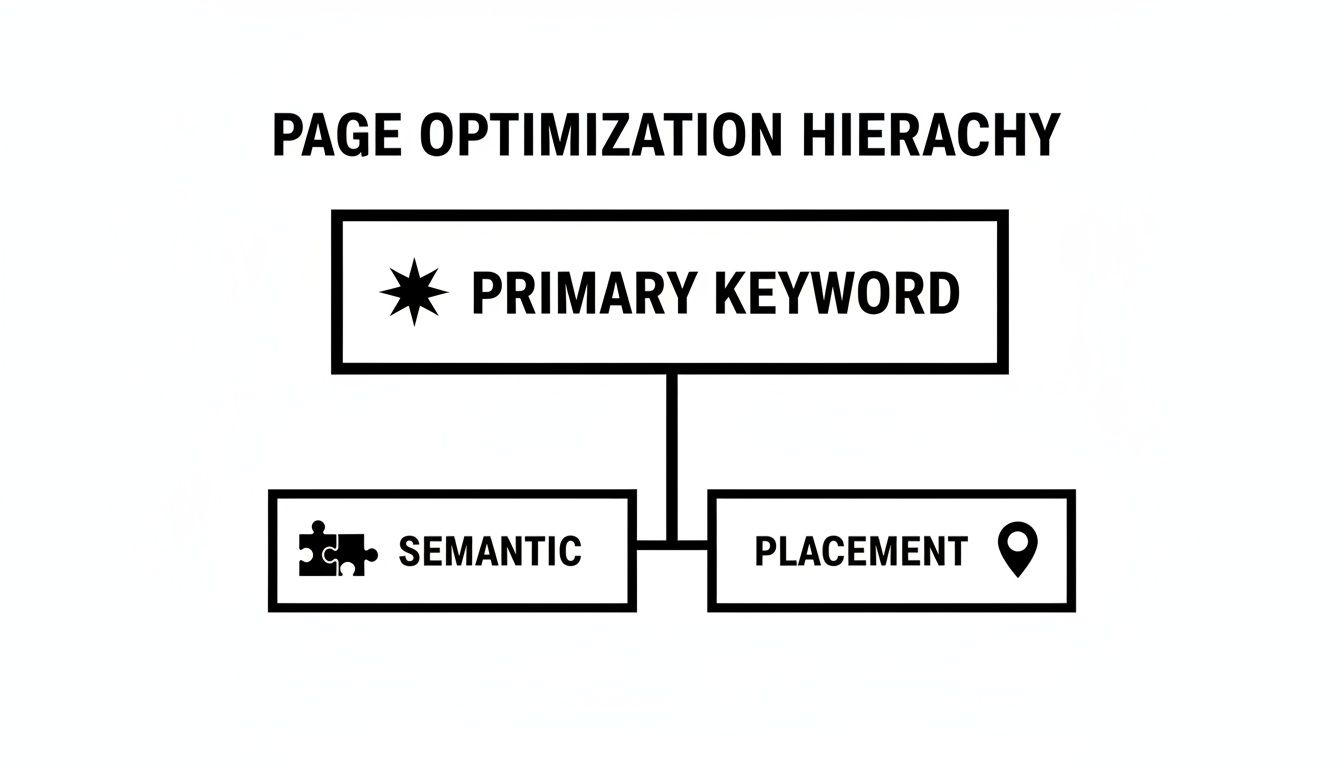
As the diagram shows, a single, clear Primary Keyword acts as the north star for the page's content. It's supported by closely related semantic terms and placed in all the right spots.
With a map, you can strategically match the user's intent to the right type of page. For instance, you'd want to map:
- Transactional keywords like "buy waterproof hiking boots" directly to your product or category pages.
- Informational keywords like "how to break in hiking boots" to helpful blog posts or guides.
- Navigational keywords like "[Your Brand] return policy" to your dedicated policy page.
To see how this works in practice, here's a simple keyword map for an e-commerce store that sells shoes. Notice how each URL has a distinct job and targets a different set of terms to avoid overlap.
Sample Keyword Map for an Online Shoe Store
| URL | Page Type | Primary Keyword | Secondary Keywords | Search Intent |
|---|---|---|---|---|
| /womens-running-shoes | Category | women's running shoes | best running shoes for women, ladies running trainers | Commercial |
| /womens-running-shoes/product-abc | Product | [Brand] Model ABC running shoe | Model ABC review, where to buy Model ABC | Transactional |
| /blog/best-running-shoes-for-beginners | Blog Post | best running shoes for beginners | what to look for in running shoes, first running shoes | Informational |
| / | Homepage | online shoe store | buy shoes online, footwear shop | Navigational |
| /sale | Sale | shoe sale | discount shoes, footwear clearance | Transactional |
This table clearly shows how to build a logical structure that guides users—and Google—to the right place every time.
Ultimately, a keyword map is more than just a spreadsheet. It’s the architectural plan for your website’s authority and search visibility. By giving every page a unique purpose, you create a structure that's easy for both people and search engines to understand, paving the way for long-term SEO success.
Putting Your Keyword Strategy into Action
Okay, we've covered the theory. Now it's time to see what this all looks like in the real world. After all, a keyword strategy is only useful if it actually brings in traffic and helps you grow. The question "how many keywords should I use?" really starts to make sense when you see it applied.
Let's walk through a few examples for different types of businesses: a SaaS startup, an e-commerce shop, and an affiliate marketer. For each one, we'll break down the primary keyword they're targeting, the secondary keywords they're weaving in, and the thinking behind it all. This should give you a solid blueprint to adapt for your own site.
Example 1: The SaaS Startup
Imagine a brand-new project management software company. Their ideal customers are small business owners who feel completely swamped and disorganized, but they aren't necessarily searching for a "project management tool" just yet. They know they have a problem, but they don't know the solution.
Their content needs to meet these people where they are. A perfect starting point is an informational blog post that tackles one of their biggest headaches.
- Primary Keyword: "how to organize team projects"
- Secondary Keywords: "project management tips for small teams," "best way to track multiple projects," "simple project organization tools," "keeping team tasks on track"
- The Thinking: The primary keyword hits their exact pain point. The secondary keywords are just natural variations of that core problem—the little questions that pop into their heads. By building a single, comprehensive article around this cluster, the startup can rank for dozens of related queries. They become a trusted resource before they ever ask for a sale.
This is a classic top-of-funnel play. By focusing on the problem first, the startup attracts the right kind of people and builds trust by offering genuine help. When those readers are finally ready for a tool, this company is the obvious choice.
Example 2: The E-commerce Store
Next up, let's picture an online store selling high-end, eco-friendly coffee beans. Their goal is simple: sell coffee. That means their keywords need to scream commercial and transactional intent. They want people who are ready to pull out their credit cards.
For a specific product page, the keywords have to be laser-focused on what a serious coffee lover would actually type into Google.
- Primary Keyword: "organic single origin ethiopian coffee beans"
- Secondary Keywords: "light roast ethiopian yirgacheffe," "ethiopian coffee tasting notes," "buy fair trade ethiopian coffee," "whole bean ethiopian coffee"
- The Thinking: That long-tail primary keyword is incredibly specific. Anyone searching for that knows exactly what they want. The secondary keywords are there to catch all the related details a buyer might care about—roast level, specific regions like "Yirgacheffe," and buying terms like "buy fair trade." This tight focus ensures the page attracts highly qualified shoppers who are way more likely to convert.
Example 3: The Affiliate Marketer
Finally, let's look at an affiliate marketer who runs a review site for home office gear. Their entire business hinges on catching people right at the end of their buying journey. These are the searchers who are comparing their final options and just need one last nudge.
The content has to be built around keywords that signal "commercial investigation"—the searcher has done their homework and is now ready to compare and buy.
- Primary Keyword: "best standing desk converters 2024"
- Secondary Keywords: "top rated sit stand desk converters," "standing desk converter reviews," "varidesk vs fully jarvis converter," "affordable desktop riser"
- The Thinking: The primary keyword is a slam dunk. It's the classic "best of" search that people use when they're ready to see a comparison. The secondary terms add more firepower by including phrases like "reviews," specific brand showdowns ("Varidesk vs Fully"), and budget-conscious modifiers like "affordable." This strategy perfectly positions the affiliate as the ultimate guide to help someone make that final buying decision.
Measuring Success and Refining Your Approach
Getting your keyword-optimized content live is a huge milestone, but it’s definitely not the finish line. A winning SEO strategy is never static. It’s a living, breathing thing that you have to monitor and adjust. The initial question of "how many keywords should I use" quickly becomes less important than "are my chosen keywords actually working?"
This is where the data comes in. You have to track performance to see what’s connecting with search engines and, more importantly, with your audience. If you're not measuring, you're just guessing.
The good news? You don't need a bunch of expensive tools to get going. Google Search Console is a completely free and incredibly powerful platform that gives you a direct line of sight into how your site is doing on Google. Think of it as your single source of truth for tracking keyword success.
Key Performance Indicators to Monitor
When you first open up your analytics, it's easy to feel a little overwhelmed. To cut through the noise, you really only need to focus on a few key metrics that tell the most important parts of the story. These numbers will show you which pages are pulling their weight and which ones need a little help.
Here are the essential metrics to keep your eye on:
- Keyword Rankings: This is the most obvious one. You need to know where your pages are actually showing up for your main keywords. Are you hitting page one, or are you buried back on page five?
- Click-Through Rate (CTR): This percentage tells you how many people saw your page in the search results and then actually clicked on it. A low CTR, even with a good ranking, often means your title tag and meta description just aren't grabbing people's attention.
- Organic Traffic: Simply put, how many visitors are landing on your site from search engines? You should see steady, upward growth here as your keyword strategy starts to work its magic.
- Impressions: This is just the number of times your page was shown in the search results. Seeing impressions rise for a target keyword is a fantastic early sign that Google is starting to view your page as a relevant answer.
Watching these numbers consistently lets you spot trends, celebrate what's working, and catch underperforming content before it becomes a bigger problem. This is a fundamental part of any solid SEO routine.
Conducting a Quarterly SEO Review
Doing a deep-dive analysis every single week is probably overkill, but letting your strategy run on autopilot for a whole year is a recipe for disaster. A quarterly review really hits that sweet spot. It gives you a structured way to make smart, data-driven decisions about your content and keyword targeting.
A quarterly review isn't about starting from scratch. It's about intelligent refinement—pruning what isn't working, nurturing what is, and planting seeds for new growth.
Think of it as a regular health checkup for your website. This is the perfect time to dig into your data and ask the tough questions. Are my primary keywords bringing in the right kind of visitors? Are there new long-tail opportunities I've overlooked? This process is a core part of learning how to do an SEO audit on your own work.
By regularly refining your plan, you ensure your keyword strategy stays effective, relevant, and perfectly aligned with your business goals. It’s the final, crucial step in turning your SEO efforts into a reliable engine for long-term growth.
A Few Common Questions We Hear All the Time
As you start piecing together your keyword strategy, a few classic questions always pop up. Let's clear the air on these so you can move forward with confidence and avoid some common pitfalls.
Getting these right is the difference between an SEO strategy that works and one that just spins its wheels.
So, What's the Deal with Keyword Density?
Remember the old days of SEO? People used to talk endlessly about keyword density—the percentage of times your keyword appeared on a page. The idea was to hit some "magic" number.
Thankfully, that era is long gone.
Today's search engines are incredibly sophisticated. They understand context, synonyms, and the overall topic of a page. Obsessively stuffing your keyword to hit a certain percentage will only make your writing sound robotic and unnatural. It’s a great way to annoy your readers and a bad way to try and impress Google.
As a general rule of thumb, a natural keyword density often lands around 1-2%. But here's the secret: don't even think about it. If you've done your research and you're writing a helpful, comprehensive piece about your topic, the keywords will appear naturally. Focus on writing for humans first.
Can I Go After the Same Keyword on a Bunch of Different Pages?
This is a huge one, and the answer is a firm "no." When you target the same main keyword across multiple pages, you create a problem called keyword cannibalization.
Think of it like this: you're making your own pages fight each other for the top spot. Google gets confused, doesn't know which page is the real authority, and often ends up ranking all of them lower as a result. You're splitting your own strength.
The fix is smart keyword mapping. Every important page on your site needs its own unique primary keyword. If you discover you have a cannibalization problem, here’s how to handle it:
- Combine and Conquer: Find the competing pages, take the best parts from each, and merge them into one powerhouse "pillar" article. Then, redirect the old URLs to the new one.
- Re-optimize: Keep the pages separate, but shift the focus of the weaker ones. Tweak them to target different, more specific long-tail variations of the original keyword.
How Often Should I Revisit My Keyword Plan?
A keyword strategy isn't a one-and-done project. Markets shift, customer language changes, and your competitors are always making moves. You have to stay on your toes.
We recommend doing a deep dive into your entire keyword map at least annually. This is your chance to zoom out and make sure your big-picture strategy still makes sense for your business goals.
But you can't wait a full year to check in. A quarterly review is perfect for tactical adjustments. This is when you'll spot new opportunities, find content that's starting to slip, and identify articles that could use a quick refresh to jump back up in the rankings.
Ready to build a website that's engineered for growth from the ground up? Sugar Pixels provides expert web design and SEO services to ensure your online presence doesn't just look great—it performs. Learn more at https://www.sugarpixels.com.