

Using email marketing to generate leads isn't just about sending newsletters. It’s a methodical process of building a targeted email list, then sharing valuable content that nurtures those subscribers until they're ready to become customers.
Think of it as creating a direct line to your audience. This connection allows you to build trust, establish your authority, and gently guide potential customers from casual interest to a real sales opportunity. It's an approach that consistently delivers a fantastic return because it’s all based on permission and personalized conversations.
Building Your Foundation for Lead Generation

Before you even think about writing a subject line, you need to lay the groundwork. A successful lead generation machine is built on a solid foundation, and that starts with a strategic mindset, not just a fancy email tool.
Your email list is one of the most valuable assets your business will ever own. Why? Because unlike your social media followers, you own your list. It gives you a direct, reliable channel to connect with your audience, free from the whims of algorithms.
This initial stage is all about figuring out who you’re talking to and what you want them to do. Getting this right from the start saves you a ton of wasted effort down the road. Without this clarity, even the most brilliant email campaign will fall flat.
Defining Your Ideal Customer and Goals
First things first: you need a crystal-clear picture of your ideal customer profile (ICP). This is way more than just age and location. You need to get inside their head and understand their world.
- What keeps them up at night? Your emails should offer the solution to their biggest problem.
- What are their aspirations? Frame your content around helping them reach their professional or personal goals.
- Where do they hang out online? Knowing what blogs they read or what podcasts they listen to informs the kind of content and lead magnets you should create.
Once you know your "who," you need to define your "what." Set specific, measurable goals for your program. Is your primary objective to generate a certain number of Marketing Qualified Leads (MQLs) each month? Or maybe you want to increase demo requests by 20%? These goals will be your north star.
Your email marketing isn't just about sending updates. It's a finely-tuned system designed to move a specific person from a state of awareness to a state of action. Every single component must serve this ultimate purpose.
Choosing the Right Email Marketing Platform
With your audience and goals locked in, it's time to pick your email service provider (ESP). Don't just sort by price. Think about where your business is headed. You need a platform that can grow with you, offering robust automation and integration capabilities.
Here are a few must-have features to look for:
- Automation Workflows: To build out nurture sequences that run on autopilot.
- Segmentation and Tagging: So you can send hyper-relevant messages based on subscriber behavior.
- A/B Testing: For optimizing everything from subject lines to send times.
- Reporting and Analytics: To actually track what's working and measure your ROI.
Building your list is the engine of this whole operation. To get started, check out our deep dive on https://www.sugarpixels.com/how-to-create-a-mailing-list/ for a ton of actionable advice.
Understanding the Email Lead Generation Funnel
The email lead generation funnel is simply the journey you guide people through. It’s not complicated and usually breaks down into three key stages:
- Top of Funnel (TOFU): This is all about attraction. You offer a valuable lead magnet to get new people to subscribe.
- Middle of Funnel (MOFU): Here, you nurture those new leads with educational content that builds trust and demonstrates your expertise.
- Bottom of Funnel (BOFU): This is where you convert those warmed-up leads with a compelling offer they can't refuse.
There's a reason so many businesses lean on email—it just works. In fact, around 78% of businesses see it as their main channel for getting new leads. Digging into the data, 48% of marketers say email is their most effective tactic, putting it ahead of both landing pages and content marketing.
This foundational work is what separates the campaigns that succeed from the ones that fizzle out. Get this right, and you're building a lead generation asset that will pay dividends for years to come.
Crafting Lead Magnets That People Actually Want
Let's be honest: a powerful lead magnet is the absolute cornerstone of your list-building efforts. It’s that irresistible offer that turns a casual browser into an engaged subscriber. We need to move past the generic "free ebook" that just sits in a downloads folder, gathering digital dust. The best lead magnets solve a very specific problem for a very specific person.
This isn't about creating some massive, exhaustive resource. It’s about delivering a quick, tangible win. If someone can use your lead magnet and see an immediate benefit, you've not only captured their email but you've also earned their trust right from the get-go. The entire goal is to align your offer so perfectly with their needs that signing up feels like a no-brainer.
Think about it in practical terms. A B2B software company could offer an interactive ROI calculator, helping a potential customer build a solid business case for their product. Or, an e-commerce brand selling skincare might create a 2-minute quiz that spits out a personalized routine. These work because they’re active, they’re personal, and they provide instant gratification.
Matching Your Offer to Your Audience
The secret to a lead magnet that converts like crazy is simple: relevance. You have to get inside your ideal customer's head. What's that one small, nagging problem you can solve for them, right now? A generic offer pulls in a generic crowd, but a specific offer attracts qualified leads who are far more likely to become customers down the road.
A great way to nail this is by thinking about where they are in their journey.
- Awareness Stage: Someone has just realized they have a problem. At this point, simple tools like a checklist, cheat sheet, or a handy template work wonders. They help organize thoughts without demanding a huge time commitment.
- Consideration Stage: Now, they're actively looking for solutions. This is your chance to shine with more in-depth content. A compelling case study, a live webinar, or a detailed guide can position you as the go-to expert.
- Decision Stage: They're on the verge of buying and are weighing their options. This is where offers like a free trial, a product demo, or a no-obligation consultation can be the perfect nudge to get them across the finish line.
The trick is to create something that lines up perfectly with a person's immediate needs. When you do that, your business becomes the obvious, helpful resource they were searching for all along.
Don’t just create content; create tools. A checklist someone can print and stick on their wall or a calculator they can bookmark and use again provides real, tangible value that a simple PDF often can't match. That utility is what makes your lead magnet memorable.
To help you get the ball rolling, here’s a look at some lead magnet ideas that are proven to work for different types of businesses.
Lead Magnet Ideas for Different Business Models
Choosing the right format is half the battle. This table breaks down some effective ideas tailored to specific business models, helping you pinpoint the best option for your audience and goals.
| Business Model | Lead Magnet Idea | Primary Goal | Example Scenario |
|---|---|---|---|
| SaaS | Interactive Template | Demonstrate Product Value | A project management tool offers a "Perfect Project Plan" template that users can fill out and use immediately. |
| E-commerce | Exclusive Discount Code | Drive First Purchase | An apparel store offers 15% off the first order in exchange for an email, encouraging an immediate sale. |
| Agency/Consulting | Free Consultation or Audit | Qualify High-Intent Leads | A marketing agency provides a free 15-minute website audit that reveals key areas for SEO improvement. |
| Online Courses | Free Mini-Course via Email | Showcase Teaching Style | An instructor offers a 5-day email course on a foundational skill, giving a taste of their full program. |
As you can see, the most effective lead magnets give a preview of the value you provide while directly addressing a user's immediate need.
Designing Signup Forms for Maximum Conversion
So you’ve got an amazing offer. Now what? You need a completely frictionless way for people to get it. Your signup form and landing page are the gatekeepers to your email list, which means their design and copy are absolutely critical. The mission here is to make the signup process as simple and intuitive as humanly possible.
Every single field you add to your form introduces friction and will chip away at your conversion rate. For a top-of-funnel offer, all you really need is an email address. Seriously, that's it. You can always gather more info later on as you build the relationship.
Where you place the form is also a game-changer. Don't just tuck a form in your website's footer and cross your fingers. You have to integrate your offer where it’s most relevant. For example, you could use an exit-intent pop-up on a blog post to catch visitors before they leave, or an embedded form within a related article that offers a "content upgrade." The context of your ask matters just as much as the offer itself.
Designing Your Automated Welcome and Nurture Funnel
Getting that new subscriber is a huge win, but it’s just the first step. What happens in the next few moments, hours, and days is absolutely critical. It’s where you set the tone for the entire relationship. If they get silence, a clunky delivery, or an aggressive sales pitch, you've likely lost them for good.
This is where a thoughtful, automated funnel becomes your best friend.
An automated sequence makes sure every single lead gets a consistent, high-quality experience. It immediately delivers on the promise you made with your lead magnet and starts building a bridge of trust from day one. Instead of scrambling to follow up manually, you can create a journey that guides subscribers toward becoming customers—all while you focus on running your business.
Remember, this initial interaction isn't about making a hard sell. It's about making a fantastic first impression and reinforcing that giving you their email address was a smart move.
Crafting the Perfect Welcome Series
Your welcome email is, without a doubt, the most important message you'll ever send. These emails see ridiculously high open rates, often hitting over 60%. You absolutely have to make this first touchpoint count. It's your one big shot to deliver value, set expectations, and show off your brand's personality.
I’ve found that a strong welcome series usually runs for three to five emails over the first week. Here’s a simple, effective structure that works like a charm:
- Email 1 (Sent Immediately): Deliver the goods! Give them instant access to the checklist, guide, or template they signed up for. No hoops to jump through. Use this email to also give a warm welcome and hint at what's coming next.
- Email 2 (Day 2): Follow up with a valuable "quick win" related to their download. If you're a creative agency, maybe you share a short case study on how you helped a similar client achieve a specific result. The goal here is to provide more value and start building your authority.
- Email 3 (Day 4): Introduce your story. Who are you, and why do you do what you do? People connect with people, not faceless brands. Sharing a bit of your origin story or mission makes the whole experience feel more personal and real.
This simple flow creates a positive onboarding experience that feels less like a transaction and more like the start of a genuine conversation.
Think of your welcome series as the opening act. It’s not the main event, but it sets the stage perfectly. It should be helpful, engaging, and make your new subscriber excited for what’s coming next.
Building a Nurture Sequence That Builds Trust
Once you’ve rolled out the welcome mat, the real nurturing begins. This is the part where you gently guide someone from being a curious lead to a qualified prospect. The key here is to educate and solve problems, not just push for a sale. A great nurture sequence often tells a story or teaches a skill over several emails.
This flowchart breaks down the simple but powerful logic: start with their problem, offer your lead magnet as the solution, and get that all-important signup.
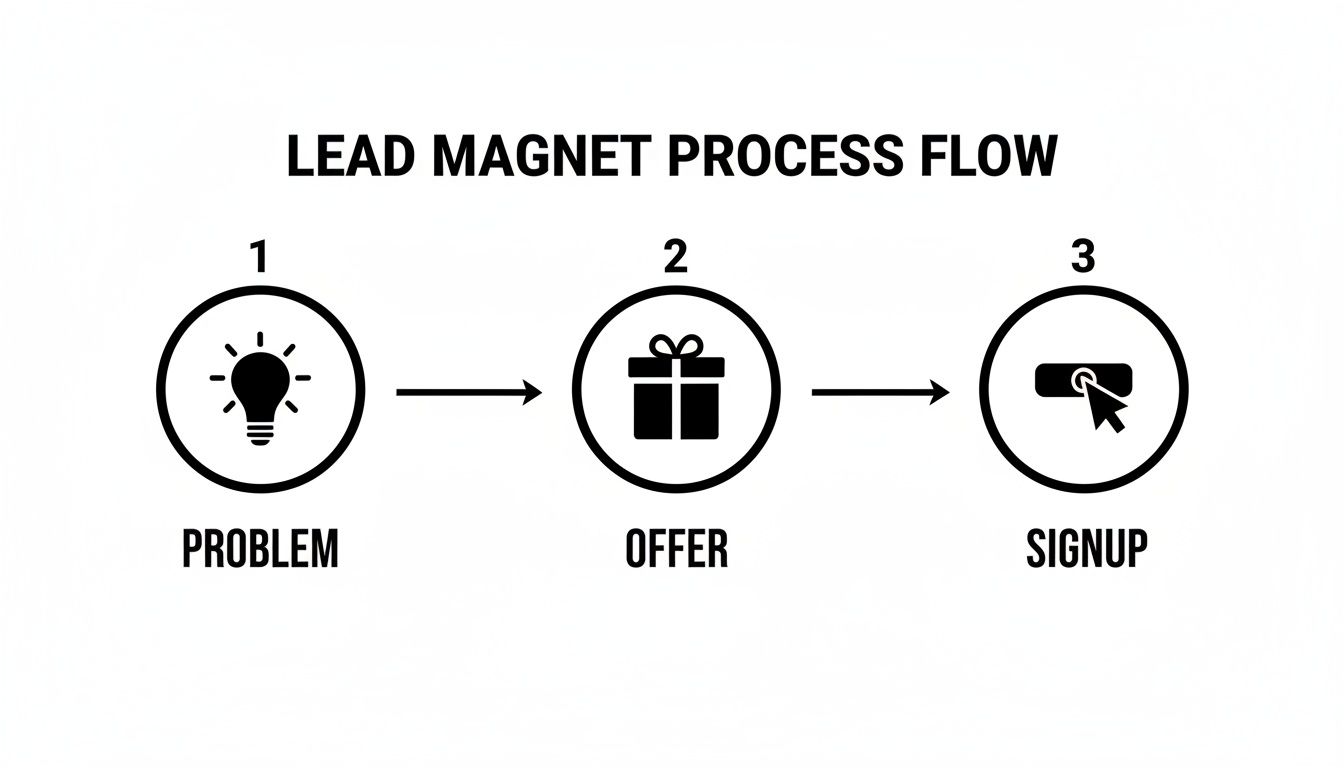
As you can see, a successful funnel always starts with empathy for the user's pain point. When you do that, your solution feels like the natural next step, not a sales pitch.
For example, a SaaS company could create a 5-day email mini-course that teaches users how to implement a core strategy their software helps with. Each email delivers one piece of the puzzle, building anticipation for the next. This positions the company as an expert and naturally introduces their product as the perfect tool for the job. To see how the mechanics work, you can check out this detailed guide on lead nurturing automation.
The power of this approach is amplified significantly with the right tools. Companies using marketing automation software see a remarkable 451% increase in qualified leads. And it’s no wonder—research shows that 82% of marketers use automation for triggered emails, which generate 8 times more opens and far higher revenue than standard bulk sends. This technology is the engine that runs modern email marketing.
Using Segmentation to Send the Right Message
If you’re sending the exact same email to every single person on your list, you’re on a fast track to the spam folder. People today expect relevance. If your messages feel generic, they'll just tune you out. This is where segmentation comes in, turning your email marketing from a one-sided monologue into a series of targeted, effective conversations.
Segmentation is really just the practice of breaking down your email list into smaller, more focused groups based on what they have in common. Instead of shouting one message at a massive crowd, you get to have hundreds of personalized conversations all at once.
And that shift is incredibly powerful. When you deliver content that actually speaks to a specific group's needs, engagement goes through the roof. People are so much more likely to open, click, and eventually buy when the message feels like it was written just for them.
Simple Ways to Start Segmenting Your List
You don’t need a fancy data science degree to get started. In fact, some of the most powerful segmentation tactics are surprisingly simple and you can put them to work right away. The key is to start grouping subscribers based on information you probably already have.
Here are a few practical ways to slice up your list:
- By Lead Magnet: Group people based on the specific checklist, webinar, or guide they downloaded. Someone who grabbed your "Beginner's SEO Checklist" has very different needs from the person who downloaded the "Advanced Link-Building Guide."
- By Website Behavior: Pay attention to which pages a lead has visited. If they’ve spent a lot of time on your pricing page or browsing a specific product category, that’s a huge signal of interest you can use to tailor your follow-up.
- By Engagement Level: Create segments for your biggest fans (people who opened or clicked in the last 30 days) and another for those who've gone quiet. You can send special offers to your loyal followers and run a re-engagement campaign to win back the others.
Once you’ve mastered the basics, you can explore more effective customer segmentation strategies to get even more granular. But the most important thing is to just start with what you know and build from there.
Moving Beyond a First Name with Personalization
Real personalization goes way beyond sticking a {{first_name}} tag in the greeting line. It’s about using the data you’ve gathered from segmentation to serve up dynamically relevant content. Most modern email platforms make this surprisingly easy, letting you show or hide entire sections of an email based on who's reading it.
This means you can send a single campaign that actually looks different to various people on your list.
Personalization is the difference between a subscriber feeling like a number and feeling like a valued individual. It shows you’re paying attention to their needs, which is how you build trust and drive action.
Think about these real-world scenarios:
- E-commerce Product Recommendations: An online store can show a "new arrivals" block featuring women’s clothing only to subscribers who've bought from that category before, while showing men's apparel to others.
- Targeted Offers: A software company can display a call-to-action for an advanced webinar to its power users, while showing a beginner-friendly tutorial to new subscribers—all within the same email broadcast.
- Behavior-Triggered Automations: The classic cart abandonment email is a perfect example. When someone adds an item to their cart but leaves, a personalized, automated email can gently remind them, often with a small discount, and recover a ton of otherwise lost sales.
This kind of tailored content feels helpful, not creepy. In fact, research shows that personalized emails can deliver six times higher transaction rates simply because they directly address what a subscriber has already shown interest in. By combining smart segmentation with dynamic content, you create an email experience that feels genuinely valuable, turning casual subscribers into engaged, qualified leads.
Measuring and Optimizing Your Email Performance

Here's a truth I've learned over years of running campaigns: a great email marketing strategy is never "done." It’s a living, breathing system that needs to adapt based on real data. Hitting 'send' on a campaign isn't the finish line; it's the starting gun. The real magic happens when you dive into the numbers, analyze what's working (and what's not), and systematically optimize your entire funnel.
This is where you shift from guessing to knowing. By adopting a data-driven mindset, you let your audience's actions—their clicks, opens, and conversions—guide your next move. This is how you turn a simple email list into a predictable, lead-generating machine.
Key Performance Indicators That Actually Matter
It’s incredibly easy to get lost in a sea of data. That’s why you need to focus on the metrics that directly impact lead generation and your bottom line. Forget the vanity metrics that look nice but don't mean much.
For a true picture of performance, keep a close eye on these KPIs:
- Signup Conversion Rate: This is the percentage of people who see your landing page or signup form and actually subscribe. If this number is low, it’s a red flag that your offer might not be compelling enough or there’s too much friction in the signup process.
- Open Rate: The classic metric showing how many people opened your email. It's an important first step, but just that—a first step. A good open rate varies wildly by industry, so it helps to understand what makes a good open rate for emails in your specific niche.
- Click-Through Rate (CTR): This tells you how many of the people who opened your email also clicked a link. A strong CTR means your message and offer resonated. A weak one means your copy or call-to-action fell flat.
- Lead-to-Customer Conversion Rate: This is the ultimate measure of success. It tracks the percentage of leads from your email efforts who eventually pull out their credit cards and become paying customers.
Don't make the mistake of looking at these numbers in isolation. A killer open rate but a terrible CTR often points to a fantastic subject line that the email body just couldn't live up to. The real insights come from connecting the dots between these KPIs.
To get a clearer picture, it helps to organize these metrics and understand what they're telling you.
Key Email Marketing KPIs for Lead Generation
| Metric (KPI) | What It Measures | Industry Benchmark | Optimization Tip |
|---|---|---|---|
| Signup Rate | % of landing page visitors who subscribe to your list. | 2-5% (Varies widely) | Test different lead magnet offers or simplify your signup form by removing non-essential fields. |
| Open Rate | % of recipients who open an email. | 21-40% | A/B test your subject lines. Try using personalization, asking a question, or creating urgency. |
| Click-Through Rate (CTR) | % of openers who click a link in an email. | ~3.25% | Make your Call-to-Action (CTA) a clear, action-oriented button. Test different copy and button colors. |
| Conversion Rate | % of clickers who complete a desired action (e.g., book a demo). | 2-3% | Ensure your landing page is a seamless continuation of the email's promise. A/B test headlines and CTAs. |
| Unsubscribe Rate | % of recipients who opt out of your list. | < 0.5% | Review your email frequency and ensure your content consistently delivers the value you promised at signup. |
Tracking these metrics gives you a dashboard for your lead generation engine, showing you exactly where you need to tune things up.
A Simple Framework for A/B Testing
A/B testing (or split testing) is your best friend for making steady, data-backed improvements. The idea is simple: you create two versions of an email, change just one thing, and see which one performs better with a slice of your audience.
To get the biggest bang for your buck, start by testing the elements that have the most impact.
High-Impact Elements to Test First:
- Subject Lines: This is your first impression. Test a direct, benefit-driven subject line against one that sparks curiosity. Think "Your New SEO Checklist Is Here" vs. "The #1 Mistake Killing Your SEO."
- Calls-to-Action (CTAs): The CTA is where the action happens. Experiment with button text ("Get Your Free Guide" vs. "Download Now"), colors, and placement within the email.
- Send Times and Days: Don't just guess when your audience is online. Test a Tuesday morning send against a Thursday afternoon one. The results might surprise you.
The golden rule of A/B testing: only change one variable at a time. If you change both the subject line and the CTA, you’ll have no idea which change was responsible for the lift (or drop) in performance. Small, consistent wins compound over time.
Troubleshooting Common Performance Issues
So, what do you do when the numbers just aren't hitting the mark? It's time to play detective.
If you’re seeing low open rates, your subject line is the most likely culprit, or perhaps your sender name isn't recognizable. Try making your subject lines more personal and intriguing.
Getting a lot of unsubscribes? That's a sign of a mismatch. You might be emailing too often, or the content isn't what people thought they were signing up for. Take a hard look at your email frequency and content alignment.
It's also crucial to ground your expectations in reality by looking at industry benchmarks. Across different sectors, email open rates average between 21.5% to 39.64%, and the average click-through rate hovers around 3.25%. When it comes to the final goal, conversion rates from email can hit 2.8% for B2C and 2.4% for B2B.
By systematically finding the weak spots and testing potential fixes, you create a powerful feedback loop that constantly strengthens your entire lead generation strategy.
Answering Your Top Email Lead Generation Questions
Even the best-laid plans run into snags. When you're deep in the trenches of email marketing, questions are inevitable. Think of this as part of the process—the constant tweaking and learning that separates the campaigns that fizzle out from the ones that drive real, predictable growth.
Let's walk through some of the most common questions I get asked, with practical answers to help you troubleshoot and refine your approach.
How Long Should My Nurture Sequence Be?
This is the big one, and the honest-to-goodness answer is… it depends. There’s no magic number.
That said, a fantastic starting point for most businesses is a 5-7 email sequence spread out over a couple of weeks. This gives you enough time to deliver on your promise, build a bit of trust, and introduce what you do without completely flooding someone's inbox. It's a solid balance between staying on their radar and giving them room to breathe.
Now, if you're in a complex B2B space with a long sales cycle, that sequence might stretch out for two months, with emails going out weekly. The real key is to watch your engagement. Are people still clicking by email #6? Great, you might have room to add a few more. Seeing a huge drop-off after email #3? It might be time to shorten the sequence and pack more punch into fewer messages.
Always, always choose quality over quantity.
How Do I Grow My List Without Website Traffic?
Starting with zero traffic feels like a classic chicken-or-the-egg problem, right? No visitors means no subscribers. The trick is to stop waiting for people to find you and go where they already are.
You need to take your best offer—that killer lead magnet you created—and put it in front of communities that are already thriving.
Here are a few ways to make that happen:
- Guest Posting: Find a popular blog in your niche and write an article that solves a genuine problem for their audience. The only "ask" is a link back to your landing page where they can get the lead magnet.
- Joint Webinars: Team up with another business that serves a similar audience but isn't a direct competitor. You co-host a live training session, promote it to both of your audiences, and share the leads. It's a win-win.
- Targeted Social Ads: Platforms like Facebook and LinkedIn are incredible for this. You can run a simple campaign promoting your lead magnet directly to users with specific job titles, interests, or even a lookalike audience based on your existing customers.
The strategy here is simple: borrow someone else's audience to build your own. When you show up with undeniable value in a place where your ideal customers already hang out, you give them a powerful reason to join your list.
Should I Clean My Email List? And How Often?
Yes, absolutely. This is one of the most overlooked but critical parts of keeping your email marketing healthy. Regularly removing inactive subscribers isn't just about tidiness; it’s about protecting your sender reputation.
When your list is full of people who never open your emails, inbox providers like Gmail and Outlook start to think your content is spammy. Before you know it, even your most engaged fans stop seeing your messages.
As a general rule, plan on doing a major list cleanup once or twice a year.
Even better, you can automate a lot of this. Set up a "re-engagement campaign" targeting anyone who hasn't opened an email in, say, 90 days. It's a short sequence designed to win them back. If they still don't engage, the system can automatically unsubscribe them. This keeps your list healthy, your deliverability high, and your audience full of people who actually want to hear from you.
Does This Work for Both B2B and B2C?
Without a doubt. The core ideas of email lead generation—giving value, building trust, making it personal—are universal. The big difference is in the execution: the tactics, the tone, and the time it takes to make a sale.
B2C (Business-to-Consumer) is often a faster, more emotional journey. The focus tends to be on:
- Promotions, flash sales, and exclusive discounts.
- Connecting on a personal level with great storytelling.
- Driving immediate actions, like recovering an abandoned cart.
B2B (Business-to-Business) is usually a longer, more logic-driven process. The goal is to build authority and prove your expertise over time. The focus here is on:
- In-depth educational content like whitepapers, case studies, and webinars.
- Nurturing leads differently based on their job title, company size, or industry.
- Guiding prospects toward a demo or a sales call, not an instant purchase.
In both worlds, segmentation is your best friend. A B2C brand might segment by past purchases, while a B2B company segments by the content someone downloaded. The strategy is the same; you just adapt it to the audience in front of you.
Ready to stop guessing and start growing? Sugar Pixels builds the high-performing websites and digital marketing engines that turn visitors into leads and leads into customers. Let us handle the technical details so you can focus on what you do best. Explore our services and see how we can help you scale.