

An email marketing plan is your strategic roadmap. It's a living document that lays out exactly what you want to achieve with your email campaigns, who you're talking to, what you'll send them, and how you'll know if it's working. Think of it less as a stuffy corporate document and more as a playbook that turns sporadic emails into a reliable source of revenue.
Why a Documented Email Marketing Plan Is a Game Changer
Let's be honest, many businesses just wing it. They send out a newsletter here, a promotion there, but it's all reactive. A documented plan forces you to be proactive. It provides a clear line of sight from your big-picture business goals—like boosting sales or keeping customers around longer—straight down to the individual emails you send.
For instance, an e-commerce store might notice a lot of abandoned carts. Instead of just hoping people come back, a planned strategy would involve setting up an automated email series to win back those potential sales. Or, a B2B company could map out a lead nurturing workflow to guide prospects from initial interest to a sales-ready conversation. These are intentional, strategic moves that come from a plan, not from guesswork.
The Power of a Strategic Roadmap
Writing down your plan does more than just keep you organized. It creates a single source of truth that gets your whole team on the same page. Your content creator, your sales team, and your marketing manager all know the objective, the message, and the desired outcome.
This alignment stops you from wasting time and money on mismatched efforts and ensures every customer interaction feels consistent. Suddenly, your email list isn't just a list of contacts; it's one of your most valuable business assets. With a solid plan, you can systematically build relationships, drive repeat business, and see a return on investment that’s hard to beat.
A documented plan transforms your email list from a simple contact database into a powerful communication channel that actively drives revenue and builds lasting customer loyalty.
Reaching an Engaged Global Audience
The sheer scale of email is staggering. By 2025, there will be an estimated 4.6 billion email users worldwide. Even more impressive? A whopping 99% of them check their email every single day.
With over 376.4 billion emails flying around daily, it's clear why 82% of marketers see it as a higher priority than social media. But all that volume means you absolutely need a plan to stand out.
To make sure you're covering all your bases right from the get-go, it’s a good idea to use a complete checklist for planning an email marketing campaign. It's a great way to ensure no critical step gets missed.
Defining Your Goals and Success Metrics
Before you even think about writing a killer subject line, you need to know what you're aiming for. A solid email marketing plan starts with a destination in mind. Without clear, measurable goals, you're just sending emails into the void and hoping for the best.
Vague ideas like "I want more engagement" are practically useless. They don't give you a real target to hit. Your email goals have to tie directly back to your business's core objectives—otherwise, what's the point? This is the difference between simply wishing for growth and actually building a strategy to achieve it.
Moving from Vague Ideas to Specific Targets
Let's get practical. It’s time to sharpen those fuzzy marketing goals into something you can actually build a plan around.
Instead of: "Get more sales."
Try this: "Boost revenue from our monthly promo emails by 20% over the next quarter."
Instead of: "Grow our subscriber list."
Try this: "Add 500 new, qualified email subscribers each month through our website's lead magnet."
Instead of: "Keep customers engaged."
Try this: "Hit an average click-through rate of 4% on our weekly newsletter."
See the difference? This kind of specificity gives every single email a purpose. Every campaign you run and every segment you create becomes a calculated move to get you closer to hitting those numbers.
Connecting Business Goals to Email Marketing KPIs
Once you know where you’re going, you need a dashboard to see if you’re on track. That's where Key Performance Indicators (KPIs) come in. These are the specific metrics that tell you if your strategy is actually working. The trick is to focus on the right ones for your business.
The table below breaks down how to align your big-picture business objectives with the email metrics that truly matter.
| Business Goal | Primary Email Marketing KPI | Example Tactic |
|---|---|---|
| Increase Sales Revenue | Conversion Rate & Average Order Value (AOV) | Send a "You Might Also Like" email with product recommendations post-purchase. |
| Generate More Leads | Click-to-Submission Rate | Promote an in-depth guide with a call-to-action to download it from a landing page. |
| Improve Customer Loyalty | Repeat Purchase Rate & Customer Lifetime Value (CLV) | Create a VIP email segment for top customers with exclusive early access to sales. |
| Build Brand Awareness | Click-Through Rate (CTR) & Social Shares | Send a weekly newsletter with valuable content and include social sharing buttons. |
| Reduce Subscriber Churn | Unsubscribe Rate | Run a re-engagement campaign for inactive subscribers before removing them from the list. |
By linking your tactics directly to KPIs and business goals, you ensure every email you send is a strategic asset, not just another piece of content.
Choosing the Right KPIs for Your Business Model
A common pitfall is getting obsessed with vanity metrics like open rates. Sure, a high open rate means your subject line worked, but it doesn't tell you if that email made you any money or moved a prospect closer to a sale.
My two cents: Always prioritize metrics that measure action over those that just measure attention. A high click-through rate is way more valuable than a high open rate, and a high conversion rate beats them all.
The KPIs you should live and breathe depend entirely on what you sell and who you sell to.
For an E-commerce Brand:
If you're running a store selling handmade leather goods, for instance, you're all about driving immediate sales and keeping customers coming back.
- Conversion Rate: This is your holy grail. What percentage of people clicked a link and actually bought something?
- Average Order Value (AOV): How much do people spend, on average, when they buy through an email link?
- Customer Lifetime Value (CLV): What’s the total revenue you can expect from a single customer over time? Email is huge for boosting this.
- List Churn Rate: How quickly are people unsubscribing? If this number is high, you might have a problem with your messaging or frequency.
For a B2B SaaS Company:
If you’re a software company with a six-month sales cycle, your focus shifts from instant purchases to long-term relationship building and lead nurturing.
- Lead Generation Rate: How many marketing-qualified leads (MQLs) did that webinar invite email actually produce?
- Click-to-Submission Rate: Of the people who clicked through to your new whitepaper landing page, how many actually filled out the form to download it?
- Lead Nurturing Engagement: Are leads in your long-term nurture sequence actually clicking on case studies and watching demo videos? This tells you if they're staying warm.
- Sales Cycle Velocity: Can you see a pattern where leads who engage with certain email campaigns end up closing faster?
Getting your goals and KPIs right from the start is the bedrock of any successful email strategy. It’s what transforms your email marketing from a line item on your budget into a predictable, data-driven engine for growth.
Get Smart with Your List: How to Segment for Emails People Actually Want to Read
Let's be honest: blasting the same generic email to your entire list is a one-way ticket to the unsubscribe button. If you want your email marketing to actually work, you have to stop broadcasting and start having real conversations. That’s where the magic of audience segmentation comes in.
Segmentation is simply the art of slicing your big email list into smaller, more focused groups based on what you know about them. Instead of shouting at a crowd with a megaphone, you get to have a more personal chat. This one shift can radically improve your open rates, click-throughs, and, most importantly, your sales.
Practical Ways to Slice Up Your Audience
The best segments aren't based on guesswork; they're built on cold, hard data. We're talking about information your subscribers give you, either by telling you directly or through their actions.
Here are a few of the most powerful ways to group your subscribers:
- Purchase History: This is a goldmine for any e-commerce store. Think about it: you can create special lists for first-time buyers, repeat customers, your big spenders (VIPs), or even people who've only bought a specific type of product.
- Website Behavior: Pay attention to what people do on your site. You can segment based on pages they’ve looked at, guides they’ve downloaded, or—a classic—if they’ve ditched items in their shopping cart.
- Email Engagement: Not everyone is a super-fan. It’s smart to create groups for your most engaged subscribers (the ones who open and click everything), those who are somewhat engaged, and the ones who’ve gone silent.
- Stated Preferences: Why guess when you can just ask? A simple preferences center in their account allows subscribers to tell you exactly what they want to hear about, whether it's product news or weekly tips.
Building your list is the first step, but understanding it is where the real work begins. If you're just starting out, our guide on how to create a mailing list that grows your business has some great foundational tips.
Let’s See Segmentation in the Wild
Imagine you run an online shop selling specialty coffee beans. Sending a single weekly newsletter just isn't going to cut it. You'd get much better results by creating a few strategic segments.
Example: "Three Peaks Coffee Co."
A savvy email plan for this coffee company would mean treating different subscribers differently, guiding them along their own unique path.
- The "New Subscriber" Segment: These are folks who just signed up but haven't pulled the trigger on a purchase yet. Your job here is to welcome and educate them. A great welcome series could introduce your brand's story, highlight what makes your coffee amazing, and maybe offer a little discount to nudge them toward that first buy.
- The "VIP Customer" Segment: This group is for your regulars—say, anyone who has spent over $200 in the last six months. They're your biggest fans. You want to keep them happy and loyal, so send them early access to new roasts, exclusive VIP-only deals, and maybe even a personal thank-you email.
- The "At-Risk Subscriber" Segment: These are the people who haven't opened an email or bought anything in 90 days. It’s time to try and win them back. A "We miss you!" campaign with a tempting offer or a quick survey asking for feedback can work wonders.
When you tailor your message like this, you’re no longer just a company pushing a product. You become a brand that gets it—a brand that understands its customers. That's how you build a loyal community, not just a faceless list.
Go a Level Deeper with Data Enrichment
For some businesses, especially in the B2B world, the basic details aren't enough. You've collected an email address, but you're only seeing a tiny piece of the puzzle. This is where data enrichment tools can be a game-changer.
For instance, using a People Enrichment API can take a simple email address and flesh it out into a full professional profile, giving you valuable info like their job title, company size, or industry. A SaaS company could use this to send a case study about startups to a founder and a different one about enterprise solutions to a marketing director. That kind of precision is what turns a good email plan into a truly great one.
Designing Your Content and Automation Workflows
Alright, you've figured out your goals and sliced your audience into neat, targetable segments. Now for the fun part: building the engine that will actually drive your email marketing. This is where we combine a smart content plan with powerful automation that works for you 24/7.
Think of it this way: your content is the valuable conversation starter, and automation is the system that delivers it to the right person at the perfect moment. When you get this right, it doesn't feel robotic at all. It feels personal, responsive, and incredibly helpful, guiding people from their first welcome email all the way to their tenth purchase.
Crafting a Content Calendar That Delivers Value
A content calendar is your sanity-saver. It’s the roadmap that stops you from scrambling for ideas at the last minute and keeps your emails consistent and on-brand. A great calendar is all about balance—mixing in your promotions with genuinely useful content that builds trust.
Here’s a simple way to build yours:
- Define Your Content Pillars: What are the 3-5 core topics your audience actually cares about? For a local coffee roaster, this could be brewing guides, new bean spotlights, behind-the-scenes stories, and local event partnerships.
- Map Out Your Campaigns: Decide on the different types of emails you'll send. This mix usually includes weekly newsletters, monthly special offers, big seasonal pushes (like for Black Friday), and major announcements.
- Set a Realistic Cadence: How often can you email without annoying your subscribers? For most, one or two newsletters a week is a great starting point. Your automated emails will then fill in the gaps.
Your calendar should be a living document. I use a simple spreadsheet to map out emails a month or two ahead, noting the topic, which segment gets it, the call-to-action (CTA), and what I'm measuring to call it a success.
Building Automated Workflows That Convert
Automation is the secret weapon of smart email marketing. These are just pre-built email sequences triggered by something a subscriber does (or doesn't do). They’re your always-on sales and relationship-building team.
This flow chart gives you a great visual for how you can send different automated campaigns to different customer groups—like your VIPs, first-time buyers, or people who haven't bought in a while.
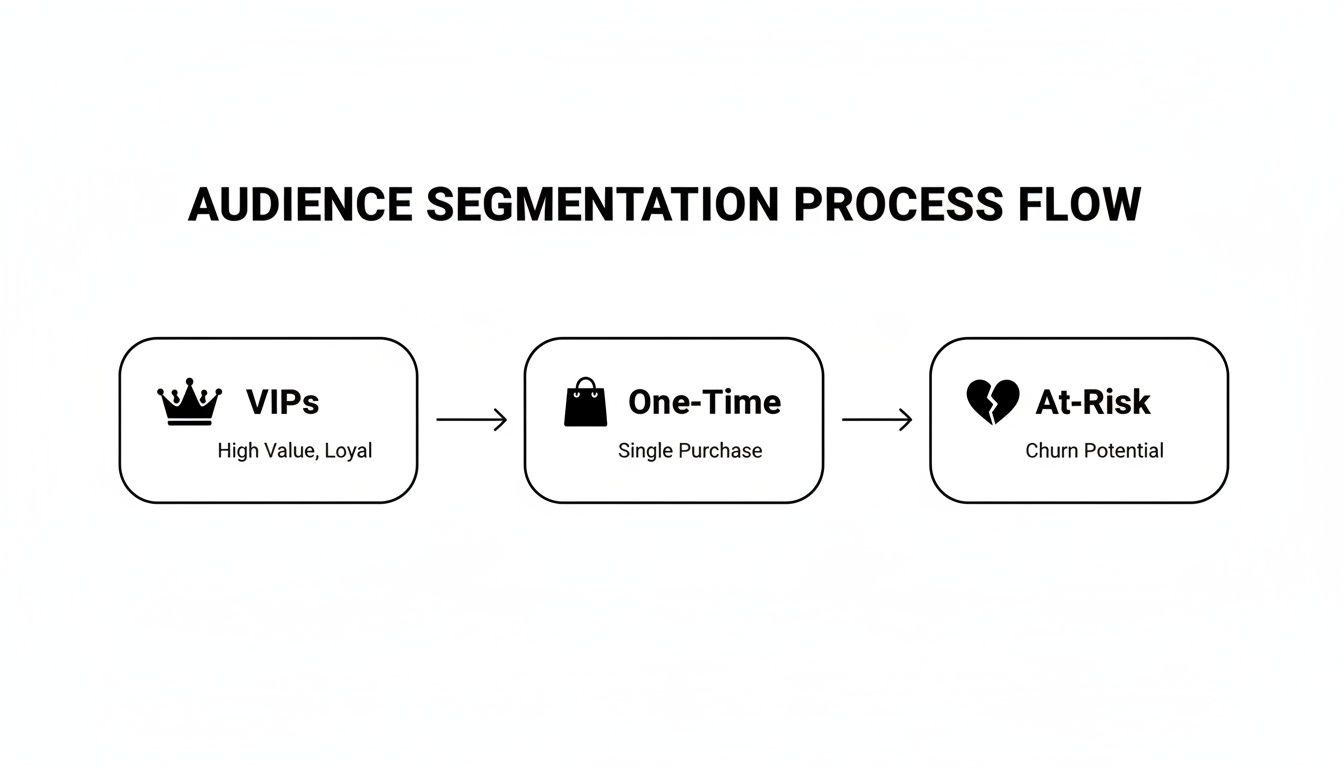
As you can see, the key is tailoring your message. You wouldn't talk to a loyal VIP the same way you'd talk to someone who's about to slip away.
Let's walk through two essential workflows every single business should have.
Example 1: The Four-Part Welcome Series
Your welcome series is your best shot at making a killer first impression. Don't just send one email and call it a day—create a journey.
- Email 1 (Immediate): Send the discount or download you promised instantly. Give them a warm welcome and a quick intro to what your brand is all about.
- Email 2 (Day 2): Share your story. What makes you different? Help them connect with the why behind your business.
- Email 3 (Day 4): Flex some social proof. Show off your top-rated products, share glowing customer testimonials, or link to your most popular content. This builds massive trust.
- Email 4 (Day 6): Ask a simple question. Something like, "What's the biggest challenge you're facing with [your topic]?" This sparks a conversation, boosts engagement, and gives you priceless feedback.
Example 2: The Abandoned Cart Sequence
If you run an e-commerce store, this is non-negotiable. Abandoned cart emails are consistently one of the highest-converting automations you can set up.
- Email 1 (1 Hour Later): A gentle nudge. Keep it friendly: "Did you forget something?" Be sure to include a picture of the item they left behind.
- Email 2 (24 Hours Later): Tackle their hesitations. Remind them about your awesome return policy, customer support, or recent five-star reviews.
- Email 3 (48 Hours Later): Introduce a little urgency. A small, time-sensitive discount ("10% off for the next 24 hours!") is often all it takes to bring them back.
If you want to dive deeper into setting these up, check out our guide on email automation for small businesses for more workflow ideas and practical tips.
Designing for the Mobile-First Reality
You can have the best content and the smartest automation in the world, but if your emails look terrible on a phone, it's all for nothing. We live in a mobile world, and your designs have to reflect that.
The data is clear: in 2025, an estimated 60% of emails are opened on mobile, where people spend an average of just 10 seconds looking at them. On top of that, automation is a huge money-maker, driving 37% of sales from only 2% of total email sends.
These stats really hammer home two points: your emails must be scannable, and you have to use automation.
Here are a few mobile-first design rules to live by:
- Stick to a Single-Column Layout: This is the easiest way to ensure your content looks great on any screen, preventing that annoying pinch-and-zoom.
- Write Short, Punchy Copy: Break your text into one or two-sentence paragraphs. Use bullet points and bold text to make key info pop.
- Make Your CTA a Big Button: A large, tappable button is so much easier to hit on a phone than a tiny text link.
- Use a Readable Font Size: A body font of at least 16px is a good rule of thumb. Don’t make people squint.
By combining a strategic content calendar with smart automation and a mobile-first design, you’re not just sending emails. You’re building a powerful, self-running system that nurtures customer relationships and drives real results.
How to Measure and Optimize Your Performance
Getting your first campaigns out the door is a huge step, but it's really just the starting line. The real magic in email marketing—the part that drives serious growth—comes from treating your plan like a living, breathing thing. You have to constantly measure, test, and tweak it based on what your audience is actually doing.
This is where you stop guessing and start making smart, data-backed decisions. Your email platform is practically overflowing with valuable feedback. Every open, click, and unsubscribe tells a story, and learning to read that story is how you turn a good strategy into a great one.
Go Way Beyond Basic A/B Testing
I can't stress this enough: A/B testing is your single best tool for optimization. Most people stop at testing a couple of subject lines, but if you want a real edge, you need to get more creative. The core idea is simple: change one thing, send it to a small slice of your audience, and see which version wins.
Imagine you discover that sending your newsletter at 10 AM on a Tuesday gets you a 20% higher open rate than your old Friday afternoon slot. That's a permanent lift in engagement from one simple test. These are the kinds of wins that add up over time and transform your email list into a revenue-generating machine.
Don't be afraid to test everything. Here are a few high-impact ideas to get you started:
- Sender Name: Does "Jenna from Sparkle Co." feel more personal and get more opens than just "Sparkle Co."? Test it and find out.
- Email Copy: Pit a short, punchy message against a more detailed, story-driven one. You might be surprised by what your audience prefers.
- Call-to-Action (CTA): This is a big one. Try changing the button text ("Shop Now" vs. "Grab Your Discount"), the color, and even its placement in the email.
- Visuals: Do emails with a big, bold hero image outperform your text-only versions? What about lifestyle photos versus clean product shots?
The most effective email marketing plans are not set in stone. They are built on a foundation of continuous, methodical testing that turns small, iterative improvements into massive long-term gains.
Of course, you need to know what you're aiming for. To get a feel for industry benchmarks, check out our guide on what makes a good open rate for emails.
The Surprising Power of List Hygiene
This is going to sound crazy, but one of the best ways to improve your email performance is to remove people from your list. It’s a practice called list hygiene, and it’s all about periodically cleaning out subscribers who are no longer engaging with your content.
Why would you do this? Because internet service providers (ISPs) like Gmail and Outlook are always watching. They track how people interact with your emails to calculate your sender reputation. A low reputation means your emails start landing in the spam folder—even for the people who love hearing from you.
Think of it this way: sending thousands of emails that never get opened tells ISPs that your content might be unwanted junk. This can seriously damage your ability to reach anyone's inbox.
Here’s a simple routine I recommend for keeping your list clean and healthy:
- Define "Inactive": First, figure out what "inactive" means for you. For most businesses, anyone who hasn't opened an email in the last 90-120 days is a good place to start.
- Run a Re-engagement Campaign: Before you say goodbye, try to win them back. A classic "We miss you!" campaign with a special offer can work wonders. Sometimes, a simple "Are you still interested?" email is all it takes.
- Cut the Cord: If they don't respond to your re-engagement efforts, it's time to let them go. Removing them protects your sender reputation and lets you focus your energy on the subscribers who are actually listening.
By making list cleaning a regular habit and constantly testing your campaigns, you create a powerful feedback loop. This commitment is what separates the email programs that just chug along from the ones that become a cornerstone of a growing business.
Got Questions About Your Email Marketing Plan? We've Got Answers.
Putting together a solid email marketing plan can feel like a huge task, and it's totally normal to have questions swirling around. Let's clear up some of the most common hurdles I see people run into. Getting these right will help you build a strategy that actually works, instead of one that just sits on a hard drive.
"How Often Should I Actually Be Emailing My List?"
Look, there's no magic number here. The right email frequency really boils down to your industry, what your audience expects, and—most importantly—how good your content is. For most businesses, sending a newsletter or a promotional email once a week is a great place to start.
Of course, some emails need to go out instantly. Think welcome emails or order confirmations. Those are triggered by a specific action, so don't delay them. The real goal isn't hitting a quota; it's delivering consistent value.
My best advice? Let your data be your guide. If you ramp up to two emails a week and your unsubscribe rate suddenly spikes, that's your audience telling you to back off. But if engagement holds steady or even climbs? You might have room to send more. Just remember to always, always choose quality over quantity.
"What Are the Best Ways to Grow My Email List?"
Growing your list is all about a value exchange. You offer something genuinely useful, and they give you their email address in return. Forget the shortcuts and focus on building a list of people who actually want to hear from you.
Here are a few methods that have never failed me:
- Create Killer Lead Magnets: Offer up free ebooks, handy checklists, or exclusive access to a webinar. Make it so good they can't say no. Then, promote it with clear call-to-action forms on your website.
- Use Pop-Ups (But Don't Be Annoying): A well-timed pop-up, like an exit-intent form that shows up just as someone is about to leave, can be incredibly effective. It's your last chance to grab their attention.
- Run a Contest or Giveaway: People love free stuff. A giveaway that requires an email signup is a fast and powerful way to attract new subscribers.
- Offer an Instant Discount: If you run an e-commerce store, a "10% off your first purchase" offer is a classic for a reason. It works.
And one thing you must never do: buy an email list. Seriously. It's the fastest way to wreck your sender reputation, land in spam folders, and violate privacy laws. Just don't.
"Which Email Marketing Software Is Best for a Small Business?"
The "best" tool is the one that fits your specific needs, budget, and how tech-savvy you are. For startups and small businesses just getting their feet wet, a few platforms offer a fantastic mix of features without breaking the bank.
Platforms like Mailchimp and MailerLite are popular for a reason—they're easy to use and have great free or low-cost plans that give you templates and basic automation. I also point a lot of creators and bloggers toward ConvertKit because its segmentation and automation features are incredibly powerful.
As you grow, you might need more muscle. For e-commerce, a tool like Klaviyo is a beast, with deep integrations into shopping platforms. B2B companies often graduate to something like ActiveCampaign to build out more complex sales and marketing workflows. When you're choosing, just ask yourself: is it easy to use, can it automate what I need, and does it play nice with my other tools?
"How Do I Keep My Emails Out of the Spam Folder?"
Landing in the inbox, or what we call email deliverability, isn't about one secret trick. It’s about building a strong reputation as a sender through a collection of good habits.
First off, always get permission. Use a double opt-in process where new subscribers have to click a link in a confirmation email. This proves they really want to be on your list. Second, keep your list clean. Regularly remove email addresses that bounce or haven't opened your emails in months. It's called list hygiene, and it's non-negotiable.
Third, you need to handle the technical side by authenticating your domain with SPF, DKIM, and DMARC. Think of these as a digital passport that proves to inbox providers like Gmail and Outlook that your emails are legitimate. And finally, don't act like a spammer. Avoid ALL-CAPS subject lines, a million exclamation points, and clickbait-y phrases. Good deliverability always comes back to sending great content to a clean, engaged list.
Ready to stop guessing and start building a high-performing email marketing plan? The experts at Sugar Pixels can help. We create custom email strategies and design beautiful, responsive campaigns that turn subscribers into loyal customers. Let us handle the technical details so you can focus on growing your business. Explore our email marketing services and get started today!