

Think of your social media content strategy as your brand's North Star. It's the master plan that guides what you post, when you post it, and—most importantly—why it actually matters for your business. This strategy turns sporadic posting into a cohesive, goal-driven effort designed to build your brand, grow an audience, and deliver real results.
What Is a Social Media Content Strategy and Why It Matters
Posting on social media without a strategy is a bit like setting sail without a map or a destination. You're out on the water, sure, but you're just drifting. A social media content strategy is that map and compass, ensuring every single tweet, Reel, and blog post is deliberately created to move you closer to your business goals.
This isn't just about filling up a content calendar. It's a comprehensive framework that ties your big-picture business mission to the day-to-day grind of creating, publishing, and analyzing content. It’s what allows you to create posts that truly connect with your ideal customers instead of just adding to the endless digital noise. For any startup, small business, or personal brand, getting this right is fundamental to building a solid presence online.
The Four Pillars of Your Strategic Blueprint
A strong, effective strategy isn't a single document; it's built on a few core pillars that all work together. If you ignore one, the whole structure gets wobbly.
To break it down, a successful social media content strategy really boils down to four key components. Each one plays a distinct role, but they are all interconnected, creating a cycle of planning, execution, and improvement.
The Four Pillars of a Social Media Content Strategy
| Pillar | Objective | Key Activity |
|---|---|---|
| 1. Audience & Goals | Define who you're talking to and what you want to achieve. | Creating detailed buyer personas and setting SMART goals. |
| 2. Content Creation | Develop content that resonates with your audience and serves your goals. | Brainstorming content pillars, creating a content calendar, and producing assets. |
| 3. Distribution & Promotion | Ensure your content reaches the right people on the right platforms. | Choosing primary social channels and developing a promotion plan. |
| 4. Analysis & Optimization | Measure what's working, what isn't, and refine your approach. | Tracking key performance indicators (KPIs) and adjusting the strategy based on data. |
By consistently working through these four pillars, you create a feedback loop that makes your social media efforts smarter and more effective over time.
This flowchart gives you a great visual of how all these pieces fit together, starting with your overarching plan and drilling down into the specific elements that bring it to life.
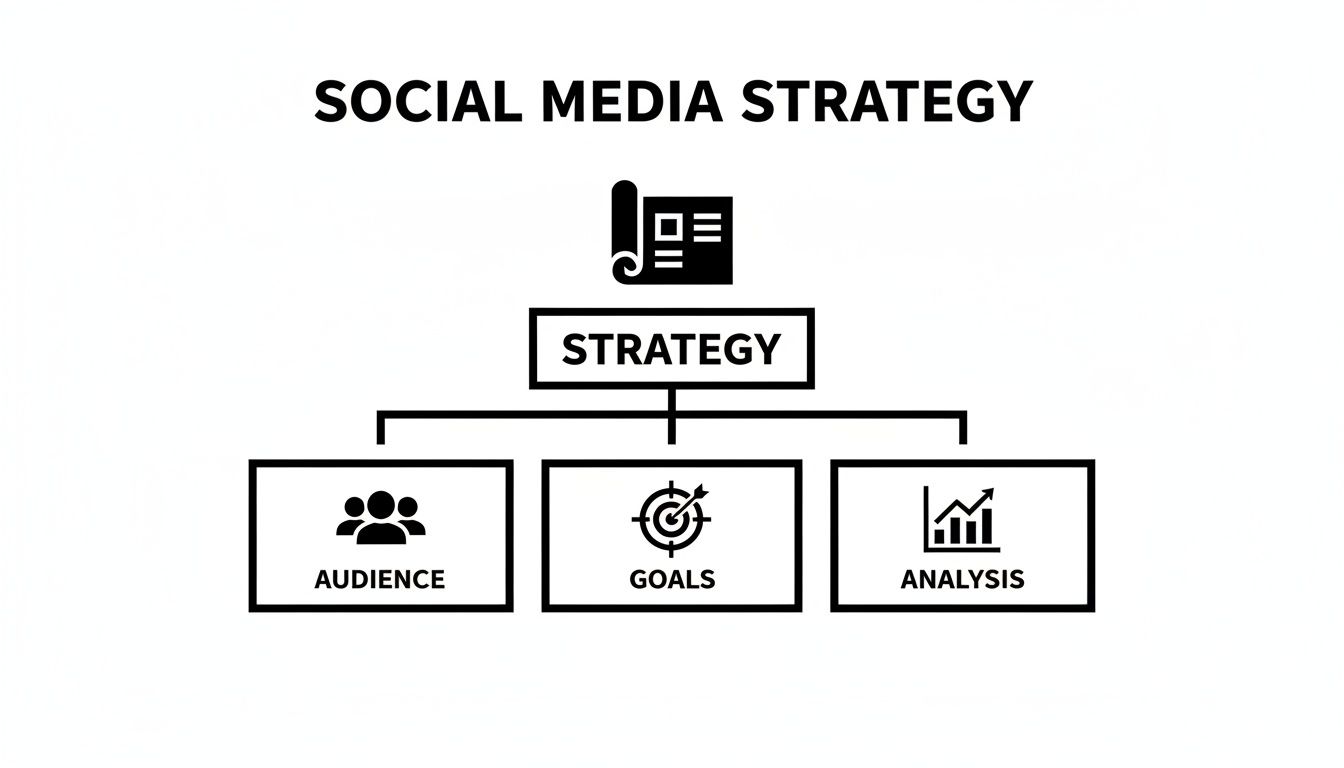
As you can see, a clear strategy is the foundation. It directly informs how you define your audience, set your goals, and measure success, creating a powerful system for growth.
A well-defined strategy gives your brand a consistent voice and direction. It’s the difference between shouting into a crowded room and starting a meaningful conversation with the exact people who want to hear from you.
Why the Human Touch Still Wins
In a world buzzing with automation and AI, people are craving real, human connection more than ever. It might sound counterintuitive, but recent consumer surveys reveal that the number one thing people want from brands on social media is human-generated content.
This desire for authenticity is a huge opportunity. Even as a majority of marketers plan to bring AI into their workflows, the winning brands will be those who remember there’s a person on the other side of the screen.
Ultimately, your strategy is the bridge connecting your business objectives to the genuine value you offer your audience. When you truly grasp why content marketing is important, you can build a plan that not only hits your targets but also builds a loyal community that cheers you on.
Know Your Destination and Your Passenger: Goals and Audience

Before you even think about creating a single post, your content strategy for social media has to answer two giant questions: “What are we actually trying to do here?” and “Who are we trying to talk to?” Without solid answers, your content is just noise. It won't connect, and it won't move the needle for your business.
Think of it like planning a road trip. Your goals are the destination, and understanding your audience is your map. You wouldn't just start driving without knowing where you're going, right? That’s just burning gas. Same thing here.
Set Goals That Actually Mean Something: The SMART Framework
Vague goals like "get more followers" or "increase engagement" aren't goals—they're wishes. To get real results, your social media objectives have to be tied to concrete business outcomes. The best way to do this is by using the SMART framework.
This just means every goal you set for social media needs to be:
- Specific: Nail down exactly what you want to accomplish. Don't say "grow our brand." Say, "Increase brand mentions on Instagram by 20%."
- Measurable: How will you track it? Pick a real number. For example, you can track website referral traffic from your social channels using Google Analytics.
- Achievable: Be honest about what you can do. Set targets that make sense for your team's size, budget, and time.
- Relevant: Does this goal actually help your bigger business objectives? It should support things like driving sales for a new product or bringing in qualified leads.
- Time-bound: Give yourself a deadline. It creates a sense of urgency and tells you when to measure success. For example, "Get 500 email sign-ups from our LinkedIn campaign by the end of Q3."
Using SMART goals turns fuzzy ideas into a clear action plan. It not only guides what you create but also makes it way easier to prove that your social media efforts are actually working.
Go Deeper Than Demographics: Build Real Audience Personas
Knowing your audience's age and location is just scratching the surface. A truly great content strategy for social media is built on deeply understanding the people you want to reach. This is where audience personas come into play.
A persona is basically a character sketch of your ideal customer, built from real data and research. It moves beyond the simple facts to get at the human stuff.
An audience persona isn't a spec sheet; it's the story of a person. It covers their struggles, their goals, and how your brand fits into their world. This empathy is what helps you create content that genuinely connects.
To build an accurate picture of your audience, you need to do a little digging. A critical first step in any content plan is figuring out how to identify your target audience. This means uncovering their psychographics—what they care about, what they believe, and how they behave online.
Here are a few practical ways to get this information:
- Dig into Your Analytics: Your existing social media platforms have a goldmine of data. Check out your audience insights to see which posts get the most shares, comments, and saves. This tells you what your current followers already find valuable.
- Just Ask Them: Use simple tools like Google Forms or Instagram Stories polls to ask your audience direct questions. Ask about their biggest challenges, what kind of content they'd love to see from you, or which social platforms they use the most.
- Spy on Your Competitors' Followers: Take a look at the people engaging with your competitors. What are they talking about in the comments? What questions are they asking? You can learn a ton about the shared frustrations and interests in your niche this way.
When you combine these methods, you can create a detailed persona that acts as your north star. It ensures every piece of content you make speaks directly to the right people, in a language they actually understand.
Developing Your Content Pillars and Platform Strategy
Okay, you've done the homework on your audience and you know what you want to achieve. Now for the fun part: turning all that research into an actual plan for what you’ll post and where you’ll post it. This is where we build the framework that stops you from posting randomly and, frankly, burning out.
Think of your brand like your favorite magazine or TV show. You know what you're going to get, right? There are specific sections or segments you look forward to. Those are your content pillars. They are the handful of core themes your brand will become known for. These pillars give you a creative filter, guiding your brainstorming and making sure every single thing you post feels connected to your brand and is genuinely useful to your audience.
Establishing Your Core Content Pillars
Your content pillars should be three to five big-picture topics that perfectly bridge your expertise with what your audience is hungry for. They're the foundation for every post, video, and story you create.
Let's say you're a personal finance coach who specializes in helping freelancers. Your pillars might look something like this:
- Tax Tips for Solopreneurs: All about quarterly payments, smart deductions, and navigating tax season without the stress.
- Smart Invoicing and Getting Paid: Best practices for billing, managing cash flow, and making sure clients pay on time.
- Investing for the Self-Employed: Breaking down complex topics like retirement accounts and investment options for people who don't have a 401(k).
See how these aren't just random ideas? They're strategic. They live at the sweet spot where your audience's problems meet your unique solutions. Having these pillars in place means you'll never have that "what on earth do I post today?" feeling again. Instead, you'll be building a library of content that cements your authority on subjects that matter.
A content pillar is more than just a topic; it’s a promise to your audience. It tells them what they can rely on you for, building trust and positioning your brand as the go-to expert in your niche.
Choosing Your Platforms Wisely
With your pillars defined, the next big decision is where to share your content. One of the classic mistakes I see startups and small businesses make is trying to be everywhere at once. It's a recipe for stretching your team too thin and watering down your message. A much smarter approach is to be selective and focus your energy where it will have the biggest impact.
The golden rule is simple: go where your audience already hangs out. Then, pick the platforms that are a natural fit for your content pillars. For example, a B2B software company sharing industry analysis is going to get way more traction on LinkedIn than they would trying to make dance challenges work on TikTok. On the flip side, a direct-to-consumer fashion brand is built for visually-driven platforms like Instagram and Pinterest.
To make this clearer, let's break down how different platforms serve different needs.
Choosing the Right Social Media Platform for Your Business
This table should help you figure out which social media channels best match up with your audience and the kind of content you plan on creating.
| Platform | Primary Audience | Best For | Top Content Formats |
| :— | :— | :— |
| Instagram | Millennials & Gen Z | Visual storytelling, e-commerce, lifestyle brands | High-quality images, Reels, Stories |
| TikTok | Gen Z & Younger Millennials | Entertainment, trends, short-form video | Quick, engaging videos, tutorials, behind-the-scenes |
| LinkedIn | Professionals & B2B | Thought leadership, networking, industry news | Articles, case studies, professional updates |
Choosing your platforms strategically is a critical part of any modern content strategy for social media, and you can't ignore the massive role of video. Short-form video now makes up over 43% of all content people watch on major platforms. Formats like Reels, Shorts, and TikToks are completely dominating our feeds.
The numbers don't lie. While the average social post gets about 1.8% engagement, TikTok boasts an incredible 5.3%. And over on Instagram, Reels see 22% higher engagement than regular video posts. You can dive deeper into these kinds of powerful social media marketing statistics on NewMedia.com.
By picking just two or three core platforms and committing to mastering them, you can create much higher-quality content that actually resonates. This approach ensures you’re not just shouting into the void, but are actively building a strong, engaged community on the channels that will truly move the needle for your business.
Creating High-Impact Content That Connects
Okay, you've laid the foundation with your content pillars. Now it's time for the fun part: moving from planning to actually creating. This is where your strategy takes shape and becomes the real, tangible stuff—the videos, images, and words that will stop people from scrolling past your brand.
Think of your content mix like a well-balanced meal. You can't just have one food group. You need a bit of everything to keep things healthy and interesting. The same goes for your social media feed. A solid mix of original content, curated shares from others, and powerful user-generated content (UGC) is the recipe for a feed that feels fresh and keeps people coming back.

Mastering High-Impact Formats
Let's be honest, not all content formats are created equal. In the fast-moving world of social media, some formats just flat-out work better than others. Putting your energy into these will give you a much better return on your creative investment.
The social media space is only getting more crowded, with ad spending projected to jump by 13.6% year-over-year. What's driving this? Video. It now accounts for over 60% of all time spent on social platforms. You can see this reflected in engagement rates, too. An analysis of 70 million posts showed TikTok leading the pack with a 3.70% engagement rate, while Facebook trails at just 0.15%. That's a huge gap, and it tells us that tailoring content to the platform is critical.
If you're wondering where to focus, prioritize these:
- Short-Form Video: This is non-negotiable. Platforms like TikTok and Instagram Reels are where the attention is. Your goal is to create quick, valuable, and entertaining clips that hook viewers in the first three seconds.
- Thumb-Stopping Visuals: Think high-quality photos, branded graphics, and carousels. These are perfect for breaking down complex ideas, showing off your products, or telling a visual story.
- Conversational Copy: Your captions are more than just descriptions; they're a chance to connect. Ask questions, share anecdotes, and write in a tone of voice that feels like a real person talking.
Writing Copy That Sparks Conversation
A great visual might stop the scroll, but it's the copy that holds their attention and gets them to act. A well-written caption can be the difference between a passive view and an active follower.
Your caption isn't just a description; it's the start of a conversation. The goal is to write something that makes your audience feel seen, understood, and compelled to respond.
Here are a few simple tips for writing better captions that get people talking:
- Lead with a Strong Hook: Kick things off with a question, a surprising fact, or a bold statement. Give them a reason to stop and read.
- Tell a Micro-Story: People are wired to connect with stories. Share a quick customer win, a behind-the-scenes moment, or a personal thought related to your post.
- Include a Clear Call-to-Action (CTA): Don't leave them hanging! Tell them exactly what you want them to do next. Whether it's "save this post for later" or "share your thoughts in the comments," be specific.
At the end of the day, knowing how to create engaging social media content that truly resonates is what will set you apart.
The Power of Repurposing Your Content
Let’s face it, especially for startups and small businesses, creating brand-new, original content every single day is a massive undertaking. This is where content repurposing becomes your secret weapon. It’s all about taking one big piece of content and strategically slicing and dicing it into smaller assets for different platforms.
This "create once, publish everywhere" mindset is a game-changer. For example, that one in-depth blog post you wrote can be brilliantly transformed into:
- An Instagram carousel that breaks down the key takeaways.
- A short video script for a snappy TikTok or Reel.
- A series of thought-provoking tweets or a LinkedIn post.
- A clean infographic that visualizes the main data points.
Repurposing doesn't just save a ton of time; it ensures your core message reaches more people in more places, all in a format that feels native to each platform. For a deeper look at making your content work smarter, not harder, check out our guide on https://www.sugarpixels.com/how-to-increase-social-media-engagement/. This approach is key to maintaining a consistent, high-quality presence without burning yourself out.
Building Your Editorial Calendar and Publishing Schedule
Consistency is the real engine behind social media growth. Without a solid plan, you end up posting whenever you remember, which feels chaotic and reactive. This approach quickly leads to burnout and a brand message that’s all over the place. An editorial calendar is what pulls you out of that chaos and into a strategic, sustainable rhythm.
Think of it as the master blueprint for everything you publish. It's the single source of truth where you can map out content weeks, or even months, in advance. This ensures every post lines up with your content pillars, supports your business goals, and syncs with any upcoming marketing campaigns or product launches. For a busy entrepreneur or a small team, this kind of proactive system is an absolute lifesaver.
From Ideas to a Concrete Plan
An editorial calendar is so much more than a messy list of post ideas. It’s a visual map of your entire strategy, brought to life. When you lay everything out, you can see your content mix at a glance and make sure you’re hitting that sweet spot—a healthy balance of educational, entertaining, and promotional content.
This kind of forward-thinking is also your ticket to insane efficiency. When you know what’s on the docket, you can start batching your work. You can block off a few hours to write all your captions for the week, another chunk of time to design graphics, and a separate session for filming videos. It’s a far more productive method than frantically trying to create something from scratch every single day.
A well-oiled calendar should track a few key details for every piece of content:
- Publish Date and Time: The exact moment a post is set to go live.
- Social Platform: Which channel is this for? An Instagram Reel is very different from a LinkedIn article.
- Content Pillar: Tag each post with its theme to keep your content strategy on track.
- Visuals and Copy: The final image or video, plus the approved caption.
- Status: A simple tracker to see where a post is in the workflow—from "idea" to "scheduled" and finally "published."
Finding Your Rhythm and Staying Flexible
While planning is everything, a truly great social media presence leaves a little room for magic. Your calendar shouldn't be a rigid, unbreakable set of rules. You need the freedom to jump on a trending meme or share an exciting, in-the-moment company update. The goal is to build a structure that powers consistency but still allows for that crucial flexibility.
Here’s a peek at what a simple but effective social media content calendar can look like inside a project management tool.
This visual layout makes it incredibly easy for a team to collaborate. Everyone can see the entire publishing schedule at a glance, organized by date, platform, and status.
One of the most common questions I get is, "How often should I post?" Honestly, it depends. The right answer is tied to the specific platform and your audience's online habits. A great place to start is your own analytics—see when your followers are most active. Many scheduling tools even offer data-backed suggestions for the best times to post. For a much deeper dive, you can learn more about how to create a content calendar that’s perfectly suited to your brand.
Your editorial calendar is a living document, not a stone tablet. Use it to establish a consistent publishing rhythm, but always be ready to adapt to current events, audience feedback, and new opportunities.
Ultimately, building a content calendar is about creating a workflow you can actually stick with. It dials down the stress, boosts the quality of your content, and makes sure your brand shows up consistently, which is how you build the trust and momentum needed to grow an engaged community.
Measuring Success and Optimizing Your Strategy
Let's be real: a social media strategy isn't something you can just "set and forget." Think of it more like a garden. You can't just plant the seeds and walk away; you have to water it, check for weeds, and see what's actually growing. Without measuring what's working and what's falling flat, you're just throwing content at the wall and hoping something sticks—and that’s a fast track to wasting your precious time and money.
This final step is where we move past the feel-good numbers, like follower counts, that don't really tell you if your business is growing. Instead, we’re going to zero in on the key performance indicators (KPIs) that connect your social media work directly to tangible results.

This constant cycle of measuring, learning, and tweaking is what turns a decent strategy into a great one. It's how you make sure your social media efforts actually become a reliable engine for your brand.
Identifying KPIs That Truly Matter
To figure out what's working, you need to track the right things. The KPIs you choose should tie directly back to the SMART goals you set at the beginning of this process. It's easy to get lost in a sea of data, so focus on just a few key metrics that clearly show how you're doing.
Here are the essential metrics to keep an eye on, broken down by what you’re trying to achieve:
- For Brand Awareness: Are people seeing you? Track impressions (the total number of times your content was displayed) and reach (how many unique people saw it). If these numbers are climbing, your brand is getting out there.
- For Community Engagement: Look at comments, shares, and saves. These are way more valuable than a simple "like." They show your audience found your content interesting enough to talk about, pass along, or come back to later. That's a huge win.
- For Business Impact: This is the big one. Measure your click-through rate (CTR) to see who’s actually heading to your website. But don't stop there. Track conversions—like email sign-ups or actual sales—to prove that your social media is making you money.
Chasing vanity metrics like follower count is like judging a restaurant by its sign instead of its food. Focus on engagement and conversion metrics—they are the true indicators of a healthy, impactful social media presence.
The Simple Framework for Monthly Reviews
All this data is completely useless until you do something with it. A simple monthly review is a powerful habit that turns numbers into smart decisions. This isn't about creating some massive, complicated report. It's just about asking the right questions to guide what you do next month.
Block off a couple of hours at the end of each month to dig into your performance. Every social media platform has its own built-in analytics tools that make this pretty straightforward.
Just follow this simple, three-step review process:
- Review Top-Performing Content: Pull up your best posts from the month. What do they have in common? Was it the format (Reel vs. carousel)? The topic? The style of the caption, or even the time you posted? Look for the patterns.
- Analyze Underperforming Content: Now for the tough part. Look at what bombed. Did one of your content pillars consistently get crickets? Did a certain video format totally miss the mark? Be brutally honest about what isn't connecting.
- Identify Actionable Next Steps: Based on what you found, decide what you'll do differently next month. Will you create more of what worked? A/B test a couple of different calls-to-action? Maybe switch up your posting schedule?
This continuous loop of testing, learning, and refining is what keeps your content strategy for social media sharp. It ensures you evolve with your audience and consistently get the results that actually matter to your business.
Frequently Asked Questions
Diving into social media content strategy always brings up a few common questions. Let's tackle some of the biggest hurdles that trip up startups, personal brands, and small businesses so you can move forward with confidence.
My goal here is to give you straightforward, actionable advice that cuts through the noise.
How Often Should I Post on Social Media?
There’s no magic number here. The real key is consistency over sheer frequency. A solid starting point for platforms like Instagram and Facebook is posting 3-5 times per week. For faster-moving channels like TikTok or X (formerly Twitter), you might aim for 1-3 times a day.
But remember the golden rule: quality trumps quantity. It’s a million times better to publish three genuinely valuable posts than seven rushed ones just to hit a quota.
Your best guide is always your own data. Dive into your social media analytics to see when your audience is most active. Use that as a starting point, then experiment with different schedules to see what actually works for your brand.
What Are the Best Tools for Managing a Content Strategy?
Having the right tools in your corner makes all the difference. A good tech stack helps you stay organized and save precious time without feeling like you're drowning in spreadsheets.
Here are the essential categories and a few of my go-to options:
- Planning and Scheduling: Tools like Buffer, Hootsuite, and Later are fantastic for mapping out your content calendar and scheduling posts ahead of time. They bring everything into one dashboard.
- Visual Creation: You don't need to be a designer to create beautiful graphics. Canva is an absolute game-changer for designing everything from Instagram carousels to video thumbnails.
- Workflow Organization: To keep your content production line running smoothly, especially if you have a team, a project management tool is a must. Asana or Trello are perfect for this.
How Can I Consistently Come Up with New Content Ideas?
The fear of running out of ideas is real, but a simple system can keep the creativity flowing. Start by breaking down each of your content pillars into smaller sub-topics.
Honestly, the best ideas come from listening. Pay close attention to the questions people ask in your comments and DMs—they are literally telling you what they want to know. Keep an eye on your competitors to see what’s resonating with their audience, too. And never forget to repurpose! That one blog post or case study can be chopped up into dozens of social media posts.
Ready to build an online presence that gets results without the technical headaches? At Sugar Pixels, we specialize in creating custom websites and digital marketing strategies that help businesses like yours grow. Explore our services and see how we can help you succeed.