

B2B SEO marketing is all about fine-tuning your company's online presence to show up when qualified decision-makers are looking for solutions on search engines. Forget casting a wide net for mass consumer traffic; the real goal here is to generate high-value leads by solving complex business problems. It's a non-negotiable strategy for any company navigating long sales cycles and serving a highly specific audience.
What Is B2B SEO Marketing and Why It Matters

Think of it this way: B2C SEO is like a megaphone at a music festival, trying to get everyone’s attention. B2B SEO, on the other hand, is more like a specialized diagnostic tool used to find the perfect surgeon for a critical operation. The aim isn't to attract everyone; it's to connect with the exact right professionals who need the solutions you offer.
This is where B2B and B2C SEO really part ways. B2C often targets individual shoppers, using emotional triggers to drive quick purchases. B2B SEO is a different game entirely—one that demands precision, patience, and unwavering authority. The stakes are higher, the sales cycles are much longer, and decisions are almost never made in a vacuum.
The B2B Buying Committee
In the B2B world, you aren't just selling to one person. You're trying to win over a whole buying committee. This group might include a research analyst, an IT manager, a department head, and even the CFO. Each one has their own priorities, pain points, and specific questions they’re typing into Google.
A smart B2B SEO strategy needs to have content that speaks to every single one of these personas, no matter where they are in their decision-making process. This means you have to get inside their heads, understand their professional challenges, and know the exact language they use to search for answers.
Problem-Solving Over Impulse Buying
B2B search intent is rarely about making a quick, impulsive purchase. It's almost always informational and solution-focused. A potential client isn’t searching for "cheap project management software." They're digging deeper with queries like "how to reduce workflow inefficiencies in a remote team" or "best CRM integration for scaling sales operations."
Your content must tackle these complex, problem-based searches head-on. The goal is to educate, build trust, and establish your company as a credible expert long before a salesperson ever gets involved. To see how these principles come together in a larger framework, it’s worth exploring a modern enterprise SEO strategy for B2B SaaS growth.
The numbers back this up. SEO is a powerhouse for B2B marketers, with 57% reporting that it generates more leads than any other initiative. In fact, SEO is directly responsible for delivering 34% of all qualified leads for B2B companies, a figure that leaves most other tactics in the dust.
B2B SEO isn't about winning a popularity contest for clicks. It's about earning the trust of a select few decision-makers who can generate millions in revenue. Your focus must shift from volume to value.
To really nail down what makes B2B SEO so distinct, a side-by-side comparison is helpful. The table below breaks down the core differences between B2B and B2C strategies.
B2B SEO vs B2C SEO Key Differentiators
| Factor | B2B SEO (Business-to-Business) | B2C SEO (Business-to-Consumer) |
|---|---|---|
| Audience | Niche, professional roles, buying committees | Broad, individual consumers, mass market segments |
| Sales Cycle | Long (months to years), multiple touchpoints | Short (minutes to days), often a single session |
| Keywords | Informational, problem/solution-focused, long-tail | Transactional, product-focused, high-volume, brand-heavy |
| Content Goal | Educate, build trust, generate qualified leads | Drive direct sales, build brand awareness, entertain |
| Decision-Making | Logical, ROI-driven, requires stakeholder consensus | Emotional, price-sensitive, often impulsive |
| Conversion | Gated content download, demo request, consultation | Online purchase, newsletter sign-up, account creation |
| Volume vs. Value | Low traffic volume, high lead value | High traffic volume, lower individual transaction value |
As you can see, every aspect of the strategy—from the keywords you target to the content you create—is shaped by the unique nature of the B2B buyer. It's a long game, but when played correctly, the payoff is substantial.
Mastering B2B Keyword Research for the Buyer’s Journey
Great B2B SEO isn't about chasing the highest search volume keywords. It’s about getting inside the heads of your future clients and understanding the exact language they use when they have a serious business problem to solve.
You have to think about the entire buying committee. What long-tail, research-heavy phrases does an analyst use when they first sniff out a problem? What comparison terms does a manager search for when pitting vendors against each other? And what specific, branded questions does a director ask Google when they’re ready to pull the trigger? It’s all about mapping language to intent.
Aligning Keywords with Buyer Intent
In the B2B world, every search tells a story. Is the person just trying to understand their problem, are they actively comparing solutions, or are they looking for a final reason to sign on the dotted line? The real magic happens when you can categorize these queries into clear stages of intent, allowing you to create content that meets them exactly where they are in their journey.
This alignment is everything. Think about it: decision-makers run an average of 12 searches before they even bother engaging with a single brand's website. That statistic, highlighted in Google's research on B2B buyers, shows just how critical it is to show up for the right terms at the right time.
Let’s break down how this looks across the three core stages of the buyer’s journey.
-
Awareness Stage (Top of the Funnel): At this point, the prospect feels the pain of a problem but can't quite name it. They're looking for educational content, so their searches are usually broad questions.
- Example keywords: "how to improve supply chain logistics," "signs of inefficient sales pipeline," "common cybersecurity threats for small businesses."
-
Consideration Stage (Middle of the Funnel): Okay, now they’ve put a name to their problem and are actively hunting for solutions. They're comparing different types of software, services, and companies.
- Example keywords: "best CRM for manufacturing companies," "salesforce vs hubspot comparison," "managed IT services providers," "project management software reviews."
-
Decision Stage (Bottom of the Funnel): They’ve narrowed it down to a shortlist and are looking for that final piece of validation. Searches become super specific, often including brand names, pricing inquiries, and implementation details.
- Example keywords: "[Your Software] pricing," "[Competitor Software] alternatives," "[Your Service] case studies," "[Your Software] integration capabilities."
Practical Ways to Discover the Right Keywords
Mapping keywords to the buyer's journey is a science, not a guessing game. You'll need some powerful SEO tools in your corner. Platforms like Ahrefs and SEMrush are non-negotiable for digging up the phrases your audience uses and seeing what your competitors are up to.
The goal of B2B keyword research isn't to find the most popular keywords. It's to find the most profitable ones—the queries that signal a real business need you are perfectly equipped to solve.
Start by brainstorming a list of "seed" keywords—the foundational terms related to what you sell. If you're a cybersecurity firm, for example, your seeds might be "data breach prevention" or "network security." From there, you use your tools to expand that list and find the hidden gems.
Uncovering Keyword Opportunities
-
Analyze Your Competitors: A "Content Gap" analysis in a tool like Ahrefs is a brilliant shortcut. It instantly shows you the keywords your competitors are ranking for that you aren't, giving you a list of proven topics your shared audience cares about.
-
Mine Google's "People Also Ask" & "Related Searches": These SERP features are a goldmine. They are a direct look into the user's mind, revealing the follow-up questions and related ideas they have. This is perfect for uncovering long-tail keywords and planning out content clusters.
-
Use Keyword Modifiers: Think of these as prefixes and suffixes you can add to your seed keywords to target different stages of intent.
- Informational: how, what, why, guide, tutorial, example
- Commercial: best, top, review, comparison, alternative
- Transactional: pricing, demo, trial, buy, quote
By systematically finding and organizing keywords this way, your B2B SEO strategy transforms. You stop throwing content at the wall to see what sticks and start building a strategic library of assets that expertly guides prospects from their first question to their final purchase.
Creating Content That Closes B2B Deals
Think of your B2B content as your best salesperson. It works around the clock, educating prospects, building trust, and showing them the way to a solution long before they ever hop on a call with your team. This isn't about churning out blog posts for the sake of it. It’s about building a library of strategic assets that answer tough questions and establish your company as the go-to expert.
Truly effective B2B content does more than just get clicks—it gives decision-makers the confidence they need to act. The goal is to create genuine thought leadership that speaks directly to the headaches and challenges of a professional audience. When you help them understand their problem on a deeper level, you build the credibility needed to turn a casual searcher into a qualified lead.
High-Impact B2B Content Formats
B2C content can often get by on entertainment or a quick how-to. B2B is a different ballgame. Your audience is weighing a significant investment of company time and money, so they need substance, data, and real-world insights to justify their decision.
Here are the content formats that consistently move the needle:
- Comprehensive Whitepapers: These are your deep dives. Use them to unpack a complex industry problem, present a well-researched argument, and subtly position your company’s offering as the most logical answer.
- Data-Driven Case Studies: Proof is powerful. Nothing builds trust faster than showing a prospect you’ve already solved their exact problem for someone else. Case studies provide that tangible evidence.
- Original Research Reports: Want to become an instant authority? Conduct your own industry surveys or data analysis. Publishing original findings is a fantastic way to generate high-quality backlinks and become a primary source of information.
- Practical Webinars: Webinars, whether live or on-demand, create a direct connection with your audience. They let you showcase your expertise, demonstrate your solution in action, and answer specific questions in real-time.
This diagram shows how to map different types of keywords—and by extension, content—to the specific stages of the B2B buyer’s journey.
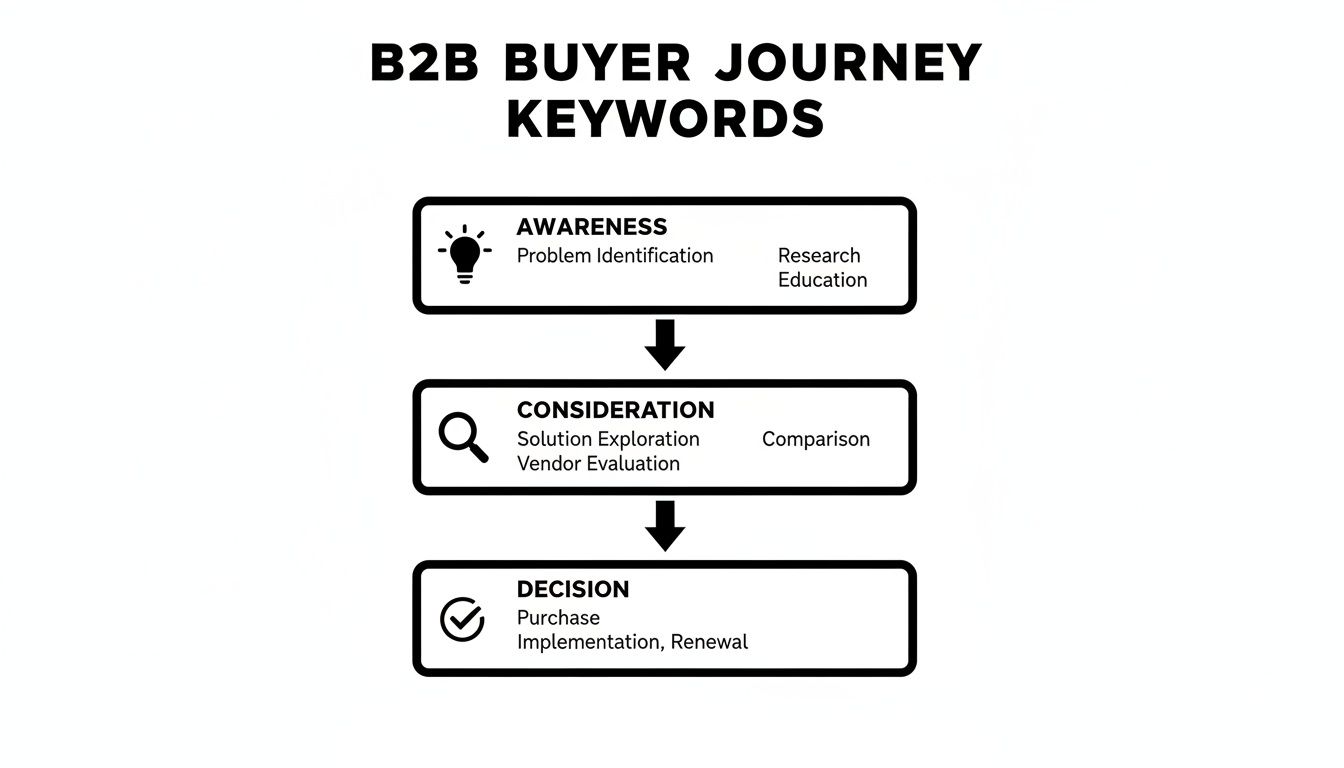
As you can see, the journey starts with broad, problem-aware searches and gradually narrows to specific, solution-focused queries as the buyer gets closer to making a decision. Your content needs to meet them at every step.
To help you plan, here's a table mapping different content formats to their ideal stage in the buyer's journey.
B2B Content Formats Mapped to the Buyer Journey
| Funnel Stage | Primary Goal | Effective Content Formats |
|---|---|---|
| Awareness | Educate, build brand recognition, attract visitors | Blog posts, research reports, infographics, guides, checklists, short educational videos |
| Consideration | Nurture leads, showcase expertise, build trust | Whitepapers, case studies, webinars, comparison guides, in-depth product feature sheets |
| Decision | Convert leads, demonstrate value, close the deal | Free trials/demos, implementation guides, ROI calculators, customer testimonials, pricing pages |
Using this framework ensures you have the right asset ready for the right person at the right time, guiding them smoothly from one stage to the next.
Building Authority with Topic Clusters
A random-acts-of-content approach simply doesn’t cut it anymore. To show both Google and your audience that you have real expertise, you need a structured plan. The topic cluster model is the perfect blueprint for this.
The strategy is simple but powerful. You start with a "pillar page"—a comprehensive, long-form guide on a core business topic. This pillar is then supported by a series of "cluster" articles, each one diving deep into a specific subtopic and linking back to the central pillar.
Imagine a cybersecurity firm using this model:
- Pillar Page: The Ultimate Guide to Small Business Network Security
- Cluster Content: A series of detailed posts on related topics like "How to Conduct a Network Security Audit," "Choosing the Right Firewall," and "Phishing Prevention Training for Employees."
This interconnected structure does two things brilliantly. First, it signals to search engines that you have deep, authoritative coverage of a subject, helping you rank for a whole family of related keywords. More importantly, it creates a seamless learning journey for your visitors, giving them immense value.
The most effective B2B content doesn't just sell a product; it sells a new way of thinking. It educates prospects so thoroughly that your solution becomes the only logical choice.
The numbers back this up. Companies that actively blog generate 67% more leads than those that don't, proving that SEO-driven content is a serious growth engine. Digging deeper, SaaS companies that segment content by industry see organic traffic jump by 28.7%, absolutely dwarfing the 4.1% lift for those with a generic approach.
By focusing on high-value formats and organizing them into a clear topic cluster framework, you build a powerful system for SEO lead generation. Your website stops being a static brochure and becomes a dynamic resource hub that nurtures prospects through the entire buying cycle, delivering better, more qualified leads to your sales team.
Optimizing Your Website for Technical B2B SEO

You can create the most brilliant, insightful content in your industry, but if your website is slow, confusing, or broken, it’s all for nothing. That's where technical SEO comes in. Think of it as the engine under the hood of your B2B SEO marketing strategy. It’s the invisible framework that makes sure search engines can find and understand your content while giving your high-value visitors a smooth, professional experience.
Imagine your website is your physical office building. If the lobby is a mess, the elevators are broken, and the directory is impossible to read, potential clients will just turn around and leave. Technical SEO is all about making sure your digital office is pristine, efficient, and dead simple to navigate.
Building a Logical Site Architecture
A smart site architecture is the bedrock of any solid B2B SEO program. It's the blueprint that guides both search engine crawlers and human visitors through your site, from a top-level blog post right down to that all-important demo request page. The goal is to make the entire journey feel intuitive and effortless.
A logical structure usually means organizing your content into clear silos or hubs, which is very similar to the topic clusters we talked about earlier. Your core service and solution pages should be front and center in the main navigation, with supporting content like case studies and guides branching off from there. This clarity helps search engines connect the dots between your pages and cements your authority on key topics. For a deeper dive, check out our guide on complete on-site optimization.
This clear hierarchy also does something else that's incredibly important: it helps spread "link equity" (or authority) across your site. When a powerful page links to a related, more specific page, it passes some of its SEO strength along, giving your entire website a ranking boost.
Enhancing Core Pages with Structured Data
Having a logical layout is one thing, but you also need to help search engines understand the context of your content. This is where Schema markup, a type of structured data, becomes your best friend. It’s like adding little descriptive labels to your website’s code that tell Google exactly what your content is about.
By using Schema, you’re not just telling Google what your page says; you’re telling Google what it is. Is it a product? An event? An organization? This clarity can lead to richer, more eye-catching search results.
For B2B websites, a few types of Schema are especially valuable:
- Organization Schema: This reinforces your brand identity, address, and contact info, which is a huge trust signal for both users and search engines.
- Service Schema: Clearly defines the services you offer, helping you show up for highly specific searches from people looking for your exact solution.
- FAQ Schema: Marks up the Q&A sections on your pages, which can land you a spot in Google's "People Also Ask" boxes—prime real estate on the search results page.
- Review/Rating Schema: Displays star ratings right there in the search results. This is powerful social proof that can seriously increase click-through rates.
Implementing structured data helps you pop on a crowded results page, signaling to potential clients that you're a credible and relevant choice.
Prioritizing Site Speed and Mobile Experience
In the professional world, time is money, and nobody has patience for a slow website. A site that takes forever to load isn't just an annoyance; it's a direct blow to your credibility. Google knows this, which is why page speed is a confirmed ranking factor. A delay of just a few seconds can send a huge chunk of your visitors packing.
Likewise, a flawless mobile experience is completely non-negotiable. B2B decision-makers are always on the go, researching solutions on their phones between meetings or during their commute. Your site has to be fully responsive and easy to use on a small screen.
The numbers don't lie. The top search result on mobile gets 27% of all clicks, and with more than half of all searches happening on smartphones, a clunky mobile site makes you invisible to a massive part of your market. B2B search trends only reinforce how critical mobile optimization has become. A fast, mobile-friendly site isn't just a "nice-to-have" technical detail; it's a fundamental part of delivering the professional, trustworthy experience your B2B audience demands.
Building Authority with Strategic B2B Link Building
In B2B marketing, trust is everything. High-quality backlinks—links pointing to your site from other reputable websites—are how you prove that trust to search engines. Think of each good backlink as a vote of confidence, a nod from a respected peer that tells Google your business knows its stuff.
This isn't about the old-school, spammy tactics of blasting out hundreds of emails begging for a link. Modern B2B link building is far more sophisticated. It's about creating content and relationships so strong that other industry players want to reference you. The fundamental rule is that quality and relevance trump everything; a single, well-placed link from a major industry journal is worth more than a hundred generic, low-quality ones.
Earning Links by Being the Expert
The most sustainable way to build a powerful backlink profile is to create assets that make you the primary source of information in your niche. This flips the script entirely—instead of asking for links, you start attracting them naturally.
Here are a few proven ways to do just that:
- Publish Original Research: Run your own surveys, dig into industry data, or package unique insights into a detailed report. When you’re the source of the data, journalists, bloggers, and even competitors have to link back to you when they cite your findings.
- Create "Ultimate Guides": Go deep on a critical topic. Develop a comprehensive, pillar-style resource that covers a subject more thoroughly than anyone else. These definitive guides naturally become the go-to reference for others.
- Lean into Digital PR: Don't just publish great content and hope for the best. Proactively pitch your research, data, and expert opinions to industry publications and journalists. Getting a quote or a mention in a top-tier trade publication often comes with a highly authoritative backlink.
The best B2B link-building strategy isn't really about building links at all. It's about building a reputation and genuine relationships. The links are just the natural result of becoming a trusted authority.
This focus on authority has a direct, measurable impact on revenue. Recent studies show that organic search is responsible for 44.6% of all revenue in the B2B world, which is nearly double the contribution from any other channel. It’s clear that a strong SEO presence, powered by authoritative backlinks, helps companies close deals at a rate of 14.6-15%. That's a massive leap from the 1.7-2% close rate you see from outbound tactics like cold calls. You can read more about these B2B SEO statistics to get the full story.
Building Bridges Through Partnerships
Beyond what you create on your own site, you can earn powerful backlinks by sharing your expertise on other platforms. This approach gets you in front of new audiences while building valuable connections across your industry.
Give these collaborative tactics a try:
- Guest Podcasting: Find podcasts your audience listens to and appear as an expert guest. It’s a fantastic way to share your insights with an engaged audience, and the host will almost always include a link to your website in the show notes.
- Strategic Partnerships: Team up with non-competing businesses that serve a similar customer base. You could co-host a webinar, co-author a whitepaper, or collaborate on a research report, leading to cross-promotion and valuable links from your partner's site.
- Contribute to Expert Roundups: Keep an eye out for articles where journalists are gathering quotes from experts on a particular topic. Participating not only builds your personal brand but also secures a relevant backlink.
By focusing on these value-first strategies, you're not just collecting links. You're building a durable, defensible authority around your brand that strengthens your entire B2B SEO marketing program, driving better leads and cementing your status as an industry leader.
7. Measuring Your B2B SEO Marketing Success
So, how do you actually prove your B2B SEO marketing efforts are moving the needle? The secret is to stop obsessing over vanity metrics like total traffic and start connecting your work directly to business outcomes.
A winning strategy isn't about getting more clicks; it's about getting the right clicks—the ones that turn into customers and revenue.
Your reporting needs to tell a story that executives care about: a story of growth, pipeline, and profit. Think of it this way: raw traffic data is just knowing how many people walked past your storefront. What you really need to know is how many came inside, asked for a demo, and ultimately signed a contract.
Key Performance Indicators That Matter
To show real value, you have to track KPIs that bridge the gap between marketing activity and sales results. These are the numbers that prove SEO is actively filling the sales funnel with qualified prospects.
Here are the essential metrics your B2B SEO reports should focus on:
- Organic-Driven MQLs: This is your north star. How many Marketing Qualified Leads are coming directly from organic search? It’s a direct measure of how well your content attracts and converts your ideal customer.
- Demo and Consultation Requests: Keep a close eye on how many visitors from organic search complete high-intent actions, like booking a demo or consultation. These are powerful signals that SEO is delivering bottom-of-the-funnel leads ready to talk.
- Keyword Rankings for Commercial Intent: Don't just track any keyword. Focus on your rankings for high-intent, bottom-of-funnel terms like "[Your Service] pricing" or "[Competitor] alternative." When these rankings improve, lead quality almost always follows.
- Organic Lead-to-Customer Conversion Rate: Go beyond just counting leads. What percentage of your organic leads actually become paying customers? This metric proves the quality of the traffic that SEO brings in.
Building a Compelling SEO Report
Your goal is to paint a complete picture of your program's impact. That means pulling data from different sources to show the full journey, from a Google search to a closed deal. The best reports weave together insights from Google Search Console, Google Analytics, and your CRM (like Salesforce or HubSpot).
A great B2B SEO report doesn't just throw data at you; it provides context. It should clearly answer the big question: "How is our investment in organic search contributing to the company's bottom line?"
To see the full financial picture, it's incredibly helpful to learn how to measure marketing ROI effectively. This translates your SEO wins into the language every stakeholder understands: money.
You can get a much clearer view of this by setting up your dashboards to track the entire customer journey. Our guide on organic search in Google Analytics walks you through how to connect website activity to tangible business goals. By focusing on metrics that truly matter and presenting them clearly, you can prove the undeniable value of your B2B SEO program.
Your B2B SEO Questions, Answered
If you're diving into B2B SEO, you probably have a lot of questions. That’s a good thing. It means you're thinking strategically about how to make it work for your business. Let's tackle some of the most common questions we hear from clients.
How Long Does B2B SEO Take to Show Results?
I get it, you want results yesterday. But B2B SEO is more like planting an orchard than flipping a light switch. It's a long-term play. You'll likely start seeing some early signs of life—like better keyword rankings and a little bump in organic traffic—within the first three to six months.
But the real, game-changing impact? That usually takes between six and twelve months. We're talking about a consistent stream of qualified leads and a return on investment you can actually measure. This timeline gives us the room to create truly valuable content, let Google recognize our technical improvements, and earn the kind of backlinks that build genuine authority. It requires patience, but the payoff is an asset that grows more valuable over time.
B2B SEO isn't about a one-time traffic spike. The real win is building a sustainable lead generation machine that works for you 24/7, for years to come.
Should We Invest in SEO or Paid Ads?
This is a classic question, but it sets up a false choice. It's not "either/or." The smartest marketers use SEO and paid ads (PPC) together, letting each channel play to its strengths.
- Paid Ads (PPC): This is your rapid-response team. It’s fantastic for generating leads right now, testing out messaging to see what resonates, and targeting buyers who are at the very end of their decision-making process.
- SEO: This is your foundation for long-term dominance. SEO is what builds unshakable brand authority and trust. It brings in a steady flow of organic traffic at a much lower cost per lead over time and educates your prospects at every single stage of their journey.
Think of it this way: Paid ads are like renting an audience, while SEO is about owning it. A great B2B strategy uses PPC for the quick wins while SEO builds the asset that fuels sustainable, profitable growth for the long haul.
How Much Should We Budget for B2B SEO?
There’s no magic number here. Your B2B SEO budget really depends on your specific situation—how competitive your industry is, what your growth goals are, and the current health of your website.
Instead of looking for a universal price tag, think about the value of a new customer. If landing just one new client brings in five or six figures of revenue, doesn't it make sense to invest a fraction of that each month into a channel that can deliver those clients reliably? For a comprehensive program covering content, technical SEO, and authority building, a typical starting investment is somewhere between $3,000 and $10,000 per month.
Ready to build a B2B SEO strategy that drives real business growth? Sugar Pixels provides expert web design and digital marketing services to scale your online presence. Learn how we can help you attract and convert high-value leads.