

In a digital landscape where attention is the ultimate currency, simply 'boosting a post' is no longer enough. The difference between a campaign that drains your budget and one that delivers exponential returns lies in strategy, creativity, and a deep understanding of the available tools. Many businesses struggle with ad fatigue, rising acquisition costs, and the overwhelming number of platforms and formats available.
This guide cuts through the noise. We've compiled 10 powerful social media advertising ideas designed not just to be seen, but to convert. These aren't generic tips; they are actionable strategies complete with targeting suggestions, creative briefs, and quick A/B testing ideas to help you find what works best for your brand.
From leveraging authentic user-generated content to building high-intent audiences with precision targeting, each idea is a practical blueprint you can implement today. To inspire your strategic ads, look at unforgettable examples of viral advertising that you can replicate for your own campaigns.
Whether you're an e-commerce store aiming to reduce cart abandonment, a startup building brand awareness, or a personal brand fostering a loyal community, these battle-tested concepts will equip you to turn clicks into customers and build a more profitable online presence. Inside, you'll discover how to effectively use:
- Influencer and affiliate partnerships
- Advanced retargeting and remarketing funnels
- UGC and testimonial-driven campaigns
- Short-form and long-form video advertising
- Lookalike and custom audience targeting
- Carousel, Collection, and Lead Gen ad formats
Let's explore the tactics that will define successful social advertising and unlock sustainable growth for your business.
1. Influencer, Micro-Influencer, and Affiliate Partnerships
This social media advertising idea combines the authentic reach of influencer marketing with the performance-driven model of affiliate partnerships. Instead of just paying for exposure, you empower creators to become genuine brand advocates who earn a commission on the sales they generate. This approach minimizes upfront risk while tapping into the trust influencers have built with their niche audiences.
Brands like Gymshark and Fashion Nova perfected this strategy by collaborating with fitness and fashion influencers. They provide unique discount codes and affiliate links, which not only give followers a reason to buy but also make it easy to track which partnerships drive the most revenue. The result is a highly scalable, ROI-focused advertising engine built on social proof and community trust.
How to Implement This Strategy
To get started, focus on building mutually beneficial relationships. Instead of a single, expensive macro-influencer, identify 5-10 micro-influencers (10,000-100,000 followers) whose audience perfectly matches your target customer.
- Structure Your Offer: Provide a clear commission structure (e.g., 10% per sale) and unique, trackable discount codes.
- Empower, Don't Dictate: Give influencers creative freedom to integrate your product authentically into their content. Provide brand guidelines but avoid overly restrictive scripts.
- Provide Resources: Equip partners with a media kit containing high-quality images, product details, and key messaging points to make their job easier.
- Track Everything: Use an affiliate management platform like ShareASale or Impact to monitor clicks, conversions, and payouts, ensuring transparent reporting.
This approach is particularly effective for e-commerce brands and startups looking to generate sales and build brand credibility simultaneously. For more detailed guidance, you can explore effective methods on how to recruit affiliate marketers and build a successful program from scratch.
2. Retargeting and Remarketing Campaigns
This social media advertising idea focuses on converting users who have already shown interest in your brand. Instead of spending your budget trying to attract cold audiences, retargeting allows you to serve strategic ads to people who have previously visited your website, added an item to their cart, or engaged with your content. By re-engaging this warm audience, you dramatically increase the likelihood of conversion at a much lower cost.
Amazon is a master of this strategy, showing you products you recently viewed across different platforms and websites. Similarly, countless Shopify stores have successfully reduced cart abandonment rates by 15-30% using dynamic product ads on Facebook that remind shoppers of the exact items they left behind. The goal is to stay top-of-mind and provide a gentle nudge to complete the desired action, turning missed opportunities into sales.
How to Implement This Strategy
Effective retargeting goes beyond simply showing the same ad again. The key is to segment your audience based on their behavior and tailor your messaging to their stage in the customer journey. For those looking to re-engage past visitors and drive conversions, consider exploring effective Facebook retargeting ads to create a powerful re-engagement engine.
- Segment Your Audience: Create separate campaigns for different user actions, such as "viewed product page," "added to cart," and "initiated checkout." Each segment requires a unique message.
- Create Sequential Ads: Develop a sequence of ads that tells a story. For example, the first ad might be a simple reminder, the second could offer a small discount, and the third could highlight customer testimonials.
- Set Frequency Caps: To avoid ad fatigue and annoying your audience, limit ad impressions to 3-5 per user per day.
- Test Time Windows: Experiment with different retargeting windows (e.g., 7, 14, or 30 days) to see which timeframe yields the best conversion rate for your business.
This approach is highly effective for e-commerce, SaaS, and any business with a multi-step conversion process, as it efficiently captures high-intent users who are already familiar with your brand.
3. User-Generated Content (UGC) Campaigns
This powerful social media advertising idea involves turning your customers into your creative team. Instead of producing every ad yourself, you encourage your audience to create and share content featuring your products. This user-generated content (UGC) is then repurposed for paid social media campaigns, lending your brand authentic social proof and a nearly endless stream of relatable creative assets.
Brands like GoPro have built their entire marketing strategy around this, using customer-shot adventure videos to create compelling ads. Similarly, Starbucks’ annual #RedCupContest generates immense buzz and provides thousands of authentic, festive images that feel more like personal recommendations than corporate advertisements. The result is a more trustworthy and engaging ad experience that builds a strong sense of community around your brand.
How to Implement This Strategy
To launch a successful UGC campaign, you need to make participation easy, exciting, and rewarding. The goal is to inspire your happiest customers to become your most vocal advocates.
- Launch a Clear Campaign: Create a branded hashtag (e.g., #BrandInAction) and provide simple guidelines for submissions.
- Incentivize Participation: Offer compelling reasons to contribute, such as weekly features on your page, discounts on future purchases, or entry into a giveaway for a larger prize.
- Request Permission and Credit: Always get explicit permission before using a customer's content in a paid ad. Provide proper attribution in the ad copy to acknowledge the creator.
- Amplify the Best Content: Curate the most impactful submissions and use them in paid formats like carousel ads, video compilations, or testimonial-style Story ads.
This approach is highly effective for B2C brands with visually appealing products or services, especially in niches like fashion, beauty, food, and travel. It lowers creative production costs while significantly boosting ad credibility and performance. For deeper insights, you can review best practices for getting started with user-generated content to ensure your campaign is a success.
4. Video Advertising (Short-Form and Long-Form)
This social media advertising idea leverages the unparalleled engagement power of video, catering to both short attention spans and audiences craving deep dives. Short-form video (Reels, TikToks, Shorts) captures immediate interest and drives virality, while long-form content (YouTube) builds authority and tells a more complete brand story. By using both, you create a dynamic content ecosystem that meets users where they are, driving higher recall and emotional connection than static ads alone.
Legendary examples include Dollar Shave Club’s viral explainer video, which used humor to disrupt an entire industry, and Blendtec’s "Will It Blend?" series, which turned a simple product demonstration into must-see entertainment. More recently, TikTok creators have driven massive sales for brands simply by showcasing products in authentic, relatable short-form clips. This proves that a powerful video ad doesn't always require a blockbuster budget, just a great idea.
How to Implement This Strategy
To succeed with video, focus on creating content native to each platform's viewing habits. A polished YouTube ad won't work as a TikTok, and a raw, vertical TikTok won't feel right as a YouTube pre-roll ad.
- Hook Within 3 Seconds: Start with your most compelling visual, a bold text overlay, or an intriguing question to stop the scroll immediately.
- Design for Sound-Off Viewing: Most users watch videos without sound. Use bold, clear captions and on-screen text to ensure your message is always understood.
- Optimize Format: Use a 9:16 vertical aspect ratio for short-form mobile content. Keep Reels and TikToks between 15-45 seconds for optimal retention.
- Repurpose Smartly: Don't just re-upload content. Edit your long-form YouTube videos into multiple, impactful short-form clips, each highlighting a single key point or moment.
- Include a Clear CTA: End every video with a specific instruction, whether it’s "Shop Now," "Learn More," or "Follow for Part 2."
This strategy is essential for any brand looking to build a strong presence, from e-commerce stores demonstrating products to personal brands sharing expertise. Video advertising ideas are versatile enough to build awareness, drive consideration, and secure conversions.
5. Lookalike and Advanced Audience Targeting
This social media advertising idea moves beyond broad targeting to leverage powerful platform algorithms that find new users who mirror your best customers. Instead of guessing who might be interested, you use your own first-party data, such as a customer email list or website pixel data, to build highly qualified audiences. The platform then analyzes the common traits of your source audience and finds new people with similar behaviors and demographics, dramatically improving ad relevance and efficiency.
E-commerce brands like Warby Parker excel at this by creating lookalike audiences from their high-value purchasers, allowing them to find more affluent, fashion-conscious professionals ready to buy. Similarly, a SaaS company can upload a list of trial users who converted to paid plans and ask the platform to find more professionals with the same attributes. This method automates prospecting and scales customer acquisition with data-driven precision.
How to Implement This Strategy
The key to success is starting with a high-quality source audience. The more refined your initial data, the more accurate your lookalike audience will be. For this advertising idea, begin with your most valuable customer segment.
- Start with Your Best Customers: Create a source audience from your highest lifetime value (LTV) customers, recent purchasers, or most engaged email subscribers. A source audience of at least 1,000 people is ideal.
- Test Audience Sizes: Begin by testing a 1% lookalike audience, which is the most similar to your source file. Gradually expand to 2%, 5%, and 10% audiences to see how performance changes as you increase reach.
- Layer for Precision: For B2B or niche products, layer your lookalike audience with additional interest or demographic targeting. For example, target a lookalike of your customers who also have "Small Business Owner" as a job title.
- Refresh Your Data: Your customer base evolves, so you should refresh your source audiences and rebuild lookalikes every 1-2 months to ensure they remain accurate and effective.
This strategy is perfect for businesses with an established customer base looking to scale efficiently. By letting algorithms do the heavy lifting, you can significantly lower acquisition costs and improve ROI. To gain deeper insights into managing your budget with these advanced techniques, you can explore guides on mastering online advertising costs and optimizing your spend.
6. Carousel and Collection Ads
This social media advertising idea moves beyond static images to create interactive, multi-product showcases directly within the user's feed. Carousel ads allow users to swipe through up to 10 images or videos in a single ad unit, while collection ads offer an even more immersive, full-screen "instant storefront" experience when tapped. Both formats are designed to reduce purchase friction by allowing users to explore a range of products or features without leaving the social media app.
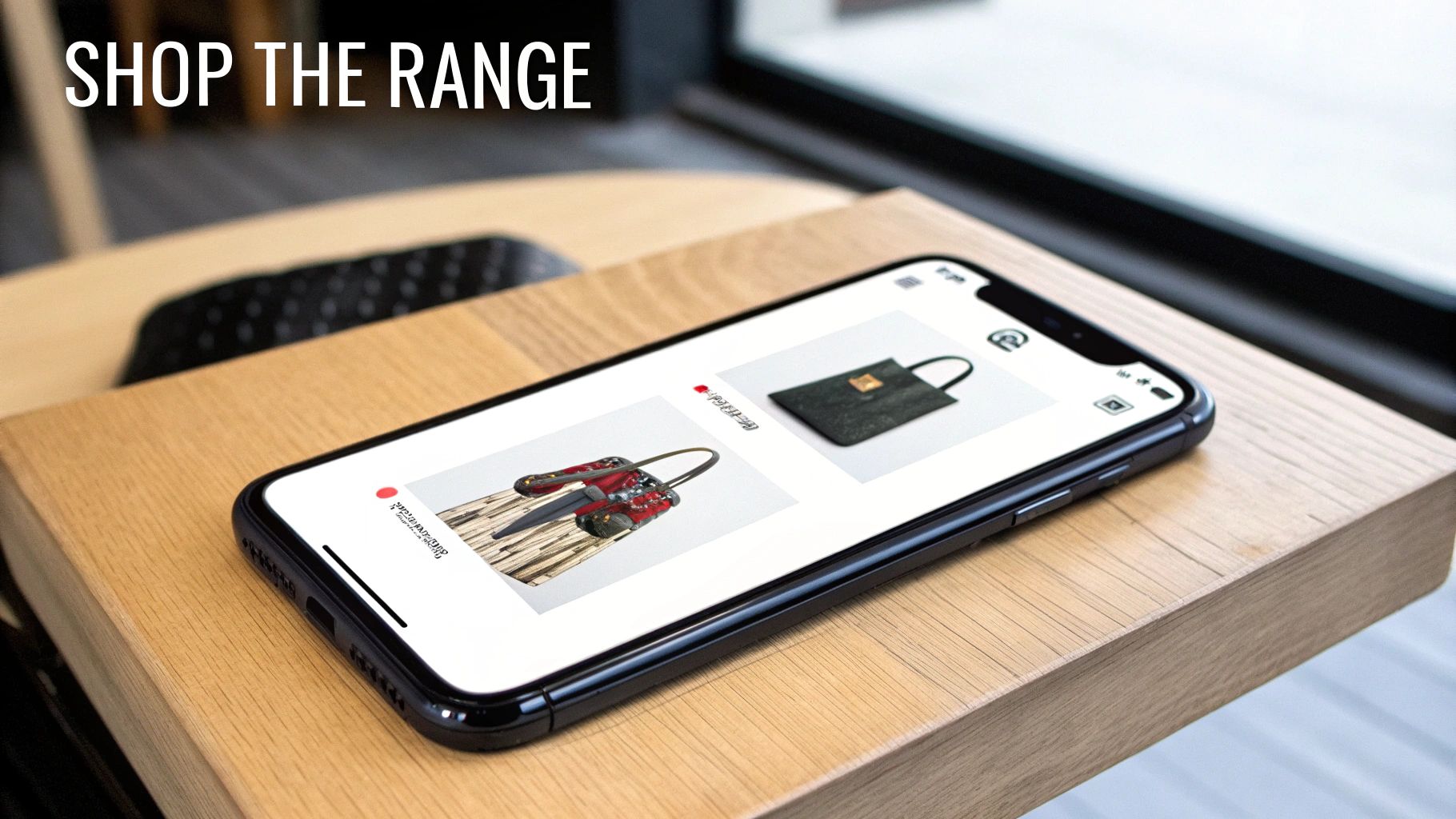
Fashion giant ASOS uses carousel ads to display multiple outfits and product variations, encouraging deeper engagement and higher click-through rates. Similarly, furniture retailers can use carousels to showcase different pieces in a coordinated room set, telling a more comprehensive visual story than a single image ever could. Collection ads are a favorite of Shopify stores, enabling a seamless transition from product discovery to purchase within seconds.
How to Implement This Strategy
To maximize the impact of these formats, focus on storytelling and visual consistency. Each card or product in your ad should contribute to a cohesive narrative or theme that captures attention and encourages interaction.
- Lead with Your Best: Place your most eye-catching or best-selling product on the first card to immediately grab the user's attention.
- Maintain Visual Cohesion: Ensure all images or videos share a consistent aesthetic, using similar lighting, color palettes, and branding.
- Optimize Card Count: For carousels, aim for 4 to 5 cards. This provides enough variety without overwhelming the user and causing them to swipe away.
- Customize Each Card: Tailor the headline, description, and call-to-action on each carousel card to its specific product, making the ad more relevant and compelling.
- Test Dynamic Content: A/B test a static image carousel against one that incorporates video on one or more cards to see which drives higher engagement.
This strategy is exceptionally powerful for e-commerce brands with a diverse product catalog, as it allows them to showcase variety and tell a richer brand story in a single, cost-effective ad placement.
7. Lead Generation Ads and Forms
This social media advertising idea streamlines the lead capture process by allowing users to submit their information directly within the social media platform. Instead of redirecting prospects to an external landing page, native lead forms (like Facebook Lead Ads or LinkedIn Lead Gen Forms) auto-populate known user data, drastically reducing friction and increasing conversion rates. This approach is ideal for capturing high-intent leads quickly and efficiently.
SaaS companies and B2B service providers use this strategy to great effect. A software company might offer a free trial, capturing a prospect's name, email, and company with just two clicks. Similarly, a real estate agency can gather contact details from interested home buyers or sellers without ever forcing them to leave their Instagram or Facebook feed. The immediate, low-effort submission process makes it a powerful tool for building a sales pipeline.
How to Implement This Strategy
To maximize completion rates, the key is to make the user experience as seamless as possible. Focus on minimizing the effort required from the user while ensuring you collect the essential information needed to qualify the lead.
- Keep It Brief: Limit your form to 3-5 essential fields. Only ask for what you absolutely need to initiate contact. More fields will cause a significant drop-off in submissions.
- Automate Your Follow-Up: Connect your lead forms directly to your CRM or email marketing platform. Trigger an instant automated email or SMS to engage the lead while their interest is at its peak.
- Set Clear Expectations: Use the "Thank You" screen to confirm the submission and tell the user exactly what will happen next (e.g., "Our team will contact you within 24 hours," or "Check your inbox for the download link!").
- Qualify and Route Leads: Integrate lead scoring to prioritize high-value submissions and use CRM rules to route them to the correct sales representative instantly.
This method is highly effective for service-based businesses, B2B marketers, and any campaign where the primary goal is collecting contact information rather than an immediate sale. While lead forms simplify the initial capture, the principles of a strong offer and clear value proposition still apply, much like those outlined in landing page design best practices.
8. Community Building and Group-Based Advertising
This social media advertising idea shifts the focus from direct, transactional ads to fostering a dedicated community around your brand. By creating an exclusive space like a Facebook Group, Discord server, or Slack channel, you build direct relationships with your most loyal customers, turning them into passionate brand evangelists who generate organic, word-of-mouth growth.
Peloton mastered this by creating a vibrant community where riders share milestones and motivate each other, making the brand an integral part of their lifestyle. Similarly, gaming companies like Epic Games use Discord to engage Fortnite players with real-time updates and exclusive content. This strategy transforms advertising from a one-way broadcast into a two-way conversation, building deep brand loyalty and long-term customer value.
How to Implement This Strategy
To start, focus on creating genuine value, not just a place to post promotions. The goal is to build an environment where customers feel connected to the brand and to each other, making this one of the most sustainable social media advertising ideas for long-term growth.
- Define a Clear Purpose: Your group needs a reason to exist beyond selling. Will it be for product feedback, exclusive content, or connecting members with shared interests?
- Start Small and Nurture: Begin with 50-100 founding members who are already fans. Their early engagement will set the tone for the entire community.
- Empower Brand Advocates: Identify your most passionate members and recruit them as moderators. This empowers them and helps scale your community management efforts.
- Create Exclusive Content: Host regular activities like Q&A sessions, member-only challenges, or behind-the-scenes content to keep the community active and valuable.
This approach is highly effective for brands with a strong lifestyle component, B2B companies looking to create expert networks, and any business aiming to reduce customer churn by building a powerful sense of belonging.
9. Pinterest and Visual Discovery Advertising
This social media advertising idea leverages Pinterest not just as a social network, but as a visual search and discovery engine. Users on Pinterest are actively planning future purchases, making it a goldmine for brands with strong visual appeal. Unlike other platforms where ads interrupt entertainment, Pinterest ads (Promoted Pins) integrate seamlessly into a user's discovery process, reaching them at the moment of inspiration.
This strategy is exceptionally powerful for industries like home decor, fashion, food, and DIY crafts. For example, a furniture retailer can capture high-intent shoppers planning a room makeover, while a food blog can drive massive traffic by promoting recipes to users searching for meal ideas. The long lifespan of a Pin means your advertising investment can continue to deliver traffic and conversions for months, far outlasting a typical social media ad.
How to Implement This Strategy
To succeed with Pinterest advertising, your focus should be on creating high-quality, inspiring visuals that align with user search intent. The platform is less about immediate conversion and more about influencing the consideration and planning stages of the buyer’s journey.
- Design for the Platform: Create Pins with a vertical aspect ratio (e.g., 1000×1500 pixels). Include clear, concise text overlays to grab attention and provide context instantly.
- Optimize for Search: Treat Pin descriptions like SEO. Use Pinterest's keyword tool to find high-volume search terms and incorporate them naturally into your descriptions and board titles.
- Create Multiple Creatives: Don't rely on a single image. Design several unique Pin graphics for the same product or URL to see which one resonates most with the audience.
- Link Directly and Deeply: Always link your Promoted Pin to the most relevant destination, such as a specific product page or blog post, never the homepage. Test Rich Pins to automatically pull in details like pricing and stock availability.
This approach is ideal for e-commerce brands in lifestyle niches looking to drive high-quality, high-intent traffic and build a long-term content asset. For deeper insights, you can explore the Pinterest Business hub for creative best practices and success stories.
10. Chatbot and Conversational Marketing Ads
This social media advertising idea moves the conversion process from a landing page directly into a user's messaging inbox. Instead of sending traffic to an external site, you use ads that initiate a conversation with an AI-powered chatbot on platforms like Facebook Messenger, Instagram DMs, or WhatsApp. This approach automates lead qualification, answers common questions, and guides users through a funnel in a highly interactive and personalized environment.
The core benefit is reducing friction. A user can engage with your brand, get instant answers, and even make a purchase without ever leaving their social media app. SaaS companies like Drift use this to book demos directly from LinkedIn ads, while e-commerce brands leverage chatbots to offer personalized product recommendations and recover abandoned carts. The result is a seamless, on-demand customer experience that boosts conversion rates and captures leads 24/7.
How to Implement This Strategy
To get started, map out a simple, goal-oriented conversation flow before building your chatbot. The aim is to provide immediate value and guide the user, not to overwhelm them with options.
- Choose Your Platform: Start with the platform where your audience is most active. Tools like ManyChat or Chatfuel offer user-friendly builders for Facebook Messenger and Instagram.
- Design a Natural Flow: Script your chatbot to sound human and conversational. Use quick reply buttons and carousels to make navigation easy and avoid open-ended questions that could confuse the AI.
- Create a "Click-to-Message" Ad: In your ad platform (e.g., Meta Ads Manager), choose an objective like "Engagement" or "Leads" and select "Messaging apps" as the conversion location. Link this ad directly to your chatbot's starting flow.
- Integrate a Human Handoff: Always provide a clear and simple option for users to connect with a live agent. This is crucial for handling complex inquiries and preventing frustration.
This strategy is highly effective for businesses with a high volume of repetitive customer inquiries, lead-generation-focused companies, and e-commerce stores wanting to offer a personalized shopping assistant. It transforms a static ad into an interactive, automated sales and support channel.
10-Point Comparison of Social Media Advertising Ideas
| Strategy | Implementation Complexity 🔄 | Resource Requirements ⚡ | Expected Outcomes 📊 ⭐ | Ideal Use Cases 💡 | Key Advantages ⭐ |
|---|---|---|---|---|---|
| Influencer, Micro-Influencer, and Affiliate Partnerships | Medium — vetting, contracts, tracking | Medium — creator fees, affiliate platform integration | Drives sales, social proof, scalable acquisition (⭐⭐⭐) | E‑commerce, digital products, startups with limited ad budgets | Authentic endorsements, pay‑for‑performance scalability |
| Retargeting and Remarketing Campaigns | Medium — pixel/list setup and segmentation | Low–Medium — ad spend + creative refreshes | Higher conversion rates vs cold traffic, efficient CPA (⭐⭐⭐⭐) | E‑commerce, SaaS trials, any site with steady traffic | Cost‑effective re‑engagement, strong cart recovery |
| User-Generated Content (UGC) Campaigns | Low–Medium — guidelines, moderation | Low — incentives, curation effort | Builds trust & continuous content stream (⭐⭐⭐) | Consumer brands with passionate customers, startups | High authenticity, low production cost, community proof |
| Video Advertising (Short-Form and Long-Form) | High — concept, production, platform optimization | High — production, editing, distribution | Strong engagement and recall; viral potential (⭐⭐⭐⭐) | Brands needing storytelling, product demos, personal brands | Superior storytelling, increased time‑on‑ad, cross‑platform reach |
| Lookalike and Advanced Audience Targeting | Medium — data prep and audience layering | Low–Medium — quality customer data + ad spend | Lower acquisition cost; scalable qualified reach (⭐⭐⭐⭐) | E‑commerce with customer data, B2B targeting on LinkedIn | Efficient scaling, reduces wasted spend, algorithmic optimization |
| Carousel and Collection Ads | Medium — multiple assets and card sequencing | Medium — images/videos per card, testing | Higher CTR and product exploration (⭐⭐⭐) | Retail, fashion, multi‑SKU catalogs, product lines | Showcase variety in one unit, reduces purchase friction |
| Lead Generation Ads and Forms | Low — form setup and CRM integration | Low–Medium — integration + follow‑up workflows | Faster list growth; higher completion vs external pages (⭐⭐⭐) | B2B, SaaS, real estate, education | Low CPL, instant CRM sync, reduced friction for signups |
| Community Building and Group-Based Advertising | High — ongoing moderation and content planning | High (time) — community managers, events | Long‑term loyalty and higher LTV; slow direct attribution (⭐⭐⭐) | Memberships, personal brands, subscription businesses | Deep brand loyalty, organic referrals, product insight |
| Pinterest and Visual Discovery Advertising | Low–Medium — creative + keyword optimization | Medium — high‑quality visuals and campaign testing | High‑intent, long‑lifecycle traffic for visual products (⭐⭐⭐) | Home, fashion, food, DIY, wedding & event services | Strong discovery intent, lower CPC, long content lifespan |
| Chatbot and Conversational Marketing Ads | Medium–High — flow design and AI tuning | Medium — bot platform + maintenance | 24/7 engagement and better lead qualification (⭐⭐⭐) | E‑commerce, B2B lead qualification, service businesses | Automated qualification, instant responses, scalable support |
From Ideas to Implementation: Your Next Steps
We've explored a comprehensive landscape of ten powerful social media advertising ideas, moving from the authentic voice of User-Generated Content to the precision of advanced Lookalike Audience targeting. The journey through these strategies reveals a central truth: successful social media advertising is no longer about simply boosting a post. It's a sophisticated blend of psychology, data science, and creative storytelling tailored to specific platforms and business goals.
The ideas presented, from leveraging influencer partnerships to deploying conversational chatbot ads, are not just a menu of options. They are a strategic toolkit. Your task now is to transition from absorbing these concepts to actively implementing them. The key is not to attempt all ten at once, but to strategically select the one or two that most directly address your immediate business challenges and align with your available resources.
Synthesizing the Big Picture
Reflecting on the strategies covered, several core themes emerge that are critical for success in today's digital advertising environment:
- Authenticity is a Currency: Ideas like UGC campaigns, influencer marketing, and community-building ads all pivot on the same principle. Consumers trust other people more than they trust brands. Your ability to facilitate and amplify genuine voices will directly impact your campaign's resonance and credibility.
- Data is Your Co-Pilot: The power of retargeting, Lookalike Audiences, and even the segmentation required for effective lead generation campaigns underscores the necessity of a data-first mindset. Your best creative ideas will only reach their potential when delivered to the right audience at the right time, a feat only achievable through meticulous data analysis.
- Engagement is the Goal, Not Just Clicks: Strategies like video advertising, carousel ads, and conversational marketing are designed to do more than just earn a click. They aim to capture attention, tell a story, and start a dialogue. This shift from passive consumption to active engagement is what builds memorable brand experiences and drives higher-quality conversions.
Your Actionable Roadmap to Success
Feeling overwhelmed by the possibilities is natural. The secret to progress lies in methodical action. Instead of aiming for a complete overhaul, focus on incremental, strategic implementation. Here is a simple, three-step framework to get started:
- Prioritize Based on Goals: First, clarify your primary objective. Are you focused on brand awareness, lead generation, or direct sales? If your goal is building social proof for a new e-commerce store, a UGC campaign is a logical starting point. If you're a B2B service provider needing qualified leads, focusing on LinkedIn Lead Gen Forms is a more direct path to your goal.
- Launch a Pilot Campaign: Select one of the social media advertising ideas and design a small-scale test. Define a clear hypothesis (e.g., "A carousel ad showcasing product benefits will achieve a higher click-through rate than our current single-image ads"). Set a modest budget and a specific timeframe (e.g., 14 days) to gather enough data to make an informed decision.
- Analyze, Iterate, and Scale: Once your pilot campaign concludes, dive into the analytics. What worked? What didn't? Use these insights not as a pass-fail grade but as a guide for your next iteration. Double down on the elements that performed well and refine or replace those that didn't. This continuous loop of testing, learning, and scaling is the engine of sustainable advertising growth.
By embracing this structured approach, you transform a list of creative social media advertising ideas into a tangible, results-driven marketing engine that propels your business forward.
Ready to turn these powerful social media advertising ideas into profitable campaigns but need an expert team to manage the execution? At Sugar Pixels, we specialize in creating, managing, and optimizing data-driven ad strategies that deliver measurable results. Let us handle the complexities of targeting, testing, and scaling so you can focus on running your business. Learn more about our services at Sugar Pixels.