

SEO content is any piece of writing, imagery, or video created to do two things really well: show up high in search engine results and genuinely help the person who's searching. It's the handshake between what someone types into Google and the valuable answer you provide.
Understanding What SEO Content Really Means

Let’s cut through the jargon. At its heart, SEO content is the direct line connecting someone's question to your business's solution. It's not just about writing; it's about crafting a resource so well-structured that search algorithms can easily understand what it's about and feel confident showing it to people.
Think of it like this: your website is a massive library. Without a solid cataloging system, even the most brilliant books would just gather dust on the shelves, completely undiscovered. SEO is that cataloging system. It labels and organizes your information so the librarian (Google) can instantly find the perfect book for every visitor.
Why SEO Content Is Not Optional
Years ago, you might have gotten away with publishing content and just hoping for the best. That "hope and pray" strategy simply doesn't work anymore. It’s a fast track to being invisible online.
Consider the numbers. A staggering 68% of all online experiences start with a search engine. If you’re not there, you’re missing the party.
This isn’t just a nice-to-have; it's a core business driver. Organic search is responsible for 53.3% of all website traffic, making it a massive source of potential customers. For 61% of B2B marketers, it's their top channel for generating leads. The proof is in the spending, with the global SEO market hitting a value of $82.3 billion in 2023.
At its heart, effective SEO content doesn't just attract search engines; it serves the reader first. Google’s goal is to provide the best possible answer to a user’s question. By creating content that does exactly that, you align your goals with Google's, creating a win-win scenario.
This guide will break down exactly how to build that system for your own website. We'll show you how to turn your content from a hidden gem into a high-traffic asset that drives real business results. For a deeper dive into the fundamentals, you might want to check out our guide on search engine optimization basics.
The Pillars of High-Ranking Content
Ever wonder why some articles rocket to the top of Google while other, equally great pieces get buried on page ten? It’s not luck. It comes down to a framework that search engines use to judge every single page. Think of it as a three-legged stool: Relevance, Authority, and Experience. If one leg is weak, the whole thing topples over.
This is a great mental model to have. It’s like getting a restaurant recommendation from a trusted friend. They’ll first consider what you’re in the mood for (relevance), how many great reviews the place has (authority), and whether the vibe and service are any good (experience).
Google does the exact same thing, just with billions of web pages. Let's dig into what each of these pillars really means for your content.
To understand how these pillars work together, here’s a quick overview:
The Three Pillars of SEO Content
| Pillar | What It Represents | Why It Matters for Ranking |
|---|---|---|
| Relevance | How well your content matches the user's search query and intent. | Google's primary job is to deliver the most accurate answer. If you're not relevant, you're not in the game. |
| Authority | The trustworthiness and credibility of your website and content. | Search engines want to recommend experts. Authority is built through high-quality content and backlinks. |
| Experience | The overall quality of a user's interaction with your page. | If your site is slow, clunky, or hard to read, users will leave. This sends negative signals to Google. |
Now, let's explore what each one looks like in the real world.
H3: Relevance: Are You Answering the Right Question?
Relevance is the absolute starting point. It's about answering one simple question: "Does this page give the searcher exactly what they came for?" If it doesn't, nothing else matters. High-ranking content must be a perfect match for the search intent behind the keyword.
For instance, someone Googling "how to fix a leaky faucet" is looking for a step-by-step guide with pictures or a video. They are absolutely not looking for a page selling plumbing services. On the flip side, a search for "plumber near me" signals an immediate need to hire someone, so a service page with a phone number and location is the perfect fit.
Google's entire business model is built on providing the best possible answer for every query. Your content becomes relevant when it is that best answer—solving the user's problem quickly and completely.
To nail relevance, you have to get inside your audience's head. Your content needs to be:
- Targeted: Built around a specific keyword and the real problem it represents.
- Comprehensive: Goes deep enough to satisfy the user so they don't have to go back to Google.
- Clear: Uses simple language and smart formatting that makes the information a breeze to digest.
H3: Authority: Why Should Anyone Trust You?
Authority is all about proving your expertise and building credibility. Google wants to send its users to sources they can trust. You’d trust a recipe from a professional chef over one from a random internet comment, right? Google applies the same logic, favoring websites that have established themselves as credible experts.
You build authority in two main ways. On your website, you do it by consistently publishing accurate, in-depth content about your niche. This signals to search engines that you know your stuff.
The other, more powerful way is through off-site signals—mainly, backlinks. A backlink is simply a link from another website to your page. Every time a reputable site links to your content, it’s like they're casting a vote of confidence, telling Google, "Hey, this stuff is legit." A single link from a major industry publication can be worth more than a hundred from small, unknown blogs.
H3: Experience: Is Your Content a Joy to Use?
Finally, there’s experience. You could have the most relevant, authoritative content on the planet, but if your site is slow, ugly, or impossible to navigate on a phone, people will leave in frustration. That quick exit, known as a high bounce rate, tells Google your page isn't a quality result.
A fantastic user experience means making your content easy and enjoyable to consume. It’s not just about looking pretty; it’s about function.
Key elements of a great user experience include:
- Blazing-Fast Page Speed: Your page has to load in a snap, especially on mobile.
- Mobile-First Design: It must look and work flawlessly on a smartphone.
- Superior Readability: Break up text with short paragraphs, headings, bullets, and images.
- Intuitive Navigation: Users should find what they need without having to think about it.
These three pillars don't exist in a vacuum; they feed into each other. Truly relevant content naturally earns authoritative backlinks, and a smooth user experience keeps people on the page, reinforcing its value to Google. If you can master all three, you'll have a formula for content that consistently wins in the search results.
Choosing the Right Type of SEO Content
When it comes to SEO content, there's no magic bullet. The real secret is matching your content format to what your audience actually needs in that specific moment.
Think of yourself as a helpful guide at a hardware store. If someone asks where the screwdrivers are, you don't hand them a complex set of architectural blueprints. You point them to the right aisle. It's the same with SEO—your job is to give people the right tool for the job they're trying to do.
The trick is to figure out their intent. Are they just starting to learn about something, or are they ready to pull out their wallet? Answering that question tells you whether to create a blog post, a product page, or a how-to guide. This is where knowing how to choose keywords for SEO becomes so crucial, because the words people use to search reveal exactly what they're looking for.
Mapping Content to the Customer Journey
The path a customer takes isn't a straight line from A to B. It’s more of a winding road with different questions and needs at every turn. A smart content strategy acts as a map for this journey, offering the right information at the perfect time.
Here are the most common types of SEO content and where they fit in:
- Blog Posts & Articles: These are the bread and butter of most content strategies. They are perfect for answering questions, exploring topics in-depth, and building your site's authority over time. They're especially great for catching people in the early "awareness" stage who just want information, not a hard sell.
- Product Pages: These pages are all business. They are designed for one thing: to turn a curious visitor into a happy customer. They target keywords with strong commercial intent (like "buy women's trail running shoes") and focus on features, benefits, and a crystal-clear call-to-action.
- Landing Pages: Think of these as specialists. A landing page is a highly focused page built for a specific marketing campaign, like a webinar sign-up or an ebook download. It targets a very narrow set of keywords and is designed to drive one single, specific action.
One of the biggest mistakes people make is trying to force one piece of content to do everything. A blog post optimized for "what is a drip coffee maker" is not the same as your main sales page for that product. Each format has its own distinct job.
Just look at how a comprehensive resource like a Wikipedia page is structured. It's designed to deliver information clearly and logically.
The detailed table of contents and sections on "Getting indexed" or "White hat vs. black hat techniques" show how informational content is organized to cover a huge topic without overwhelming the reader.
Strategic Content Formats for Deeper Engagement
Once you have the basics down, you can move on to other formats that build even stronger authority and connect with different parts of your audience. These often take more time and effort to create, but the long-term SEO payoff can be massive.
An "ultimate guide," for example, can become a cornerstone piece of content for your entire site. It's the kind of resource that other websites will link to, establishing your brand as a true expert in the field. This type of content is perfect for users who are deep in the research phase and just want a single, trustworthy source of information.
Consider adding these powerful formats to your mix:
- In-Depth Guides: These are long-form articles, often 2,000+ words, that tackle a topic from every possible angle. They’re fantastic for building authority and attracting those all-important backlinks from other sites.
- Case Studies: Nothing builds trust like a real-world success story. Case studies show potential customers exactly how your product or service solved a real problem for someone just like them. They are perfect for people in the "consideration" stage who need proof you can deliver.
- Comparison Pages: These pages pit your product against a competitor's or compare different options in your own lineup. They directly target users who are at the finish line, weighing their final options before making a decision.
In the end, the search query is your guide. A truly effective SEO strategy uses a blend of all these formats, making sure you have the perfect answer ready for any potential customer, no matter where they are on their journey.
A Practical Workflow for Creating SEO Content
Turning a blank page into a high-ranking piece of content isn't about luck; it's about following a solid, repeatable process. A great workflow is what separates theory from action, giving you a clear set of steps to make sure every article or blog post you publish is built to perform from the very beginning. This is your blueprint for creating content that actually gets seen.
Before we dive in, it helps to understand the specific strategies for how to write SEO articles that climb the rankings. The goal isn't to find shortcuts but to build a strong foundation at every stage, from digging into research to hitting "publish" and promoting your work.
Step 1: Uncover Search Intent with Keyword Research
Every piece of successful SEO content starts with one thing: understanding what your audience is actually trying to find. That's the whole point of keyword research. It’s less about just finding a word to target and more about figuring out the questions, problems, and needs behind what people type into Google.
Think of it like being a detective. Your main keyword is the first clue, but the real "aha!" moments come from looking at related questions and longer, more specific phrases. Tools like Google Keyword Planner or Ahrefs are great for this, helping you see if someone is looking for information ("how to"), comparing options ("best"), or ready to make a purchase ("buy").
A keyword isn't just a target; it's a window into your audience's mind. The goal is to create a piece of content that so perfectly matches their intent that they have no reason to go back to the search results.
This research phase is everything. If you get it right, you’re not just making content—you’re creating the exact answer someone is actively searching for. A well-defined SEO content strategy is what guides this entire process.
Step 2: Outline and Structure for Readers and Crawlers
Once you know what people are looking for, you need to build a logical structure for your content. A detailed outline is your best friend here. It helps ensure the piece flows naturally for a human reader while also making it incredibly easy for search engine crawlers to understand what it’s all about.
A simple way to start is by looking at the pages already ranking at the top for your keyword. What topics do they cover? What common questions do they answer? Use that intel to build out your own comprehensive outline, using H2 and H3 headings for your main sections. This hierarchy isn't just for looks; it gives search engines clear signposts to follow.
This diagram shows how different types of content work together, moving a user from a blog post to a landing page and finally to a product page.
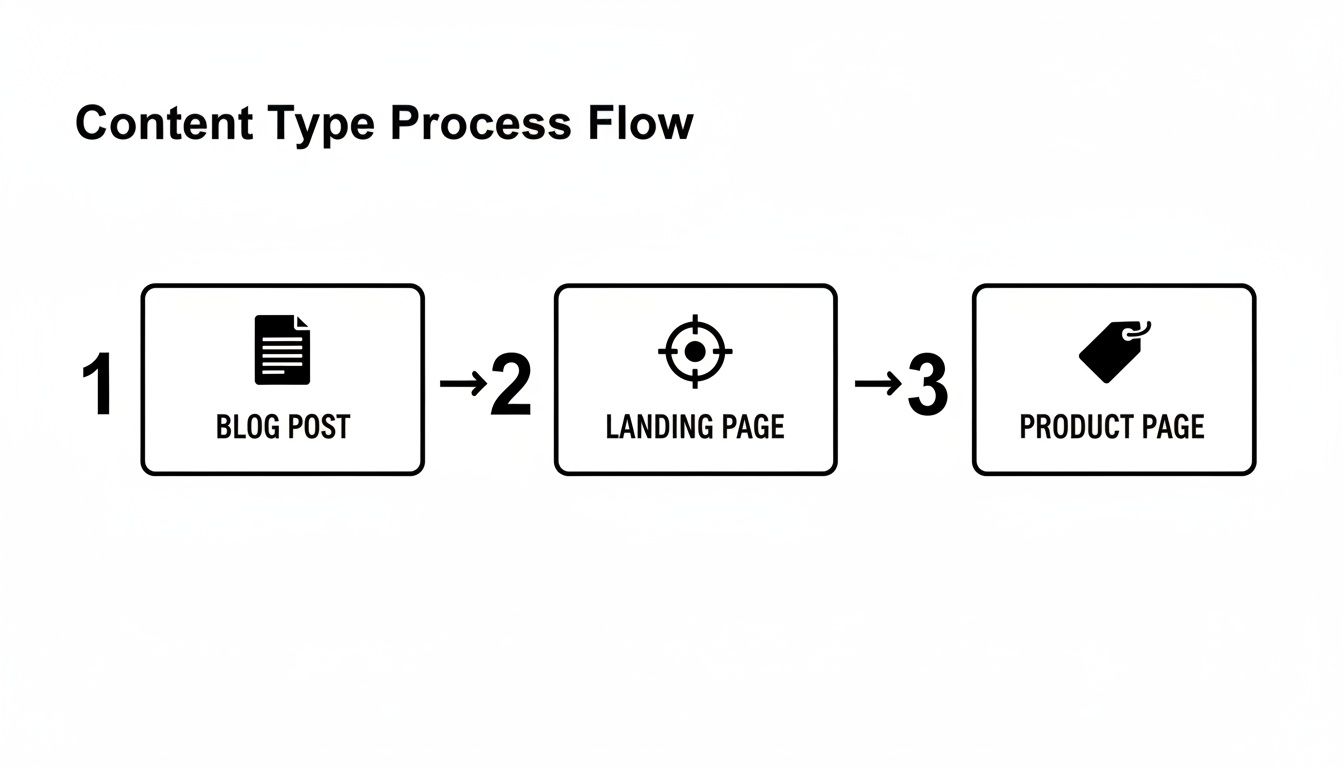
As you can see, each piece is designed to meet a user at a different stage of their journey, guiding them from discovery toward a specific action.
Step 3: Draft and Optimize On-Page Elements
With a solid outline in hand, it’s time to start writing. Your main goal is to create genuinely valuable content that completely answers the user's question. As you write, work your main and related keywords into the text where they feel natural—especially in a few key places.
Be sure to nail these on-page elements:
- Title Tag: This is the headline everyone sees in the search results. Make it catchy and try to put your main keyword near the front.
- Meta Description: Think of this as your ad copy. It’s a short summary under the title that needs to convince someone to click on your link over all the others.
- Headings (H1, H2, H3): Your H1 should have your main keyword, and your subheadings should include variations to reinforce what the page is about.
- Internal Links: Link out to other relevant pages on your own website. This helps both users and search engines find more of your great content and understand how it all connects.
The way content is made has also changed dramatically. AI is no longer a futuristic idea; it’s a major player. As of 2025, AI-generated content accounts for a staggering 17.3% of all articles in Google's top 20 results. That’s a huge leap from just 2.3% in 2020. Even more telling, roughly 66% of these AI-written articles manage to secure top rankings in less than two months, which shows just how powerful these tools have become.
Step 4: Refine with Semantic SEO and Promotion
Finally, it’s time to take your content from good to great. This is where you can enrich it with semantic SEO, which just means adding related concepts, answering follow-up questions, and defining key terms to show Google you’re a true authority on the topic, not just someone stuffing in keywords.
And remember, your job isn't done when you hit publish. Promotion is what gives your content its initial boost. Share it on social media, send it to your email list, and post it in relevant communities online. A consistent workflow that covers research, outlining, writing, optimizing, and promoting is the surest way to create SEO content that gets results and keeps on giving.
Measuring the True Impact of Your Content
So, you’ve published your content. What now? Hitting ‘publish’ is just the starting line, not the finish. To build a strategy that actually wins, you have to get good at figuring out what’s working, what’s a total dud, and—most importantly—why.
This is where measuring your content’s impact comes in. It’s how you stop guessing and start building a repeatable formula for success. It's the proof that your hard work is actually generating real value for the business.
Think of it this way: just looking at page views is like counting the number of people who walk past your storefront. It's a number, sure, but it doesn't tell you much. The real magic happens when you start tracking how many people came inside, what they looked at, and whether they bought anything. That's the story your SEO data should be telling.
Key Metrics for SEO Content Success
To get the full picture, you'll need to keep a close eye on a handful of key performance indicators (KPIs). These numbers, pulled from tools like Google Analytics and Google Search Console, show you exactly how your content is doing in search and what people do once they land on your site.
If you need a hand getting everything set up, our guide on how to track your website traffic walks you through the whole process.
So, what should you be watching? Let's break down the essential metrics that tell the real story of your content's performance.
Key Metrics for SEO Content Success
A breakdown of the essential KPIs for measuring content performance and what each one indicates about your strategy.
| Metric (KPI) | What It Measures | Tool for Tracking |
|---|---|---|
| Organic Traffic | The number of visitors who find your site through a search engine. | Google Analytics |
| Keyword Rankings | Where your content appears in search results for your target keywords. | Google Search Console, Ahrefs |
| Click-Through Rate (CTR) | The percentage of searchers who see your page in the results and actually click it. | Google Search Console |
| Conversion Rate | The percentage of visitors who take a specific, desired action (like a purchase or signup). | Google Analytics |
| Backlinks Acquired | The number of other websites linking to your content, which signals its authority. | Ahrefs, Semrush |
By tracking these KPIs over time, you’ll start to see clear patterns emerge. A steady climb in organic traffic or improving keyword rankings are direct signals that your SEO content strategy is on the right track.
Connecting Content Performance to Business Goals
Data is just a bunch of numbers until you connect it to real-world business outcomes. The end game for SEO content isn't just about ranking on page one; it’s about driving tangible growth. This is where you connect the dots between your metrics and what the company actually wants to achieve.
For instance, you might dive into the conversion rate for a specific blog post. Let's say an article on "how to choose the right running shoe" is driving a ton of newsletter sign-ups. Boom. You've just learned that topic hits a nerve with your ideal audience. That insight is gold—it tells you to create more content just like it to attract even more of those high-intent visitors.
The most powerful SEO analysis moves beyond asking "How many visitors did we get?" and starts asking "What did those visitors do, and was it valuable to our business?" This shift in perspective is what separates a simple content plan from a true growth engine.
Using Data to Refine and Improve
Your analytics aren't just a report card on past performance; they're a roadmap for the future. You can use the data you collect to make smarter decisions and constantly fine-tune your approach.
Here are a few practical ways to put your SEO data to work:
- Spot the Underperformers: Find pages with weak traffic or poor rankings. These are prime candidates for a "content refresh"—update them with fresh information, new data, and stronger optimization.
- Dig for Keyword Gold: Your queries report in Google Search Console shows you the actual terms people are using to find your site. You’ll often uncover valuable keywords you weren't even trying to target.
- Boost Your CTR: Got a page that’s ranking well but nobody’s clicking? Time to experiment. Rewrite the title tag and meta description to make it more magnetic and compelling in the search results.
When you get into a rhythm of measuring and analyzing your SEO content, you create an incredibly powerful feedback loop. You learn what your audience craves, you give them more of it, and you prove the real, tangible return on your investment every step of the way.
Common Content Mistakes That Tank Your Rankings
Crafting great SEO content is as much about dodging bullets as it is about hitting targets. It's easy to pour hours into a piece of content, only to have it fall flat because of a few common, yet critical, mistakes. These are the kinds of errors that quietly tell search engines your content isn't up to snuff.
The good news? Steering clear of these traps is one of the quickest ways to see better results. Most of these mistakes come from an old-school mindset of trying to "game" the algorithm instead of just helping the reader. Today's search engines are smart—they're looking for content that is genuinely useful and a pleasure to read.
Let's walk through the most common pitfalls and how to sidestep them.
Ignoring Search Intent
This one is the big kahuna. Search intent is the why behind a search, and getting it wrong is like showing up to a party with the wrong gift. You brought a book, but everyone else brought a bottle of wine. Your content just doesn't fit the occasion.
Let's say someone searches for "best waterproof running jackets." They're in the final stages of shopping. They want comparisons, reviews, and a clear path to making a purchase.
- The Mistake: You publish a deep-dive article on the history of Gore-Tex fabric. It's interesting, maybe, but it's not what they need right now.
- The Fix: You create a detailed comparison guide of the top 5 jackets, with clear pros and cons, pricing, and links to buy each one.
When your content misses the mark like this, people bounce. That high bounce rate is a huge red flag for Google, telling it your page wasn't a good answer for that query, and your rankings will pay the price.
Publishing Thin or Duplicate Content
In SEO, quality demolishes quantity every single time. Thin content is the SEO equivalent of empty calories—pages that look like content but offer zero real value. They're often short, superficial, or just a lazy rehash of information found on ten other websites.
And then there's duplicate content. This is when you copy and paste chunks of text from other pages—either on your own site or from someone else's. It's a massive no-no. It confuses search engines and can get your pages penalized or even dropped from their index altogether.
Google wants to reward originality and expertise. Your goal for every piece of content should be simple: make it the best, most helpful resource on the internet for that specific topic. Offer a perspective or detail no one else has.
Overlooking the User Experience
You could write the most groundbreaking article ever, but if your page is a frustrating mess to navigate, it's all for nothing. A poor user experience is a silent killer of good content.
Keep an eye out for these classic UX blunders:
- Intimidating Walls of Text: Huge, unbroken paragraphs are a nightmare to read, especially on a phone.
- Painfully Slow Page Speed: People are impatient. If your page doesn't load in a couple of seconds, most visitors are gone.
- Awful Mobile Design: With over 60% of searches now happening on mobile devices, your site must look and work flawlessly on a small screen.
The solution is simple. Break up your text. Use headings, short paragraphs, bullet points, and images to create visual breathing room. Make sure your site is fast and responsive. When people stick around and engage, it signals to search engines that you've got something good.
Frequently Asked Questions About SEO Content
Even after you get the hang of the basics, a few practical questions always seem to pop up. Let's tackle some of the most common ones we hear from marketers and business owners trying to create SEO content that actually works.
How Long Does It Take for SEO Content to Rank?
Patience is probably the most underrated SEO tool. There’s no exact timeline, but you can generally expect to see some real movement in your rankings within 6 to 12 months of consistent, high-quality work.
Why such a wide range? A few things tip the scales: your website's existing authority, the competitiveness of your keywords, and the sheer quality of your content. The best mindset is to focus on a long-term strategy of consistently publishing great stuff, not pinning your hopes on a single piece going viral overnight.
What Is the Difference Between SEO Content and a Blog Post?
This is a great question because it cuts right to the core of strategy. Here’s a simple way to think about it: a blog post is the car, but SEO content is the engine that actually drives it forward in search results. A blog post only becomes SEO content when it's built from day one with the goal of ranking.
A blog post is a format. SEO content is a purpose. Any blog post can be SEO content, but not every blog post is.
This means the content is intentionally built to:
- Target a specific keyword that your audience is really searching for.
- Match a clear search intent, giving the user exactly what they came for.
- Be technically sound with proper headings, internal links, and meta tags.
Is It Better to Create New Content or Update Old Posts?
Honestly, you need to do both. A smart SEO strategy balances creating brand-new articles with refreshing your older, evergreen posts. They each play a different, but equally critical, role.
Creating new content lets you target new keywords and reach different segments of your audience. At the same time, updating your existing content—what we call a "content refresh"—sends a strong signal to Google that your information is still relevant and trustworthy. You'd be surprised how much of a ranking boost you can get just by updating old posts with new stats or better internal links.
How Often Should I Publish New SEO Content?
Here’s the thing: consistency is way more important than frequency. Publishing one incredible, deeply researched article every week will always beat churning out five mediocre posts just to hit a number.
Find a publishing schedule you can realistically stick to, whether that's once a week or once a month. The goal is to create the absolute best resource out there for every topic you cover. Once you get that process down, you can think about picking up the pace. Quality gets you ranked, not volume.
At Sugar Pixels, we specialize in building powerful SEO strategies that turn your website into a growth engine. From crafting high-ranking content to designing a seamless user experience, we handle the technical details so you can focus on your business. Discover our web design and SEO plans today.