

A solid backlink strategy is about much more than just racking up links. Think of it as building a network of digital endorsements from respected sources, signaling to Google that your content is credible and worth showing to its users.
Why a Cohesive Backlink Strategy Is a Game-Changer for Growth
Letting your backlink profile grow randomly is like building a house without a blueprint. Sure, you might get a few walls up, but the structure won't be stable, secure, or valuable. A planned, strategic approach, on the other hand, is one of the most reliable ways to climb the search rankings, boost your domain authority, and drive sustainable organic traffic.
Instead of viewing it as a tedious SEO chore, treat link building as a core business investment. It has a clear, measurable return. Every high-quality backlink you earn is a powerful vote of confidence that strengthens your site's credibility, not just with search engines, but with real people who could become your customers.
The Real-World Business Impact
So what does all this "digital trust" actually do for your business? The benefits are tangible and hit your bottom line directly. A well-executed backlink strategy creates a powerful flywheel; the effort you put in today continues to generate results and compound over time.
- Better Search Visibility: Links from authoritative sites help you rank for valuable, high-intent keywords, putting your brand right in front of the people looking for what you offer.
- Stronger Domain Authority: As you build a healthy backlink profile, your site's overall authority (a key metric used by tools like Ahrefs and Moz to predict ranking potential) grows. This gives all of your content a better chance to rank.
- Lasting Organic Traffic: Paid ads bring traffic, but only as long as you keep paying. The visitors you get from strong organic rankings fueled by backlinks are consistent and can grow for years to come.
I see so many people get hung up on the number of links. The truth is, one link from a major industry publication is worth more than a hundred links from irrelevant, low-quality directories. Quality and relevance always win.
This whole process is a chain reaction that directly leads to business results.
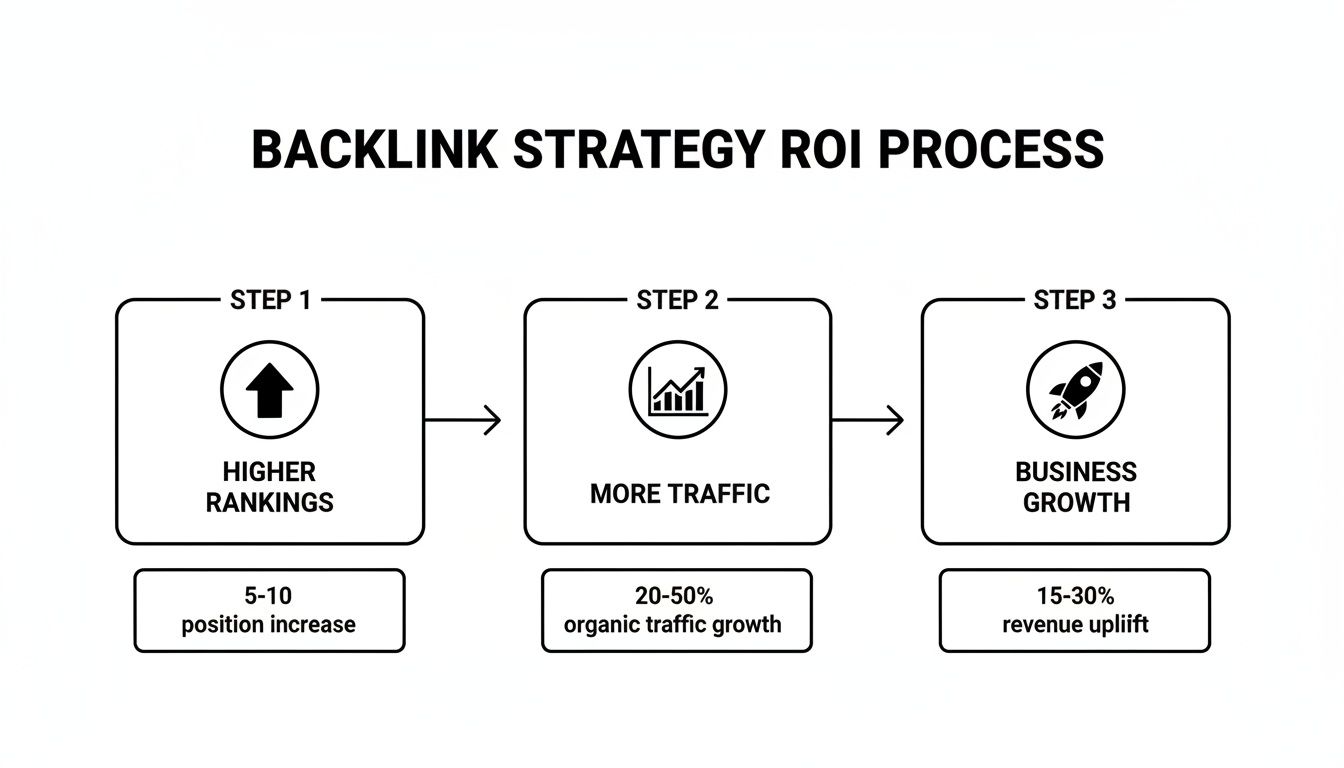
As you can see, higher rankings aren't the end goal. They are the trigger that brings in more traffic, which is what ultimately fuels real, measurable business growth.
The data backs this up without a doubt. Despite all the algorithm changes over the years, backlinks remain one of the most critical ranking factors. There's a direct correlation between the number of unique domains linking to a page and its position in the search results.
In fact, according to research from Backlinko, pages ranking #1 on Google have an average of 3.8 times more backlinks than the pages ranking in positions 2 through 10. That's a massive difference.
How a Backlink Strategy Fuels Different Business Goals
A smart backlink strategy isn't one-size-fits-all. The approach needs to be adapted to what you're trying to achieve, whether that's getting more foot traffic to your local shop or driving sign-ups for a global SaaS product.
| Business Type | Primary Goal | Strategic Focus Example |
|---|---|---|
| Local SMB | Increase local foot traffic & phone calls | Getting featured in local news sites, blogs, and city-specific business directories. |
| E-commerce Store | Drive product sales | Earning links from product review sites, affiliate blogs, and gift guides. |
| SaaS Company | Generate qualified leads & trial sign-ups | Building links to case studies and landing pages from industry-specific publications. |
| Affiliate Site | Boost organic traffic & commission revenue | Creating linkable assets (e.g., data studies) to attract links from high-authority blogs. |
| Enterprise | Build brand authority & thought leadership | Securing links from top-tier media and academic journals to establish market dominance. |
As the table shows, aligning your link-building efforts with your primary business objectives is what turns a simple SEO tactic into a powerful growth engine.
Auditing Your Current Link Profile to Find Opportunities
Before you can build a powerful backlink strategy, you need a clear map of your current terrain. Jumping into outreach without first understanding your existing link profile is like trying to navigate a new city without a map—you might get somewhere, but it won’t be the most efficient or strategic route. A thorough backlink audit is your foundational step, revealing hidden strengths, critical weaknesses, and untapped opportunities.

This process goes far beyond just exporting a list of URLs from a tool like Ahrefs or Semrush. The real value comes from the analysis—learning to see the story your backlinks tell about your brand's authority and relevance in the eyes of Google.
Gathering Your Link Data
First things first, you need to pull your complete backlink data. Most major SEO tools offer a one-click export feature that gives you a spreadsheet of every domain linking to your site. This raw data is your starting point.
You’ll get a massive file, typically with columns for the referring domain, the specific linking page, the anchor text used, and authority metrics like Domain Rating (DR) or Authority Score (AS). Don't let the sheer volume intimidate you; we’ll break down how to make sense of it all. This is also the perfect time to do some competitor SEO research to analyze backlinks, which can uncover a goldmine of link prospects.
Key Areas for Analysis
Once you have your data, it's time to put on your detective hat. You're not just sorting "good" links from "bad" ones; you're looking for patterns and strategic gaps you can exploit.
Start with your anchor text distribution. Does it look natural, or is it stuffed with the same keyword over and over? For example, if 80% of your links use the exact anchor text "best running shoes," that's a huge red flag for search engines. A healthy profile has a nice mix of branded anchors ("Nike"), naked URLs ("www.nike.com"), and topical variations ("running shoes for flat feet").
Next, eyeball the quality of your referring domains. One link from a top-tier industry publication is worth more than a hundred links from spammy, low-quality directories. I like to create a simple tier system to categorize domains:
- High-Tier: Authoritative, highly relevant sites. These are your gold standard.
- Mid-Tier: Decent, relevant blogs or smaller industry sites. Solid links to have.
- Low-Tier: Irrelevant or low-quality sites. These probably aren't hurting you, but they aren't helping much either.
- Potentially Toxic: Obvious spam, manipulative link schemes, or penalized sites. Flag these for a potential disavow down the road.
A rookie mistake is focusing only on the homepage. If you pull your data and see that 95% of your links point to your main URL, you've just found a massive opportunity. Building links directly to important product, service, or content pages is how you start ranking those pages for their target keywords.
Identifying Actionable Opportunities
The whole point of an audit is to walk away with a clear action plan. Your analysis should highlight specific weaknesses and opportunities that will drive your entire link building strategy. You can also learn more about finding your backlinks in our guide for a deeper dive into the discovery process.
This data-first approach keeps you away from risky tactics like reciprocal link schemes, which can backfire. And it’s well worth the effort. With organic traffic driving 300% more visits than social media, investing in high-quality backlinks is one of the smartest moves you can make to boost visibility.
By the end of your audit, you should have a straightforward to-do list:
- Replicate Competitor Links: Find high-quality domains linking to your competitors but not to you.
- Strengthen Internal Pages: Pinpoint key "money pages" that have few or no external links and prioritize them.
- Diversify Anchor Text: If your profile is over-optimized, plan outreach that encourages more natural and branded anchors.
- Clean Up Toxic Links: Create a list of harmful domains to monitor and potentially disavow later.
Doing this foundational work turns link building from a guessing game into a precise, data-driven discipline.
Creating Content That Naturally Attracts Links
You can't build links to thin air. The whole game of earning high-quality backlinks hinges on one simple thing: having something on your website that people actually want to link to. This is where "linkable assets" come in—these are the pieces of content you create specifically to do the heavy lifting of link attraction for you.
Instead of just churning out another blog post, you need to start thinking like a publisher. The goal is to create a resource so genuinely helpful and authoritative that it becomes the go-to reference for a particular topic. When another writer, journalist, or blogger is covering that subject, your content should be the first thing they find and the most credible source they can cite.
Moving Beyond Standard Blog Posts
While keeping a consistent blog is important for a lot of reasons, not all content is created equal when it's time to earn backlinks. If you really want to move the needle on your domain authority, you have to develop assets that offer unique value that can't be found anywhere else.
Put yourself in the shoes of someone writing an article. They want to link to sources that make them look smart and add credibility to their own work. A generic "5 tips for X" article just doesn't cut it.
Here are a few formats I've seen work time and time again as powerful link magnets:
- Original Research & Data Studies: This is the gold standard. Surveying your audience, analyzing your internal data, and publishing unique findings is a goldmine for links. Journalists and bloggers are always desperate for fresh statistics to cite.
- Ultimate Guides & In-Depth Tutorials: A truly comprehensive guide that covers a topic from every possible angle becomes an evergreen resource. Think about the difference between a 500-word overview and a 5,000-word deep dive on "e-commerce SEO."
- Free Digital Tools & Calculators: A simple but genuinely useful tool—like a mortgage calculator on a real estate site or a headline analyzer for a marketing blog—can attract hundreds of links because it provides real, ongoing utility.
- Data-Rich Case Studies: Detailed case studies backed by hard numbers and specific results do two things: they showcase your expertise and provide concrete proof that other industry blogs will be eager to reference.
The common thread here is irreplaceable value. If someone can find the same information on ten other websites, there’s no compelling reason for them to link specifically to you. Your job is to create something that stands alone as the best resource on the subject.
The Proven Power of Long-Form Content
There’s a clear, well-documented connection between content length, search rankings, and the number of backlinks a page earns. I’m not saying you should add fluff just to hit a word count, but creating truly in-depth resources naturally results in longer content that builds more authority.
The data doesn't lie. Companies that consistently publish content get 97% more backlinks than those that don't. More specifically, long-form pieces are wildly effective; research from Backlinko shows that content over 3,000 words attracts, on average, 77.2% more backlinks than shorter articles. This approach essentially turns your blog into a magnet for authoritative links.
This chart from the research perfectly illustrates the relationship between backlinks and a top Google ranking.
The takeaway is crystal clear: pages ranking in the top spots have significantly more backlinks, which hammers home the importance of creating content that earns these links in the first place.
Brainstorming Your First Linkable Asset
So, how do you actually come up with an idea? Don't try to reinvent the wheel. A great starting point is to see what's already working in your space. Use an SEO tool like Ahrefs or Semrush to analyze your competitors' most linked-to pages. You're not looking to copy them, but to spot the topics and formats that are already resonating with your industry's audience.
For example, an e-commerce store selling coffee beans could create the definitive guide to cold brew methods, complete with original photography, brewing videos, and the science behind extraction. A B2B software company might publish an annual "State of the Industry" report filled with survey data that becomes a go-to citation source for years. Your SEO content strategy should be built around creating these cornerstone pieces.
Here’s a simple framework to kick off your brainstorming:
- Identify Your Expertise: What does your business know better than anyone else? What unique data or insights can you access that no one else has?
- Analyze Competitor Success: What types of content have earned your competitors their best links? Look for "link gaps"—topics they've covered poorly that you can absolutely dominate.
- Solve a Pressing Problem: What are the biggest, most frustrating challenges your audience faces? A resource that provides a clear solution to a painful problem is inherently link-worthy.
- Find a Unique Angle: Can you present information in a completely new way? Maybe everyone else has written a listicle, but nobody has created an interactive infographic, a detailed video course, or a downloadable template.
By strategically focusing on creating just a few of these high-value, linkable assets each year, you can build far more authority than you would with a hundred generic blog posts. It’s about shifting your mindset from content quantity to undeniable content quality—and that’s the foundation of any successful backlink strategy today.
Mastering the Art of Strategic and Personalized Outreach
Having a fantastic, link-worthy piece of content is only half the battle. Seriously. Now you’ve got to get it in front of the right people—the editors, journalists, and site owners who can actually give you that valuable backlink. This is where strategic, personalized outreach comes in, turning your link building from a passive hope into an active, relationship-building machine.

Forget mass-blasting a generic template to hundreds of email addresses. That approach stopped working years ago. Today, it'll just get your emails marked as spam before anyone even reads them. Effective outreach is all about quality over quantity, focusing on building genuine connections by providing real value first.
Identifying and Prioritizing Your Targets
Before you even think about writing an email, you need to know exactly who you're writing to. Your goal is to build a highly curated list of websites that are both relevant to your niche and have enough authority to actually move the needle on your SEO.
Think beyond just grabbing your competitor's backlinks. While that’s a decent starting point, you need to broaden your scope.
- Industry Blogs and Publications: These are the watering holes where your target audience already hangs out.
- News Outlets and Journalists: Perfect if you have original data or a unique story to share.
- Complementary Businesses: Think about non-competing businesses that serve the same audience. They can make great partners.
- Resource and Link Pages: Many sites curate lists of helpful resources. Getting your asset included is often a quick and easy win.
Once you have a list, it’s time to prioritize. Not all targets are created equal. I use tools like Ahrefs to check a site's Domain Rating (DR) and get a feel for its organic traffic. You’ll want to focus your initial efforts on the sites that offer the best mix of high authority and strong topical relevance. This targeted approach ensures your time is spent where it will have the biggest impact.
The most successful outreach campaigns are built on empathy. Before you even think about asking for a link, ask yourself: 'How does my content make this person's job easier or their own content better?' If you can't answer that, you're not ready to reach out.
This value-first mindset is everything in modern link building. You're not just another person asking for a favor; you’re a colleague offering a resource that can help them improve their own work.
Crafting Emails That Actually Get Opened
Let's be real: editors at high-authority sites get dozens, if not hundreds, of these requests every single week. Your email has to stand out from the noise, and that means personalization is non-negotiable.
This goes way beyond just using their first name. Mention a specific article they recently published, compliment a point they made on social media, or reference a shared interest. It immediately shows you’ve done your homework and aren’t just another spammer blasting a template.
Keep the email itself short, sharp, and focused on them, not you. A simple structure that I've found works well is:
- The Personalized Opener: Start with a genuine, specific compliment or connection.
- The Value Prop: Briefly explain why you’re contacting them and what’s in it for them. (e.g., "I saw you wrote about X, and I have some new data that could add a fresh angle to your article.")
- The Resource: Give them a direct, no-strings-attached link to your content.
- The Soft Ask: Gently suggest where your link could fit naturally. Make their job as easy as possible.
This process is critical because consistent link building creates its own powerful momentum. Research shows that the top-ranking page on Google typically gains 5% to 14.5% more 'dofollow' backlinks from new websites each month. It's a flywheel effect where success builds on itself. You can find more data on this in this comprehensive SEO stats report.
Comparing Different Outreach Approaches
Different goals require different tactics. A guest post pitch, for instance, looks completely different from a broken link building request. You have to tailor your outreach to the specific situation to have any hope of success.
For example, when I’m promoting a new study, my email is all about how that data benefits the recipient's audience. I'm just making them aware of a valuable asset they might want to share. But for broken link building, the approach is more direct. You're actively helping them fix an error on their site (the broken link) while conveniently offering your content as the perfect replacement. It's a classic "give before you ask" strategy that provides immediate value.
This table breaks down some of the most common methods I use and their typical success rates.
| Outreach Type | Key Element | Best For | Typical Success Rate |
|---|---|---|---|
| Guest Posting | Pitching a unique, high-quality article idea | Building brand authority and earning editorial links | 5-15% |
| Resource Promotion | Showcasing a valuable "linkable asset" | Promoting guides, studies, or tools to relevant sites | 2-8% |
| Broken Link Building | Finding dead links and offering a replacement | Earning links on established pages with existing authority | 6-12% |
| Unlinked Mentions | Finding mentions of your brand without a link | Securing "quick win" links from existing brand awareness | 10-20% |
As you can see, choosing the right strategy really depends on your specific assets and goals. By mastering a few of these outreach types, you can build a versatile and effective link building program that consistently earns high-quality links and drives real organic growth.
How to Measure Success and Manage Risk
Putting your backlink strategy into motion is a huge step, but the work doesn’t stop once the outreach emails go out. The real, lasting value comes from keeping a close eye on your results and proactively managing the health of your link profile. This is what separates a campaign that fizzles out from one that becomes a true engine for organic growth.

Tracking success is so much more than just counting new links. It’s about drawing a clear line from your link-building efforts to real business outcomes. Are you seeing more organic traffic hitting those key pages? Are your rankings for your most valuable keywords actually improving? Answering these questions is how you prove ROI and make the case for continued investment.
Key Performance Indicators to Monitor
Forget the vanity metrics. To get a real sense of your campaign’s impact, you need to zero in on KPIs that actually reflect SEO progress and your company's bottom line. To do this right, you'll need solid SEO reporting tools for agencies or your in-house team.
Here are the core metrics I never fail to track for any campaign:
- Growth in Referring Domains: The number of unique websites linking to you is almost always more important than the total number of backlinks. Seeing a steady climb in high-quality referring domains is one of the best signs of a healthy strategy.
- Organic Traffic Trends: Is organic traffic going up, especially to the specific pages you’re building links to? Jump into Google Analytics, filter traffic to those target URLs, and watch how they grow over time.
- Keyword Ranking Improvements: Keep a close watch on a handful of target keywords tied to your "money pages." Seeing those pages climb from the depths of page three to page one is definitive proof your links are building authority.
- Domain Authority (DA) or Domain Rating (DR): While these are third-party metrics, a rising DA or DR score is a great directional signal. It tells you that your site's overall authority is growing in the eyes of major SEO tools.
The most crucial shift you can make is connecting these SEO metrics to actual business goals. For an e-commerce site, that means tracking the rise in organic revenue. For a SaaS company, it's all about monitoring growth in organic leads and trial sign-ups. That’s how you translate "more links" into "more money."
This connection isn't just theoretical. Quality backlinks have a direct, measurable impact on your search rankings. In some cases, a single quality backlink can boost a page's ranking by as much as 1.5 positions. It’s an incredibly high-leverage activity for any business.
Managing Risk and Keeping Your Profile Clean
A smart backlink strategy involves playing defense, too. As your site grows, it will inevitably pick up some low-quality or spammy links. While Google's algorithm has gotten pretty good at ignoring most of this junk, proactively managing risk is just good practice for long-term site health.
This is where you’ll want to revisit those toxic links you flagged during your initial audit. If you’ve acquired links from spammy directories, private blog networks (PBNs), or other shady schemes, you need a plan to deal with them.
Using the Disavow Tool Responsibly
Google's Disavow Tool is your way of telling Google to ignore specific links when it looks at your site. But let me be clear: this is a powerful tool that you need to use with extreme caution. Disavowing the wrong links can absolutely wreck your SEO.
Here’s a simple framework for when to even consider using it:
- You Have a Manual Action: If you get a manual penalty from Google for "unnatural links," you must use the Disavow Tool as part of your reconsideration request. No way around it.
- You're Under a Negative SEO Attack: If you see a sudden, massive wave of spammy links that are clearly meant to harm your site, a disavow can be a smart protective measure.
- You Have a History of Paid Links: If your site has a past of buying links that violate Google's guidelines and you can't get them removed, disavowing them is a necessary part of the cleanup.
For the vast majority of sites, you will probably never need to touch this tool. But knowing it’s there—and when to use it—is a critical part of responsible profile management. You can find a variety of helpful SEO tools for small businesses in our guide that can help you keep an eye on your profile.
By pairing active link acquisition with diligent monitoring, you’ll build an online presence that’s not just authoritative, but also resilient.
Answering Your Top Backlink Strategy Questions
Even with the best plan laid out, you're going to have questions. That's just part of the process. When you start digging into your own backlink profile, you'll inevitably run into some common hurdles.
Let's tackle some of the most frequent questions I get from everyone, whether they're a founder at a new startup or an in-house marketer at an enterprise company. These are the practical, real-world answers you need to keep moving forward.
How Many Backlinks Do I Actually Need?
This is, without a doubt, the question I hear most often. The honest answer? It depends. There’s no magic number.
Instead of getting fixated on quantity, your focus should really be on quality and velocity. The goal isn't to hit some arbitrary target but to earn links from relevant, authoritative sites at a natural, steady pace.
The real benchmark is your competition. Take a look at the top-ranking pages for your main keyword. If they each have around 50 high-quality referring domains, your job is to build a profile that can compete with that—not just to scramble for 51 links from anywhere. It's about matching and then exceeding their quality.
What's The Difference Between Dofollow and Nofollow Links?
Think of a dofollow link as a direct endorsement. It’s a signal to search engines that passes authority (what we used to call "link juice") from one site to another, which is what directly helps your rankings. These are the golden tickets you’re after with your outreach efforts.
A nofollow link has a small snippet of code that tells search engines not to pass that authority. You’ll find them everywhere—blog comments, forums, social media posts. But just because they don't pass authority doesn't mean they're worthless. Far from it.
A healthy backlink profile always has a natural blend of dofollow and nofollow links. Those nofollow links can be fantastic for driving real, interested people to your site and building brand awareness. Don't discount them.
How Long Does It Take to See Results from Link Building?
Building a strong backlink profile is a marathon, not a sprint. A new link's impact is never immediate. First, Google has to crawl the page with your link, then it has to index that link, and finally, it has to factor that new signal into its massive algorithm.
Generally speaking, you might start to see some positive movement in your rankings within 3 to 6 months of consistent, high-quality link building. But the really significant, lasting results? Those often take upwards of a year to fully mature as your domain's authority begins to compound. Patience and consistency are your best friends here.
Is It Okay to Buy Backlinks?
Let me be direct: No. Don't do it.
Paying directly for links in an attempt to manipulate search rankings is a crystal-clear violation of Google's webmaster guidelines. This includes everything from straight-up cash for a link to sending free products in exchange for a followed link.
If you get caught—and the algorithms are getting smarter every day—you risk a manual penalty that can vaporize your organic traffic overnight. It's a massive gamble for a tiny, short-term gain. A real SEO strategy is about earning links through valuable content and genuine relationships. There are no shortcuts.
What Should I Do If I Get a Spammy Looking Link?
First off, don't panic. Any website that gets a bit of traction will inevitably attract some weird, low-quality links. It's just the cost of doing business online.
The good news is that Google's algorithm is now incredibly sophisticated at identifying and simply ignoring the vast majority of this link spam. For the most part, you can just let them be.
Unless you see a sudden, massive flood of toxic-looking links (a sign of a potential negative SEO attack) or you get a dreaded manual penalty notification in your Google Search Console, you don't need to touch the Disavow Tool. In fact, using it improperly can sometimes do more harm than good.
Ready to stop guessing and start building a backlink strategy that drives real growth? At Sugar Pixels, we specialize in creating custom SEO and web design solutions that build lasting authority for your brand. Learn how our expert team can scale your online presence today.