

Localized digital marketing isn't just about changing the language on your website. It's the art and science of weaving your brand into the fabric of a specific geographic community. Think of it as making your business feel like a true local—someone who understands the neighborhood, its people, and what makes it unique. This is how you build real trust and, ultimately, drive real action.
Why Localized Marketing Is Your Unfair Advantage
In a marketplace flooded with generic ads from global giants, localized marketing is how you cut through the noise. It’s the difference between a big-box store’s bland flyer and the neighborhood hardware store sponsoring the local little league team. One is just an ad; the other is a genuine connection. This isn't just a strategy for brick-and-mortar shops, either. It’s a game-changer for any business wanting to truly own a specific regional market.
At its heart, the concept is simple: people buy from businesses they know and trust. A localized approach embeds your brand into the daily rhythm of a community, making you the natural choice when a customer has a need. This focus on relevance creates a powerful, protective moat that bigger, slower competitors just can't cross.
Connecting With Customers On Their Terms
Instead of broadcasting one message to the masses, you're having a dozen different, more meaningful conversations. You're tailoring your communication to reflect local tastes, events, and culture.
This could look like:
- Community-Centric Content: Maybe you write a blog post about the best dog parks in your city, feature a local artist in your newsletter, or create a guide to an upcoming street fair.
- Hyper-Relevant Ads: You could run a Facebook ad campaign that mentions a beloved local landmark or ties into a big high school football game. It instantly feels more personal and timely.
- Authentic Visuals: Ditch the sterile stock photos. Use real pictures of your team and happy customers right there in your local shop or service area.
When you do this, you stop being just another business and start becoming a valued part of the community.
The Direct Path From Local Search To Sales
The results of a smart local strategy aren't fuzzy—they show up in your bottom line, and quickly. When someone pulls out their phone and searches for a product or service "near me," their intent to buy is incredibly high.
The data backs this up. A staggering 76% of people who conduct a local search on their phone visit a related business within 24 hours. Even better, 28% of those searches result in a purchase. The connection between local intent and sales is undeniable.
A generic, one-size-fits-all strategy is like trying to use a single key for a thousand different locks. A localized strategy is about crafting the specific key that opens the door to each community, building trust and loyalty that national campaigns can never replicate.
Ultimately, this targeted approach gets more people through your door (or to your website), skyrockets your visibility in local search results, and wins the loyalty of customers who are tired of being treated like a number.
For a deeper dive into establishing a strong local footprint, these 10 essential local business marketing strategies are a great starting point. And for more practical ideas you can implement right away, check out our guide on 10 proven local marketing techniques.
Building Your Technical SEO Foundation
Your entire localized marketing strategy hinges on a solid technical backbone. It's the unglamorous but absolutely essential work that happens behind the scenes. Without it, even the most brilliant content or ad campaigns will struggle to find an audience. Getting this right is how you send crystal-clear signals to search engines like Google, making your business the obvious choice for nearby customers.
Think of it like the plumbing in your house. When it works, you don't notice it. But when it's broken, nothing else functions properly. We'll start with the single most powerful tool you have for local SEO: your Google Business Profile.
The customer journey is surprisingly direct. A local search kicks things off, leading to a visit, and then a purchase. It's a simple flow, but one that breaks down completely without a strong technical setup connecting the dots.
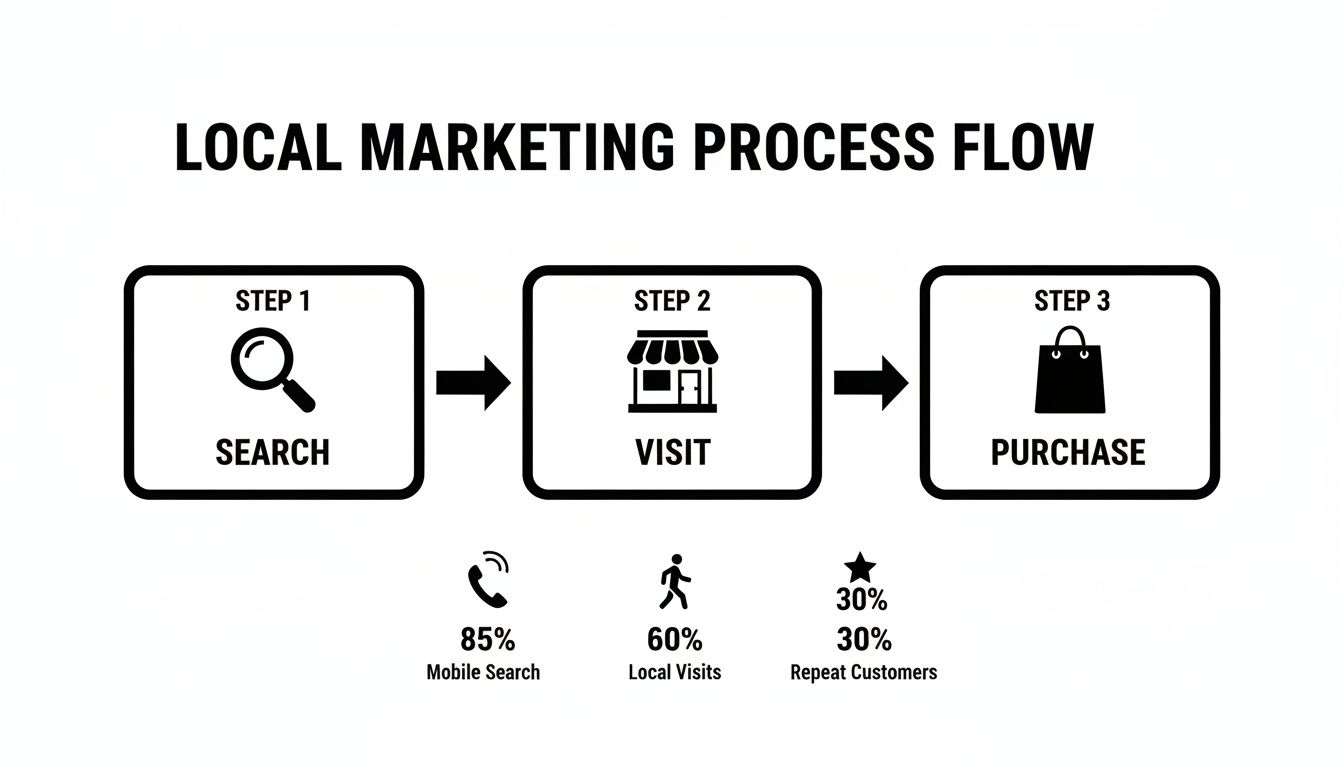
As you can see, the path from search to sale is short. Your job is to make sure your business shows up right at the beginning of that journey.
Mastering Your Google Business Profile
Your Google Business Profile (GBP) is far more than a simple listing—it's your digital storefront on the world's largest search engine. For many customers, it’s the very first impression they'll have of your brand. An incomplete profile is a huge missed opportunity, while a fully fleshed-out one can skyrocket your visibility in both the map pack and standard search results.
First things first: absolute accuracy is non-negotiable. Your business Name, Address, and Phone number (NAP) must be perfectly consistent everywhere—on your GBP, your website, and any other online directory. I’ve seen businesses hurt their rankings over something as small as "St." versus "Street." It sounds minor, but it's enough to confuse search engines and dilute your authority.
Next, get granular with your categories. Choose the primary category that perfectly describes your main offering, but don't stop there. Add every relevant secondary category you can. If you're a bakery that also serves fantastic coffee, you need to be listed as both a "Bakery" and a "Coffee Shop" to show up for both types of searches.
The details are what separate the winners from everyone else. Fill out every single field you can. Business hours, accessibility options, service details like "curbside pickup"—these are all filters that help you appear in highly specific searches.
Finally, make it visual. Don't just upload a few photos and call it a day. Consistently add new, high-quality, geo-tagged photos of your location, your products, and your team in action. This shows potential customers what you're all about and signals to Google that your business is active and relevant. If you're worried about common technical missteps, this guide on https://www.sugarpixels.com/technical-seo-issues/ is a great resource.
Implementing Local Schema Markup
While your GBP speaks to customers, local schema markup speaks directly to search engines. It’s a bit of code you add to your website that translates your business information into a language Google and others can instantly understand. Think of it as a cheat sheet for search engine crawlers.
When you add schema, Google can pull that data to create "rich snippets" in the search results—things like star ratings, hours of operation, or upcoming events. These eye-catching details make your listing far more clickable. The most important one for any local business is LocalBusiness schema.
Here’s what it really does for you:
- Clarifies Your Identity: It leaves no room for interpretation, confirming your exact business name, address, phone number, and hours.
- Defines Your Services: You can get specific about your business type, whether you're a
Dentist,Restaurant, orPlumber. - Builds Trust: By providing structured, verifiable data, you're making it easy for search engines to trust that your information is accurate.
Adding this markup, usually in the header or footer of your site, can give you a significant edge in how Google displays your information.
Essential Local SEO Schema for Your Website
To really dial this in, you'll want to use more than just the basic LocalBusiness schema. Here are the most critical types I recommend for local businesses to stand out.
| Schema Type | Primary Function | Best Use Case Example |
|---|---|---|
LocalBusiness |
The foundational schema that identifies your business name, address, phone (NAP), and hours. | A brick-and-mortar retail store wants to appear in "near me" searches with correct hours. |
Review |
Displays aggregate star ratings directly in search results, building immediate social proof. | A restaurant with great Yelp reviews wants to show its 4.5-star rating on Google. |
Event |
Highlights upcoming events, workshops, or sales with dates, times, and locations. | A local bookstore promoting an author signing event, making it visible in search. |
Product |
Provides detailed product information, including price, availability, and ratings. | An electronics shop wants to show that a specific TV model is in stock at their location. |
FAQPage |
Answers common customer questions directly on the search results page, saving users a click. | A dental clinic answers "Do you accept my insurance?" to pre-qualify potential patients. |
Using a combination of these schema types sends powerful relevancy signals and makes your search listings much more compelling to potential customers.
Creating High-Converting Location Pages
If your business has more than one location, dedicated pages for each are an absolute must. And I don't mean just copying your main service page and swapping out the city name. Each page needs to be a unique, valuable resource for the community it serves.
A great location page always includes:
- Unique Local Content: Talk about nearby landmarks, mention your involvement in local events, or share testimonials from customers in that specific neighborhood.
- Specific NAP Information: The unique name, address, and phone number for that exact location need to be front and center.
- An Embedded Google Map: Make it ridiculously easy for people to find you and get directions.
- Location-Specific Schema: Each page needs its own
LocalBusinessschema markup with that location's specific details.
A truly solid technical foundation also includes practices like citation building for local SEO, which ensures your NAP information is consistent across key online directories like Yelp. When all these technical elements—from your GBP to your schema—are working together, your business becomes undeniably relevant to local searchers. This focus on local precision pays off. We're seeing localization strategies slash marketing costs by 30% through automation, while optimized local profiles get 7x more clicks. That’s a powerful combination for growth.
Crafting Content That Resonates Locally
Let's be honest: generic, one-size-fits-all content is the digital equivalent of junk mail. It's instantly forgettable and usually ends up in the trash. If you want to make a real impact with your local marketing, your content has to speak the language of the community you're in—both literally and figuratively.
The real goal here is to shift your brand's perception from being just another faceless company to a genuinely helpful, knowledgeable neighbor. When you create content that helps people navigate their local world, you build a kind of authentic connection that big national brands just can't touch. You become a resource, not just a retailer.
Go Beyond Your Products and Services
Some of the best-performing local content I've seen has almost nothing to do with the actual product being sold. Instead, it focuses on the community itself, weaving the business into the local fabric. This simple shift shows you care about the same things your customers do, and that builds incredible goodwill and keeps you top-of-mind.
Think about a real estate agency in a growing suburb. They could just post listings all day, but what if they created content like this?
- "The Ultimate Guide to Parks and Playgrounds in [Neighborhood Name]": Perfect for young families and instantly positions the agency as a community expert.
- "Meet the Owner of [Local Coffee Shop]": Featuring another local business fosters a sense of community and opens doors for cross-promotion.
- "A Weekend Itinerary for Visitors in [Your City]": This shows off the area's best assets, which is great for attracting new residents and giving current ones ideas.
Suddenly, their blog and social media aren't just a sales pitch; they're a community hub. You’re providing real value that solves local problems, which is the whole point of a strong SEO content strategy.
Weave Local Flavor into Everything
Authenticity is everything. Your content needs to feel like it was made by someone who actually lives there and loves the area. That means getting the language and the visuals right.
Start by paying attention to local slang and landmarks. Mentioning "the Loop" in Chicago or "PCH" in Southern California is an instant signal that you're an insider. Reference the local high school football team, a beloved annual festival, or even a quirky town tradition. These small details make your content feel personal and relatable.
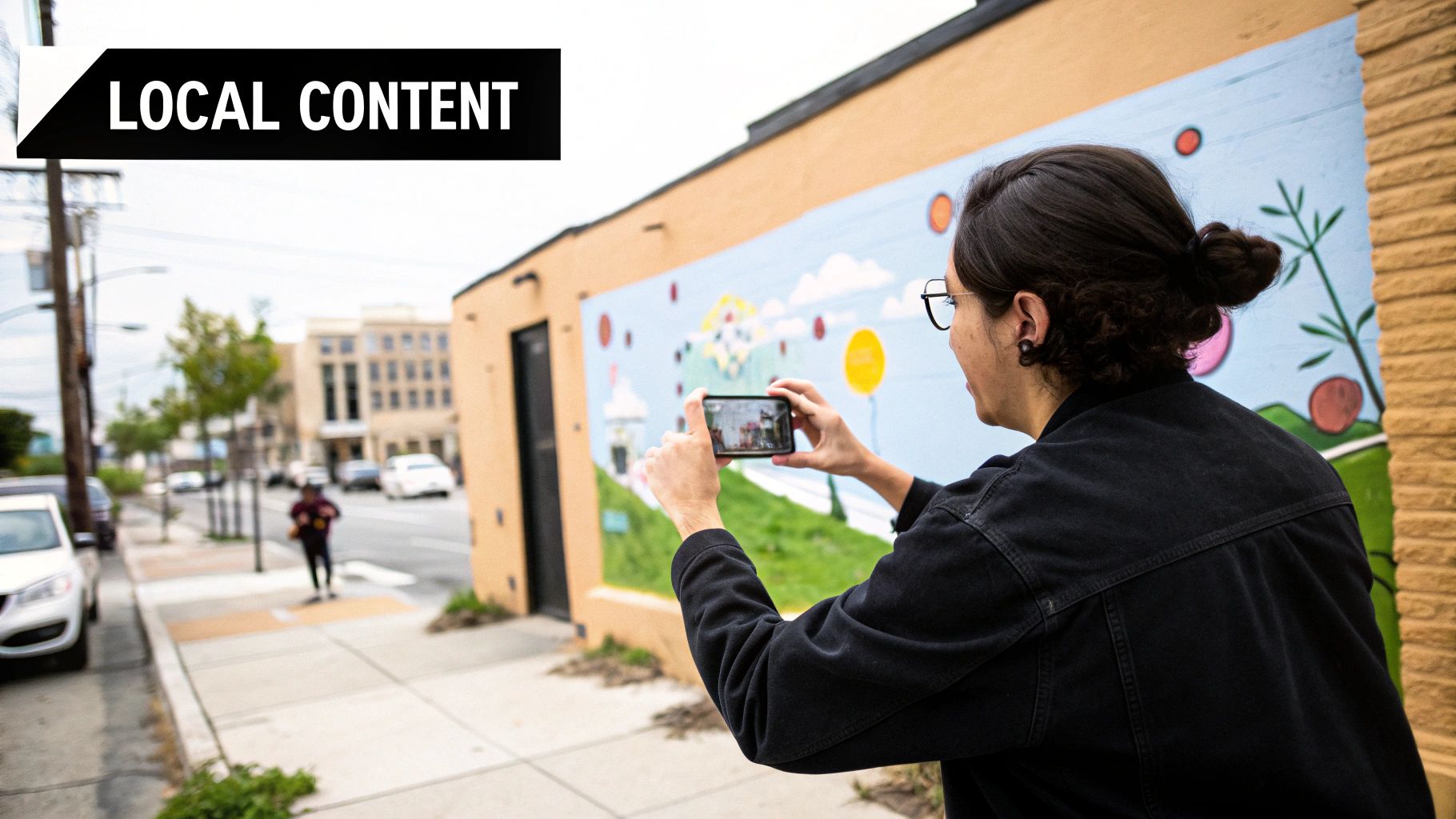
Your visuals are just as critical. Ditch the generic stock photos. Instead, use high-quality images of familiar local spots—your storefront, your team at a community fair, or a well-known mural down the street. Video is especially powerful here. A quick video tour of your neighborhood or an interview with a local customer can forge an immediate and powerful connection.
People feel a natural psychological closeness to local brands over global ones. Your content is the bridge that creates that feeling. When your photos, videos, and stories reflect their world, you’re no longer just a business—you’re one of them.
Spotlight Your Community and Customers
One of the most effective content plays you can run is to make your community the hero of the story. Focusing on user-generated and community-centric content builds massive social proof and fosters a sense of shared identity.
Here are a few ideas you can put into action right away:
- Feature Customer Success Stories: Don't just post a testimonial. Interview a local customer and tell the story of how your product or service genuinely helped them.
- Run a Local Photo Contest: Ask your followers to share photos of their favorite local spots with a branded hashtag. Feature the winners on your social channels and website.
- Partner with Other Local Businesses: Team up with a non-competing business to co-create content. A local gym and a healthy café, for instance, could create a "Wellness Guide to [Your Town]." This doubles your reach and deepens your community ties.
By consistently creating content that celebrates and serves your local area, you establish deep roots. You're proving you're invested in the community's success, which in turn makes the community invested in yours. This isn't just good marketing; it's how you build a loyal local following that actually lasts.
Winning Local Search with Paid Ads and Social Media
While a strong organic foundation is your long game, paid advertising and social media are the accelerators that put your local marketing into high gear. These channels let you jump the line, getting your message directly in front of the right local customers precisely when they're ready to buy. This isn’t about casting a wide, expensive net; it’s about surgical precision.
Think of it like this: paid local ads are your digital billboard on the busiest street corner in your neighborhood. You get immediate visibility with the exact audience you want to reach, driving not just online clicks but real-world foot traffic.
Mastering Geo-Targeted Paid Advertising
Geo-targeting is the engine that makes local paid campaigns work. It’s how you draw a virtual boundary around your service area and show ads only to the people inside it. Platforms like Google Ads and Meta (for Facebook and Instagram) offer incredibly powerful tools for this, letting you get much more specific than just a city or zip code.
You can actually dial it down to a one-mile radius around your storefront. Imagine you’re a new café running a "Free Coffee Friday" promotion. With geo-targeting, you can show that ad only to people who are physically within walking distance. This kind of surgical approach slashes wasted ad spend and sends your return on investment soaring.
Another fantastic tactic is geo-fencing. This means setting up a virtual perimeter around a competitor’s store, a local event, or even a business that complements yours. When a potential customer walks into that area, your ad can pop up on their phone. A local bookstore, for instance, could geo-fence the nearby university campus during finals week with an ad promoting study guides and late-night hours.
The real magic of localized paid ads isn't just where you show them, but what you say. Your ad copy is your chance to prove you're a true local, not a faceless national brand.
It's amazing how effective simple phrases can be. "Proudly serving the Austin community since 2015" or "Your friendly neighborhood plumber in Oak Park" creates an instant connection. Pair this with location extensions in Google Ads—which show your address and a "directions" button—and you’ve built a direct path from someone's search to your front door.
Engaging Communities with Localized Social Media
Social media is where your brand's personality truly shines. For a local business, the goal isn't to go viral globally; it's to become a beloved and trusted voice right in your own community. This is where you build relationships at scale.
Start by just showing up in local conversations. Find and join community Facebook groups. Don't just spam your services—that’s the fastest way to get kicked out. Instead, offer helpful advice and be a good neighbor. When someone asks for a recommendation for a service you happen to provide, you can chime in authentically.
Your content strategy needs to be deeply rooted in your location. Here are a few ideas you can put into action today:
- Use Location-Based Hashtags: Forget generic tags. Get specific with hashtags like
#DowntownDenverEatsor#BrooklynArtiststo plug into active, local discovery feeds. - Run Local-Only Contests: Host a giveaway where the prize is a gift card to another popular local spot. This builds goodwill and cross-pollinates your audience with theirs.
- Spotlight Your Neighbors: Feature other non-competing local businesses you love on your social channels. This kind of authentic cross-promotion is invaluable for building a strong local network.
Remember, you want to create a feed that reflects the life and energy of your community. It should feel like it’s run by a local, for locals.
Choosing Your Local Paid Advertising Channel
Deciding where to put your ad budget can feel overwhelming. Every platform has its strengths, and the right choice really depends on your business and what you’re trying to achieve. To help you decide, here’s a quick comparison of the major players.
| Channel | Best For | Key Targeting Feature | Typical Cost Per Result |
|---|---|---|---|
| Google Ads | Capturing high-intent customers actively searching for your services ("plumber near me"). | Keyword targeting combined with precise radius targeting around your location. | Higher, but often delivers more qualified leads due to strong purchase intent. |
| Meta (Facebook/IG) | Building brand awareness and reaching specific demographics based on interests and behavior. | Detailed demographic and interest layering, plus lookalike audiences based on local customers. | Lower, excellent for top-of-funnel engagement and community building. |
| Yelp Ads | Businesses that rely heavily on reviews and reputation, like restaurants, home services, and salons. | Targeting users who are actively browsing your business category on a trusted review platform. | Varies, but targets users at the final stage of their decision-making process. |
| Nextdoor | Hyper-local service providers looking to build trust with homeowners in specific neighborhoods. | Sponsoring posts directly within verified neighborhood communities to generate word-of-mouth. | Moderate, highly effective for building a reputation as the go-to local expert. |
Ultimately, a smart strategy combines the laser-focus of paid advertising with the authentic community-building of social media. When you get this right, you’re not just reaching customers; you’re embedding your business into the fabric of the neighborhood, ensuring you’re the first name they think of when they have a need.
Your Local Reputation is Your Lifeline
In any local market, trust isn't just a nice-to-have—it's everything. Your online reputation is the modern-day word-of-mouth, and what people say on Google, Yelp, or local Facebook groups is often the last thing a potential customer checks before deciding to walk through your door or click "buy."
This isn't just about chasing five-star ratings. It’s about actively managing the public conversation around your brand. If you don't, you’re letting strangers define your business for you. A solid reputation management plan is a non-negotiable part of any local marketing strategy.
Don't Wait for Reviews—Go Get Them
Sitting back and hoping for good reviews to trickle in is a recipe for a mediocre rating. Why? Because the happiest customers are often silent, while a single unhappy person can be incredibly loud. The trick is to make it ridiculously easy for your satisfied clients to share their great experiences.
Here are a few tactics I’ve seen work wonders:
- The Simple Email Ask: A day or two after a purchase, send a quick, personal email. No marketing fluff. Just something like, "Hi [Customer Name], hope you're loving the new . If you have a second, a review on Google would mean the world to us."
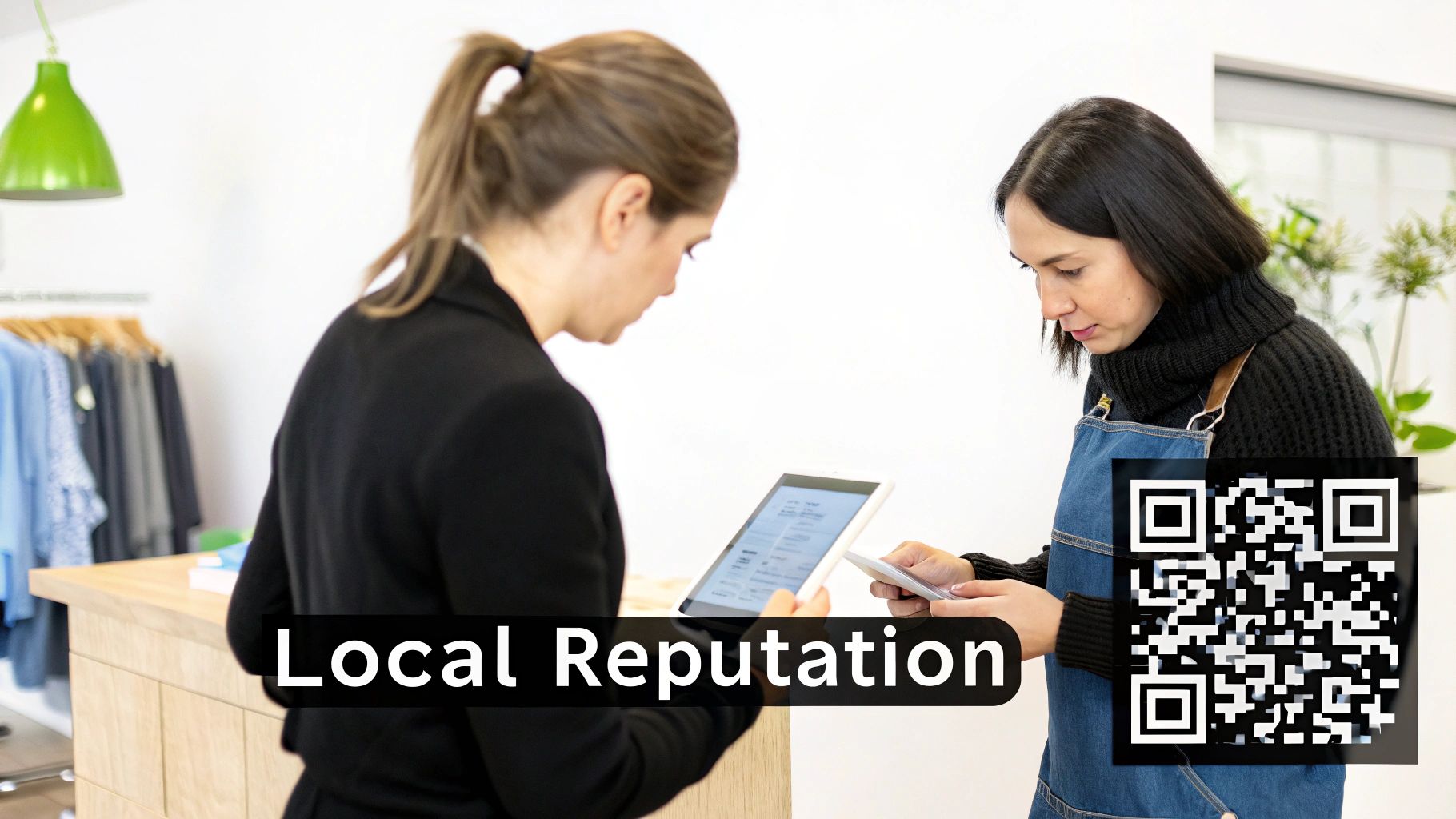
- Point-of-Sale QR Codes: This is my favorite. Place a small, well-designed sign right at your checkout counter or on receipts with a QR code that goes straight to your Google review page. You're catching them at their moment of peak satisfaction.
- The Follow-Up Text: Especially for service businesses, a simple text is incredibly effective. "Thanks for choosing us! How did we do? If your experience was great, we'd be grateful for a review!" It works.
The goal is to weave the "ask" right into your workflow until it’s an automatic, consistent habit.
You Have to Respond to Every Single Review
How you handle feedback is just as telling as the feedback itself. When you respond to reviews—both glowing and critical—you're showing everyone that you’re listening and that you genuinely care. It's a public display of your customer service in action.
Remember, your response to a negative review isn't really for the person who wrote it. It’s for the hundreds of potential customers who will read it later. A thoughtful, professional reply can completely neutralize a bad review and even turn it into a win for your brand.
Here’s a simple framework to follow.
For the Good Ones:
- Thank them by name. A little personalization goes a long way.
- Mention a specific detail. "So glad you enjoyed the spicy margarita!" shows you actually read it.
- Invite them back. This is how you build loyalty.
For the Tough Ones:
- Acknowledge their frustration and apologize. Start with empathy. "I'm so sorry your experience didn't meet your expectations."
- Stay professional. Whatever you do, don't get defensive or make excuses.
- Take the conversation offline. This is key. Provide a direct email or phone number to resolve the issue privately. It shows you're serious and moves a heated exchange out of the public square.
A great response can transform a public complaint into a visible example of your commitment to getting it right.
Monitor the Local Chatter
Your reputation lives beyond the big review platforms. People are talking about local businesses in community Facebook groups, on Nextdoor, and in Instagram comments. You need to be listening.
Set up alerts for your business name (and any common misspellings!). When you see a positive shout-out, jump in and thank the person. If you spot a complaint, handle it with the same professional framework you'd use for a negative review.
Being present in these conversations shows you're an active, engaged, and responsible member of the local business community. That kind of trust is your most valuable asset in any local market.
Frequently Asked Questions About Localized Marketing
It’s completely normal to have questions when you’re diving into localized digital marketing. It's a different beast than broad-strokes online advertising. Let’s clear up some of the most common things business owners ask, whether you're just starting out or looking to sharpen your existing strategy.
How Is Localized Digital Marketing Different From General SEO?
Think of it this way: general SEO is like trying to get noticed in a massive, crowded stadium. Localized digital marketing is about becoming the hometown hero in your specific community's ballpark.
While general SEO chases broad keywords on a national or even global scale, local is all about laser-focused relevance in a specific geographic area. The goal isn't just to be visible everywhere, but to be the no-brainer, top choice for customers right around the corner.
This strategy hinges on very specific signals you send to search engines. We're talking about a perfectly optimized Google Business Profile, consistent local citations (your business name, address, and phone number listed online), locally-flavored content, and a steady stream of reviews from actual local customers. It’s how you win those high-intent searches like "best coffee near me" or "web design agency in Austin" that bring in highly qualified leads and, for brick-and-mortar shops, real foot traffic.
What Are the First Three Steps a Small Business Should Take?
It’s easy to get overwhelmed by all the advice out there. If you're a small business, the key is to forget about doing everything at once. Focus on the foundational moves that give you the most bang for your buck right out of the gate.
Nail these three things first:
- Claim and completely fill out your Google Business Profile. This is your digital storefront. Seriously, if you do nothing else, do this. It's the single most powerful action you can take for local search. Leave no field empty.
- Make your business info consistent everywhere. Your Name, Address, and Phone number (we call this NAP) has to be identical across your website and all the major online directories. Any inconsistency creates confusion for search engines and erodes trust.
- Kick off a simple review generation process. Don't just sit back and hope for reviews. Actively and politely ask your happiest customers to leave feedback on Google. Getting those first few reviews creates the social proof you need to convince new customers to give you a shot.
Getting these three pillars in place builds the trust and visibility you need to compete effectively in your local market.
Buyers have been shown to feel a natural psychological closeness to local brands over global ones. A localized strategy is what builds the bridge to that feeling, turning a company into a trusted neighbor.
Can Ecommerce Brands Use Localized Marketing?
Absolutely. It’s a huge misconception that localization is just for businesses with a physical front door. For e-commerce brands, the strategy just shifts. Instead of driving foot traffic, you're building deep brand loyalty and relevance within key target markets. It makes an online-only business feel less like a faceless corporation and more like a part of the community.
For instance, an online clothing boutique could run geo-targeted ad campaigns with creative that speaks directly to a city's vibe. Think: "Stay warm, Chicago! Our new winter collection just dropped." It’s far more personal and effective than a generic, one-size-fits-all ad.
Here are a few other powerful tactics for e-commerce:
- Create localized landing pages or blog content, like "A Style Guide for Miami's Art Basel."
- Partner with local influencers in high-value cities to showcase your products to an engaged, regional audience.
- Run shipping promotions or special offers that are exclusive to certain states or metro areas.
This approach lets online brands carve out market share region by region, driving targeted sales and slashing wasted ad spend on people who just aren't your ideal customers.
How Do I Measure the ROI of My Local Marketing Efforts?
Measuring your return on investment (ROI) here isn't about a single metric. It’s about piecing together a complete picture by tracking both online and offline signals. Your goal is to connect your digital efforts to actual business results.
Online, you can track very specific actions that scream local intent. Keep an eye on metrics in your Google Business Profile insights, like clicks on the "call" button or requests for driving directions. Inside Google Analytics, you can dig into the traffic and conversions coming from your location-specific pages.
For the offline piece, you might have to get a little old-school. You could implement coupon codes that are exclusive to a local digital campaign. One of the simplest and most effective methods? Just train your staff to ask new customers, "How did you hear about us?" Tallying those responses over a month can be incredibly revealing.
By combining these online and offline data points, you'll see exactly how your local marketing is translating into real revenue.
Ready to build a powerful local presence that drives real growth? At Sugar Pixels, we specialize in creating custom web design and digital marketing strategies that connect businesses with their communities. Let us handle the technical details so you can focus on what you do best. https://www.sugarpixels.com