

Responding to negative reviews isn't just a chore; it’s a crucial part of running a modern business. Think about it: 81% of travelers read reviews before they even think about booking. Your public reply is just as important as the original comment, maybe even more so.
When you ignore bad feedback, you’re basically telling the world you don't care. A thoughtful response, on the other hand, can mend a broken relationship with an unhappy customer. More importantly, it shows all the potential customers watching from the sidelines that you’re accountable and professional.
Why You Must Respond to Every Negative Review
Letting a negative review sit there unanswered is like hanging a "We Don't Care" sign on your digital front door. In a world where your online reputation is everything, silence isn't golden—it's expensive.
Every ignored complaint slowly erodes the trust you've spent years building. It lets a story write itself: either you're oblivious to your own flaws, or you just don't care. That perception has real consequences, from bleeding sales to a tarnished brand image that search engines like Google absolutely notice.
The Silent Audience Is Your Future Customer
Remember, when you reply to a negative review, you're not just talking to one person. You're speaking to everyone who is considering doing business with you. They're the silent audience, and they're judging your character based on how you handle criticism.
A study from Expedia found that a staggering 91% of travelers think property owners should reply to negative feedback. A polite, professional response immediately improves their impression of your business. It’s your chance to put your commitment to customer satisfaction on full display.
A calm, clear response shows future guests that you care, you pay attention, and you act professionally when something goes wrong. It turns a moment of criticism into a powerful marketing opportunity.
Turning a Negative into a Positive
The right response does more than just damage control. It can actually turn a frustrated customer into one of your biggest fans.
Imagine a customer complains about slow service. If you ignore them, you've pretty much guaranteed they'll never be back.
But a quick, sincere reply can completely change the game. Here's how:
- Acknowledge their frustration: "We're so sorry to hear your wait was longer than expected. We understand how frustrating that can be."
- Offer a solution or context: "We were short-staffed that evening, but that's no excuse. We're actively hiring to ensure this doesn't happen again."
- Take the conversation offline: "We'd appreciate the chance to make this right. Please contact me directly at…"
This approach makes the customer feel heard, shows you take responsibility, and provides a clear path to fixing the problem. You not only increase the odds of keeping that customer, but you send a powerful signal to everyone else reading. It says you're a business that listens, learns, and acts.
This proactive stance is fundamental to maintaining a strong online presence. For a deeper dive into this topic, explore our comprehensive small business online reputation management guide. At the end of the day, every negative review is an invitation—an opportunity to publicly prove your commitment to excellence.
How to Triage and Prioritize Negative Feedback
When a negative review pops up, the gut reaction is to panic. Every bad comment feels like a full-blown emergency. But if you treat every complaint like a five-alarm fire, your team will burn out fast.
The truth is, not all bad feedback is created equal. The key to managing it without losing your mind is to learn how to triage. A solid plan turns a chaotic flood of criticism into an orderly, manageable process, letting you focus your energy where it'll make the biggest difference.
Without a system, you’re just playing whack-a-mole. With one, you're in control.
At its core, the choice is simple. You can either ignore the feedback and watch potential customers walk away, or you can engage thoughtfully and build the kind of trust that keeps people coming back.
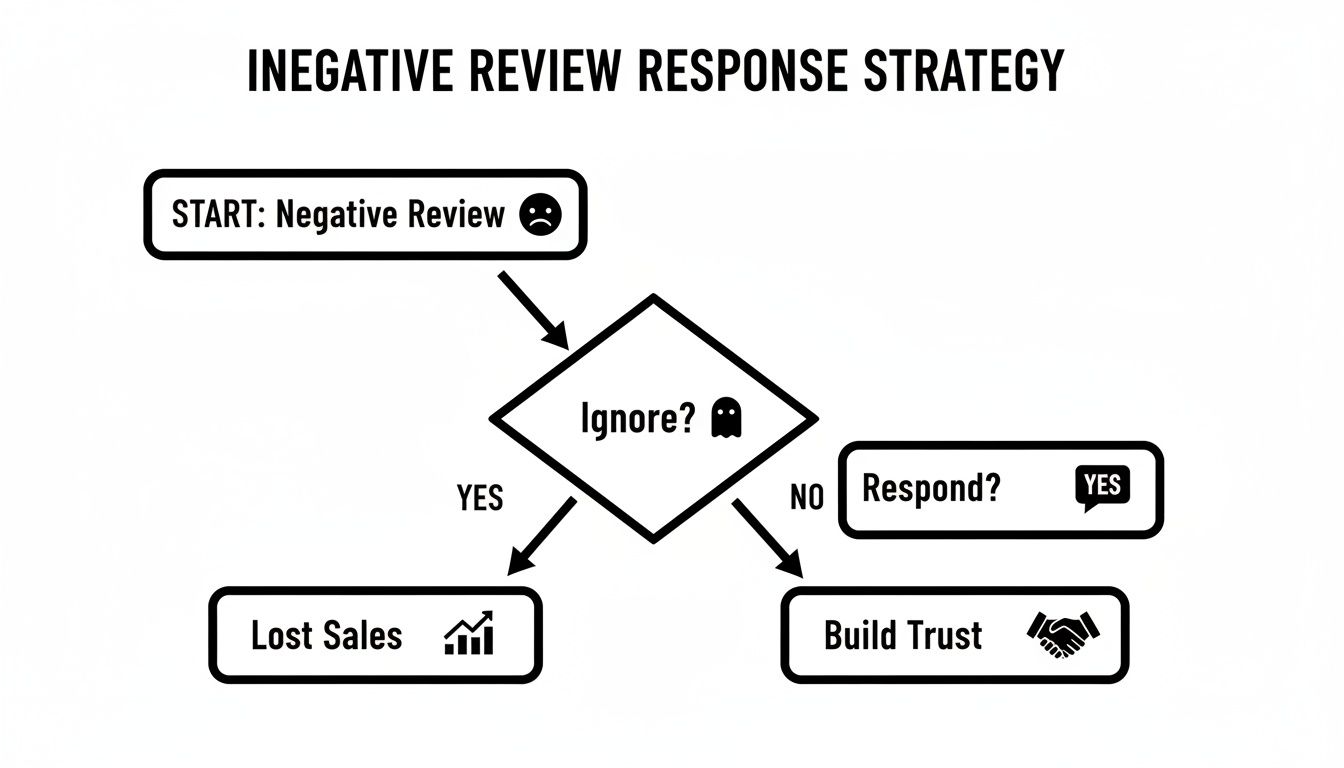
This flowchart nails it. Responding isn’t just about damage control; it's an opportunity to show everyone else watching that you care.
Creating Your Review Triage Framework
The first step is to sort incoming reviews into different buckets based on how serious they are and the potential damage they could cause. This lets you put your best people on the biggest problems right away, while more common complaints get a standardized—but still personal—response.
Think about what categories make sense for your business. A good starting point usually includes these four:
- Code Red: These are the big ones that need to be escalated immediately. We're talking about legal threats, safety issues, accusations of discrimination, or a major product failure that hints at a much bigger problem.
- Legitimate Gripes: This bucket is for valid complaints about things you dropped the ball on. A defective product, a late shipment, a rude employee. They aren’t emergencies, but they need a quick and sincere response.
- Simple Misunderstandings: Sometimes, a customer is unhappy because they misunderstood a return policy or thought a product did something it doesn't. These are great opportunities to publicly clarify how your business works.
- Trolls and Fakes: This is for the junk—irrelevant comments, obvious spam, or reviews you suspect are from a competitor. The goal here isn’t to engage. It's to report the review and get it taken down.
Assessing the Blast Radius
Once a review is categorized, you need to figure out its potential impact. A one-star rant from an industry influencer with 50,000 followers on Twitter is a whole different beast than an anonymous complaint on a small forum.
Here’s a quick mental checklist to run through:
- Who’s the reviewer? Check out their profile. Do they have a huge following? A long history of leaving detailed reviews? Their influence matters.
- Where was it posted? A negative review on your Google Business Profile or Amazon product page is front-and-center for potential buyers. A comment on a niche blog? Not so much.
- Is this a one-off or a pattern? If one person says their package was late, it’s an isolated incident. If ten people say it in a week, you've got a systemic shipping problem that needs immediate attention.
By looking at the reviewer, the platform, and the problem itself, you build a clear action plan. A viral tweet about a dangerous product defect gets flagged for your PR and legal teams instantly. A minor hiccup with an order gets routed to customer service.
Below is a simple matrix you can adapt to build your own triage system. It helps formalize this process so everyone on your team knows exactly what to do when a negative review comes in.
Review Triage and Prioritization Matrix
| Review Category | Description & Example | Priority Level | Recommended First Action |
|---|---|---|---|
| Code Red | Reviews alleging safety issues, legal threats, discrimination, or severe service failures. Example: "Your product caused an allergic reaction and the packaging had no warning." | Critical | Immediately escalate to senior management, legal, and/or PR. Do not post a public response until cleared. |
| High Impact | A legitimate complaint from an influencer or on a high-visibility platform like Google, Yelp, or Amazon. Example: A food blogger with 100k followers leaves a 1-star Yelp review. | High | Craft a careful, public response within 1-3 hours. Escalate internally to the relevant department head (e.g., store manager, head of product). |
| Service Failure | A valid complaint about a specific, verifiable issue like a product defect or poor customer service. Example: "My order arrived with the wrong item, and support was unhelpful." | Medium | Respond publicly within 24 hours, apologize, and offer to take the conversation offline to resolve the issue directly. |
| Misunderstanding | A negative review based on a customer's incorrect assumption about a policy, feature, or service. Example: "I'm upset I was charged a restocking fee on my return!" | Medium | Respond publicly within 24-48 hours. Politely clarify the policy or feature while still validating the customer's frustration. |
| Fake or Spam | A review that is clearly malicious, irrelevant, or violates platform terms of service. Example: A 1-star review with no text, or a review promoting a competitor. | Low | Do not respond. Immediately flag and report the review to the platform for removal. Document the incident internally. |
This matrix provides a clear, consistent roadmap. It removes the guesswork and ensures every review gets the right level of attention from the right people, every single time. A smart triage system is your best defense against chaos. It empowers your team to stop fighting fires and start building trust.
Crafting a Response That Actually Resolves the Issue
Moving past a generic, "We're sorry for your experience," is the first real step. When you respond to a negative review, you're not just talking to one unhappy customer—you're having a public conversation. Your goal is to make things right for them while showing every potential customer watching how you handle things when they don't go perfectly.
A great response can do far more than just quiet a critic; it can actively build trust. This is your chance to put your professionalism and commitment to service on full display.

The Acknowledge, Apologize, Act, and Follow-Up Formula
The best responses I’ve seen all follow a simple, four-part structure. It’s easy to remember and ensures you hit all the crucial notes needed to de-escalate the situation and solve the problem.
-
Acknowledge the Specific Problem: Start by showing you’ve actually read their complaint. Don't just gloss over it. Mention the specific issue, whether it was a "late package" or "unhelpful staff." This instantly validates their feelings and proves you’re not just pasting in a canned response.
-
Apologize Sincerely: Offer a genuine apology. Remember, an apology isn't necessarily an admission of guilt; it's an expression of empathy that their experience didn't meet their expectations (or yours). A simple, "We're truly sorry you had such a frustrating experience," can go a long way.
-
Explain the Action You'll Take: This is where you pivot from words to solutions. Tell them what you’ve done or will do to address the problem. Maybe you're retraining staff, investigating the shipping delay, or clarifying a product description. Be specific.
-
Offer a Way to Follow Up Offline: Provide a direct line of contact—a manager’s name, a specific email address, or a direct phone number. This moves the sensitive part of the conversation out of the public square and signals that you're serious about a resolution, without setting a public precedent for compensation.
Setting the Right Tone: Professional Yet Empathetic
Tone is everything. You need to sound like a calm, reasonable human being, not a defensive corporate drone or a lawyer. Aim for a tone that's consistently professional but also warm and genuinely empathetic.
Whatever you do, avoid getting defensive. Phrases like "That's not our policy" or "You must have misunderstood" are like throwing fuel on a fire. They only escalate things. Instead, use collaborative, solution-focused language.
A calm, clear response shows future guests that you care, you pay attention, and you act professionally when something goes wrong. It’s your chance to show potential guests how you act when things don’t go perfectly.
Speed matters, too. A prompt reply, ideally within 24-48 hours, shows both the reviewer and the public that you're attentive. Long delays can feel like indifference, which is the last message you want to send. While direct data on review response times is still developing, general customer service benchmarks underscore the importance of speed. To get a broader sense of this, you can explore customer service call center statistics and insights from platforms like Sprinklr.
Real-World Response Scenarios
Let's see how this framework plays out in a couple of common, tricky situations. Notice how each response is tailored to the complaint but still follows those core principles.
Scenario 1: The Shipping Delay
- The Review: "My order was supposed to arrive last week and it's still not here. Tracking is useless. I'm so disappointed and will never order from you again!"
- The Response: "Hi [Customer Name], thank you for bringing this to our attention. We are so sorry to hear your order hasn't arrived yet and completely understand your frustration. After looking into your tracking number, it appears there’s an unexpected delay at the regional hub. We are working directly with the carrier to get this sorted out for you immediately. Please contact our support lead, Sarah, at [email] so she can personally oversee this and make it right."
Scenario 2: The Service Mishap
- The Review: "The barista was incredibly rude this morning. Rushed me through my order and acted like I was an inconvenience. Ruined my morning."
- The Response: "Hi [Customer Name], we are very sorry that your experience with our team fell short of our standards. There is no excuse for rude service, and we appreciate you bringing this to our attention. We will be addressing this feedback directly with our morning staff to ensure this doesn't happen again. We'd value the opportunity to make this right and hope you'll give us another chance."
In both cases, the response hits all the key points: it acknowledges the specific issue, apologizes sincerely, explains the action being taken, and (in the first example) provides an offline channel to resolve the issue personally. This is how you turn a negative into a net positive for your brand.
Adapting Your Strategy for Different Review Platforms
A great response on one platform can absolutely bomb on another. You can't just copy and paste a template and expect it to work everywhere. The key to handling negative reviews is understanding that your tone, style, and even the core of your message have to fit the specific playground you're in.
Think about it: the audience, rules, and general vibe on Google are worlds away from Yelp or Amazon. A customer dropping a one-star review on Google is probably upset about a local service experience. On Amazon, they're laser-focused on a faulty product. If you miss these subtle differences, your perfectly planned response will just fall flat.
Navigating Google Reviews for Local SEO
Let's be honest, Google is the new front door for most local businesses. That means your reviews—and your responses—are front and center. When you reply here, you’re really talking to two audiences at once: the customer who left the review, and Google’s algorithm. A quick, professional response can actually give your local search ranking a nice little bump.
Keep these things in mind when you're crafting a reply on Google:
- Be Smart with Keywords (But Don't Force It): If someone complains about "slow coffee service," it's natural to mention "our coffee shop" or "barista service" in your reply. This just helps Google connect the dots and reinforce what your business is all about.
- Ground Your Business in the Community: When it makes sense, mentioning your neighborhood or a local landmark can strengthen those local SEO signals. It shows you’re a real part of the community.
- Remember You Can Edit Your Reply: This is a big one. Google lets you update your responses. If you resolve an issue and the customer is happy, go back and edit your original reply to reflect that positive outcome. It closes the loop for everyone reading.
For a much deeper dive into the nitty-gritty of Google's platform, our guide on how to respond to negative Google reviews has a ton of specific advice.
Managing Perception on Yelp
Ah, Yelp. The community there is known for being… well, passionate. Yelpers often write incredibly detailed, novel-length reviews, and they can smell a fake, corporate-sounding reply from a mile away. Authenticity is everything.
On Yelp, your main job is to show the community that you're a reasonable, engaged human being who runs the business.
Your response on Yelp is less about winning back one customer and more about demonstrating your character to the hundreds of potential customers reading along. Transparency and a human touch are non-negotiable here.
You have to get personal. Use the reviewer's name. Mention specific points from their review so they know you actually read it. Your public goal should always be de-escalation; offer to take the conversation offline to work out the details and find a real solution.
Adhering to Amazon's Strict Guidelines
Responding to negative feedback on Amazon is a completely different ballgame. The entire Amazon world is built on product performance and seller metrics, and their rules are incredibly strict. Forget empathy and personality; your response needs to be professional, factual, and all about the solution.
Here's what's different when you're dealing with an Amazon review:
- Stick to the Facts of the Order: Was the item broken? Was the shipping late? Address the logistical problem head-on. No fluff.
- Zero Promotional Language: Never, ever include marketing links, ask them to change their review, or offer a refund in your public response. This is a fast track to getting your account flagged for violating Amazon's terms of service.
- Use the "Contact Buyer" Button: For anything complex, your best bet is to use Amazon’s official, private messaging system to contact the buyer. Solve the problem there, away from public view.
Your goal on Amazon is simple: fix the customer's problem and, in doing so, show future shoppers that you're a trustworthy seller who stands behind what you sell. For more on navigating this unique ecosystem, this resource on How to Handle Negative Customer Reviews on Amazon is a great read. Each platform has its own unwritten rules; learning them is the secret to protecting your reputation.
Knowing When to Escalate a Negative Review
Most negative reviews can be handled with a well-thought-out public reply. That’s standard procedure. But every now and then, you’ll encounter a review that’s more than just a complaint—it’s a potential landmine.
Learning to spot these critical situations is less about reputation management and more about protecting your business from serious legal, PR, or safety issues. Some fires just can't be put out with a simple comment. You need to know when to sound the alarm and bring in the cavalry.
Identifying Legal and PR Red Flags
Before you even think about drafting a public response, you need to scan for reviews that require immediate internal escalation. These are the ones that carry real risk and demand a coordinated response from legal, senior leadership, or your communications team.
Keep a sharp eye out for these serious red flags:
- Defamatory Claims: There's a big difference between an opinion ("The service was slow") and a false statement of fact ("The owner is a convicted felon who steals from the register"). The latter could be defamation, and it needs a legal eye.
- Credible Threats: Any review that mentions violence, harassment, or threats toward your team or property is a zero-tolerance issue. Escalate it immediately.
- Accusations of Discrimination: Claims of racism, sexism, or other forms of discrimination are incredibly serious. These require a careful, structured response, almost always with legal guidance.
- Safety or Health Hazards: A customer reporting a severe allergic reaction, food poisoning, or an injury from a faulty product isn't just an unhappy customer—they're a potential liability.
Crucial Takeaway: When you see a review like this, your first move is not to reply publicly. A knee-jerk, emotional response can create legal headaches or pour gasoline on a PR fire. Escalate internally. Period.
When to Take the Conversation Offline
Beyond the major legal threats, some discussions just don't belong in a public forum. A public review thread is the last place you want to get into a back-and-forth about a complex billing error or a detailed service failure.
Your public reply should be a simple, professional acknowledgment that steers the conversation to a private channel. Something like, "We're very concerned to read this and want to investigate immediately. Please email us at [email protected] so we can get the details."
Taking it offline does two things beautifully. First, it shows the customer you’re taking their specific problem seriously. Second, it stops a messy public argument before it starts—a fight where, frankly, nobody wins. This is especially true if the customer is clearly emotional or their complaint involves sensitive personal information.
Building an Internal Feedback Loop
Here's the thing: responding to negative reviews isn't just about damage control. If that’s all you’re doing, you’re missing the point. Every single piece of negative feedback is a free, unfiltered data point telling you exactly what’s broken in your business.
Turn those complaints into a powerful tool for improvement.
Create a simple system—a shared spreadsheet, a Slack channel, or a ticket in your help desk—to log and categorize every complaint. After a month, you'll start seeing patterns. Is everyone complaining about the same buggy feature? The same confusing return policy? The same employee?
This feedback loop should be the engine for real change:
- Staff Training: Use specific examples to show where teams need more coaching or support.
- Product Development: Let real customer complaints guide your bug fixes and feature roadmap.
- Process Changes: Identify and fix the weak links in your shipping, customer service, or operational workflows.
While it can be hard to find stats specifically on review response, the principle is proven time and again in customer service studies. As highlighted by CMSWire, being attentive and responsive is non-negotiable. By systematically tracking and acting on feedback, you stop playing defense and start turning your biggest critics into your most valuable source of business intelligence.
Turning Feedback into Long-Term Improvement
Responding to negative reviews is a great defensive play, but the real win is getting fewer of them over time. The final, and most critical, part of this whole process is closing the feedback loop. This is where you shift from simply reacting to problems to proactively using customer complaints as a blueprint for a stronger, more customer-focused business.

That shift starts with measurement. After all, you can't fix what you don't track. By monitoring a few key metrics, you can see the actual impact of your responses and, more importantly, spot recurring issues before they spiral.
Tracking the Right Metrics
To turn all that feedback into something you can actually use, you need to focus on a handful of core metrics. These numbers will give you a clear, honest picture of your customer experience and how well your reputation management is working.
- Overall Star Rating Trends: Are you actually moving the needle? Keep an eye on your average rating month-over-month on the platforms that matter most. A steady climb is the best proof that your changes are resonating.
- Sentiment Analysis: Go deeper than the stars. Are the common keywords in your reviews changing from "slow shipping" and "rude staff" to "fast delivery" and "great service"? That qualitative shift tells you exactly where you're making progress.
- Review Response Time: How fast are you getting back to people? Consistently lowering your average response time shows customers you're listening and that you care. It builds trust.
- Updated Review Rate: This one is huge. Track how many negative reviews get updated or even removed after your team steps in to fix things. It’s a direct measure of your success in turning a bad experience around.
Pinpointing Root Causes
Once the data starts coming in, you can begin the real detective work: finding the root causes of customer frustration. A single complaint about a rude employee might just be a one-off. But if you see five similar complaints in a month, you've clearly got a training gap that needs immediate attention.
This is how you learn to turn complaints from consumers into your greatest asset.
The goal isn't just to apologize for a mistake; it's to create a system that prevents that same mistake from ever happening again.
Getting this right requires buy-in from your entire organization. The insights you pull from reviews should be shared regularly with your product, operations, and marketing teams. The process is a lot like building a content calendar; it helps get different departments aligned on a shared mission. In fact, our guide on how to create a content calendar shares some similar principles for getting everyone on the same page.
When customer complaints become the catalyst for real operational improvements, you stop just putting out fires. You start building a fundamentally better business.
Frequently Asked Questions About Negative Reviews
When you're dealing with a flood of online feedback, you're bound to run into some odd situations that don't quite fit the playbook. What do you do with a review you're pretty sure is fake? Or when you can't even find the person in your system?
Let's tackle some of those common curveballs so you can handle them like a pro.
How Should I Handle a Fake or Anonymous Review?
First thing's first: don't take the bait. It’s incredibly tempting to jump in and defend your business, but firing back at a fake review just makes you look defensive and gives the comment more attention. It’s a losing game.
Instead, the best move is to work behind the scenes.
- Report it immediately. Go straight to the platform’s reporting tool—whether it's Google, Yelp, or another site—and flag the review. Be specific about why it violates their policies. Is it spam? A clear conflict of interest? Hateful content? The more precise you are, the better.
- Keep good records. Screenshot everything: the review itself, the user's profile (if they have one), and a note of when you reported it. This can be useful if you need to follow up.
- Drown it out with positivity. Your best defense is a good offense. Focus your energy on encouraging your actual, happy customers to leave genuine reviews. A steady stream of positive feedback will quickly push the fake one down and make it irrelevant.
What If I Can't Verify the Customer?
This happens more than you'd think. You get a scathing review from a "John S." but have no record of a customer by that name or a transaction matching the details. It could be a fake review, or it could be someone using a different name online. You have to tread carefully.
Your public response needs to be professional and helpful without admitting fault for something that might not have even happened.
The goal is to show other potential customers that you're responsive and operate in good faith, even when a complaint seems fishy. Transparency is your friend here.
A good public reply strikes a balance. Try something along these lines:
"Hi there, thank you for taking the time to leave this feedback. We've looked through our records but can't seem to find an order or appointment under your name. We take feedback like this very seriously and want to investigate further. Could you please reach out to our manager, Sarah, at [email protected] so we can get a few more details?"
This approach takes the conversation offline and shows everyone else you’re on top of it.
Is It Ever Okay to Ask for a Review to Be Changed?
This is a tricky one. The short answer is almost never. Never try to bribe, pressure, or offer an incentive to a customer to change their review. Not only does it feel disingenuous, but it's also against the terms of service for most review platforms and can get you in hot water.
The only exception is when you’ve truly turned the situation around. If you’ve worked with the customer, solved their problem, and they are genuinely thrilled with the outcome, you have a small opening.
After you're sure they're happy, you could say something like, "I'm so glad we were able to find a solution that worked for you. If you have a moment and feel that your original review no longer reflects your experience with us, we'd certainly appreciate an update. But please, don't feel obligated at all."
It has to be a soft suggestion, leaving the ball entirely in their court. Anything more is too much.
Managing your online reputation is a massive job. At Sugar Pixels, we build powerful websites and create digital marketing strategies that help you put your best foot forward. Let us handle the technical details so you can focus on what you do best—running your business. Visit us at https://www.sugarpixels.com to learn more.