

So, you're wondering how much a website costs. The honest answer? It's a lot like asking, "How much does a car cost?" You could be talking about a simple scooter or a heavy-duty transport truck, and the price tags are worlds apart.
A basic website can run you anywhere from $500 to $5,000, but a more complex, feature-rich site can easily climb from $5,000 to over $50,000. The final number really boils down to what you need it to do—the features you include, the intricacy of the design, and whether you go it alone or bring in the pros.
Decoding The Price Of Your Digital Storefront

Think of your website as a business tool. Its cost is directly tied to the job it needs to perform. A personal blog is like that scooter—simple, affordable, and perfect for getting your thoughts out there. A small business website designed to generate leads is more like a reliable sedan, requiring a bit more investment to get the job done right.
Then you have the e-commerce giants, built to handle thousands of transactions every single day. That's your custom delivery truck, engineered from the ground up for heavy-duty commercial work. Each serves a different purpose, and each comes with a corresponding price.
Understanding The Cost Tiers
To get a clearer picture, it helps to break websites down into four main categories. Each tier comes with a different level of complexity, a unique set of features, and, naturally, a different budget range.
Here’s a quick overview to help you see where your project might fit in.
Typical Website Cost at a Glance
| Website Type | Typical Upfront Cost | Estimated Annual Maintenance |
|---|---|---|
| Personal / One-Pager | $500 – $2,500 | $100 – $500 |
| Small Business | $2,500 – $10,000 | $500 – $2,000 |
| E-commerce | $10,000 – $40,000+ | $1,500 – $10,000+ |
| Enterprise / Custom App | $40,000 – $100,000+ | $10,000 – $50,000+ |
This table gives you a ballpark idea, but remember that the features are what really drive the cost up.
Key Factors Driving The Numbers
Recent studies show just how much these factors matter. While a DIY site builder might get you started for under $100, a professionally built small business site typically lands somewhere between $2,000 and $8,000. For e-commerce, that investment jumps significantly, often falling between $15,000 and $75,000.
What's behind that big leap? It turns out that 61.5% of an e-commerce site's cost is driven by its features and functionality. Things like payment gateways, inventory management, and customer accounts add layers of complexity that require expert development.
The most crucial first step is to nail down your website's primary job. Is it here to inform, sell products, or provide a complex service? Your answer to that single question lays the foundation for your entire budget.
Getting this right from the start is the key to making an informed decision. As you start digging into the details, you'll see that costs like hosting are a core part of any website budget. A guide on understanding cheap VPS can offer some great insights into finding budget-friendly solutions that don't skimp on performance.
And of course, who you choose to build your site makes all the difference. Our guide on how to choose a web design agency can walk you through finding the right partner for your project's scope and budget.
The Core Factors Driving Your Website Price
Ever wonder why one website quote lands at $2,000 while another flies past $50,000? It's not random. The final price tag comes down to the complexity and quality of the build, much like constructing a house. A basic prefab home just doesn't cost the same as a custom-built mansion with a smart home system and an infinity pool.
The same logic applies to your website. The typical website cost is a sum of its parts. Things like design, special features, and the sheer number of pages all play a huge role. Getting a handle on these key drivers is the first step to setting a realistic budget and making smart choices for your project.
Design and User Experience
How your site looks and feels—what we call UI (User Interface) and UX (User Experience)—is one of the biggest line items on any quote. This isn't just about picking pretty colors and fonts. It's about crafting a smooth, intuitive path that guides visitors to do what you want them to do, whether that's buying a product or scheduling a call.
You've got two main roads you can take here:
- Template-Based Design: Think of this as buying a floor plan from a catalog. It’s faster and much more affordable, with costs usually falling between $500 and $5,000. The trade-off? You're limited in how much you can change, and your site might end up looking like a lot of others out there.
- Custom Design: This is like hiring an architect to design your dream home from the ground up. A designer creates a completely unique look and user journey that’s built specifically for your brand and your customers. It’s a lot more work, pushing the design investment into the $5,000 to $15,000+ range for a small business site, but what you get is a one-of-a-kind digital storefront.
A great design isn’t just window dressing; it’s a business tool. A study found that 75% of consumers judge a company's credibility based on its website design. A professional look builds trust and has a real impact on your bottom line.
Functionality and Custom Features
What your website does is every bit as important as how it looks. Each feature you add is like another room or a high-end appliance in your house—it adds to the final bill. Basic stuff like a contact form or a photo gallery comes standard. The price really starts to climb when you need more advanced tools.
Here are a few common features that can significantly drive up the typical website cost:
- E-commerce Functionality: If you want to sell products online, you'll need a solid system for product pages, a shopping cart, secure payment gateways, and inventory tracking. Bolting on an e-commerce engine can add anywhere from $5,000 to $25,000+ to the project.
- Database Integration: Does your website need to talk to other software, like a CRM, an inventory management system, or a third-party booking tool? Getting these systems to sync up requires a skilled developer to make sure the data flows correctly, and that means more development hours.
- Content Management System (CMS): A CMS like WordPress is what lets you update website content yourself without calling a developer. While the software itself is often free, shaping it to fit your exact business needs often requires expert setup and custom development.
Simply put, the more specialized the function, the higher the cost. A basic mortgage calculator is one thing; a real-time scheduling system for a whole team of consultants is a completely different animal.
Size and Complexity of Content
It stands to reason that the number of pages on your website is directly tied to the time and effort needed to design, build, and write content for it. A classic five-page "brochure" site—Home, About, Services, Blog, Contact—is pretty straightforward.
But what about a site with 50+ pages? Now you're talking about unique layouts for different departments, in-depth case studies, and a sprawling blog. Every single one of those pages needs to be designed, developed, filled with content, and optimized for search engines. This is exactly why a large corporate site can cost exponentially more than a small business site, even if their core features seem similar. Scale is a massive part of the final investment.
Typical Website Cost By Business Type
To get a real handle on your budget, it helps to look at what businesses like yours actually spend. The typical website cost isn't some magic number; it’s tied directly to what you need your site to do. Let's walk through four common scenarios, from a simple digital handshake to a complex online operation.
We'll look at the features you can expect, the usual development routes, and both the upfront and ongoing costs for each. Think of this as a practical roadmap to help you plan your project without any nasty surprises.
Solopreneurs And Personal Brands
If you're a consultant, freelancer, or personal brand, your main goal is usually simple: look professional online. Your website is essentially a digital business card that builds trust, shows off your portfolio, and gives potential clients an easy way to reach you.
The features here are pretty straightforward.
- Core Pages: Just the essentials—a Home, About, Services or Portfolio, and a Contact page with a simple form.
- Design: A clean, professional look, often built using a high-quality template to keep things affordable.
- Functionality: Basic SEO setup, mobile-friendly design, and maybe a simple blog to share your expertise.
For a project like this, a DIY website builder is a really popular, budget-friendly choice. That said, many solopreneurs opt to hire a freelancer to get a more polished result without sinking all their own time into it.
Upfront Cost: Plan on spending anywhere from $500 to $2,500. The lower end covers a premium template and your own sweat equity, while the higher end gets you a freelancer for a custom-feeling setup.
Small Businesses Focused On Lead Generation
A small business website has a much bigger job to do. It’s not just a brochure—it’s a workhorse built to attract visitors and turn them into qualified leads. The investment goes up because the goals are bigger.
These sites need more firepower to back up their marketing.
- Expanded Content: You'll have the core pages, plus dedicated service pages, case studies, and a blog that's actively used for content marketing.
- Lead Capture Tools: Think advanced contact forms, newsletter sign-ups that talk to your email marketing service, and strong calls-to-action (CTAs).
- Custom Design: A unique design that reflects your brand and is strategically built to guide users toward becoming a lead.
- CMS Integration: Usually built on a flexible platform like WordPress, so your team can easily add new blog posts or landing pages without calling a developer.
This level of strategy and customization almost always calls for a professional freelancer or a small web design agency. If you want to dig deeper into the numbers, a comprehensive guide to small business website cost is a great resource.
Upfront Cost: The typical website cost for a small business is between $2,500 and $10,000. This budget covers professional design, development, and the foundational SEO needed to start bringing in business.
This diagram shows how design, features, and the sheer size of a site all drive up the final price tag.
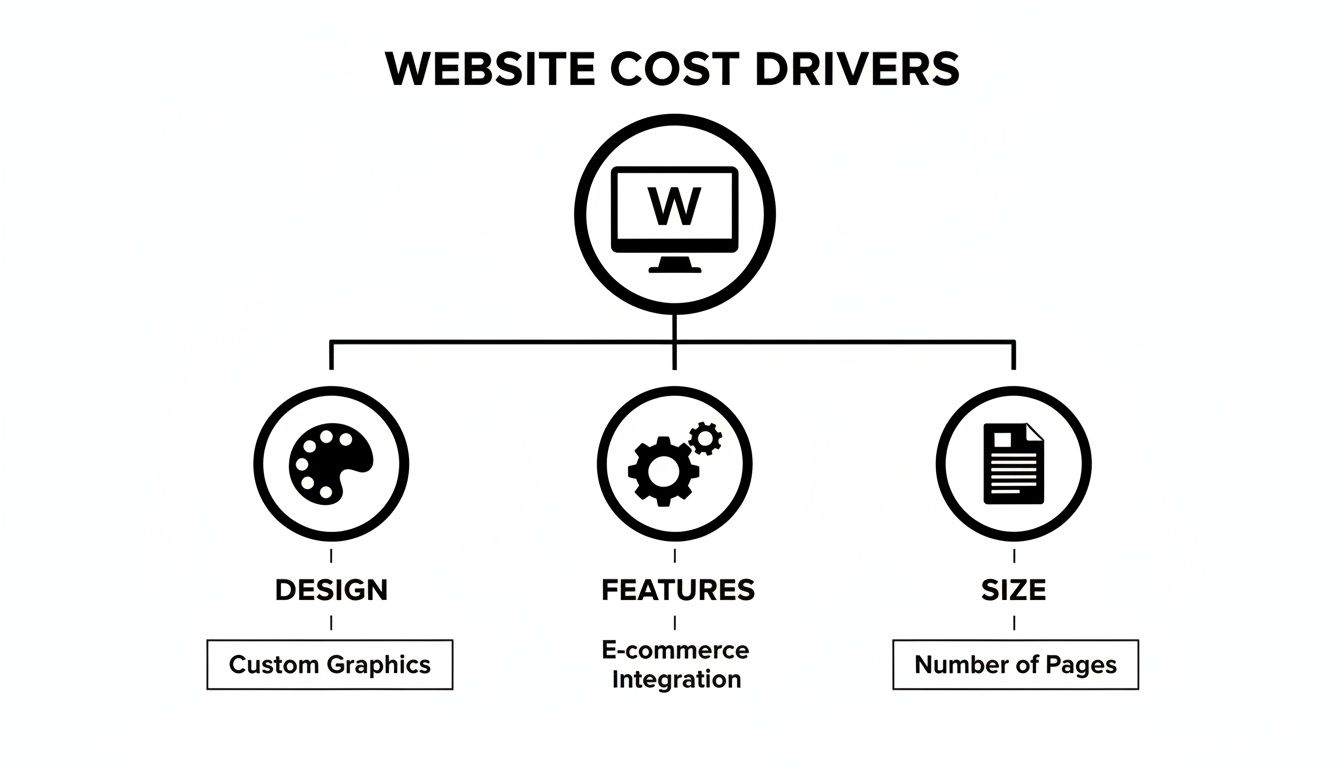
As you can see, these elements build on each other. The more custom features and pages you add, the more the investment grows.
E-commerce Stores Built For Sales
When your website is your business, the investment jumps significantly. An e-commerce site is a complex machine that has to juggle product displays, inventory, secure payments, and shipping. Every single part of it has to work perfectly to create a smooth, trustworthy shopping experience.
The feature list for an online store is long.
- E-commerce Engine: A powerful platform to manage products, categories, pricing, and sales.
- Secure Payment Gateway: Integration with services like Stripe or PayPal to handle money safely.
- Customer Accounts: A place for users to create profiles, check their order history, and save shipping details.
- Advanced Features: Things like product filters, a good search function, customer reviews, and inventory tracking.
Building a great e-commerce site is a specialized skill. You'll want to work with an agency or developer who has real-world experience in online retail. For a more detailed look, our guide on e-commerce website development cost really breaks down how to budget for an online store.
Upfront Cost: A professional e-commerce site usually starts around $10,000 and can easily climb past $40,000, depending on your product catalog and how many custom features you need.
Enterprise Companies With Custom Needs
For a large company, a website is a critical piece of infrastructure that plugs into all sorts of internal systems. These aren't just websites; they're custom digital platforms designed to serve different departments, audiences, and business goals all at once.
The needs are highly specific and totally unique to the organization.
- Custom Development: Features, workflows, and interfaces built from the ground up.
- Third-Party Integrations: Deep connections to internal software like CRMs, ERPs, and marketing automation tools.
- Scalability and Security: A rock-solid foundation built to handle tons of traffic and meet strict security and compliance rules.
- Multi-site Management: The ability to manage several brand sites or regional portals from one central hub.
This kind of project is handled exclusively by seasoned web development agencies or specialized in-house teams. The process is intense, involving deep discovery, strategic planning, and a whole lot of custom code.
Upfront Cost: Enterprise projects begin at $40,000 and often go well over $100,000. This price reflects the immense amount of planning, custom development, and complex integration work involved.
Beyond the Build: Unpacking Your Website's Ongoing Costs
The day your website goes live isn't the finish line; it’s really just the starting gun. So many business owners get blindsided by the expenses that pop up after the initial build is done—the costs to keep the site healthy, secure, and actually doing its job.
A website isn't a one-and-done purchase. It’s a living business asset that needs regular attention, much like a car needs gas, insurance, and tune-ups to keep running smoothly. Getting a handle on these recurring fees is key to budgeting properly and avoiding nasty surprises later on. The upfront build is just one piece of the typical website cost puzzle; the long-term investment is what keeps it delivering value.
The Bare Essentials: Keeping Your Website Online
Every single website, no matter how big or small, has a few non-negotiable running costs. These are the fundamental fees you have to pay just to keep your site online and available for people to visit. Think of them as your digital rent and utilities.
Here’s the absolute minimum you need to plan for:
- Domain Name Renewal: This is your website's street address on the internet (like yourbusiness.com). You typically pay for it once a year, and it usually costs between $10 to $20 per year for a standard .com or .org address.
- Web Hosting: This is the service that rents you server space where all your website's files are stored. The price tag here can vary wildly, from $3 to $15 per month for shared hosting (which is fine for most small sites) to well over $500 per month for a dedicated server that a high-traffic site would need.
- SSL Certificate: This little piece of tech is what puts the padlock icon in a visitor's browser bar, securing the connection between them and your site. Some hosts throw in a free one, but premium certificates can run from $50 to $300 per year. It's an absolute must for building trust, especially if you sell anything online.
These three things are the foundation of your annual website budget. Without them, your site simply won't work.
A website is a living asset, not a static brochure. Failing to budget for its ongoing care is like buying a high-performance car and never changing the oil. Eventually, it will break down.
The Costs of Keeping Your Site Healthy and Growing
Beyond just keeping the lights on, there are other crucial costs tied to making sure your site performs well and grows with your business. This is about keeping things secure, running fast, and continuing to bring in the right kind of visitors. If you skimp here, you're risking security breaches, a terrible user experience, and a website that just sits there, gathering dust.
This is where a professional maintenance plan becomes a smart investment. These services handle all the critical behind-the-scenes work—things like software updates, security scans, and performance checks. To get a better sense of everything involved, this guide on what is website maintenance is a great resource. Depending on how complex your site is, these plans can cost anywhere from $50 to over $5,000 a month.
Budgeting for Marketing and Improvements
Finally, a website that actually makes you money needs a budget for ongoing improvements and marketing. This is the part of your investment that starts generating a real return by attracting new customers and driving sales.
Plan on setting aside funds for a few key areas:
- Content Creation & SEO: You can't just launch a site and expect people to find it. Regularly adding new blog posts and optimizing your pages for search engines is essential for getting seen. This can cost anywhere from $500 to $5,000+ per month, depending on how aggressive you want to be.
- Software and Plugin Licenses: Many of the best tools for things like analytics, email marketing, or advanced e-commerce features come with annual subscription fees. These can easily add another $100 to $1,000+ per year to your total.
- Digital Marketing: To really drive traffic, you'll need to invest in things like Google Ads, email campaigns, or social media promotion. This budget is completely flexible and depends entirely on your business goals and industry.
When you factor all these "hidden" costs into your financial planning from the start, you're setting your website up to not just launch successfully, but to thrive for years to come.
How Your Team's Location Affects Website Costs
When you start getting quotes for a new website, you might be surprised by how much the numbers can swing. A huge, often overlooked, factor in the typical website cost is where your design and development team is based. The very same project—with identical features, design, and goals—can have a wildly different price tag depending on whether you hire an agency in San Francisco or one in Southeast Asia.
It’s not just a simple matter of cheaper labor. It's a complex mix of local market rates, the cost of living, and the concentration of specialized skills in a given region. Think of it this way: a custom-made suit from a tailor on Savile Row in London will cost far more than an equally well-crafted suit from a master tailor in Bangkok. The fabric and skill might be comparable, but the price reflects the environment where the business operates. The same logic applies to web development on a global scale.
A Look at Regional Rate Differences
The hourly rate for a talented developer can vary dramatically from one country to another. This is the main reason you'll see such a massive range in project quotes. Getting a handle on these regional benchmarks is key to understanding if a proposal is a great deal or completely out of line.
Here’s a rough guide to what you can expect to pay per hour:
- North America (USA & Canada): Home to some of the highest rates, typically running from $100 to $250+ per hour. This is driven by a high cost of living and fierce competition for top-tier developers.
- Western Europe (UK, Germany, France): Also a premium market, with rates generally falling between $70 and $180 per hour. You’ll find world-class agencies here that are brilliant at handling complex, large-scale projects.
- Eastern Europe (Poland, Ukraine): This region has become a powerhouse, known for excellent technical schools and a deep talent pool. It offers a sweet spot of quality and value, with rates often between $40 and $90 per hour.
- Asia (India, Philippines): A go-to for many businesses focused on maximizing their budget. You can find skilled developers here with hourly rates from $25 to $60.
These differences can completely change the final cost of a project. For example, a 100-hour build could cost $15,000 with a U.S. agency but just $4,000 with a team in Eastern Europe. Suddenly, geography becomes a central piece of your budgeting puzzle.
It's Not Just About the Hourly Rate
While the rate is a big piece of the puzzle, a team's location influences other critical factors, too. An agency in the U.S. or Europe will likely have firsthand, in-depth experience with local regulations like GDPR or e-commerce payment compliance, which are must-haves for businesses serving those markets.
A project’s real cost goes beyond the final invoice. It’s a blend of price, quality, communication ease, and the long-term value you get. Chasing the lowest hourly rate can sometimes backfire, leading to costly misunderstandings, delays, or rework.
The numbers don't lie—geography has a massive impact on the typical website cost. A standard e-commerce site that might cost $6,000 to $25,000 in the USA could be built for $1,500 to $6,000 in India. Offshoring can slash a project budget by 60-75%, which is why so many companies look for talent abroad.
As you discover more insights about e-commerce cost factors on sigmasolve.com, you'll see how understanding these global dynamics helps you find the right partner—one that fits both your quality standards and your budget.
Making a Smart Website Investment That Pays Off
It’s easy to fall into the trap of viewing your website as just another line item on a spreadsheet. I’ve seen countless business owners make this mistake. The right way to think about it is as your single most dedicated employee—the one that never sleeps, working 24/7 to find customers, nurture leads, and even close sales while you're off the clock.
Once you shift your mindset from cost to value, the entire conversation about website pricing changes. It stops being about "how can I get this done for cheap?" and starts being about "where should I put my money to actually grow my business?" You're not just buying a website; you're building a business asset that should pay for itself over and over again.
Starting Smart with Phased Development
Here’s a secret: you don't need every feature you've ever dreamed of on launch day. One of the most effective strategies I recommend for managing costs without sacrificing quality is phased development. The idea is to launch a Minimum Viable Product (MVP)—think of it as the lean, essential version of your site that does the most important things really well.
Launching with an MVP gets you in the game faster. Here's what that approach does for you:
- Launch Sooner: You can get your digital doors open in a fraction of the time and start getting invaluable feedback from actual users.
- Manage Your Cash Flow: A smaller upfront investment means you can use the revenue your new site generates to pay for the next round of features.
- Make Smarter Decisions: Instead of guessing what customers want, you can use real data to decide what to build next.
Imagine a new online store. Phase one could be simple product pages and a rock-solid checkout. Once sales start coming in, you can reinvest that income into phase two, adding things like customer accounts, wish lists, or a rewards program. This turns your website into an evolving tool that grows with your business, not a giant, risky project you have to pay for all at once.
A website is a tool for business growth. Prioritize functionalities that directly contribute to your bottom line, such as streamlined checkout processes, clear lead capture forms, and compelling calls-to-action.
Building a Foundation for Future Growth
Now, starting with an MVP doesn't mean cutting corners on the important stuff. The one area you absolutely shouldn't skimp on is the foundation. It's like building a house: you might only build a one-story home today, but you pour a foundation strong enough to add a second floor later without having to tear everything down and start over.
Investing in a scalable platform and clean, professional code from day one will save you from a world of expensive headaches down the road. This is where choosing the right technology and the right development partner is so critical. A solid, flexible foundation ensures your website can handle more traffic, more products, and more complex features as your business succeeds. That foresight is what separates a short-term expense from a true long-term investment.
Common Questions About Website Costs
Even with a detailed breakdown, it’s completely normal to have a few nagging questions about website costs. Let's tackle some of the most common ones I hear from business owners trying to navigate their budgets.
How Much Should a Small Business Website Cost?
For a professionally built small business site, you're typically looking at an initial investment of $2,500 to $10,000. This ballpark figure usually gets you a custom-designed, mobile-friendly website with all the essential pages (Home, About, Services, Contact) and some foundational SEO to get you started.
Don't forget about the ongoing costs, though. Once your site is live, plan on budgeting for annual expenses like hosting, security, and maintenance. These can run anywhere from $600 to $5,000 a year, depending on how complex your site is and how much hands-on support you need.
Why Do Website Quotes Vary So Much?
The huge range in quotes boils down to one thing: you're not always comparing apples to apples. The quote you get from a freelancer working with a pre-made template is worlds apart from what a specialized agency will charge to build a custom platform from the ground up.
The biggest price drivers are always custom design, unique features, integrations with other software (like a CRM or booking tool), and the amount of strategic planning involved. Always dig into the proposal to see what you’re actually getting for the price, not just the bottom-line number.
Is It Cheaper to Build My Own Website?
Sure, using a DIY builder like Wix or Squarespace can save you money upfront, but it costs you something else: your time. Business owners have to ask themselves if the hours spent learning a platform, designing pages, and fixing glitches are worth more than the time they could have spent running their actual business.
While DIY can work for very simple sites or when the budget is razor-thin, a professional brings expertise in performance, security, and strategy that almost always delivers a much better return in the long run.
Ready to build a website that delivers real business value without the guesswork? The team at Sugar Pixels specializes in creating beautiful, high-performing websites tailored to your budget and goals. Let's build your perfect online presence together.