

For a small business owner, email automation is like having a tireless virtual assistant working for you 24/7. It's a smart system that sends the right message to the right person at exactly the right time, all without you having to hit "send" over and over again. This isn't just about saving a few hours; it's about building a powerful engine that can welcome new subscribers, nudge hesitant shoppers, and bring back old customers, driving real, measurable growth.
How Email Automation Actually Drives Growth for Small Businesses
Think about the daily hustle of running a small e-commerce shop. One person signs up for your newsletter. Another fills a cart but gets distracted and leaves. A third just made their first purchase. Trying to send a personalized, relevant email to each of them manually is a recipe for burnout, especially as you grow.
This is exactly where email automation steps in, turning that potential chaos into an orderly, revenue-boosting process.

It's not some overly complex technology reserved for giant corporations. It's a completely accessible tool that lets you build genuine relationships with your customers, even when you have hundreds or thousands of them.
It All Starts With Triggers and Sequences
At its heart, automation runs on a simple "if this, then that" logic. A specific action taken by a customer (the trigger) kicks off a series of pre-written emails (the sequence).
It’s easier than it sounds. For example:
- Trigger: A visitor signs up for your newsletter.
- Sequence: They immediately get a warm welcome email. A few days later, another email automatically goes out showing off your best-sellers.
This simple setup ensures every single new contact gets a fantastic first impression—without you having to do anything after the initial setup. It’s how you start turning casual website visitors into loyal fans.
The Real-World Benefits You Can Expect
Moving from manual emails to an automated system is about so much more than just saving time. It's about bottom-line growth. The numbers don't lie: businesses that use automation see 320% more revenue from their automated emails than from their one-off broadcast messages.
Why? Because things like welcome series and cart abandonment reminders are incredibly timely and relevant, converting on-the-fence shoppers into paying customers.
By automating the repetitive communication, you reclaim countless hours. That's more time you can spend on what really moves the needle: making your products better, talking to your customers, and planning your next big move.
For many small businesses, pairing this with an automated lead generation guide can be a game-changer. It ensures that every potential customer is nurtured systematically, guiding them from initial curiosity to a confident purchase. Automation is the key to scaling your marketing without having to scale your team.
Laying the Foundation for Successful Automation
Jumping straight into choosing an email automation platform without a clear strategy is like trying to build a house without a blueprint. I've seen it happen time and again. The flashiest software in the world can't fix a fuzzy plan. The real secret to making email automation work for a small business is knowing exactly what you want to achieve before you ever write a single email.
This initial planning phase is all about setting specific, measurable goals. Don't just aim for "more sales." Get granular. Are you trying to boost repeat purchases from first-time buyers by 15% this quarter? Or is the focus on converting 10% more free trial users into paying customers?
These hard numbers become your North Star, guiding every decision you make from here on out. Without them, you're just sending emails that keep you busy but don't actually grow your business. A clear goal is what turns automation from a simple time-saver into a strategic growth engine.
Charting Your Customer's Journey
Once you know your destination, you need a map. In email automation, that map is your customer journey. This is simply the path a person takes from first hearing about your business to becoming a loyal, raving fan.
Visualizing this journey helps you pinpoint the most important moments to connect with them. This doesn't have to be complicated—grab a whiteboard or open a simple document. The idea is to find those key touchpoints where a timely, automated email can make all the difference.
For a small online store, a typical journey might look something like this:
- Awareness: Someone stumbles upon your brand through an Instagram ad.
- Consideration: They click over to your site, browse a few products, and sign up for your newsletter to get a discount.
- Purchase: They use that welcome discount to make their first purchase.
- Retention: You follow up after their product arrives to make sure they're happy and know how to use it.
- Advocacy: They love it so much they leave a glowing review and tell their friends about you.
Every single one of these stages is a golden opportunity for a well-placed automated email.
Identifying Your Automation Trigger Points
With your customer journey mapped out, the "trigger points" practically jump off the page. These are the specific actions a customer takes that should kick off an automated email or sequence. Their behavior is telling you exactly what they need to hear from you, right at that moment.
Look at the "Consideration" phase again. When someone signs up for your newsletter, that’s a huge trigger. It's the perfect time to send a warm welcome series that introduces your brand and points them toward your bestsellers. This is infinitely more effective than just dumping them onto a generic mailing list. If you're starting from scratch, our guide on how to create a mailing list will give you a solid footing for building that audience.
The real power of automation is unlocked when you align your emails with your customer's intent. By responding to their actions in real-time, you create a personalized experience that feels helpful, not intrusive.
Another classic trigger is an abandoned cart. When a customer adds an item to their cart but leaves without buying, their high interest is a clear signal. That's your cue to trigger an abandoned cart sequence. Similarly, a purchase confirmation triggers a post-purchase follow-up asking for a review a week later.
The effort you put into setting up these strategic touchpoints really pays off. On average, marketing automation can bring back $5.44 for every $1 invested over three years. Small businesses have seen a 34% revenue increase and a staggering 451% jump in qualified leads. You can discover more insights about automation ROI on thunderbit.com.
By carefully planning your goals and mapping the journey first, you ensure every automated email serves a distinct purpose, moving customers smoothly toward their next purchase and building a loyal following.
Crafting the Core Four: Your First High-Impact Email Automations
Alright, you've laid the groundwork. Now comes the fun part—actually building the automated email sequences that will work for you 24/7. This isn't about complex code or being a tech genius; it's about setting up thoughtful, automated conversations that kick in at just the right moment.
We're going to zero in on four essential sequences that pack the biggest punch for small businesses. Think of these as the workhorses of your email strategy. Each one has a specific job, from rolling out the red carpet for new subscribers to recovering sales you thought were lost. Nail these, and you'll have a powerful engine for growth.
Every single sequence we build, from a simple welcome to a more complex nurture flow, is built on the same three-part foundation.
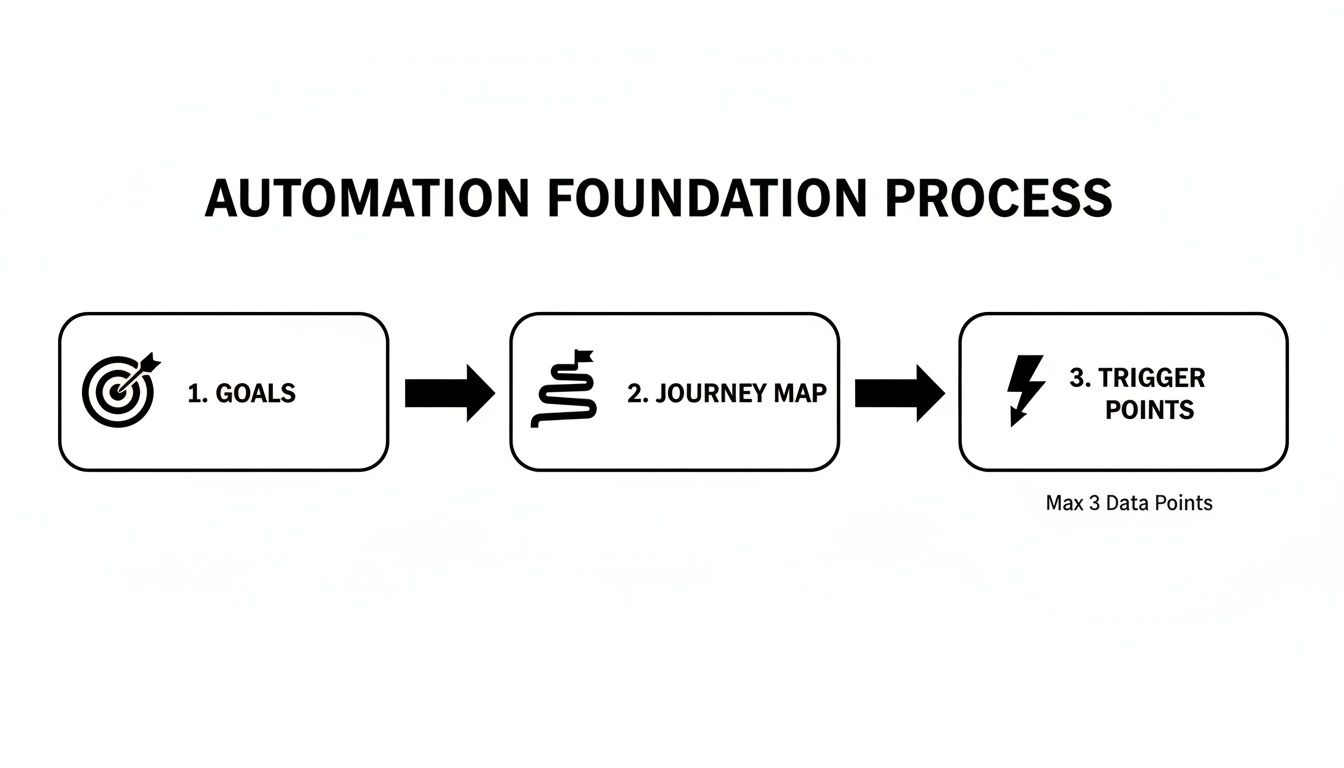
This simple process—defining your Goals, mapping the Customer Journey, and identifying the Trigger Points—is the blueprint you’ll use for everything that follows.
The Welcome Series: Make a Killer First Impression
Your welcome series is, without a doubt, the most important automation you will ever build. Why? Because new subscribers are never more engaged than in the moments after they sign up. The average open rate for a welcome email is a staggering 82%—you just can't afford to miss that opportunity.
The goal isn't just a transactional "thanks for subscribing." It's about pulling back the curtain and inviting them into your world.
- Email 1 (Send immediately): Deliver on your promise. If they signed up for a discount code, a checklist, or a guide, give it to them right away. Keep this first email focused, friendly, and friction-free.
- Email 2 (Wait 2 days): Tell your story. Who are you? What’s the "why" behind your business? This is your chance to forge a human connection that goes beyond just products and prices.
- Email 3 (Wait 2 more days): Show them the good stuff. This is the perfect time to introduce your best-sellers, share a powerful customer testimonial, or link to your most popular blog post. Let your happy customers do the selling for you.
Key takeaway: The tone you set in your welcome series becomes the foundation for your entire relationship with that subscriber. Keep it personal and focused on the value you bring to their lives, not just on what you want to sell them.
The Nurture Sequence: From "Just Looking" to "Ready to Buy"
Let’s be real: most people who join your email list aren't ready to buy on day one. A lead nurture sequence is designed specifically for these folks. It's your tool for gently guiding prospects who need more information and trust before they feel comfortable making a purchase. This is absolutely critical for businesses with a longer sales cycle or higher-priced offerings.
Here, your job is to educate, overcome objections, and position your brand as the go-to expert.
Imagine you sell premium, handcrafted coffee beans. Your nurture sequence might look like this:
- Email 1 (Triggered by a "Perfect Brew Guide" download): Start by saying thanks and sharing a little about your bean-sourcing philosophy.
- Email 2 (Wait 3 days): Tackle a common problem. An email titled "Tired of Bitter Coffee? The Secret is in the Grind" provides real value while subtly pointing toward your high-quality whole beans.
- Email 3 (Wait 3 days): Share a customer story. Feature a testimonial from a coffee lover who transformed their morning routine with your product. Show, don't just tell.
- Email 4 (Wait 4 days): Make a gentle offer. Now that you've built trust and demonstrated expertise, you can introduce a "Tasting Trio" bundle or a special discount on their first order.
The Abandoned Cart Sequence: Your Revenue Recovery Machine
Did you know that nearly 70% of online shopping carts are left behind before a purchase is made? That’s a massive amount of potential revenue just sitting there. A simple, automated abandoned cart sequence is one of the quickest and most effective ways to boost your bottom line. Done right, these emails can recover up to 10% of otherwise lost sales.
The trick is to be helpful and timely, not creepy or demanding.
- Email 1 (Send 1-3 hours after abandonment): The gentle nudge. Something simple like, "Did you forget something?" or "Your cart is waiting!" is often all it takes. Life happens, and people get distracted.
- Email 2 (Wait 24 hours): Overcome the hesitation. Use this email to remind them of your free shipping, easy returns policy, or glowing customer reviews. Remove any friction that might be holding them back.
- Email 3 (Wait 48-72 hours): Create a little urgency. A final, friendly reminder with a small incentive—like a 10% off code or free shipping—can be the perfect push to get them over the finish line.
If you're looking for great real-world examples, you can find a whole host of creative drip marketing examples on sugarpixels.com to see how other brands handle these crucial automations.
The Re-Engagement Campaign: Win Back Your Silent Subscribers
It’s natural for some subscribers to go quiet over time. A re-engagement (or "win-back") campaign is your proactive strategy to rekindle their interest before you clean them from your list. Keeping a healthy, engaged list is vital for your long-term success.
First, you need to define what "inactive" means for you. Is it 90 days with no opens? Six months with no clicks or purchases? Once you have your trigger set, you can build the flow.
- Email 1: The "We Miss You" Nudge. Use a friendly, non-demanding tone. A subject line like "Is this goodbye?" or "Still want to hear from us?" often gets an immediate response. Remind them why they signed up in the first place.
- Email 2: The Last-Chance Offer. If the first email didn't work, it's time to bring out your best offer. This could be a significant discount, a free gift, or exclusive content to remind them of the value you provide.
- Email 3: The Conscious Uncoupling. Still no response? It's time to say goodbye. Send a final, polite email letting them know you'll be removing them from your active list to respect their inbox. Give them one last button to click if they want to stay. This might seem counterintuitive, but cleaning your list of unengaged subscribers is one of the best things you can do for your email deliverability and overall engagement rates.
Here’s a quick-glance blueprint of these four essential automation sequences to help you map out your own.
Essential Automation Sequence Blueprint
| Sequence Type | Primary Goal | Typical Length | Example Email Flow |
|---|---|---|---|
| Welcome | Onboard new subscribers & make a strong first impression. | 3-4 Emails | Email 1: Deliver lead magnet/discount. Email 2: Tell your brand story. Email 3: Showcase best-sellers & social proof. |
| Lead Nurture | Build trust & educate prospects who aren't ready to buy. | 3-5 Emails | Email 1: Acknowledge their interest. Email 2: Address a pain point. Email 3: Share a case study. Email 4: Make a soft offer. |
| Abandoned Cart | Recover potentially lost sales & overcome buying friction. | 3 Emails | Email 1 (1 Hr): Gentle reminder. Email 2 (24 Hrs): Handle objections (shipping, returns). Email 3 (48 Hrs): Create urgency with an offer. |
| Re-Engagement | Win back inactive subscribers or clean the email list. | 2-3 Emails | Email 1: "We miss you" check-in. Email 2: Present a compelling final offer. Email 3: Announce removal from list (with a final chance to stay). |
This table provides a solid starting point. As you get more comfortable, you can tweak the timing, add more emails, and test different content to see what resonates best with your specific audience.
Choosing the Right Tools Without Overspending
Let's be honest: navigating the world of email automation software can feel like a chore. You're bombarded with platforms all promising the moon, and it's easy to get stuck either by analysis paralysis or, worse, by locking into an expensive plan that's total overkill for what you actually need.
The secret isn't finding the "best" platform—it's about finding the right one for your business at this very moment. You need a tool that solves today's problems without creating new ones, like a clunky interface or a surprise bill. It should match your goals, play nicely with your current setup (like your website or shop), and be ready to grow when you are.
What to Look For in an Automation Platform
Before you even glance at a pricing page, jot down a simple list of your must-haves. This little bit of prep work will help you tune out the marketing hype and zero in on the features that will genuinely make a difference for your business.
Think about these core questions:
- Is it easy to use? How intuitive is the workflow builder? Can you map out a sequence without calling in a developer? Most good platforms offer a free trial—use it! See if the interface feels natural to you.
- Does it integrate with my core tools? This is non-negotiable. If you run an e-commerce store, you need a seamless connection to Shopify, WooCommerce, or BigCommerce. For a service business, it might be your CRM or scheduling software.
- Can it grow with me? What's the upgrade path? A great starting platform lets you begin on a free or low-cost tier and add features as your business grows. The last thing you want is to be forced into a complicated migration a year from now.
- How good is the segmentation? Can you easily tag subscribers based on what they do (or don't do)? Look for the ability to create segments like "first-time buyers," "hasn't purchased in 90 days," or "clicked a specific link in the welcome email."
The goal is to find a tool that empowers you, not one that makes you a part-time tech support specialist. Your time is far better spent on strategy and writing great emails, not wrestling with confusing software.
A Real-World Example
Let's ground this in a practical scenario. Imagine you run a small online store on Shopify. Your first goal is to set up a welcome series for anyone who signs up for your newsletter in the website footer.
The first, most critical step is connecting your email platform to Shopify. Most modern tools like MailerLite or ActiveCampaign offer a direct, one-click integration. Once connected, a new subscriber's info (name and email) gets zapped from Shopify to your email list automatically.
Now, inside your email tool, you'll create an automation. You set the trigger to be "When a subscriber joins the 'Newsletter' list." From there, you just drag and drop the steps: send Email 1 immediately, wait two days, send Email 2, wait three more days, send Email 3. That single integration is what makes powerful email automation for a small business a set-it-and-forget-it reality.
Comparing Your Options: From Free to Pro
The good news is there are solid options for every budget. I've seen countless small businesses thrive by starting with a robust entry-level platform that has more than enough power to handle the essential automations we're talking about here. For a deeper dive into what you can expect to pay, check out this guide on email marketing costs.
To help you see the differences, I’ve put together a quick comparison of what you typically get at different levels.
Email Automation Platform Feature Comparison
| Feature | Entry-Level Platforms (e.g., MailerLite) | Mid-Tier Platforms (e.g., ActiveCampaign) | Advanced Platforms (e.g., HubSpot) |
|---|---|---|---|
| Visual Automation Builder | Simple, linear workflows are easy to set up. | Advanced branching logic (if/then paths) for more personalized journeys. | Highly sophisticated with lead scoring, A/B testing, and dynamic content. |
| E-commerce Integration | Good for basic triggers like abandoned carts and purchase follow-ups. | Deep integration for segmenting based on purchase history, frequency, and lifetime value. | Full e-commerce marketing and sales hub integration. |
| CRM Functionality | Limited or non-existent. It’s primarily focused on email marketing. | Often includes a built-in CRM to track lead scores and manage sales pipelines. | Fully integrated, powerful CRM is the core of the platform. |
| Pricing Model | Usually offers a generous free plan and stays very affordable as your list grows. | More expensive, priced on features and contacts, but delivers immense power. | Premium pricing, often an all-in-one solution for marketing, sales, and service. |
For most small businesses, an entry-level platform provides all the muscle you need to get a fantastic return on your investment. You can easily launch high-impact welcome, cart recovery, and re-engagement campaigns without paying for advanced features you might not touch for years.
My advice? Start simple, master the fundamentals, and only upgrade when your strategy genuinely demands more sophisticated tools.
How to Measure and Improve Your Automation Performance
Getting your first automation sequence live is a huge milestone. Seriously, pop the champagne. But the real magic—the part that drives sustainable growth—happens next. Great email automation isn't a "set it and forget it" machine; it’s a living system that you have to measure, tweak, and improve.
This is where you put on your data detective hat, even if you hate spreadsheets.
The key is to look past the vanity metrics. Sure, a high open rate is a nice little ego boost, but it doesn't pay the bills. The numbers that really matter are the ones that show you how your automations are impacting your bottom line.
Key Metrics That Actually Move the Needle
To get a clear picture of what's working, you have to focus on the metrics tied directly to revenue and real customer engagement.
Here are the numbers I always keep a close eye on:
- Conversion Rate: This is the big one. It’s the percentage of people who actually did the thing you wanted them to do—make a purchase, book a call, or download a guide. A high conversion rate means your email isn't just being read; it's driving action.
- Click-Through Rate (CTR): This tells you how many people clicked on a link inside your email. A healthy CTR shows that your message and call-to-action were compelling enough to get someone to leave their crowded inbox and land on your site.
- Revenue Per Email (RPE): For any e-commerce business, this metric is pure gold. You calculate it by dividing the total revenue from an email by the number of people who received it. RPE helps you spot which specific emails in a sequence are your money-makers.
To make sure your automation is pulling its weight, you have to check in on it. Getting comfortable with tracking email marketing KPIs gives you the roadmap you need to make smart improvements.
Your data tells a story. A sudden drop-off in clicks on email #2 of your welcome series might mean your hook isn't strong enough. A spike in unsubscribes after a salesy email probably means your pitch felt too aggressive or came too early. Listen to what the numbers are telling you.
The Power of Simple A/B Testing
Once you know your numbers, you can start making them better. The best tool for this is A/B testing, which is just a fancy term for comparing two versions of an email to see which one performs better.
Don't let the term intimidate you. It's really about testing one small, manageable change at a time.
Here are a few high-impact elements perfect for testing:
- Subject Lines: Try a direct, no-fluff subject line ("Your 10% discount code is here") against one that sparks curiosity ("A little something for your cart…").
- Calls-to-Action (CTAs): See if "Shop Now" out-pulls "Explore the Collection." Does a bright green button get more clicks than a subtle blue one? Sometimes the smallest things make the biggest difference.
- Email Content: Pit a version with a powerful customer testimonial against one without. Test a simple, plain-text email against a more polished, image-heavy design. You might be surprised by what resonates with your audience.
A Simple Rhythm for Optimization
Optimization doesn't have to be some massive, all-consuming project. By building a simple, repeatable process, you can make steady improvements that create huge results over time. Think of it as a quarterly check-up for your automation engine.
Here’s a workflow you can steal:
- Review: Once a quarter, pull up the performance reports for your core automation sequences.
- Identify: Find the weakest link in the chain. Which email has the lowest CTR or conversion rate?
- Hypothesize: Make an educated guess about why it's falling short. "I bet the subject line is too generic and getting lost in the inbox."
- Test: Set up an A/B test for that one element. Let it run for a week or two—long enough to get meaningful data.
- Implement: If your new version wins, fantastic! Make it the new control. If it doesn't, you've still learned something valuable about what your audience doesn't want.
Following this simple rhythm turns optimization from a chore into a rewarding process. By consistently measuring what matters and testing small, thoughtful changes, your email automation for small business will evolve from a helpful tool into your most reliable engine for growth.
Taking Your Automations Live: A Final Checklist and Some Hard-Won Advice
You’ve done the heavy lifting: the customer journey is mapped, your sequences are built, and the tools are in place. Now comes the exciting part—flipping the switch. Launching your first automation might feel a little nerve-wracking, but it’s really just a matter of a final, careful once-over to make sure every component is ready to go.
Think of this checklist as your pre-flight inspection. It breaks everything down into simple, manageable steps so you can launch with confidence, knowing nothing important has slipped through the cracks.
The Pre-Launch Checklist
Before you activate a single workflow, take a few minutes to run through these critical checks. This is about more than just making sure things work; it’s about ensuring you deliver a seamless, professional experience from the very first email.
- Proofread Everything: Seriously. Read every email for spelling and grammar, then have a colleague or friend read it, too. A fresh pair of eyes always catches something.
- Test Every Single Link: Click on your logo, your social media icons, and especially your main call-to-action buttons. You'd be surprised how often a broken link sneaks in.
- Verify Your Trigger Logic: Is the automation set to fire for the right reason? Double-check that it’s connected to the correct list, tag, or customer action (like an abandoned cart).
- Confirm Your Timing: Are the delays between your emails logical? A 24-hour or 2-day delay feels natural for a welcome series. A 2-minute delay feels like you're yelling at someone.
- Send a Real Test: The most important step. Trigger the automation yourself using a personal email address. Open the emails on your phone and your computer. Does it look right? Does it feel right?
Pro Tips for Long-Term Success
Getting your automations live is just the beginning. The real magic happens when you start refining them based on real-world results. These are a few tips I’ve picked up over the years that will keep your automations humming and your subscribers happy.
First, never, ever forget about mobile. With over 60% of emails now opened on a smartphone, your design has to be responsive. That means using a clean, single-column layout, fonts that are easy to read on a small screen, and big, obvious buttons that are easy to tap.
I always tell clients to think of their email list like a garden. You can't just plant the seeds and walk away. You have to actively tend to it. Make it a habit to regularly prune subscribers who haven't opened an email in six months. This keeps your list healthy, improves deliverability, and makes sure you're only talking to people who want to listen.
Finally, you have to push your personalization beyond just dropping in a {{first_name}}. Segment your audience by what they do. For example, you could create a dynamic segment of "first-time buyers" and automatically send them a follow-up email with tips for using their new product. That’s the kind of relevance that turns a one-time sale into a loyal customer, and it’s the real secret behind effective email automation for small business.
Don't feel like you need to build ten complex sequences on day one. Just start with a single, high-impact automation—your welcome series is usually the best place. Get it right, see how it performs, and then build on that success. That methodical approach is how you build a powerful system that actually grows your business.
Ready to build a powerful online presence that drives real results? At Sugar Pixels, we specialize in creating custom websites and digital marketing strategies that empower small businesses to grow. Let's build something amazing together.