

Finding the right digital marketing agency is less about hiring a vendor and more about finding a true partner. Before you even start looking, the real work begins internally. You need to get crystal clear on your specific business goals, lock in a realistic budget, and write a solid brief.
This prep work ensures you're judging agencies on what matters to your business, not just how slick their sales pitch is.
Laying the Groundwork for Your Agency Search

Jumping into calls with agencies without a clear picture of what success looks like is a classic mistake. It almost always leads to wasted time and mismatched expectations. Honestly, this homework phase is the most critical part of the whole process.
When you've done the work upfront, you control the conversation. You’re not just listening to a pitch; you're strategically evaluating whether they can meet your specific needs.
Translate Business Needs into Marketing Goals
Fuzzy goals like "get more traffic" or "improve brand awareness" won't cut it. To find the right agency, you have to turn those big-picture business objectives into hard, measurable marketing goals. This is how you find an agency with the right kind of experience.
Let's say your business goal is to boost Q4 revenue by 20%. Your marketing goals might look more like this:
- Bring in 500 marketing qualified leads (MQLs) each month from organic search.
- Hit a 3:1 return on ad spend (ROAS) on all e-commerce PPC campaigns.
- Grow the email list by 25% using targeted content and lead magnets.
Defining these key performance indicators (KPIs) from the start gives you a clear yardstick for success. Any agency you talk to needs to be able to speak directly to these numbers. If you're weighing the pros and cons of hiring help, this founder's guide to outsourcing digital marketing is a great resource.
Establishing a Realistic and Strategic Budget
Your marketing budget shouldn't be a number you just pull out of thin air. Think of it as a strategic investment tied directly to your growth targets. Too many businesses ask agencies, "What can I get for $X?" without first figuring out what it will actually take to hit their goals.
A much smarter way is to work backward. If you need 500 new customers and you know your average customer acquisition cost (CAC) is $50, then you need a budget of at least $25,000 for ad spend, plus the agency’s fee.
It's all about value, not just cost. An agency that costs $10,000 a month but generates $50,000 in return is a much better deal than a $2,000 agency that delivers zero results.
When you present a thought-out budget, it shows agencies you're serious and helps them build a proposal that actually works. To get a better handle on the services you might need, you can learn more about what a digital marketing agency is and what they do in our detailed guide.
Crafting a Clear and Concise Agency Brief
Once your goals and budget are set, pull it all together into a straightforward agency brief. This document is your North Star for the search, making sure every agency gets the exact same information.
It doesn’t have to be a novel, but it does need to be precise.
What to include in your agency brief:
- Company Overview: A quick rundown of what you do, who you sell to, and what sets you apart.
- Marketing Objectives: Your specific, measurable goals (like the examples we just talked about).
- Target Audience: Who is your ideal customer? Describe their demographics, pain points, and where they hang out online.
- Budget Range: Be upfront about your monthly or quarterly budget for both ad spend and agency fees.
- Current Challenges: Be honest. What have you tried that isn't working? Where are you stuck?
This brief gives potential partners everything they need to know to see if it’s a good fit and put together a proposal that’s actually relevant. It streamlines the whole process, saving you countless hours and making sure you find an agency that’s truly on the same page.
Sizing Up an Agency’s Real Expertise and Fit

Alright, you’ve done the internal homework. Now for the hard part: figuring out if an agency is actually as good as their sales pitch. It’s incredibly easy to get wowed by a slick presentation, but the success of this partnership comes down to their actual skills and whether their team genuinely clicks with yours.
The digital marketing world is booming. The global market is set to hit a staggering $1.16 trillion by 2030, and in the U.S. alone, there are over 60,000 agencies. That's a lot of noise. Having more options is great, but it means you have to be extra sharp to find a partner with a real track record.
Specialist vs. Full-Service: Which Is Right for You?
One of the first forks in the road is deciding between a niche specialist and a do-it-all full-service agency. There’s no right or wrong answer here—it all boils down to your specific goals and what your team looks like right now.
-
A niche agency goes deep on one thing. Think B2B SaaS link building or e-commerce PPC. They live and breathe their specialty, often bringing sophisticated strategies that a generalist just won't have.
-
A full-service agency gives you a connected strategy across all the key channels: SEO, content, paid ads, email, and social. This is perfect for ensuring your message is consistent everywhere and that all your efforts are working together, not in silos.
Use this breakdown to understand which agency type—niche, full-service, or specialized—is the best match for your specific goals and resources.
Comparing Agency Models for Your Business Needs
| Agency Type | Best For | Pros | Cons |
|---|---|---|---|
| Niche/Specialist | Businesses with in-house teams needing targeted expertise (e.g., technical SEO, CRO). | Deep, cutting-edge knowledge in one specific area. Often more agile and focused. | Can't provide an integrated, multi-channel strategy. May have a narrow view of the overall marketing picture. |
| Full-Service | Companies seeking a comprehensive, managed marketing strategy without hiring a large internal team. | A single point of contact for a unified strategy. Ensures consistency across all channels. | Can sometimes be a "jack of all trades, master of none." Expertise might not be as deep in every single service. |
| Specialized (Industry) | Companies in complex or regulated industries like healthcare, finance, or legal. | Understands industry-specific jargon, compliance, and audience nuances. Proven strategies for that vertical. | May be less innovative, relying on industry-standard playbooks. Less cross-industry experience. |
Ultimately, choosing the right model comes down to a simple gut check. If you have a strong marketing team that just needs to fill a specific skill gap, a niche specialist is a fantastic choice. But if you’re looking for someone to build and run the entire marketing engine for you, a full-service agency is almost always the better bet.
Look Past the "Services" Page
Every agency website has a laundry list of services: SEO, content creation, social media. Honestly, that list tells you almost nothing. To get a real sense of their expertise, you have to dig into their process.
Instead of asking, "Do you offer SEO?" try these questions:
- "What does your process for a technical SEO audit look like in the first 90 days?"
- "How do you approach keyword research for a company in our industry? Can you walk me through it?"
- "What's your philosophy on link-building, and how do you prove it's working?"
Their answers will quickly show you if they have a real strategy or just a checklist of tactics. You want a partner who can explain the why behind their work, not just the what. This is especially true for companies looking into SEO services for startups, where getting the foundation right is everything.
Find Proof of Relevant Experience
An agency might show off stunning case studies, but if they're all for Fortune 500 retailers and you’re a B2B software startup, that experience probably won’t translate. You need to see a track record with businesses like yours—similar in size, industry, and business model.
When you look at their portfolio, don't just get impressed by the logos. Ask them to share results from a client who started with a budget like yours or faced the same market challenges you're up against. That’s the real proof they know how to win in your world.
Don't Underestimate the Culture Fit
This is the human side of the equation, and I can tell you from experience, it’s just as important as technical skill. A bad culture fit can poison a partnership from day one. You aren't just hiring a vendor; you’re bringing a team into your inner circle.
Think about these things to see if you’ll work well together:
- Communication Style: How do they keep you in the loop? Are they proactive with updates, or do you find yourself constantly asking for them? A good partner sets a clear communication rhythm right away.
- Radical Transparency: Are they upfront about their process, pricing, and even their mistakes? An agency that will tell you about a campaign that flopped—and what they learned from it—is far more trustworthy than one that only shows you a highlight reel.
- Partners, Not Vendors: Do they treat you like a client to be managed or a partner to collaborate with? The best relationships are built on mutual respect and a shared drive to hit your goals.
- Their Tech Stack: The tools they use matter. It shows how efficient and data-driven they are. For example, knowing the top social media management tools for agencies can give you a peek into how they run their operations behind the scenes.
In the end, you need a partner whose values and work ethic feel like a natural extension of your own. When you find that fit, you haven't just hired a service—you’ve gained a true ally who is invested in seeing you grow.
Looking Beyond Case Studies for Real Proof of Performance
Every agency has a polished sales deck filled with their greatest hits—impressive logos, shiny awards, and hockey-stick growth charts. But a great presentation doesn't always signal a great partner. The real test isn't how well they present their wins, but how transparently they can prove them.
Your job is to get past the surface-level shine and dig for actual, tangible evidence of their performance. Think of their case studies not as the final proof, but as the starting point for a much deeper conversation.
Dissecting the Case Study
A compelling case study tells a great story, but it’s often an edited one. Key details can get left out, so you need to look beyond the big, flashy percentage increases. Without context, those numbers don't mean much for your business.
It's time to peel back the layers of their success stories. Start asking questions that get to the heart of the matter:
- What was the total client investment to get these results? A 300% jump in traffic sounds incredible, but not if it required a completely unsustainable ad spend.
- What was the timeline for this project? Did it take them three months or three years to deliver? Time is money.
- Where was the client starting from? Growing a site from 100 to 400 visitors is a world away from growing one from 10,000 to 40,000.
- Who from your team worked on this account? Critically, you need to know if the A-team that produced these amazing results will be the same people working on your business.
Asking these questions changes the entire dynamic. It moves the conversation from vague claims to a real discussion about resources, timelines, and what it actually takes to generate a return.
Verifying Claims with Real People
Honestly, the single most powerful way to vet an agency is to talk to their clients. Website testimonials are nice, but a live conversation with a current or former client is pure gold. If an agency seems hesitant or unwilling to provide a reference, that’s a massive red flag.
When you get on the phone with a reference, come prepared. Don't just ask, "Are you happy with them?" Dig deeper.
Key Questions for Agency References:
- How proactive are they with communication? Do you have to chase them for updates?
- Can you walk me through a time a campaign wasn't working and how they handled it?
- How well did they grasp your business and industry during the onboarding process?
- Looking back, has the value they provide truly justified the investment?
A candid chat like this will tell you more about an agency's process, transparency, and problem-solving skills than any polished PDF ever could.
Pro Tip: Try to speak with a reference who has been with the agency for over a year. This is the ultimate proof that they can build long-term relationships and deliver sustained results, not just quick, flashy wins.
Spotting the Red Flags in a Portfolio
As you look through different portfolios, you'll start to notice patterns. Some of these are warning signs that should make you pause, often pointing to a focus on vanity metrics over real business impact.
Keep an eye out for these common issues:
- An overemphasis on vanity metrics. Be skeptical of case studies that lead with "impressions," "likes," or "reach" but fail to connect them to actual leads, sales, or revenue.
- Missing or vague timelines. Results without a clear timeframe are pretty much meaningless. "We doubled their traffic" is a weak claim if you don't know whether it took a month or two years.
- No mention of ROI or ROAS. For channels like paid advertising, the return on investment is the only metric that truly matters. Good agencies aren't afraid to talk numbers. In fact, it's worth taking time to learn more about how to calculate marketing ROI yourself to better evaluate their claims.
- A portfolio of irrelevant industries. An agency that works exclusively with local restaurants probably isn't the best fit for a B2B software company with a long, complex sales cycle.
This is especially critical when evaluating paid media capabilities. Paid advertising is now a core service for 89% of agencies. With marketing budgets now averaging 7.7% of total company revenue—and over 30% of that slice going to paid media—you have to be certain an agency can deliver a clear, positive return on ad spend (ROAS).
Using a Scorecard to Make a Data-Driven Decision
After a few weeks of calls, presentations, and reference checks, your top contenders can all start to sound the same. It's tempting to just go with your gut, but that's a classic recipe for buyer's remorse. The best way to pick a digital marketing partner is to take emotion out of it and get methodical.
This is where a simple evaluation scorecard becomes your best friend. It forces you to rate each agency against the criteria you decided were most important, making sure your final choice is based on solid evidence, not just a killer sales pitch.
Building Your Agency Scorecard
Think of this as your own custom rubric for this big decision. Instead of a generic template, you'll want to build one that reflects what you really need. A B2B startup desperate for leads will weigh technical SEO and content strategy much higher than an e-commerce brand that needs a master of complex Google Ads campaigns.
Here are the core categories I always recommend starting with. Adjust them to fit your business.
- Strategic Alignment (Weight: 30%): Did they actually get it? Do they understand your goals, your customers, and the challenges you’re facing? A great agency feels like they’re already part of your team before they even sign the contract.
- Team & Expertise (Weight: 25%): How deep is the bench? More importantly, who will you actually be working with every day? If you didn't meet your day-to-day contact, that's a red flag.
- Communication & Transparency (Weight: 20%): What's their process for reporting? How often will you meet? What happens when things go sideways? You’re looking for a clear, proactive communication plan.
- Proof of Performance (Weight: 15%): Were their case studies and references relevant and impressive? Could they back up their claims with real numbers and confidently talk about ROI?
- Cultural Fit (Weight: 10%): This one’s a bit softer, but it matters. Does their pace, working style, and general vibe feel like a good match for your own company?
Once you have your categories and weights locked in, score each agency on a simple 1-to-5 scale for each line item. The math will do the rest, pointing you to your logical front-runner.
The entire vetting process—analyzing their proposal, asking sharp questions, and verifying their claims—is designed to give you the data you need to fill out this scorecard.
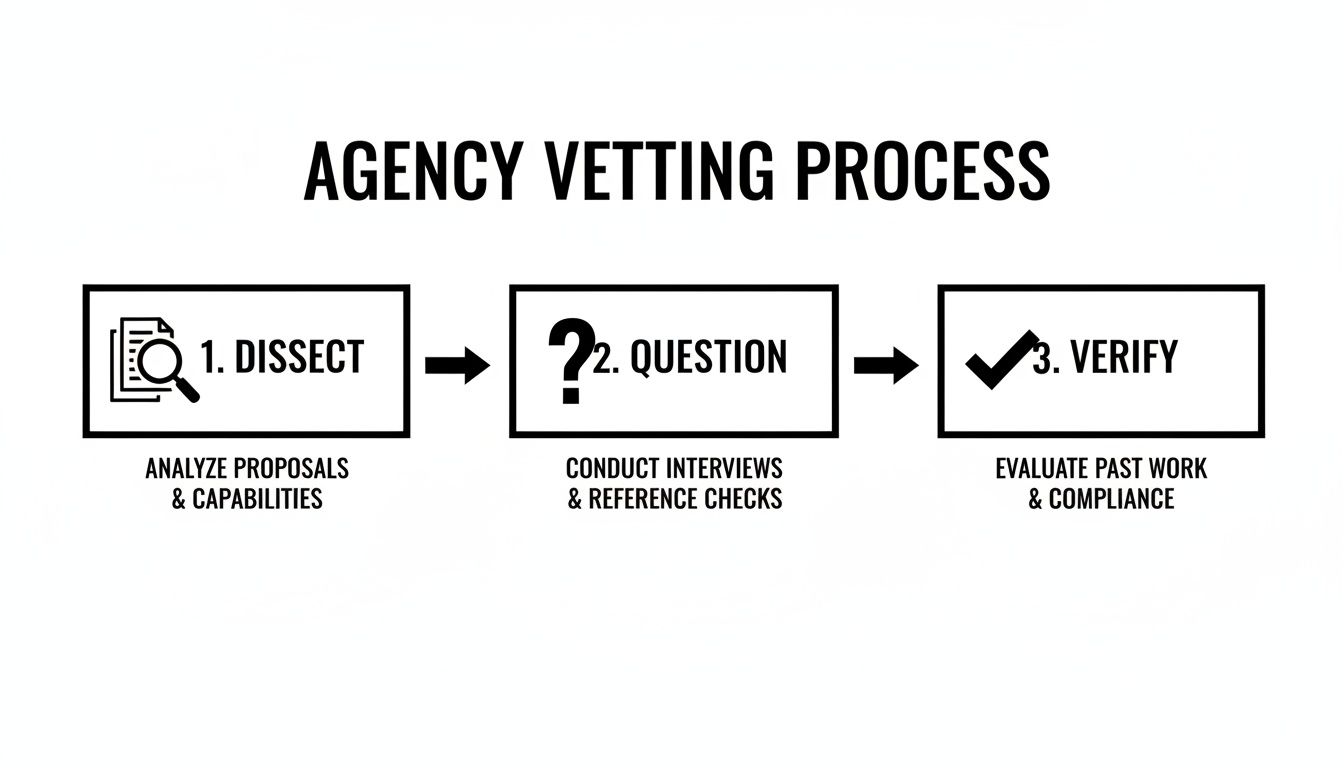
This simple framework—Analyze, Question, Verify—is your sanity check. It ensures you’re not just taking their word for it, but are actively digging in to make an informed choice.
To give you a clearer picture, here's a basic scorecard template. You can use this as a starting point to score your finalists and keep the comparison objective.
Agency Evaluation Scorecard Template
| Evaluation Criteria | Agency A Score (1-5) | Agency B Score (1-5) | Notes |
|---|---|---|---|
| Strategic Alignment | Did their strategy feel custom or cookie-cutter? | ||
| Team Expertise | Was I impressed by the person who will be my main contact? | ||
| Communication Plan | How clear and proactive is their reporting process? | ||
| Case Study Relevance | Did they have experience with businesses like mine? | ||
| Cultural Fit | Do I feel like we could work well together under pressure? |
After you've scored each agency, the total scores will provide a much clearer, data-backed view, helping you move past any lingering indecision.
Going Deeper with Killer Questions
Of course, your scorecard is only as good as the information you put into it. To get real insights, you have to ask questions that go beyond the surface and reveal how an agency thinks, acts, and solves problems.
Forget the softballs. Try these instead:
-
"Walk me through your process for when a campaign is underperforming or failing to meet its KPIs."
This might be the single most important question you ask. Their answer tells you everything about their accountability, honesty, and problem-solving skills when the pressure is on. -
"Who, specifically, from your team will be my primary day-to-day contact? What’s their background?"
You need to know if you're getting the senior strategist from the pitch meeting or a junior coordinator who is fresh out of school. Don't be shy about asking to meet the actual people you'll be working with. -
"How do you stay on top of all the industry changes, and how does that knowledge get shared across your team?"
This separates the agencies that are committed to learning from those just running the same old plays from five years ago.
It’s also crucial to ask about their tech stack. For instance, AI-related services have grown to represent 17% of all agency offerings. A staggering 73% of agency leaders believe AI has completely changed the SEO game. Ask them how they're using AI for things like keyword research or content briefs. You want a partner who is leaning into the future. For more on this, you can explore the findings in the 2025 digital agency industry report.
A great agency won't just answer your questions; they'll ask you thoughtful ones in return. A partner who is genuinely curious about your business, your challenges, and your vision is one who is ready to invest in your success.
By combining a quantitative tool like a scorecard with these kinds of qualitative, in-depth questions, you get a complete picture. This disciplined approach cuts through the noise and lets you confidently choose an agency that isn't just capable, but is truly the right partner to help you grow.
Finalizing the Partnership for Long-Term Success
You’ve sat through the pitches, you’ve checked the references, and you’ve run the numbers on your scorecard. A clear winner is emerging. Now it’s time to transition from a promising conversation into a solid, working partnership. This is less about being sold and more about setting the ground rules for success from day one.
How an agency handles this final stretch speaks volumes. A great partner becomes even more proactive and transparent, guiding you through the details. If communication suddenly gets spotty or they get cagey about contract details, that’s a major red flag.
Analyzing the Proposal and Contract
Think of the proposal as the blueprint for your entire relationship, not just a price list. A weak proposal simply lists a bunch of tactics. A strong one is a strategic document that connects every single activity directly back to the business goals you’ve been discussing.
Here’s what a good proposal should nail:
- A Clear Strategy: It needs to show they were listening. The document should recap your objectives and explain the why behind their approach, not just list the what.
- Defined Deliverables: Forget vague promises like "improving SEO." You want specifics, like "one 2,000-word blog post targeting long-tail keywords per week" or "a complete technical site audit delivered by the end of month one."
- Transparent Pricing: The costs should be broken down clearly. Look for a distinct separation between one-time setup fees, the monthly retainer, and the ad spend budget you control.
Once the proposal looks good, the contract makes it official. Don't just give it a quick glance. This document is your safety net, so it’s worth the time to read every line.
Your contract is the single source of truth for the partnership. It should eliminate any gray areas and give you a clear path forward, especially if things go sideways. Pay close attention to the termination clause—a fair contract allows either party to exit with reasonable notice, usually 30 days.
Key Contract Terms to Scrutinize
Legal jargon can be a headache, but a few clauses are absolutely critical for protecting your business. Before you sign anything, make sure your agreement clearly addresses these points.
Must-Have Contract Clauses:
- Ownership of Assets: It must state, in no uncertain terms, that you own everything. This includes all creative work, website access, and ad accounts created for you, even if you part ways.
- Performance and Reporting: The contract should specify how and when you'll get updates. For example, "monthly KPI dashboards delivered by the 5th" and "quarterly strategic review meetings."
- Confidentiality (NDA): A standard non-disclosure agreement is a must to ensure your business data and internal strategies stay private.
- Termination Policy: Look for a fair and straightforward exit clause. You want to avoid being locked into a long-term contract with no escape hatch if the relationship isn't working.
If any of these terms are vague or missing, push back. Ask for revisions. A good partner won’t have a problem clarifying the language to make sure you both feel secure.
What a Strong Onboarding Process Looks Like
The first 30 days set the tone for the entire engagement. A great agency doesn't just cash your check and go dark for a month. They’ll have a structured, collaborative plan to get up to speed and integrate with your team.
A solid onboarding plan almost always includes:
- A kickoff meeting to get all the key people from both sides in the same room.
- Discovery sessions where they dig deep into your brand, customers, and internal workflows.
- A smooth process for sharing access and credentials to all the necessary tools (Google Analytics, your CMS, ad accounts, etc.).
- A 90-day roadmap that clearly outlines the initial priorities and key milestones.
This kind of organized start ensures nothing falls through the cracks. It’s the final confirmation that the agency is as invested in a successful launch as you are, and a powerful sign that you’ve made the right choice.
Still Have Questions? Let’s Clear Things Up
Even after you’ve done your homework, a few questions always seem to pop up right before you sign on the dotted line. Making the final call on a digital marketing agency is a big decision, and it’s smart to be thorough. Let’s tackle some of the most common things business owners ask.
One of the biggest anxieties is money. It’s the elephant in the room, but figuring out a realistic budget is crucial. The temptation to just pick the cheapest option is strong, but it's almost always a mistake.
What Should This Actually Cost?
There's no one-size-fits-all answer here. Agency pricing is all over the map, depending entirely on what you need and their experience level.
A small business focusing on a single service—say, just SEO or social media—might spend anywhere from $2,000 to $7,000 a month. If you're a mid-sized company looking for a complete, multi-channel strategy, you’re more likely looking at retainers in the $7,000 to $25,000+ monthly range.
The trick is to stop thinking of it as a cost and start seeing it as an investment. You have to look past the monthly fee and evaluate the potential return on investment (ROI). A good agency will give you a proposal that breaks down every single deliverable, so you’ll know exactly what you’re paying for.
Should I Go With a Niche Specialist or a Full-Service Agency?
This really depends on your immediate goals and what your own team looks like. There’s no right or wrong answer, but one will almost certainly be a better fit for you right now.
- A niche agency—one that only does B2B SaaS link building, for example—brings incredibly deep expertise to the table. They’re a fantastic choice if you already have a solid marketing team but need to plug a very specific skill gap.
- A full-service agency makes more sense when you need a unified strategy. If you want your content, paid ads, and email marketing to all work together as one cohesive machine, this is the way to go.
Honestly, for most businesses aiming for steady, long-term growth, a full-service partner is less of a headache. They provide the strategic oversight and save you from the nightmare of juggling multiple vendors who aren't talking to each other.
It all comes down to alignment. Whether they're a specialist or a generalist, the agency you choose has to understand your business goals and show you a clear, believable plan for getting there.
What Are the Biggest Red Flags to Watch Out For?
Picking the right partner is as much about spotting the bad ones as it is about finding the good ones. A few warning signs should set off alarm bells immediately.
Keep an eye out for these red flags:
- "Guaranteed" results: This is the big one. Nobody can promise you the #1 spot on Google. An agency making absolute guarantees is either naive or dishonest.
- Vague processes: If they can't clearly explain their methods, their pricing structure, or who on their team you'll be working with, that’s a bad sign. Transparency is non-negotiable.
- Poor communication from the start: The way they communicate during the sales process is exactly how they'll communicate once you’re a client. Slow replies and evasive answers are huge warnings.
- Hiding behind jargon: A great partner makes the complex simple. If they’re just throwing around buzzwords without explaining the why behind their strategy, they aren’t interested in a true partnership.
From the very first call, a great agency should feel like an extension of your own team—accountable, transparent, and focused on the same goals you are.
Ready to partner with an agency that prioritizes transparency and results? Sugar Pixels offers full-service digital marketing and web design solutions to help your business grow. Learn more about how we can build your online presence.