

Choosing a web host is about so much more than finding the cheapest monthly plan. It's really about finding a provider whose performance, security, and support line up with where you want to take your business.
Think of your host as a silent partner. The right one keeps your website fast, secure, and always online—directly impacting your reputation and, ultimately, your bottom line.
Why Your Web Host Is Your Most Important Business Partner

Before we get into the nitty-gritty of servers and storage, let's zoom out and look at the real-world impact of this decision. Your web host is the foundation of your entire online presence. It's not just another bill to pay; it’s a core piece of your business infrastructure that can either fuel your growth or become a major roadblock.
A subpar host can absolutely cripple your business with slow loading times, frequent outages, and glaring security holes. It’s not an exaggeration. Research has shown that just a one-second delay in page load time can cause a 7% drop in conversions. If you're an e-commerce store pulling in $100,000 a day, that single second costs you over $2.5 million in lost sales every year.
The Business Impact of a Hosting Decision
Every part of your digital strategy hinges on having a solid hosting foundation. As you get ready to create a business website, the host you pick will have a direct say in several key areas:
- User Experience (UX): We've all been there—a slow, clunky website is frustrating. A fast, reliable host delivers a smooth experience that keeps visitors engaged and makes them far more likely to stick around.
- SEO Rankings: Google has made it clear that it favors fast-loading, secure websites. High-performance hosting can give you a real edge in search rankings, making it easier for new customers to find you.
- Revenue and Sales: Every single minute your site is down, you're losing money. A host with a rock-solid uptime guarantee (we're talking 99.9% or higher) is non-negotiable for protecting your revenue.
- Security and Trust: A quality host isn't just about speed. They provide essential security layers like SSL certificates, firewalls, and malware scanning to protect your data and, just as importantly, build trust with your customers.
I like to think of a web host as the digital landlord for your business. A good one keeps the lights on, the doors locked, and makes sure customers have a great visit. A bad one can lock you out, leave the place vulnerable, and scare away traffic.
To help you get this right, I've created the table below to summarize the most important factors. It’s a quick-glance checklist that will help you prioritize what truly matters for your business.
Web Hosting Priorities at a Glance
This table breaks down the essential factors to evaluate when choosing a web host, helping you prioritize your business needs.
| Priority Factor | Why It Matters for Your Business | What to Look For |
|---|---|---|
| Performance | Speed directly impacts user experience, conversions, and SEO. A slow site costs you money. | SSD storage, CDN integration, server location options, and low Time to First Byte (TTFB). |
| Uptime/Reliability | Downtime means lost sales and a damaged reputation. Every minute counts. | An uptime guarantee of 99.9% or higher, backed by a Service Level Agreement (SLA). |
| Security | Protects your customer data, prevents hacks, and builds trust. A breach can be catastrophic. | Free SSL certificates, web application firewall (WAF), malware scanning, and regular backups. |
| Support | When something goes wrong (and it will), you need fast, expert help to get back online. | 24/7 availability through multiple channels (live chat, phone), with positive user reviews. |
| Scalability | Your hosting needs to grow with your business without causing downtime or major headaches. | Easy upgrade paths between plans (e.g., from Shared to VPS) and flexible resource allocation. |
| Cost | You need a plan that fits your budget without sacrificing critical features like security or support. | Transparent pricing, no hidden fees, and clear renewal rates. Avoid "too good to be true" offers. |
This guide is designed to give you a clear roadmap for evaluating potential hosts. Think of it as your checklist for finding a true partner, not just a service provider. By focusing on these business-critical factors, you can confidently choose a web host that will support your success for years to come.
Aligning Your Hosting With Your Business Strategy
Choosing a web host without a clear business plan is like building a house without a blueprint. You might get the walls up, but the foundation will be all wrong for what you actually need. A slick, minimal hosting setup that works wonders for a freelance writer's portfolio would buckle instantly under the pressure of a busy e-commerce shop.
The trick is to nail down your requirements before you even look at a single pricing page. This bit of foresight is what stops you from paying for server power you'll never touch or, even worse, picking a cheap plan that you outgrow in six months, leading to a massive migration headache.
Get Real About Your Traffic
First things first, you need an honest estimate of your website traffic. Are you launching a small blog that might get a few hundred visitors in a good month? Or are you moving an established online store that already sees thousands of people every day? A brand-new local business, for example, can often start strong and stay happy on a quality shared hosting plan.
But what if you're gearing up for a big product launch or a marketing campaign you hope goes viral? Your needs are completely different. You have to plan for those sudden traffic surges. If your host can't handle a rush, your site will go down at the most critical moment, costing you sales and damaging your brand's reputation.
Pinpoint Your Website's Main Job
What your site actually does is a huge piece of the puzzle. A simple, informational site with a few pages and a contact form has completely different demands than a dynamic, interactive one.
Let's look at a few real-world examples:
- A Local Plumber's Website: This site's main job is to show up in local searches and be reliable. It’s mostly static pages—Services, About Us, Contact—so a high-quality shared hosting plan usually gets the job done perfectly.
- An Online Course Platform: Here, you're dealing with user logins, video streaming, and payment processing. That requires a lot more server muscle (CPU and RAM) to manage everything happening behind the scenes, making a Virtual Private Server (VPS) a much better fit.
- A Growing E-commerce Store: With thousands of products, a customer database, and secure checkout, this site needs serious performance and rock-solid security. A VPS or a scalable cloud hosting solution is non-negotiable for smooth checkouts and protecting sensitive customer data.
A crucial part of aligning hosting with your goals is ensuring the provider offers solid IT scalability. You need a clear and simple upgrade path that lets your site grow without causing downtime or technical nightmares.
Plan for Tomorrow's Growth
Your business goals aren't set in stone. Where do you see yourself in a year? Five years? A smart hosting choice always accounts for the future.
One of the most common mistakes I see is people choosing a host based only on what they need on day one. Good hosting isn't just about today; it's about having the room to grow into your ambitions for tomorrow.
Imagine your blog gets a surprise feature in a major online magazine. Your traffic could easily jump 10x overnight. Will your hosting plan keep up, or will your big moment be spoiled by a "503 Service Unavailable" error? A host that lets you easily scale up your resources or offers a seamless upgrade from a shared plan to a VPS provides incredible peace of mind.
Thinking ahead like this makes your web host a true partner in your growth, not an anchor holding you back. When you match your hosting to your business model and future plans, you're making a strategic investment that will pay off for years.
Comparing the Different Types of Web Hosting
Shared, VPS, Cloud, Dedicated—it’s easy to get lost in the jargon. But picking the right one is crucial. Think of it like real estate: you can rent a small apartment, lease a townhouse, or build a custom home. Each option serves a different need, and the same goes for web hosting. Your choice directly impacts your site's speed, security, and ability to grow.
Let’s break down what these hosting types actually mean for your business. The flowchart below is a great starting point for matching your business goals to the right kind of hosting.
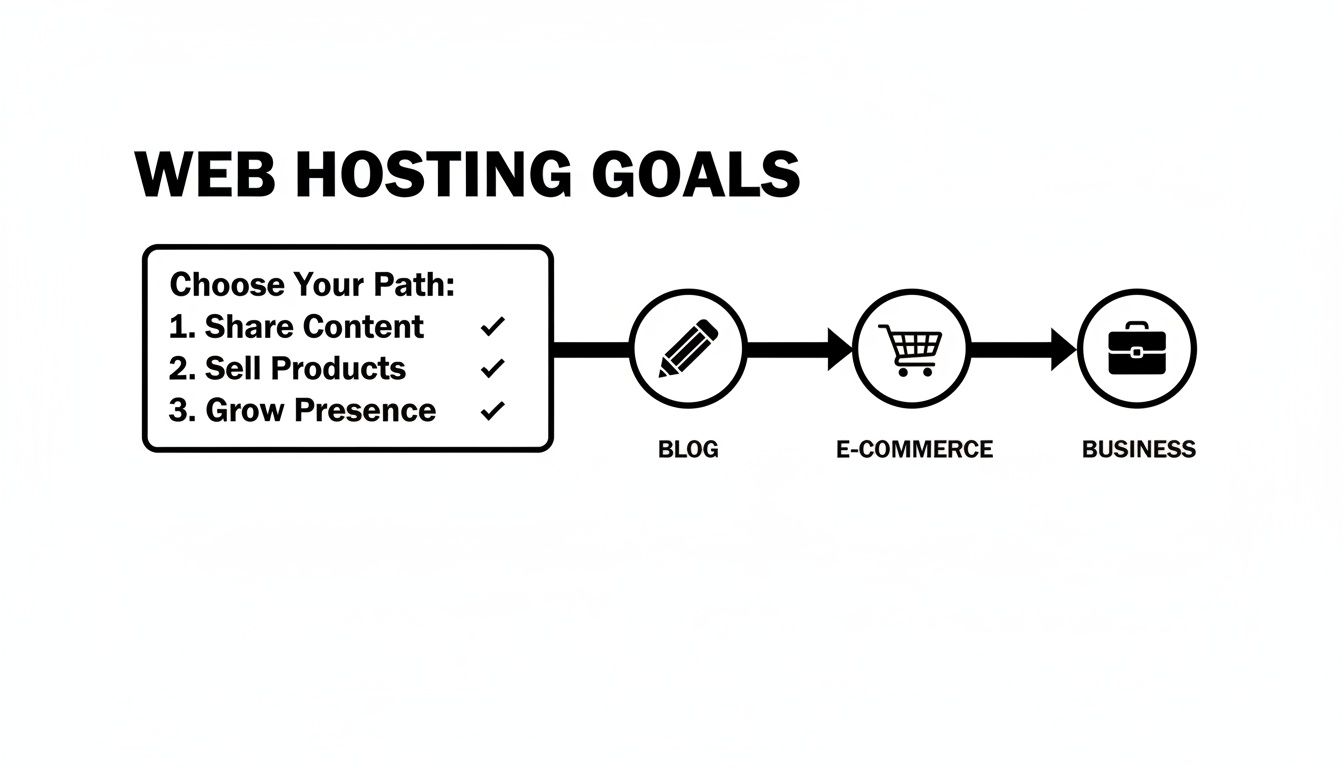
As you can see, a simple blog has very different needs than a booming online store. Let’s dig into the details.
Shared Hosting: The Entry-Level Option
Shared hosting is where most people start, and for good reason. It’s the most affordable option out there. Imagine it as an apartment building where you and hundreds of other tenants share utilities like water and electricity. Your website shares server resources—like CPU, RAM, and disk space—with many other sites.
This setup is perfect for:
- Brand new blogs or personal projects
- Online portfolios
- Small local businesses with a basic informational site
But there's a catch, often called the "noisy neighbor" problem. If another website on your server suddenly gets a huge surge of traffic, it can hog all the resources and slow your site down. It’s cheap, but that low cost comes with a performance trade-off.
VPS Hosting: The Powerful Middle Ground
When you've outgrown that first apartment, you look for a townhouse. That's a Virtual Private Server (VPS). You’re still on a physical server with other users, but virtualization technology carves out a private, guaranteed slice of resources just for you. No more noisy neighbors.
A VPS gives you your own dedicated environment without the massive price tag of a dedicated server. It’s the sweet spot for those who need more power and control.
A VPS is ideal for:
- Growing e-commerce stores with increasing traffic
- Websites that are starting to see consistent, moderate visitor numbers
- Anyone who needs to install custom software or have more server control
Dedicated and Cloud Hosting: For Peak Performance and Flexibility
Now we’re moving into the big leagues. Dedicated Hosting is like owning your own house. The entire physical server and all its resources belong to you and you alone. This gives you maximum power, control, and security. It's the go-to for high-traffic websites, large-scale e-commerce operations, and any application that can't afford to share.
Cloud Hosting is a more modern, flexible alternative. Instead of being tied to one physical server, your site runs on a network of connected servers (the "cloud"). If one machine has a problem, another one seamlessly picks up the slack.
The real beauty of cloud hosting is its incredible scalability. If you get featured on the news and traffic explodes, you can add more resources instantly. When things quiet down, you scale back. You only pay for what you use, which is perfect for businesses with unpredictable traffic or big growth plans.
To see a full breakdown of how these solutions stack up against each other, our detailed https://www.sugarpixels.com/website-hosting-comparison/ guide digs into the technical specs and best use-cases.
Which Web Hosting Type Is Right for You?
To make it even simpler, here's a quick comparison table to help you see the key differences at a glance.
| Hosting Type | Best For | Typical Cost | Performance | Scalability |
|---|---|---|---|---|
| Shared | Beginners, blogs, small personal sites | $2-$15 / month | Can be slow, affected by others | Limited |
| VPS | Growing businesses, e-commerce, moderate traffic | $20-$80 / month | Consistent, dedicated resources | Good, can add resources |
| Cloud | High-growth sites, unpredictable traffic | Pay-as-you-go, variable | Excellent, highly reliable | Excellent, on-demand |
| Dedicated | Large enterprises, high-traffic sites, apps | $80-$300+ / month | Highest level, total resource control | Limited to server capacity |
This table should give you a solid idea of where your website fits. Choose based not just on where you are now, but where you plan to be in the next year or two.
What About Managed Hosting?
You'll often hear the term "managed" thrown around. This isn't a separate type of hosting but a service layer you can add to a VPS, Cloud, or Dedicated plan. Think of it as hiring a property manager for your server.
With managed hosting, the provider handles all the technical headaches: server setup, security updates, backups, and performance tweaks. This lets you focus on your business, not on becoming a server administrator. If you'd rather not deal with the back-end, investing in managed website services is a smart move.
A little market data can also guide your choice. Shared hosting still holds a massive 37.6% of the market for a reason—it works for many small businesses. But for more complex sites like the ones we build at Sugar Pixels, a VPS (with a 25.38% market share) often hits that perfect balance of cost and performance, steering clear of the much higher costs associated with dedicated servers (17.98% share).
The Non-Negotiable Technical Specs
Once you’ve figured out which type of hosting fits your project, it’s time to get into the nitty-gritty. The technical specs aren't just marketing buzzwords; they’re the engine that drives your site’s speed, reliability, and security. Getting this part right is absolutely critical if you want a host that won’t let you down later.
What That "Uptime Guarantee" Really Means
You've seen it everywhere: "99.9% uptime." It sounds impressive, but what does that number actually mean for your website? It’s a direct measure of how often your site will be accessible. And that tiny fraction of a percent makes a huge difference.
Let’s put it into perspective:
- 99.9% uptime translates to about 43 minutes of downtime per month.
- 99.95% uptime is better, cutting that to around 21 minutes per month.
- 99.99% uptime is the gold standard, meaning your site is offline for less than 5 minutes a month.
Imagine you run an e-commerce store. Those 43 minutes could fall right in the middle of a Black Friday sale, costing you thousands in lost revenue. A serious hosting provider will back up their claim with a Service Level Agreement (SLA), which spells out exactly what they’ll do for you if they fail to meet that promise. Honestly, any host offering less than a 99.9% guarantee should be a hard pass.
Server Speed and Response Time
A snappy website starts with a fast server. It’s the foundation for a great user experience and a major factor in SEO. A key metric here—and one that's often overlooked—is Time to First Byte (TTFB). This is a pure speed test that measures how quickly the server acknowledges a visitor's request before a single pixel of your site even begins to load.
Google pays close attention to site speed, and a slow TTFB is a huge red flag that your server is sluggish. A quick server response doesn't just help with rankings; it keeps impatient visitors from hitting the back button. For a deeper dive, check out our guide on how to optimize website performance where we cover server response in more detail.
Your host's infrastructure has a direct line to your bottom line. Slow servers mean frustrated users, which tanks conversions and hurts your search rankings. Don't cheap out on speed.
The web hosting market is exploding, projected to grow from $130.1 billion in 2023 to $159.9 billion in 2024. This massive demand shows just how critical robust infrastructure has become. It also means you need to pick a provider that’s actively investing in their tech to keep up.
The Security Features You Can’t Afford to Skip
In a world of constant cyber threats, your web host is your first line of defense. A great provider does more than just rent you server space—they actively work to keep your site safe.
Here are the security essentials to look for:
- Free SSL Certificates: An SSL certificate encrypts the data between your site and its visitors. It's essential for trust and security. Most quality hosts provide this for free through services like Let's Encrypt.
- Web Application Firewall (WAF): Think of a WAF as a security guard for your website, filtering out malicious traffic and blocking common hacking attempts before they ever reach your site.
- Malware Scanning & Removal: Even with the best defenses, things can happen. Your host should be regularly scanning for malware and, crucially, have a clear plan to help you clean up an infection if one is found.
- Regular Automated Backups: This is your ultimate safety net. A good host performs daily, automated backups and makes it dead simple to restore a clean version of your site with just a click.
Server Location and CDN Integration
Believe it or not, the physical location of your server matters. A lot. If most of your customers are in the United States, hosting your site on a server in Virginia will deliver a much faster experience than one located in Germany. Data has to travel, and the shorter the distance, the faster your site loads.
This is where a Content Delivery Network (CDN) comes in. A CDN is a global network of servers that caches copies of your site's content.
So, when a visitor from London lands on your site, the CDN serves them the content from a nearby European server instead of fetching it all the way from the US. This simple trick slashes load times for everyone, no matter where they are. Many top-tier hosts now bundle a free CDN with their plans, giving you an easy performance boost right out of the box.
Evaluating Support and Long-Term Value
Let's be honest. All the talk about server specs and unlimited bandwidth means nothing when your site goes down at 3 AM on a holiday weekend and you can't get a real person on the line. When you’re trying to pick a web host, the quality of their support is often the single most important—and most overlooked—factor.
It's the true test of whether you've found a partner or just another monthly bill.
A host's website might flash "24/7 support" in big, bold letters, but that phrase can mean wildly different things. For some, it means you can submit a ticket into the void and wait hours for a scripted reply from an outsourced agent. For a genuinely great host, it means you can open a live chat and be connected with a knowledgeable tech who can actually fix your problem in minutes.
How Good Is Their Support, Really?
Before you even think about signing up, you need to put their support to the test. Don't just take their marketing at face value.
Fire up their live chat in the middle of the night with a pre-sales question. See how long it takes to get a response. Is the answer actually helpful, or does it sound like it was copied and pasted from a manual? This little test can tell you everything you need to know.
A good host gives you options. Look for a mix of channels:
- Live Chat: Your go-to for quick questions and minor headaches.
- Phone Support: Absolutely essential for those heart-stopping, site-down emergencies.
- Ticket System: Best for complex issues that need a detailed investigation and a clear paper trail.
- Knowledge Base: A well-stocked library of tutorials and guides is a huge plus, letting you solve common issues yourself.
If a provider makes you jump through hoops just to find a contact form, that's a massive red flag. They should want to help you.
Uncovering the True Cost
That super-low monthly price plastered on the homepage? It's almost never the full story. Many hosting companies hook you with an irresistible introductory rate, only to triple the price when it’s time to renew. You have to look beyond the first-year discount and figure out the total cost of ownership.
A cheap host might feel like a win today, but hidden fees and shocking renewal prices can make it a very expensive mistake down the road. A quality host has transparent pricing and real human support that ultimately saves you time, frustration, and money.
Keep an eye out for these all-too-common hidden costs:
- Steep Renewal Prices: Always, always check the fine print for the renewal rate.
- Migration Fees: Will they help move your site for free, or is that a surprise hundred-dollar fee?
- Backup and Restore Costs: Some hosts offer "free" backups but charge you a fee if you actually need to use one to restore your site.
- SSL Certificate Upsells: A basic SSL certificate from Let's Encrypt should always be free. Don't pay for it.
- Email Hosting: Is a professional email address at your domain included, or is that another monthly add-on?
Making a Data-Informed Decision
Looking at the broader market can also give you a sense of stability. When giants like Amazon hold 12-13% of the entire global market and North America accounts for 39-42% of hosting revenue, it shows you where the established, reliable infrastructure is.
And with WordPress powering an incredible 62.2% of all websites with a known CMS, picking a host that specializes in managed WordPress (a market segment that makes up 34% of hosting) is a pretty safe bet. By aligning with proven leaders, you’re not just buying server space; you’re investing in a platform built for the long haul. You can find more insights into web hosting market trends on DiviFlash.com.
In the end, choosing a host isn't just a technical decision. It's about finding a long-term partner who will be there to support you as your business grows.
Got Questions About Web Hosting? We've Got Answers.
Jumping into the world of web hosting can feel like learning a new language. You’ve probably got a bunch of questions floating around, and getting straight answers is the only way to feel good about your decision. Let's tackle some of the most common things business owners ask when they’re picking a host.
How Much Should I Actually Be Paying for This?
Honestly, the price tag can be all over the map, but it really comes down to what you need right now.
If you're just launching your first site, a Shared hosting plan is usually the perfect fit. You can find solid options for just $3 to $10 a month, which is a fantastic way to get online without breaking the bank.
But what happens when your site starts getting real traffic? That’s when you’ll want to look at a Virtual Private Server (VPS). It gives you more horsepower and control, typically running between $20 and $80 per month. For big e-commerce stores or complex web applications, a Dedicated server is the top-tier choice, giving you unparalleled performance for $80 to $100+ each month.
My Two Cents: Don't get hooked by a super-low introductory price. Always, always check the renewal rate. That amazing deal can easily double or triple after the first year, so make sure you budget for the real, long-term cost.
Do I Need to Be a Tech Whiz to Handle My Own Hosting?
Not at all. For most people, the answer is a resounding "no." Modern hosting companies have made things incredibly simple with user-friendly dashboards. Tools like cPanel or a provider’s own custom interface let you do things like install WordPress or set up email with just a few clicks—no coding required.
If you’d rather not touch any of the technical stuff, then Managed Hosting is your best friend. With a managed plan, the host takes care of all the behind-the-scenes work: server upkeep, security scans, software updates, you name it. It frees you up to just focus on what you do best—running your business.
What if I Pick the Wrong Host? Can I Switch Later?
Yes, you absolutely can. You're never stuck with a provider forever. Moving a website to a new host is a pretty standard procedure, and it's something most businesses do as they grow and their needs evolve.
The process might sound intimidating, but many great hosts will actually handle the entire migration for you.
- When you're shopping around, look for hosts that offer free or low-cost migration services.
- A host's willingness to help you move your site over is a great sign. It shows they're confident you'll love their service and want to make it easy for you to join them.
What’s the Difference Between a Domain and Hosting, Anyway?
This is a great question that trips up a lot of people. Let's use a simple analogy.
Think of your website like a brand-new house.
- Your domain name is the street address (e.g.,
www.yourbusiness.com). It’s the unique address people type in to find you. - Your web hosting is the actual plot of land and the physical house built on it. It’s the server where all your website’s files—the text, the images, the code—are stored.
You can't have a functional website without both. You need the address so people can find you, and you need the house to welcome them in.
At Sugar Pixels, our goal is to take all this complexity off your plate. We provide secure, fast hosting and maintenance plans designed for businesses that just want things to work. We'll handle the technical foundation so you can focus on building your brand. Learn more about our custom web solutions.