

To have any real shot at growing your business online, you need to build a solid digital foundation first. This isn't just about throwing up a website; it's about having a conversion-focused website, a crystal-clear picture of your ideal customer, and specific, measurable goals. Everything else—your SEO, your ads, your social media—is built on top of this groundwork.
Building Your Digital Foundation for Growth
Before you even think about scaling, you have to get the basics right. I've seen countless entrepreneurs jump straight into fancy tactics like paid ads or elaborate content funnels without a solid base. It’s like trying to build a house on a foundation of sand; it’s just not going to hold up.
A strong digital foundation is more than a pretty website. It’s about strategically aligning your business goals with what your target audience actually needs. Your website is the center of this universe—it's your primary digital asset, where you turn curious visitors into paying customers and build a brand that people trust.
Defining Your Strategy and Audience
First things first: clarity. You need to know exactly who you're talking to and what makes you different. Vague messaging is a killer. It gets you nowhere. The goal is to shift from "we sell to small businesses" to something like, "we help solo photographers automate their client onboarding process." That level of specificity is what makes marketing work.
To get there, you need to nail down three core areas:
- Unique Value Proposition (UVP): What specific problem do you solve, and why should someone choose you over the other guy? Your UVP needs to be a short, punchy statement that communicates your unique benefit.
- Ideal Customer Profile (ICP): Go deeper than just age and location. What are your ideal customer's real pain points? What are their goals? Where do they hang out online? Knowing this is half the battle.
- Key Performance Indicators (KPIs): How will you know if you're winning? Set clear, measurable goals from day one. This could be anything from monthly website traffic and conversion rates to your customer acquisition cost. These numbers will be your North Star.
Your Website as a Conversion Engine
Think of your website as your best salesperson—one that works 24/7 without a coffee break. Every single element, from the headline to the button color, should be designed to guide visitors toward a specific action. That could be making a purchase, booking a call, or signing up for a newsletter. This is what we call a conversion-optimized website.
This whole process can be broken down into a simple flow: define your strategy, build your digital assets, and then measure your results to figure out what’s working and what’s not.
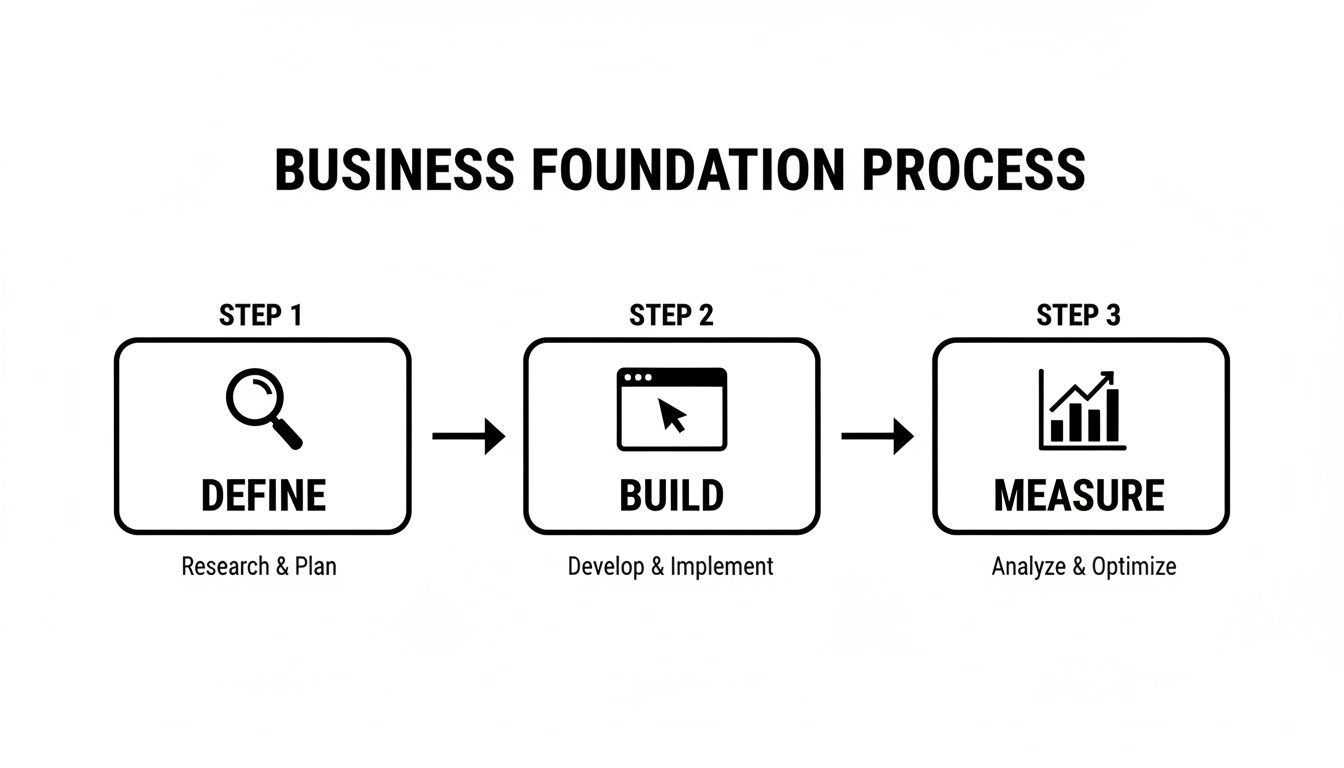
This isn't random guesswork. Growth is a systematic process. It starts with a clear plan and a solid build before you can get any meaningful insights from your data.
Before you start any growth campaigns, it’s a good idea to run a quick audit of your digital foundation. This checklist covers the absolute must-haves.
Digital Growth Foundation Checklist
| Pillar | Key Action | Why It Matters |
|---|---|---|
| Strategy | Define your Unique Value Proposition (UVP) and Ideal Customer Profile (ICP). | You can't hit a target you can't see. This ensures your message resonates with the right people. |
| Website | Ensure your site is mobile-friendly, fast-loading, and has clear calls-to-action (CTAs). | Your website is your digital storefront. A poor user experience costs you sales. |
| Goals | Set specific, measurable KPIs (e.g., conversion rate, traffic goals, lead targets). | This is how you track progress and make data-driven decisions instead of guessing. |
| Content | Have core pages (Home, About, Services/Products, Contact) that speak to your ICP's pain points. | This content is the foundation of your SEO and convinces visitors you're the right solution. |
Nailing these four pillars puts you in a much stronger position to invest in marketing that actually delivers a return.
And the opportunity is massive. In 2022, global digital ad spend hit an incredible $601.8 billion, accounting for 67% of all media spending. To grab your slice of that pie, a high-performing website and a clear strategy aren't just nice-to-haves; they're essential.
To get started on the right foot, it helps to map out a clear e-commerce growth strategy. This initial planning ensures your website is built for performance from day one. If you’re ready to roll up your sleeves, our guide on how to create a business website will walk you through the entire process, step by step.
Attracting Organic Traffic with SEO and Content

Alright, you’ve built your digital home base. Now it's time to get people to visit. While you could pay for every single visitor with ads, the real long-term win comes from organic search. This is where you build sustainable, trust-based growth through Search Engine Optimization (SEO) and content marketing.
Think about it: 93% of all online experiences kick off with a search engine. This stat alone makes SEO a must-do, not a nice-to-have. When you land that top organic spot on Google, you’re looking at capturing between 27-33% of all the clicks for that search. That’s a huge slice of the pie you can’t afford to ignore.
Figure Out What Your Customers Are Actually Searching For
Before you write a single word, you have to get inside your customers' heads. You need to understand the exact words and phrases they’re typing into Google when they need what you sell. This is called keyword research, and it’s the absolute bedrock of a good SEO strategy.
Let's say you sell handmade leather journals. Trying to rank for a super-broad term like "journals" is like trying to shout over a rock concert—it’s nearly impossible.
Instead, good research helps you uncover more specific phrases (we call them long-tail keywords) that show someone is ready to buy. You might find goldmines like:
- "best leather journal for fountain pens"
- "personalized refillable leather notebook"
- "how to care for a leather journal cover"
These phrases have less competition and attract people who are much closer to making a purchase. The goal isn't just to get more traffic; it's to get the right traffic.
Pro Tip: Stop thinking only about what you sell and start thinking about the problems you solve. Your customer might not know your product exists, but they are absolutely searching for a solution to their problem. Create content that provides that solution, and you'll earn their trust and their business.
Create Content That Ranks and Converts
Once you've got a solid list of keywords, it's time to roll up your sleeves and create content that both Google and your future customers will love. This isn’t about tricking the algorithm by stuffing keywords everywhere. It's about creating genuinely helpful, valuable content that positions you as the expert.
Having a clear plan is critical here. Our guide on building a powerful SEO content strategy can walk you through creating a roadmap for your content.
A smart content mix usually involves a few different formats to keep things interesting:
- Deep-Dive Guides: Think "The Ultimate Guide to Starting a Journaling Practice." These big, comprehensive pieces are fantastic for establishing your authority and attracting links from other websites.
- Practical Blog Posts: Shorter, punchier articles that solve one specific problem, like "5 Creative Ways to Use Your New Leather Journal." These are perfect for driving consistent engagement week after week.
- Engaging Videos: Show off your products in action, give a behind-the-scenes look at your workshop, or create simple tutorials. Video builds a personal connection that text just can't match.
The secret sauce is consistency. A simple content calendar helps you stay on track, plan your topics, and maintain a steady rhythm. This regular activity tells search engines that your site is alive and well, which is a huge part of growing your business online.
Nail the On-Page SEO Basics
Great content is just one piece of the puzzle. You also need to make it incredibly easy for search engines to find and understand what your pages are about. We call this on-page SEO.
Think of it like adding clear signposts for Google's little web crawlers. For every piece of content you publish, you need to get these core elements right:
| SEO Element | What It Is | Best Practice Example |
|---|---|---|
| Title Tag | The clickable headline in search results. | "Handmade Leather Journals for Writers | Sugar Pixels" |
| Meta Description | The short summary that appears under your title. | "Discover our collection of premium, handcrafted leather journals. Perfect for writers and artists. Free personalization available." |
| URL Structure | The actual web address of your page. | yourwebsite.com/handmade-leather-journals |
| Internal Linking | Linking from one page on your site to another. | In a blog post about journaling, link directly to your leather journal product page. |
Beyond these, don't forget the technical stuff. Things like your site speed and mobile-friendliness are absolutely crucial. A slow, clunky website is a guaranteed way to lose visitors and get penalized by Google. Investing in SEO and content is a long game, but it's hands-down the most reliable way to build a pipeline of qualified customers who are already looking for you.
Using Paid Advertising for Rapid Scalability

While SEO and content are building your long-term organic foundation, paid advertising is like pouring gasoline on the fire. It’s your ticket to immediate visibility and a direct line to leads and sales while your other strategies are still warming up.
This is about much more than just “boosting” a post. We're talking about a strategic approach to get your product or service in front of the exact people who need it, right when they’re ready to act. When done right, paid ads create a predictable, scalable stream of new customers you can turn on and off like a faucet.
Choosing Your Paid Advertising Channels
First things first: you need to figure out where your ideal customers hang out online. One of the biggest mistakes I see is businesses spreading their budget too thin across every platform imaginable. Don't do that. Focus your initial efforts on just one or two channels where you know you can make a real impact.
-
Google Ads (Search): This channel is all about capturing intent. When someone types "best leather journal for writers" into Google, they have their wallet out. Your ad shows up at that precise moment of need, making it an absolute powerhouse for driving sales.
-
Social Media Ads (Facebook, Instagram, LinkedIn): These platforms are built for discovery. People are scrolling, not actively searching for your product. But you can target them based on their interests, job titles, and behaviors to get their attention. This is perfect for building brand awareness and introducing your business to new audiences who have never heard of you.
Think about it this way: a B2B software company will likely get its highest-quality leads from LinkedIn Ads by targeting specific job titles. On the other hand, an e-commerce brand selling custom pet portraits will find its people on Facebook and Instagram, targeting users who love pets and art.
The goal isn’t to be everywhere. The goal is to be exactly where your ideal customer is, with a message so relevant they can't help but click. Precision always beats volume.
Building Your First High-Converting Campaign
Once you’ve picked your platform, it’s time to build your campaign. A killer ad isn't just a pretty picture; it’s a finely-tuned machine combining a hyper-specific audience, irresistible copy, and a crystal-clear call to action.
Let's break down the core pieces.
1. Hyper-Targeted Audience Definition
This is where the real magic happens. On platforms like Facebook, you can go way beyond basic demographics. You can target users based on their interests (like "journaling" or "creative writing"), behaviors (like "engaged shoppers"), or even retarget people who have visited your website. The more specific you get, the lower your costs and the higher your conversions will be.
2. Compelling Ad Copy and Visuals
Your ad has one job: stop the scroll. Start with a hook that speaks directly to a pain point or a deep desire. Keep your copy clear, concise, and focused on the benefits for the customer. Then, pair it with a high-quality visual—a striking image or a short, engaging video—that grabs attention immediately.
3. A Clear and Irresistible Offer
What do you actually want people to do? Your call-to-action (CTA) needs to be completely unambiguous. Whether it's "Shop Now," "Download Free Guide," or "Book a Demo," leave no room for confusion. Make sure the offer itself is valuable enough to earn that click.
Measuring What Matters Most
You can burn through cash fast if you aren't tracking performance. Don't get lost in a sea of vanity metrics. Focus on the numbers that directly impact your bank account.
| Metric | What It Measures | Why It's Important |
|---|---|---|
| Return on Ad Spend (ROAS) | The total revenue generated for every dollar spent on ads. | This is your ultimate profitability score. A 4:1 ROAS means you made $4 for every $1 you spent. |
| Cost Per Acquisition (CPA) | The average cost to get one new customer from your campaign. | This tells you if your advertising is sustainable. Your CPA must be lower than your customer lifetime value. |
| Click-Through Rate (CTR) | The percentage of people who see your ad and actually click on it. | A high CTR is a great sign that your ad creative and targeting are resonating with your audience. |
| Conversion Rate | The percentage of clicks that lead to a desired action (like a purchase). | This measures how well your landing page is doing its job of turning visitors into customers. |
Start with a small, controlled budget. Test your audiences, your ad copy, and your offers. Use A/B testing to let the data tell you what works. Once you find a winning formula that delivers a positive ROAS, that’s your green light to start increasing the budget and scaling your growth.
Building an Engaged Community on Social Media
Let's get one thing straight: social media isn't just a digital billboard for your latest sale. If you're serious about growing your business online, you need to see it as the digital town square—the place where you build real relationships, earn loyalty, and turn quiet followers into your most vocal fans.
This is a huge mental shift for many business owners. It’s about moving away from just broadcasting your message and toward building a genuine community. You're creating a space where people feel heard and valued, a place where they connect with your brand and, just as importantly, with each other. The real goal here is genuine interaction, which means your strategy has to be about conversation, not just conversion.
Choose Your Platforms Wisely
One of the biggest mistakes I see businesses make is trying to be everywhere at once. It's a classic case of being a jack of all trades and a master of none. When you spread yourself too thin, you never build real traction anywhere.
The secret? Go where your customers already are.
If you're a B2B software company trying to reach tech executives, you'd be crazy not to focus your energy on LinkedIn. But if you're selling beautiful handcrafted jewelry, your people are on visually-driven platforms like Instagram and Pinterest. Don't chase the latest trendy app; follow your audience.
- Selling visual products or a lifestyle? You absolutely need to be on Instagram and Pinterest. They’re built for showing off aesthetics and inspiring people to buy.
- A service-based or B2B business? LinkedIn and X (formerly Twitter) are your best bets for sharing industry know-how, networking with peers, and cementing yourself as an expert.
- Targeting a wide range of consumers? Facebook is still a giant, especially for building tight-knit communities in Groups and connecting with local customers.
Pick one or two core platforms and go all in. Consistency is what separates the brands that get noticed from those that just fade into the noise.
Spark Conversations, Not Just Clicks
Your content needs to do more than just exist—it has to invite people in. Stop thinking only about product photos and start thinking about what your audience actually cares about. What are their struggles? What gets them excited?
Drop open-ended questions into your captions. Run polls asking for opinions on a new feature you're considering. Share some behind-the-scenes chaos that shows the real people behind your brand. The idea is to post things that people want to reply to.
For instance, a local coffee roaster could post a great shot of their new single-origin beans and ask, "What's your go-to brew method on a Monday morning? Pour-over, French press, or are you a die-hard espresso fan? Tell us everything!" That one simple question turns a passive post into an active conversation.
A brand is no longer what we tell the consumer it is—it is what consumers tell each other it is. Your social media community is where that story gets written, every single day. Being an active part of that conversation is one of the most powerful things you can do for your growth.
Harness the Power of Collaboration and Trust
Once you've got a little buzz going in your own channels, it's time to amplify it with strategic partnerships. And I'm not talking about paying for shallow celebrity endorsements. This is about building real relationships with people your audience already listens to and trusts.
Influencer and Affiliate Marketing
Working with the right creators can be a game-changer, putting your brand in front of a new, perfectly matched audience. My advice is to look for micro-influencers—people with smaller, but hyper-engaged, followings. Their recommendation often feels more like a tip from a trusted friend than an ad from a mega-influencer with millions of disconnected followers.
An affiliate program formalizes this. You're essentially creating a motivated sales team out of your most passionate customers and partners. By giving them a commission on sales they drive, you create a powerful win-win that fuels growth through authentic, word-of-mouth marketing.
User-Generated Content (UGC)
This is the holy grail of social proof. Actively encourage your customers to share photos and videos of themselves using your products in their everyday lives. UGC is raw, it's believable, and it shows potential customers exactly how your products fit into the real world.
Create a unique hashtag for your brand and make a habit of featuring the best customer posts on your own feed (always ask for permission first!). Not only does this give you an amazing source of free content, but it also makes your customers feel seen and appreciated, which tightens their bond with your brand.
Converting Leads with Smart Email Marketing
Here's a hard truth about online growth: your social media followers and search rankings are rented land. The platforms can change their algorithms overnight. But your email list? That's an asset you own. It's a direct, unfiltered line of communication to people who have explicitly raised their hands and said they want to hear from you.
This is exactly why building and nurturing an email list is one of the most powerful things you can do to grow your business online. The numbers don't lie—the average return is an incredible $36 for every $1 spent, making it a profit-driving machine. But it all starts with earning a visitor's trust enough for them to hand over their email address.
Build Your List With High-Value Lead Magnets
People are fiercely protective of their inboxes these days. Just slapping a "Subscribe to our newsletter" button on your website and hoping for the best is a strategy from a decade ago. It doesn't work anymore.
To get that coveted email address, you have to offer something genuinely valuable in return. This is what we call a lead magnet. The most effective ones solve a very specific problem for your ideal customer and provide an immediate win. It's your first chance to showcase your expertise and build a foundation of trust.
Here are a few lead magnet ideas that consistently get great results:
- Checklists or Cheatsheets: Think simple, one-page PDFs that make a complex process feel easy. A fitness coach could offer a "5-Minute Daily Stretching Routine" checklist.
- Exclusive Guides or Ebooks: This is for when you need to go deeper on a topic. A financial advisor might create "The Solopreneur's Guide to Q4 Tax Planning."
- Webinar Recordings: Repurpose a great training session into an on-demand asset. It instantly positions you as an expert and delivers a ton of value.
- Templates: Give people something they can use right away. A marketing agency could offer a set of social media graphic templates, or a consultant could provide a project budget template.
The trick is to align your lead magnet with the products or services you eventually want to sell. This ensures you're attracting qualified leads, not just people hunting for free stuff. For a deeper dive, you can explore more ways of using email marketing to generate leads to really dial in your strategy.
Nurture Relationships with Automated Drip Campaigns
Getting someone on your list is just the first step. The real work—and the real magic—happens next. If you immediately bombard new subscribers with sales pitches, you’ll see your unsubscribe rate skyrocket. Instead, you need to nurture that brand-new relationship with an automated email sequence, often called a drip campaign or welcome series.
This automated sequence is your chance to make a perfect first impression, every single time. It works for you 24/7, building trust and guiding subscribers toward becoming customers without you lifting a finger.
Think of your welcome sequence as a guided journey, not a single event. A great one is typically a series of 3-5 emails sent over a week or two that systematically introduces your brand, delivers on your promise, and builds rapport.
Here’s a proven structure you can adapt for your own welcome series:
- Instant Delivery & Welcome: This email has to hit their inbox immediately. It should deliver the lead magnet they signed up for and give them a warm, personal welcome that confirms they made the right choice.
- Share Your Story: The next email is about connection. Tell them why you started your business, introduce the face behind the brand, or share a relatable customer story that mirrors their own struggles and aspirations.
- Provide More Value, No Strings Attached: Send another helpful resource, like a link to your most popular blog post or a quick video tutorial. This builds more trust and reinforces your role as a generous expert.
- Introduce Your Solution: Now that you've established trust and goodwill, you can gently pivot to your core offer. Frame it not as a product, but as the solution to the problem they're trying to solve.
- Create Gentle Urgency (Optional): Your final email can present a special, limited-time offer just for new subscribers. A small discount or an exclusive bonus can be the perfect nudge to encourage them to take that next step.
This methodical approach turns a cold lead into a warm prospect who understands your value and is genuinely interested in what you have to offer. To take this to the next level, you'll want to explore some ecommerce marketing automation strategies that grow your store to make the whole process even more efficient and impactful.
Making Sense of the Numbers: How Data Drives Real Growth
You can have a gorgeous website, killer content, and brilliant ad campaigns, but if you’re not looking at the numbers, you're essentially flying blind. Growth just doesn't happen by accident; it stalls when it's not guided by solid data. This is where you finally connect all your hard work to actual results, turning hopeful guesses into a predictable engine for growth.
Think of it this way: understanding your data is the only way to truly know what’s working. It tells you where to double down on your efforts and, just as importantly, where to stop wasting time and money. It’s how you make every dollar and every hour count.
Stop Guessing, Start Tracking
Remember those Key Performance Indicators (KPIs) we hammered out in the beginning? It's time to get obsessed with them. Tools like Google Analytics 4 (GA4) aren't just nice to have; they are absolutely essential for this. GA4 gives you a clear window into how people are actually finding you and what they do once they land on your site.
The trick is not to get lost in a sea of metrics. Instead, focus laser-sharp on the numbers that tie directly back to the goals you set. A simple, at-a-glance dashboard will quickly become your best friend.
Pro Tip: Don't let the data intimidate you. It's just direct feedback from your customers. Seeing a high bounce rate on a certain page? That's your audience telling you it wasn't what they were looking for. A specific ad campaign crushing it with a high conversion rate? They're literally showing you the exact message that clicks with them.
Start by monitoring just a handful of the most important metrics for each channel. This keeps you from getting overwhelmed and ensures you're always focused on what actually moves the needle.
To help you cut through the noise, here's a quick look at the most important metrics you should be tracking across your marketing channels.
Essential Growth Metrics to Track
| Channel | Primary KPI | Secondary Metric |
|---|---|---|
| Website & SEO | Conversion Rate | Organic Traffic & Bounce Rate |
| Paid Advertising | Return on Ad Spend (ROAS) | Cost Per Acquisition (CPA) |
| Email Marketing | List Growth Rate | Open Rate & Click-Through Rate |
| Social Media | Engagement Rate | Follower Growth & Website Clicks |
Looking at these numbers isn't enough. The real magic happens when you start asking, "Why?" Why did our organic traffic suddenly spike last Tuesday? Why did the click-through rate on our latest email campaign tank? The answers to those questions are where your next big growth opportunities are hiding.
Work Smarter: Scaling with Automation
As your business grows, you'll hit a wall. There's a hard limit on what you can do yourself, and your time quickly becomes your most valuable—and scarcest—resource. This is the point where smart automation isn't a luxury; it's a critical next step for anyone serious about how to grow a business online.
Automation is all about putting the repetitive, soul-crushing tasks on autopilot so you can focus on the big-picture strategy. It’s the classic definition of working smarter, not harder.
Here are a few perfect places to start automating:
- Nurturing New Leads: Set up an automated welcome email sequence to engage every new subscriber the moment they sign up, no manual work required.
- Keeping Social Media Active: Use tools like Buffer or Later to schedule out your social posts for weeks in advance.
- Providing Instant Support: Implement a simple chatbot on your site to handle the most common customer questions, giving people instant answers 24/7.
When you use data to find out what works and then use automation to execute on those winning strategies at scale, you create a powerful, self-improving growth loop. This is the system that separates the businesses that hit a plateau from the ones that achieve incredible, lasting success.
At Sugar Pixels, we specialize in building the high-performance websites and data-driven marketing strategies that fuel this kind of growth. If you’re ready to stop guessing and start scaling, explore our digital marketing services to see how we can build your online presence.