

If you're still running your SEO and PPC campaigns in separate lanes, you're leaving money on the table. It's an old-school approach that just doesn't cut it anymore. Think of them as two sides of the same coin—a single, cohesive search strategy where each side makes the other stronger.
When you get them working together, the quick wins from PPC can immediately inform your long-term SEO content, and your strong organic rankings can drastically cut down what you need to spend on ads.
The Problem with Keeping SEO and PPC in Silos
For too long, marketing departments have pitted SEO and PPC against each other, making them rivals fighting for the same budget. The SEO team is playing the long game, building organic authority over months or years. Meanwhile, the PPC team is in a constant sprint, chasing immediate conversions. This division is a recipe for missed opportunities and massive blind spots.
Imagine your PPC manager uncovers a handful of new, high-converting long-tail keywords every single day. If they aren't talking to the SEO team, that goldmine of real-time data just sits there. Your content strategy ends up based on last month's research, completely missing what your customers are actually searching for right now.
What Separate Strategies Really Cost You
When you run these channels independently, you're basically paying to learn the same lessons twice. You might burn through thousands in your PPC budget to figure out which ad copy connects with your audience, while your SEO specialist is busy A/B testing page titles to solve the exact same puzzle. An integrated SEO and PPC management workflow puts a stop to that waste.
The fallout from this separation is real and it hits your budget hard:
- Wasted Ad Spend: Are you bidding on keywords where you already own the #1 organic spot? If so, you're literally paying for clicks you would have gotten for free.
- Stagnant SEO: Your organic strategy is starved of the instant feedback from PPC ads, making you slow to target keywords that are proven to drive sales.
- A Fractured View of the Customer: You can't see the full picture. You're missing how paid and organic clicks work together to guide a user from discovery to purchase.
The Power of a Unified Front
When SEO and PPC join forces, they create an unstoppable presence on the search results page. Let's say you're an e-commerce brand launching a new sneaker. You can spin up a PPC campaign for an instant sales boost. At the same time, you're feeding all that performance data—click-through rates, conversion metrics, winning ad copy—right back into the product page's long-term SEO strategy.
This isn't just about being more efficient. It's about total market dominance. When a user sees your brand in both the paid and organic results, it builds incredible trust and authority. They're far more likely to click on you than a competitor.
While both channels are vital, the data is clear: organic search often delivers more bang for your buck over time. In fact, SEO tends to beat PPC on conversion rates in most industries. A deep-dive analysis found that SEO delivered higher conversions in 14 out of 15 sectors, with one industry seeing a 3.4x advantage for organic. You can find more on these conversion rate benchmarks at First Page Sage.
This proves just how critical it is to use your paid campaigns to support and accelerate a powerful, long-term organic foundation.
Building Your Integrated Campaign Foundation
Ditching the old siloed approach for a truly integrated strategy means starting with a shared foundation. This isn't just about running two campaigns at the same time; it's about weaving SEO and PPC together from day one. The whole point is to create a single, powerful search presence where each channel makes the other one stronger.
This journey begins with how you handle keywords. Forget having one team hunt for long-term organic targets while another chases quick PPC wins. You need to combine those efforts to get a much richer, more complete picture of what's happening on the search results page.
A Unified Approach to Keyword Research
The first real step is building a master keyword list that serves both your paid and organic efforts. This is more than just mashing two spreadsheets together. It's a strategic exercise to sort keywords by user intent, how competitive they are, and where they fit best in your marketing funnel.
Here’s a practical way to think about it:
- PPC "Test Bed" Keywords: These are the high-commercial-intent terms that are just too competitive to rank for organically anytime soon. They're perfect for PPC. You get immediate visibility and start collecting real-world conversion data while your SEO work gains traction.
- SEO "Long Play" Keywords: Think informational and long-tail queries here. These signal that someone is in the research phase. They might not convert right away, but they are gold for building topical authority with blog posts and in-depth guides, letting you connect with people much earlier in their journey.
- "SERP Domination" Keywords: These are your money terms—the high-value, branded, or bottom-of-the-funnel keywords you absolutely must own. The goal here is to show up in both the paid and organic results, maximizing your click-through rate and pushing competitors right off the page.
Your shared keyword map is your strategic blueprint. It should clearly outline which channel is primarily responsible for each keyword group. This simple step prevents your own teams from bidding against each other and ensures everyone is pulling in the same direction.
You can't ignore the power of paid search for getting immediate traffic. With US paid search spending projected to hit a staggering $124.59 billion, it's obvious PPC is essential for businesses that need to be seen now. This channel often drives 27.6% of new visitor traffic, making it a critical piece of any modern search strategy. If you want to dive deeper, you can find more in-depth PPC statistics on Backlinko. This data really drives home why using PPC to quickly test keywords is so valuable before you pour resources into a big SEO content push.
Setting Up Shared Tracking and Goals
Your whole setup is only as good as the data you can get out of it. A successful SEO PPC management program absolutely depends on shared tracking and unified goals. Without this, you'll never be able to see the true, combined impact of your hard work.
First things first: make sure your Google Ads and Google Search Console accounts are properly linked to your Google Analytics 4 (GA4) property. This is the bedrock of integrated reporting. It’s a simple connection that unlocks the ability to analyze your paid and organic performance side-by-side in one place.
Now, let's talk about the distinct roles SEO and PPC play. It's easy to get them mixed up, but understanding their unique strengths is key to making them work together.
Comparing SEO and PPC Roles in an Integrated Strategy
This table breaks down the distinct yet complementary roles of SEO and PPC, helping you allocate resources and set realistic expectations for each channel.
| Attribute | SEO (Search Engine Optimization) | PPC (Pay-Per-Click) | Integrated Goal |
|---|---|---|---|
| Time to Impact | Long-term (months) | Immediate (hours/days) | Use PPC for quick wins and data while building sustainable organic growth. |
| Cost Model | Resource investment (content, tech) | Direct ad spend (pay per click) | Balance upfront ad costs with long-term, lower-cost organic traffic. |
| Primary Goal | Build authority, trust, and sustainable traffic | Drive targeted traffic and immediate conversions | Capture users at every stage of the funnel with the most suitable channel. |
| Audience Targeting | Broad, based on search queries | Highly specific (demographics, location, remarketing) | Use PPC learnings to refine SEO content and organic insights to discover new PPC audiences. |
| SERP Position | Earned organic rankings | Top ad placements | Dominate the SERP by securing both paid and organic real estate for key terms. |
Understanding these differences helps you move away from siloed metrics. Instead of just judging your PPC manager on cost-per-click and your SEO specialist on rankings, you can establish shared objectives that reflect the health of your entire search presence.
Examples of Unified Goals:
- Total Non-Branded Search Conversions: Combine the conversions from both paid and organic for all keywords that don't include your brand name. This gives you a clean look at your new customer acquisition efforts.
- Overall Search Click-Through Rate (CTR): Analyze the blended CTR across both channels for your most important keywords. This helps you spot where owning both an ad and an organic listing gives you a massive engagement boost.
- Cost Per Acquisition (CPA) by Funnel Stage: Measure the total cost to get a customer, tracking how an initial organic touchpoint (like a blog post) followed by a paid ad work together to drive the final conversion.
This shared mindset should also extend to your website. Your landing pages need to be built for both paid and organic traffic. A page designed for a PPC campaign needs a crystal-clear call-to-action, but it also benefits massively from solid SEO fundamentals that support long-term organic visibility. Our guide on effective on-site optimization is a great checklist for making sure your pages work hard for both audiences.
By building this shared foundation from the start, you're setting yourself up for a much more dynamic and efficient search strategy down the road.
Creating a Powerful Data Feedback Loop
An integrated search strategy isn't about running two campaigns in parallel; it's about making them talk to each other. Think of it as a constant, dynamic exchange of information. The fast, hard data from your paid campaigns should directly shape your long-term organic content strategy. And in turn, your SEO wins can supercharge your PPC performance.
When you get this right, your entire search marketing effort becomes a single, self-improving machine. The whole process really boils down to a few core workflows that connect the dots between what you learn from paid ads and what you create for your content calendar.
Here’s a look at how this foundational process comes together:
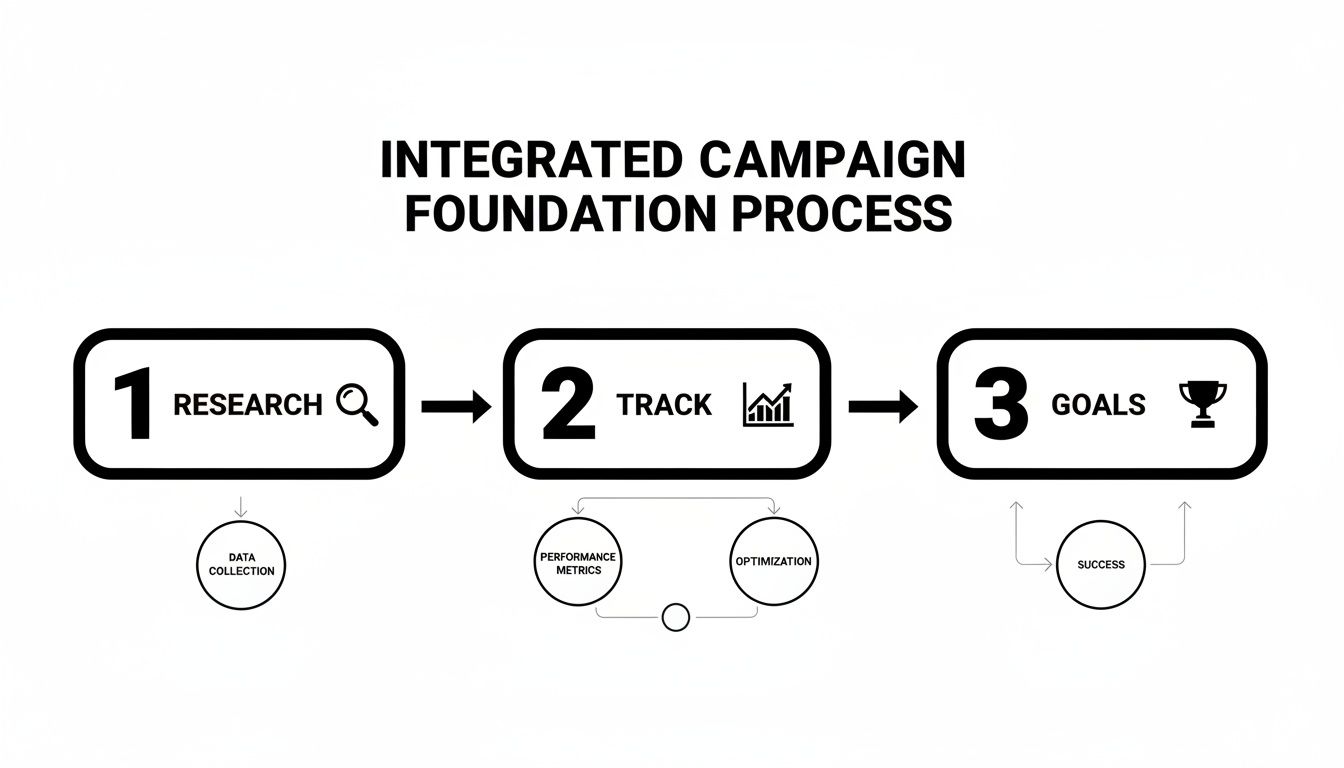
As you can see, a successful feedback loop starts with unified research. It’s then kept alive by shared tracking and aligned goals, which together form the bedrock of any effective SEO PPC management system.
Using PPC Data to Find SEO Gold
Your Google Ads Search Terms report is one of the most powerful—and most overlooked—tools for content creation. This isn't just a list of keywords; it's a raw feed of the exact phrases people typed into Google just before clicking your ad. It’s a direct window into your customer's mind.
Here’s a simple workflow to turn that raw data into a pipeline of killer content ideas:
- Hunt for High-Converting Terms: Dive into your Search Terms report. Your first move is to filter for queries that have already led to conversions. Specifically, look for ones that also have a low impression share. These are proven money-makers you’re not yet fully capturing.
- Spot Your Content Gaps: Take that list of converting terms and check it against your current organic rankings. Are you on page one? If not, you've just found the perfect topic for your next blog post or landing page.
- Create a "PPC-to-Blog" Pipeline: This is where the magic happens. Set up a shared document or a Trello board. The PPC manager can drop in these high-potential search terms on a regular basis, and the SEO or content team can grab them, knowing they're already validated by actual customer conversions.
This process completely removes the guesswork from your content strategy. You’re no longer hoping a topic will resonate; you’re building content around phrases you already know attract paying customers.
Leveraging SEO Wins to Boost PPC Performance
This data-sharing relationship is a two-way street. Your best-performing organic content can be a massive asset for your paid campaigns, often leading to a serious improvement in results.
When you have a blog post that ranks well and pulls in consistent organic traffic, that's a huge signal. It tells you the content connects with your audience and that Google sees it as high-quality. Using that specific page as the landing page for a related PPC ad group can dramatically improve your Quality Score.
A higher Quality Score is basically Google's way of rewarding you for a great user experience. This isn't just a vanity metric—it directly leads to lower costs-per-click (CPCs) and better ad positions. You get more clicks for less money.
Rethinking Keyword Cannibalization
The old-school fear of "keyword cannibalization"—where your organic and paid results supposedly compete with each other—needs a serious update. In a modern, integrated strategy, owning both the top ad spot and the #1 organic result isn't competition. It’s SERP domination.
The real strategic question isn't if you should target a term with both channels, but when and why.
- Defensive Plays: For your core branded keywords, running ads is non-negotiable. It’s a defensive move to stop competitors from siphoning off clicks that should be yours.
- High-Commercial Intent: On bottom-of-the-funnel keywords, showing up in both paid and organic slots maximizes your visibility. It pushes competitors further down the page and has been shown to significantly increase your total click-through rate.
- Informational Keywords: For these top-of-funnel queries, a strong organic article is usually all you need. Save your PPC budget for terms that show a clearer intent to buy.
This feedback loop is becoming even more essential as AI gets smarter. With 91% of marketers confirming SEO's positive impact on website performance and 68% of executives seeing a positive ROI from AI, the tools for deep analysis are getting more powerful every day. AI is already streamlining 38% of routine SEO tasks and helping professionals write more effective ad copy, making it easier than ever to manage the connection between channels.
To truly understand the journey your customers take, digging into a multi-touch attribution playbook is a must. This helps you properly credit how a user's path might start with an organic blog post and end with a click on a paid ad days later. And if you're looking to automate these workflows, our guide on integrating marketing automation provides concrete steps to get your systems connected and running smoothly.
Smart Budgeting and Bidding Strategies
Figuring out how to split your budget between SEO and PPC is one of the trickiest balancing acts in search marketing. A lot of folks get stuck on a simple percentage split and never look back, but the real magic happens when you let your budget flow dynamically between the two channels.
Think of it this way: your budget shouldn't be a rigid, locked-in number. It should be fluid, moving to where it can make the biggest impact right now. Are you launching a new product line? It makes perfect sense to pour more cash into PPC for that instant visibility and market feedback. You need to get in front of people, and paid ads are the fastest way to do it.
But that doesn't mean you turn off the SEO tap. The key is to maintain a consistent, foundational investment in SEO to build that crucial long-term authority, while using PPC for more tactical, short-term sprints.
Dynamic Budget Allocation Models
There's no such thing as a one-size-fits-all budget. Your allocation needs to mirror your company’s maturity, your position in the market, and what you’re trying to achieve. A startup fighting for its first customer has completely different needs than an established brand defending its turf.
Here’s a simple way I often think about it:
- Launch Phase: When you're new to the game, a 70% PPC / 30% SEO split is a solid starting point. PPC gets you that initial traffic and priceless conversion data, while your SEO budget starts laying the foundation for the future.
- Growth Phase: Once organic traffic starts to pick up, you can move toward a more balanced 50% PPC / 50% SEO model. At this stage, PPC is great for targeting those high-intent, bottom-of-funnel keywords, while SEO works on broadening your reach with top-of-funnel content.
- Maturity Phase: For established brands with strong organic rankings, flipping to a 30% PPC / 70% SEO split makes a lot of sense. SEO is now your primary, most cost-effective growth engine, and PPC becomes a strategic tool for fending off competitors or running highly-targeted campaigns.
To give you a clearer picture, I've put together a sample framework showing how this might play out depending on your situation.
Sample Budget Allocation Model for Integrated Campaigns
This table is a sample framework illustrating how a business might allocate its search marketing budget based on strategic goals and market position.
| Business Stage | Primary Goal | Suggested PPC Allocation | Suggested SEO Allocation | Rationale |
|---|---|---|---|---|
| New Startup | Market Entry & Data Gathering | 75% | 25% | Prioritize immediate traffic and conversion data to validate the business model and inform SEO. |
| Growing SMB | Scaling Customer Acquisition | 50% | 50% | Balance immediate lead generation from PPC with building sustainable, long-term organic traffic. |
| Established Brand | SERP Dominance & Efficiency | 25% | 75% | Focus on maintaining and growing cost-effective organic authority; use PPC for defense and new initiatives. |
| Product Launch | Immediate Visibility & Sales | 80% | 20% | Heavily fund PPC for a short, intense burst of awareness and to drive initial sales momentum. |
Remember, this is just a starting point. The real secret is staying agile. Review your performance every month or quarter, and don't be afraid to shift funds based on what the data is telling you.
Integrating Bidding with Organic Rank
This is where truly advanced seo ppc management comes into play. You can let your organic performance directly inform your PPC bidding strategy. One of the smartest things you can do is adjust your PPC bids based on where you already rank organically for a given keyword.
It just makes sense—why pay top dollar for a click you're already likely to get for free?
This approach, usually handled with automated bidding scripts in platforms like Google Ads, is all about maximizing every dollar in your budget.
Here’s how the logic breaks down:
- Low Organic Rank (Position 5+): If you're buried on page one (or worse, page two) for a valuable keyword, you need to bid aggressively. The goal here is to buy your way onto the first page and capture traffic you'd otherwise completely miss out on.
- Mid-Range Organic Rank (Positions 2-4): You're in the game, but not at the top. Here, you can be a bit more moderate with your bids. The ad serves as a powerful reinforcement, helping you dominate more SERP real estate and grab a larger total share of the clicks.
- Top Organic Rank (Position 1): When you own that coveted #1 organic spot, you can pull back significantly on your PPC bid. In some cases, you might even pause the ad for that keyword entirely. You're already in the best possible position, so reallocating that ad spend to keywords where you’re weaker is a much smarter move.
This isn't about just turning off ads when you rank well. It's about smart automation. By connecting your organic ranking data to your bidding platform, you build a self-optimizing system that automatically funnels your ad spend to where it's needed most, maximizing your total search footprint without blowing up your budget.
Unified Reporting to Measure True ROI
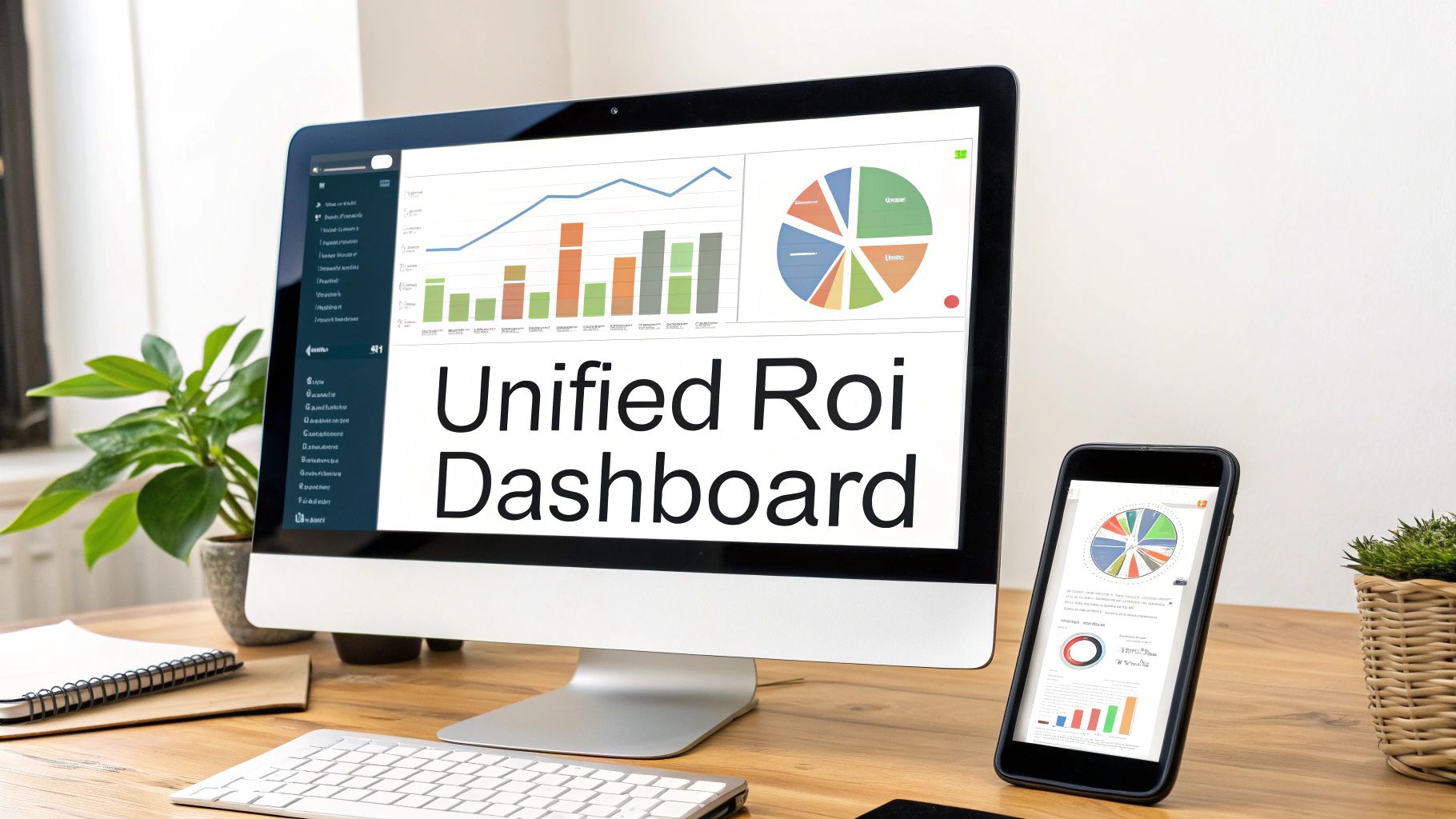
If you can't measure your integrated efforts, you can't prove their value. It’s that simple. Siloed reports lead to siloed thinking, making it impossible to see how your SEO and PPC campaigns are really working together. The final, crucial piece of a successful seo ppc management strategy is building a unified dashboard that tells the complete story.
This means getting past channel-specific vanity metrics. Sure, a PPC report might show a great cost-per-click, and your SEO report might show a steady climb in organic traffic. But what does that actually mean for the business? A unified dashboard connects those dots, creating a single source of truth that shows the real, combined impact of your work.
Building Your Single Source of Truth
First things first, you have to bring all your data into one place. Tools like Google's Looker Studio are perfect for this. They let you build custom, interactive dashboards that pull data directly from Google Ads, Google Search Console, and Google Analytics 4. This isn't just about sticking two charts side-by-side; it's about blending the data to answer bigger, more strategic questions.
For instance, you could create a chart that overlays your PPC spend for a keyword group against the organic rankings for those same terms. Right away, you can spot opportunities to shift budget or see how paid support is propping up (or being propped up by) organic visibility. The whole point is to make the relationship between your channels impossible to ignore.
Key Metrics for an Integrated Dashboard
A unified report should focus on cross-channel KPIs that actually reflect the health of your entire search presence.
- Total Non-Branded Search Conversions: This is your north star for new customer acquisition. It combines conversions from both SEO and PPC for all keywords that don't include your brand name.
- Blended Cost-Per-Acquisition (CPA): Calculate a true CPA by dividing your total SEO and PPC costs (ad spend plus any agency or team costs) by your total search conversions. This changes the conversation from "which channel is cheaper?" to "how efficient is our overall search program?"
- SERP Ownership Rate: For your money keywords, track the percentage of time you appear in both paid and organic results on page one. This is a direct measure of your success at SERP domination.
The most powerful shift you can make is from channel-specific reporting to customer-centric reporting. Your dashboard should tell the story of the entire user journey, not just isolated touchpoints.
Understanding how to measure the real impact of your marketing efforts is foundational. For a deeper dive into this topic, our guide on how to measure marketing ROI provides a comprehensive framework you can apply to your integrated strategy.
https://www.sugarpixels.com/how-to-measure-roi-marketing/
Demystifying Attribution Modeling
Finally, you have to get attribution right. The default last-click model, which gives 100% of the credit to the final click before a conversion, is completely broken for an integrated strategy. It totally ignores how your SEO efforts might have introduced a customer to your brand weeks before they finally clicked a PPC ad to buy something.
Exploring a data-driven or position-based attribution model in Google Analytics will give you a much more accurate picture. When you can clearly show how an organic blog post assisted a later paid conversion, you can justify the budget for both channels with total confidence. To get up to speed, this guide to multi-touch attribution offers an excellent breakdown of how to approach this.
By building a unified dashboard and choosing an attribution model that reflects reality, you stop defending your budget and start demonstrating undeniable value. You can finally show stakeholders the true, combined ROI of your sophisticated SEO and PPC management.
Your Top SEO & PPC Management Questions, Answered
Jumping into integrated search marketing always brings up a few key questions. It's completely normal to wonder how to handle the overlap on the SERP, where to put your budget, and what tools actually get the job done right. Let's tackle some of the most common questions we hear from clients.
Should I Stop PPC for Keywords Where I Rank #1 Organically?
It’s the million-dollar question: if you’re already sitting pretty at the top of the organic results, why pay for an ad? It feels like paying for something you're already getting for free. But it's not that simple.
Keeping your ads running for top-ranking keywords is a classic power move. For one, you absolutely dominate the search results page. When a user sees your brand in the top ad spot and the top organic listing, it sends a massive signal of authority. You're not just a result; you're the result. This pushes competitors way down the page and can significantly boost your total clicks.
Paid ads also give you a level of messaging control you just don't get with organic listings. You can test a new tagline, shout about a 24-hour flash sale, or use a much more aggressive call-to-action than what works for an SEO page title. That kind of tactical flexibility is priceless.
- Play Defense: Running ads on your brand name is non-negotiable. It stops competitors from squatting on your turf and stealing away customers who are specifically looking for you.
- Maximize Your Footprint: Think of it as claiming more real estate. Some people are conditioned to click ads, while others scroll right past them. By being in both places, you capture the maximum possible audience.
Not sure if it's worth it? Test it. Pick a keyword group, pause the ads for 30 days, and watch your numbers like a hawk. If your total traffic and conversions from those terms take a nosedive, you have your answer. The dual presence is paying for itself.
How Should I Allocate My Budget When Starting Out?
When you’re first weaving SEO and PPC together, your budget needs to be all about getting quick wins and immediate data. SEO is a marathon, not a sprint—it can easily take months to see real traction. PPC, on the other hand, can start driving traffic and telling you what works almost overnight.
Because of this, I almost always recommend front-loading your budget toward paid search.
A 70% PPC and 30% SEO split is a great starting point for any new integrated campaign. This lets you lean on paid ads to generate immediate traffic, find out which keywords actually convert, and test your messaging. The insights you get from those early PPC campaigns are pure gold; they tell your SEO team exactly what kind of content they should be building for the long haul.
Over the first six to twelve months, as your organic rankings start to climb and deliver consistent traffic, you can start to rebalance that split. The ultimate goal is to shift toward a more even, or even SEO-heavy, budget once your organic foundation is solid. This approach gets you results today while you build a more sustainable, cost-effective engine for tomorrow.
What Are the Best Tools for Integrated Management?
The right toolset is one that shatters the data silos between your channels. You need to stop looking at SEO and PPC in isolation and start analyzing them on the same screen.
Here are the tools and platforms we can't live without:
- Keyword & Competitor Research: You need an all-in-one platform here. Tools like Semrush and Ahrefs are the industry standard for a reason. They show you the entire landscape for a keyword—paid bidders, organic rankings, CPC data, and traffic estimates—all in one place.
- Analytics & Reporting: This one’s a no-brainer: Google Analytics 4. When you properly link it with your Google Ads and Google Search Console accounts, it becomes your single source of truth for tracking performance across the board.
- Dashboard & Visualization: To truly see how everything works together, you need a dashboard. Google Looker Studio is fantastic (and free) for pulling data from all your different sources into one clean, visual report. This is how you get that at-a-glance view of your combined performance.
- Competitive Intelligence: Sometimes you need to do some deep reconnaissance on your rivals. A tool like SpyFu is incredible for this. It can show you where your competitors are spending their ad dollars and where their organic blind spots are, which is perfect for finding new opportunities.
At Sugar Pixels, we specialize in creating cohesive digital strategies that make your SEO and PPC efforts work together seamlessly. If you're ready to move beyond siloed campaigns and unlock the full potential of your search marketing, let's build a powerful online presence for your business.