
Think of your product description as your 24/7 salesperson. It’s a short, punchy pitch that needs to do a lot of heavy lifting: show off features, highlight benefits, and solve a customer's problem.
To get it right, you need a plan. The best descriptions are built on a solid foundation: knowing your ideal customer, defining your brand's voice, and then structuring the copy so it’s easy to scan and impossible to ignore. A great formula is a catchy headline, a short, engaging paragraph, and a handful of benefit-driven bullet points.
The Blueprint for a High-Converting Description

Before you even think about writing, you have to do the prep work. Powerful product descriptions don’t just happen—they’re the result of smart planning and a genuine understanding of who you’re selling to.
Jumping straight into writing without this groundwork is like trying to build a house without a blueprint. You might end up with something that looks like a house, but it’s going to be wobbly and won’t serve its purpose.
Everything starts with your ideal customer. You simply can't write a description that connects if you have no idea who you're talking to. That’s why creating a detailed buyer persona is the non-negotiable first step.
Define Your Ideal Customer
A buyer persona isn’t just a fuzzy idea of your customer; it's a detailed, semi-fictional profile built from market research and real data on the people who already buy from you. It goes way beyond basic demographics like age or location and gets into their mindset.
To build a persona that actually helps, you need to answer a few key questions:
- What keeps them up at night? Pinpoint the exact problems, frustrations, or annoyances your product is designed to eliminate.
- What are their goals? Get a handle on what they want to achieve and figure out how your product is the bridge that gets them there.
- How do they talk? Listen closely to the specific words and slang they use when discussing their needs online. This is gold.
- What drives their buying decisions? Is it all about the best price? Or are they motivated by quality, social status, or pure convenience?
One of the best ways to get this intel is to dive deep into product reviews—yours and your competitors'. You'll quickly spot recurring themes, complaints, and things people absolutely love. Also, spend some time lurking on platforms like Reddit, Instagram, or niche forums where your audience hangs out. It’s an unfiltered look into how they really think and speak.
When you understand the exact words your customers use to describe their problems, you can mirror that language back to them. This creates an instant "you get me" connection that builds trust.
Establish Your Brand Voice and Value
Once you know who you’re talking to, you have to figure out how you'll talk to them. This is your brand voice—the personality that comes through in all your communication. Are you playful and a bit cheeky? Or are you more professional and authoritative? Maybe you’re warm and encouraging.
Whatever it is, that voice needs to be consistent everywhere, especially in your product descriptions. It should also tie directly into your unique value proposition (UVP)—the one core thing that makes you the obvious choice over the competition. Your UVP isn't just a feature; it's the fundamental promise you make to every customer.
The demand for great copy that clearly communicates this value is exploding. In fact, the global content writing services market is projected to hit USD 38.6 billion by 2033, fueled by the e-commerce boom.
Laying this groundwork is crucial for turning browsers into buyers. If you want to dive deeper into improving your site's performance, check out this guide on conversion rate optimization best practices. By combining a sharp buyer persona with a distinct brand voice, you create the perfect blueprint for descriptions that don't just sell products—they build relationships.
How to Structure Descriptions for Readability and Impact
Let's be honest: nobody reads product descriptions word-for-word. We scan. Our eyes dart across the page, hunting for the exact information we need to make a quick decision. A dense block of text is an instant turn-off.
Your job is to make that scanning process effortless. You need to guide your customer's eyes to the most important points, helping them quickly grasp the value and feel confident enough to hit that "Add to Cart" button.
Think of it as a quick conversation. You start with a hook, elaborate just enough to keep their interest, and then offer up the key details in a way that’s easy to digest. A smart structure can single-handedly turn a bounce into a sale.
Crafting a Compelling Headline
The first thing anyone sees is your headline. Its only job is to stop the scroll. It needs to be short, punchy, and focused entirely on the single best outcome your product delivers.
This isn't the place for the product name or a dry list of features. Instead, you have to immediately answer the customer's silent question: "What's in it for me?"
- Weak Headline: All-Weather Commuter Backpack
- Strong Headline: Your Gear Stays Dry, No Matter the Downpour
The second one just hits differently, right? It instantly solves a real-world problem and connects with the commuter’s fear of a soggy laptop. That emotional hook is infinitely more effective than a generic label.
The Persuasive Opening Paragraph
Once you've grabbed their attention with the headline, the opening paragraph has to hold it. This is your spot to expand on that core benefit and tell a quick story. Two or three sentences is all you need.
Your goal is to paint a picture your customer instantly recognizes. Describe the problem they're dealing with and introduce your product as the perfect solution. This is where you make that emotional connection before you get into the nitty-gritty specs.
Here’s an example for a bag of high-end coffee beans:
"Tired of bitter, uninspired morning coffee? Imagine starting your day with a rich, aromatic brew that transports you to a mountainside café. Our single-origin beans are hand-roasted to perfection, unlocking a smooth, complex flavor that turns your daily ritual into a moment of pure bliss."
See? It’s not about the bean origin or roast level yet. It’s about selling an experience using sensory words like "rich," "aromatic," and "smooth."
Using Bullet Points for Scannability
Okay, you’ve hooked them emotionally. Now it’s time for the facts. Bullet points are your absolute best friend here. They're perfect for breaking up the text and making features and technical specs easy to scan.
But don't just list them out. The real secret to powerful bullet points is to translate every feature into a tangible benefit. A simple formula I always use is: [Feature], which means [Benefit].
Let’s try it with our all-weather backpack:
- 100% Waterproof Fabric: So your laptop and important documents stay completely dry, even in a sudden downpour.
- Padded Laptop Sleeve: Meaning your tech is safe from the bumps and drops of your daily commute.
- Ergonomic Shoulder Straps: Allowing you to carry everything in total comfort, all day long.
This format explicitly connects the "what" (the feature) with the "so what" (the benefit), making the value proposition crystal clear. This is fundamental when you're learning how to write product descriptions that actually sell. Most research suggests aiming for a sweet spot between 100 and 300 words—enough to persuade without overwhelming. You can find more great insights into product description strategies on blym.co.
Integrating Social Proof for Trust
Finally, nothing builds trust faster than hearing from a happy customer. Weaving a short quote or a snippet from a five-star review directly into the description is a brilliant move. It's one thing for you to say your product is great; it's another for a real person to back it up.
Try placing a powerful quote right below your bullet points or near the call-to-action. It can be the final nudge a hesitant buyer needs.
"I used to dread rainy commutes, but this backpack is a game-changer. Everything stays bone-dry, and it's surprisingly comfortable. Worth every penny!" – Sarah K.
By combining a strong headline, a persuasive opening, benefit-driven bullets, and a sprinkle of social proof, you create a description that’s not just easy to read, but also incredibly effective at turning shoppers into buyers.
Using Persuasive Language That Sells
https://www.youtube.com/embed/EvgKr7tJF4U
Getting your product description’s structure right will grab a shopper's attention, but it’s the words you choose that truly create desire. This is your chance to go beyond technical specs and really tap into your customer's imagination. You want them to feel, see, and almost taste the experience your product delivers before they’ve even clicked "buy."
Powerful persuasive writing isn’t about being pushy or hyping things up. It’s all about building an emotional connection that makes the purchase feel not just smart, but essential. This comes down to picking words that spark feelings and paint a crystal-clear picture in their mind.
Tap into the Senses
One of the most effective tricks of the trade is to use sensory words—language that appeals to sight, sound, smell, taste, and touch. These words pull the customer out of their reality and drop them right into a scene where they’re already enjoying your product.
Just look at the difference here:
- Plain: This coffee has a strong flavor.
- Sensory: Awaken your senses with the rich, bold aroma of freshly ground beans, followed by a smooth, velvety finish.
The second version doesn’t just describe the coffee; it creates an entire morning ritual. The shopper can practically smell it brewing in their kitchen and feel the comforting warmth of that first sip. You're not just selling a bag of beans; you're selling an experience.
Focus on Benefits, Not Just Features
Customers don't buy features; they buy solutions to their problems. They want to know "What's in it for me?" Your job is to translate every feature into a tangible benefit that improves their life.
I see this mistake all the time: companies get so excited about their product's technical specs that they forget to explain why those specs matter to the person buying it. A simple way to reframe your thinking is to turn every "our product has…" statement into a "so you can…" statement.
Here’s a quick guide to transforming standard, tech-heavy features into benefits your customers will actually care about.
| Transforming Features into Customer-Focused Benefits | |
|---|---|
| Standard Feature | Customer-Focused Benefit |
| "Made with 100% waterproof ripstop nylon." | "Stay completely dry and confident, no matter what the weather throws at you." |
| "Equipped with a 5,000 mAh battery." | "Enjoy a full day of use on a single charge, so you’re never scrambling for an outlet." |
| "Features an intuitive drag-and-drop interface." | "Build your project in minutes, not hours—no technical skills required." |
See the shift? The benefit is all about the customer's success, convenience, or peace of mind. That’s what sells.
Tell a Mini-Story
Every great product solves a problem, even a small one. Use your description to tell a quick story where the customer is the hero, and your product is the trusty sidekick that helps them win the day. This narrative hook makes your product feel more relatable and its value more concrete.
Start by painting a picture of the problem they're facing. Then, position your product as the clear, simple solution they've been searching for.
For instance, a description for a portable power bank could tap into that universal panic of a dying phone battery when you’re lost or need to make an important call. The power bank isn't just a gadget; it's a lifeline. It’s freedom.
The most effective product descriptions create a bridge between the customer's current reality and their desired future. Your product is that bridge.
This storytelling approach creates an emotional anchor, making the benefits stick in the customer's mind far better than a dry list of features ever could. It’s a core principle when learning how to write product descriptions that truly connect with people on a human level.
Use Power Words to Drive Action
Some words just have a certain psychological kick that nudges people to act. These aren't magic spells, but "power words" tap into common human desires for ease, exclusivity, and immediate results. Sprinkling a few into your copy can add a welcome layer of excitement and urgency.
Think about words like:
- Effortless: Suggests a simple solution to a complex problem.
- Instant: Appeals to our love of immediate gratification.
- Exclusive: Creates a feeling of scarcity and being part of a select group.
To write descriptions that get people to click, consider using proven strategies to create urgency in sales. Simple phrases like “Limited Edition” or “Get Yours Now” can be the final push a hesitant shopper needs. The key is to weave them in naturally so they sound helpful, not desperate.
Integrating SEO to Attract Organic Traffic
A beautifully written product description is fantastic, but it's only half the battle. If shoppers can't find your product in the first place, even the most persuasive copy won't matter. This is where search engine optimization (SEO) comes in. It’s all about making sure your product pages show up when people search on Google for what you sell.
Think of SEO as putting up giant, flashing signs that point searchers directly to your online store. Without it, your product is practically invisible to the millions of people actively looking for it.
Folding basic SEO into your writing process isn't some dark art reserved for tech wizards. It’s a core part of crafting product descriptions that pull in a steady stream of free traffic and, ultimately, drive sales.
Finding the Right Keywords
Everything in SEO starts with keywords. These are simply the words and phrases your ideal customer types into the search bar. Your job is to figure out what those terms are and then work them naturally into your product descriptions.
You don't need a bunch of fancy, expensive tools to begin. Just put yourself in your customer's shoes. If you were searching for your product, what would you type? Think about the problem it solves, the product category, or even specific brand names.
For instance, almost no one just searches for "backpack." They get much more specific, using what we call long-tail keywords:
- "waterproof laptop backpack for cycling"
- "best anti-theft travel backpack"
- "lightweight hiking daypack for women"
These longer, more detailed phrases signal that the searcher knows what they want and is likely ready to buy. They're also less competitive, giving your product a much better shot at ranking high on the results page. A quick Google search for your product type will often reveal a "People Also Ask" section—this is an absolute goldmine for keyword ideas.
Weaving Keywords into Your Content
Once you've identified a primary keyword and a few related phrases, you need to place them where they’ll have the most impact. The goal here is subtlety. It should feel completely natural, not like you're awkwardly stuffing words where they don't belong.
Here are the most important spots to place your main keyword:
- Product Title (H1): This is SEO 101. Your primary keyword needs to be right here, front and center.
- Opening Paragraph: Try to include the keyword within the first 100 words. This immediately tells search engines what your page is all about.
- Subheadings (H2s or H3s): If your description is long enough for subheadings, they're a perfect place to work in your primary or secondary keywords.
- Image Alt Text: This is the descriptive text that helps search engines "see" your images. It’s a small detail that many people miss, but it’s a valuable spot for SEO.
Don't get hung up on "keyword density." That's old-school thinking. Instead, just focus on writing genuinely helpful content for a human reader. If you do that, the keywords will naturally fall into place. Google is smart enough to understand context and synonyms.
Why Unique Content Is Non-Negotiable
This is a big one, especially if you're a reseller. It’s so tempting to just copy and paste the manufacturer's generic product description and call it a day. Please, don't do it.
When Google finds the exact same block of text on multiple websites, it gets confused. This is called duplicate content, and it can absolutely tank your search rankings because the algorithm doesn't know which page to show as the original.
Always take the time to write a fresh, unique description in your brand's voice. This simple step not only helps you avoid SEO penalties but also gives you a critical opportunity to connect with your customers in a way that bland, generic copy never could. For a deeper look at getting your products to rank, it's worth checking out a complete guide to online store SEO that goes into more advanced tactics.
By doing a little research into what your customers are searching for and thoughtfully placing those terms in unique, compelling copy, your product descriptions will do more than just convert visitors—they’ll actively go out and find new ones for you.
Scaling Your Writing with Templates and AI
Let’s be honest: writing a unique, compelling description for every single product is a monumental task, especially if you have a large or growing catalog. The good news? You don't have to start from a blank page every time. By creating smart systems, you can produce high-quality copy at scale without losing your brand’s personality.
This is where a hybrid approach—combining structured templates with the power of artificial intelligence—really shines. It's not about letting robots take over creativity. It's about automating the repetitive, formulaic parts so you can pour your energy into the human touch that actually sells. This method helps you maintain consistency while seriously speeding up your workflow.
Creating Versatile Product Description Templates
A solid template is your secret weapon. Think of it as a fill-in-the-blank guide for your writing. It gives you a consistent structure, ensuring you always hit the key points—headline, problem, solution, benefits—while leaving plenty of room for the unique details that make each product special.
I’ve found that creating different templates for different product categories is crucial. After all, the way you sell a high-tech gadget is completely different from how you sell a piece of clothing.
Tech Product Template Example (for a Smartwatch):
- Benefit-Driven Headline: [Desired Outcome] Right On Your Wrist
- Opening Story (1-2 Sentences): Tired of [Common Frustration]? Imagine effortlessly [Solving the Problem] with a single glance at your watch.
- Key Benefit Bullets:
- Stay Connected: With [Specific Feature], you can [Achieve Benefit] without ever reaching for your phone.
- Track Your Health: Our [Sensor Technology] monitors your [Health Metric], giving you the insights to [Achieve Health Goal].
- All-Day Power: The [Battery Spec] battery means you get [Number] hours of use, so it keeps up with your busiest days.
Fashion Item Template Example (for a Linen Shirt):
- Evocative Headline: Effortless Style for [Occasion or Season]
- Sensory Opening (1-2 Sentences): Feel the light, breathable touch of our [Fabric Type] shirt, designed to keep you cool and confident from [Morning Activity] to [Evening Event].
- Style & Benefit Bullets:
- Timeless Look: The [Style Detail] creates a classic silhouette that pairs perfectly with everything from jeans to tailored trousers.
- All-Day Comfort: Made from 100% premium linen, its [Fabric Benefit] feel is perfect for warm-weather adventures.
- Easy Care: This shirt is fully machine-washable, so you get that [Desirable Feeling] look without the high-maintenance hassle.
Using templates like these gives you a reliable starting point. It guarantees your brand voice and core messaging stay consistent across your entire store.
Using AI as Your Creative Assistant
Artificial intelligence has gone from a sci-fi concept to a genuinely practical tool for anyone creating content. When you use it right, AI can be an amazing assistant for brainstorming ideas, churning out first drafts, and blasting through writer's block. The secret is to treat it like a collaborator, not a replacement for your own expertise.
I like to think of AI as a brilliant but inexperienced intern. You have to give it clear, specific instructions (prompts) to get anything useful back. Vague prompts will always give you generic, uninspired copy.
A well-crafted AI prompt is the difference between getting a bland, robotic paragraph and a creative draft that's 80% of the way there. Your job is to provide the strategy and the final polish.
A successful workflow brings AI in early, as this simple visual guide for product SEO shows.
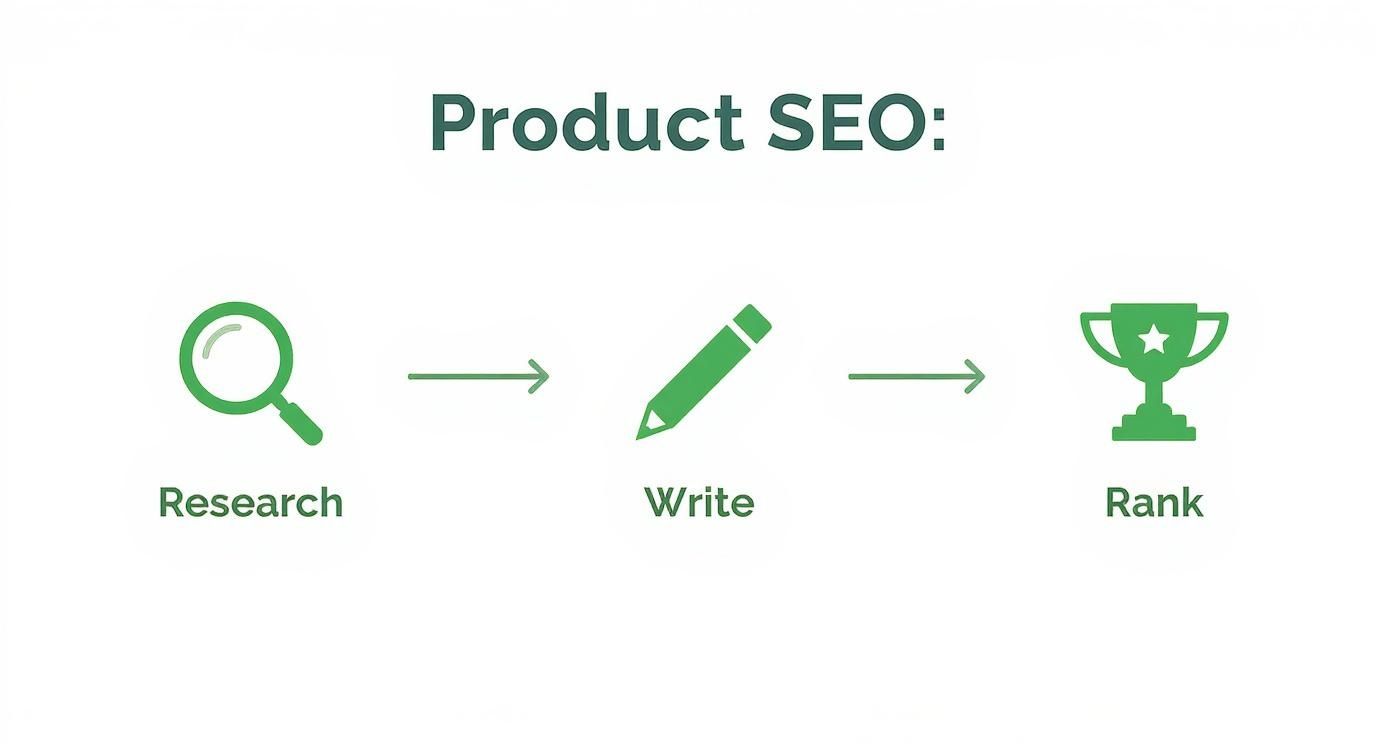
As you can see, writing is just one piece of the puzzle. AI helps speed up that middle stage, which frees you up to spend more time on the crucial research and optimization work that really moves the needle.
Crafting Effective AI Prompts
The quality of what you get out of an AI tool is a direct reflection of what you put in. Here are a few prompt formulas I use to get much better product descriptions from the get-go.
1. The Persona-Driven Prompt:
- "Act as a professional e-commerce copywriter for a brand that is [Brand Voice Adjective 1] and [Brand Voice Adjective 2]. Write a 150-word product description for [Product Name]. Our target audience is [Describe Buyer Persona]. Focus on how this product solves their main problem: [Customer Pain Point]. Here are the key features and benefits: [List 3-4 Feature/Benefit Pairs]."
2. The Storytelling Prompt:
- "Write a short, compelling story (around 75 words) for a product description. The product is a [Product Name]. The story should describe a relatable scenario where the customer struggles with [Problem] and uses our product to achieve [Desired Outcome]. Use sensory language to bring the experience to life."
3. The Feature-to-Benefit Bullet Prompt:
- "Turn these product features into benefit-driven bullet points. For each feature, explain what it allows the customer to do. Use an enthusiastic and helpful tone. Product: [Product Name]. Features: [List Features]."
This hybrid human-AI approach is a cornerstone of effective content marketing for small business, letting teams create more without needing a massive budget. And to make sure all your hard work gets seen, I highly recommend digging into ecommerce SEO best practices.
Just remember, an AI draft is only a starting point. Always, always edit for accuracy, voice, and that final human touch that connects with a customer and closes the sale.
Answering Your Most Common Product Description Questions
Even with the best templates and guides, you're bound to hit a few tricky spots when you start writing. I've been there. Over the years, I've seen the same questions pop up time and time again.
So, let's tackle those nagging "what if" scenarios head-on. Here are my answers to the questions I hear most from e-commerce pros, from hitting the right word count to making dry technical specs feel exciting.
What’s the Ideal Length for a Product Description?
This is the big one, and the honest answer is a frustrating one: it depends. There's no single magic number that guarantees a sale. However, a great starting point is to aim for a sweet spot between 100 and 300 words.
That range typically gives you enough room to tell a compelling story, hit the key benefits, and list important features without a potential customer's eyes glazing over. A simple t-shirt might only need 100 words, but a high-end camera with multiple lenses and settings could easily need closer to 300 to do it justice.
The real goal isn't hitting an arbitrary word count. It's about giving a customer just enough information to make a confident decision—and not a single word more.
How Do I Handle Very Technical Products?
Selling something with a long list of technical specs is a classic challenge. You have to satisfy the expert who pores over every detail, but you can't scare off the newcomer who just wants to know, "Will this thing solve my problem?"
The key is to use a layered approach. Always lead with the benefits and the story, just like any other product. Then, get smart with your formatting to present the specs in a digestible way.
- Benefit-Focused Bullets: First, pull out the most important specs and translate them into simple, real-world benefits.
- Expandable Sections: Use an accordion menu or a "read more" link for the full, nitty-gritty spec sheet. This keeps the page clean but gives the power users the data they crave.
- Comparison Tables: If you offer different models, a table is hands-down the best way to show how the technical features stack up against each other.
This strategy lets every type of customer find exactly what they're looking for without getting buried in information they don't need.
Should I Use Bullet Points or a Paragraph?
Easy one: both. They serve two different, equally critical jobs, and your description will feel flat if you only use one. They work as a team.
Here's how I think about it:
- The Paragraph: This is for the heart. It’s where you tell your mini-story, use sensory words, and help the customer picture the product in their life. It builds an emotional connection.
- The Bullet Points: This is for the brain. It’s where you lay out the features and benefits for quick scanning, making the core value proposition crystal clear in just a few seconds. It justifies the purchase logically.
The perfect product description hooks the reader with a short, persuasive paragraph and then seals the deal with a scannable list of bullets.
How Often Should I Include Keywords for SEO?
This is where people get tripped up, but it's simpler than you think. You want to include your primary keyword naturally in a few key places, but don't ever force it. Keyword stuffing is a relic from a bygone era of SEO; today, it hurts your rankings and makes you sound like a robot.
Instead, focus on placing your main keyword where it has the most impact:
- In your Product Title (H1)
- Somewhere in the first paragraph
- In at least one subheading (H3), if you have them
- In the image alt text
Beyond that, just write for a human being. Use synonyms, related terms, and conversational language. Google's algorithm is incredibly sophisticated now—it understands context and user intent far better than a keyword-stuffed page ever could.
Ready to transform your online presence with a website that not only looks stunning but is built to convert? The team at Sugar Pixels specializes in creating custom web solutions that drive growth. Start your project with us today!